Mobile Navigation

  • National
    • Policy
      • High Expectations
      • Quality Choices
      • Personalized Pathways
    • Research
    • Commentary
      • Gadfly Newsletter
      • Flypaper Blog
    • Events
    • Scholars Program
  • Ohio
    • Policy
      • Priorities
      • Media & Testimony
    • Research
    • Commentary
      • Ohio Education Gadfly Biweekly
      • Ohio Gadfly Daily
  • Charter Authorizing
    • Application
    • Sponsored Schools
    • Resources
  • About
    • Mission
    • Board
    • Staff
    • Career
Home
Home
Advancing Educational Excellence

Main Navigation

  • National
  • Ohio
  • Charter Authorizing
  • About

National Menu

  • Topics
    • Accountability & Testing
    • Advanced Education
    • Career & Technical Education
    • Charter Schools
    • Curriculum & Instruction
    • ESSA
    • Evidence-Based Learning
    • Facilities
    • Governance
    • Personalized Learning
    • Private School Choice
    • School Finance
    • Standards
    • Teachers & School Leaders
    • Think Again
  • Research
  • Commentary
    • Gadfly Newsletter
    • Flypaper Blog
    • Gadfly Podcast
  • Events
  • Scholars Program

The Education Gadfly Weekly

Sign Up to Receive Fordham Updates

We'll send you quality research, commentary, analysis, and news on the education issues you care about.
Thank you for signing up!
Please check your email to confirm the subscription.

The Education Gadfly Weekly: Solutions to the chronic absenteeism crisis

Volume 23, Number 38
9.21.2023
9.21.2023

The Education Gadfly Weekly: Solutions to the chronic absenteeism crisis

Volume 23, Number 38
view
elementary student
High Expectations

Chronic absenteeism has become a crisis, part 3: Solutions

Part one of this series explored many possible explanations for the rise in absenteeism. They come in all shapes and sizes, some more plausible than others. Part two unpacks how this issue plays out in cities and suburbs—and what stands out most is how kids are missing school everywhere. This final post offers five solutions.

Tim Daly 9.21.2023
NationalFlypaper

Chronic absenteeism has become a crisis, part 3: Solutions

Tim Daly
9.21.2023
Flypaper

Public charter schools and the Chipotlification of education

Christy Wolfe
9.21.2023
Flypaper

Excellence gaps: New resources and a personal history

Jonathan Plucker
9.18.2023
Flypaper

In the wake of the pandemic, time is of the essence for high school students

Victoria McDougald
9.21.2023
Flypaper

2021 PIRLS test results starkly illustrate global learning loss

Jeff Murray
9.18.2023
Ohio Gadfly Daily

Cheers and Jeers: September 21, 2023

The Education Gadfly
9.21.2023
Flypaper

What we're reading this week: September 21, 2023

The Education Gadfly
9.21.2023
Flypaper
view

Public charter schools and the Chipotlification of education

Christy Wolfe 9.21.2023
Flypaper
view

Excellence gaps: New resources and a personal history

Jonathan Plucker 9.18.2023
Flypaper
view

In the wake of the pandemic, time is of the essence for high school students

Victoria McDougald 9.21.2023
Flypaper
view
PIRLS learning loss SR image

2021 PIRLS test results starkly illustrate global learning loss

Jeff Murray 9.18.2023
Ohio Gadfly Daily

view

Cheers and Jeers: September 21, 2023

The Education Gadfly 9.21.2023
Flypaper
view

What we're reading this week: September 21, 2023

The Education Gadfly 9.21.2023
Flypaper
view
elementary student

Chronic absenteeism has become a crisis, part 3: Solutions

Tim Daly
9.21.2023
Flypaper

Editor’s note: This is part three of a three-part series. Part one examined possible cause of chronic absenteeism, and part two explored how it plays out in cities and suburbs. This was first published on the author’s Substack, The Education Daly.

Key points from the previous two posts:

  • Absenteeism has risen across the entire U.S.—all fifty states.

  • While the pandemic was a massive accelerant, chronic absenteeism was already increasing before anyone had heard of Covid.

  • There are many different explanations for what’s behind the absenteeism crisis and relatively little consensus about which ones are most responsible.

  • All types of kids are missing more school than before—wealthy, poor, urban, suburban.

Today, it’s time for solutions.

—

I desperately want our kids—all of them—back in school. Unless student attendance improves, any efforts to address pandemic learning loss are doomed to fail. Let’s start there. Struggling students will fall further and further behind. Moreover, if we aren’t willing to expect students to show up for school, what are we willing to expect from them?

Yet current strategies are a patchwork of local initiatives that aren’t making much of a difference. At this rate, it could easily take a decade to bring chronic absenteeism back to pre-pandemic levels—and to be clear, those levels were already problematic in many places.

Here are my five recommendations.

#1. Distinguish between chronic absenteeism and school avoidance

A key first step is clarifying the degree to which we’re dealing with situations where students can’t get to school versus situations where they won’t go. The solutions for those two scenarios are very different.

In a brief published this year, Attendance Works and The Education Trust argue that punitive responses—civil penalties like tickets and fines, as well as school-level measures like exclusion from extracurricular activities—are ineffective. They call for tiered supports aimed at making schools physically and emotionally welcoming places where students will feel a sense of belonging.

It’s hard to be against any of that. Surely many students are missing school because they have become disconnected. But if you look into best practices for addressing school avoidance—the phenomenon of refusing to go to school or creating reasons not to go—they are pretty different, and they definitely include some things that verge on punitive.

For instance, check out a list of tips from the American Academy of Pediatrics. Keep discussions about physical symptoms or anxieties to a minimum. If your child is well enough to be up and around the house, they are well enough to go to school. If a child stays home, do not offer any special treatment. No visitors. No appealing snacks. This is coming from doctors.

Harvard Medical School goes even further by counseling parents to “make staying home boring” so it’s not a preferable option to attending school. Take away all screens. No sleeping or lounging unless a child is genuinely ill.

The underlying message here is that if staying home playing video games and scrolling through social media platforms in pajamas is an option, plenty of kids are going to take it. They’re kids. Were you any different at their age? There’s only so much schools can do to make themselves appealing. Combatting school avoidance starts with a commitment to “be firm” about the imperative to be in school.

After wading through all of this, I suspect school avoidance is a meaningful contributor to our surge in chronic absenteeism. We should acknowledge it and develop specific solutions that address it just as we address other problems like bus driver shortages.

#2. Learn from employers

We educators are not alone. Companies have seen the same challenges when asking their workers to give up the flexibility of remote/hybrid routines and return in person to their offices. It started with assurances about robust health precautions. That didn’t fill any cubicles. Bosses moved on to a comical sequence of incentives—many outlined in a Slate piece from Sept 2022—such as coffee, breakfast, hot pretzels, Red Bull, puppies, cornhole tournaments, and booze. When all those failed, they tried soft mandates that were enforced not at all or selectively enforced based on the perceived difficulty of replacing the employees who balked.

But the social fabric of workplaces had changed. Working from home had become normalized among employees and valued for the ways it made life easier for working parents and former commuters. Some of those who heeded the early calls to return to the office felt like dupes when they realized many of their colleagues weren’t coming back and faced no consequences for refusing to do so. White collar workers became rebels against badging in.

Eventually, employers figured out that carrots needed to be supplemented with sticks. Over the course of 2023, mega-companies like Disney and Amazon have mandated time in the office. Others, like Google, have warned of low performance evaluations for those who don’t comply with guidelines for in-person work. As the New York Times told us recently, even Zoom is cracking down.

Doesn’t this sound an awful lot like what happened with schools? First, nobody was allowed to attend in person. Then assurances were given that it would be safe to attend, but wide accommodations were made for those who weren’t comfortable or whose vulnerabilities made it dangerous for them to be in person. Over time, schools tried to lure back reluctant learners with welcoming environments, parties, and incentives. But the norms about attendance had clearly changed. Any stigma related to missing school was gone. Some students weren’t willing to attend regularly, and both they and their parents figured out that there weren’t many consequences for absenteeism.

My specific recommendation here is to treat consistent attendance as a social norm that needs to be named, supported, and reestablished. Stop hoping kids will attend regularly and begin insisting on it. Be understanding with those families who face genuine barriers—but those cases are the exception. The vast majority of kids can be in school more than 90 percent of days. How do we know? Because a decade ago, students were chronically absent far less often.

#3. Stop enabling absenteeism

I’m conscious of not painting with too broad a brush, but some schools have absolutely perpetuated the absenteeism problem with lax policies and minimal enforcement of them. Things like:

  • Allowing students to participate in extracurriculars, sports, and leadership activities if they attend any part of a given school day—even half of one period.

  • Unlimited retakes of quizzes and tests at any time during the grading period.

  • Unlimited time to make up work missed during absences.

  • No caps on the number of unexcused absences a student can have and still receive credit for a course.

  • Pressuring parents to keep their kids home with any sniffle, however small.

  • Excused absences for “mental health days” without any requirement to have seen a mental health professional or received a diagnosis.

In light of our predicament, do these things seem wise? Absences are a part of school life and always will be. But if students can miss school as often as they like with virtually no downside, they are going to miss a lot of school. (And their parents are not likely to tell them they can’t.)

#4. Adopt affordable, research-tested practices

There are practical things districts can do. Todd Rogers is a Harvard behavioral scientist who has done innumerable experiments testing light-touch absenteeism interventions. In a 2018 paper, he found that parents often believe their children have missed school far less often than is the case. When repeatedly provided with printed information about the true number of days their child has been absent, guess what happens? Families get their kids to school more often. It’s just a day here, a day there—but those days quietly add up. This kind of intervention doesn’t solve the whole problem, but it’s cost-effective and easy to execute. He started EveryDay Labs to help districts implement their own initiatives. The company now delivers millions of absence-reduction communications to families each year. Letters home are far less punitive than prosecuting the parents of kids with too many unexcused absences, as Missouri has done and Texas is considering.

Your local district got piles of federal money to combat the effects of the pandemic. Do you know if its leaders used any of it to send carefully crafted letters to the parents of kids who are missing school?

#5. Be honest and direct with parents

Despite all schools can do, attendance is far more dependent on factors related to parents and students. They are the ones who set alarm clocks. At parent-teacher conferences, in weekly bulletins, at bake sales, and during morning drop-off, here are some key messages that can’t be repeated by school leaders frequently enough:

  • Missing school regularly is not healthy for your child. This is probably the number one thing we learned during the pandemic. In-person school works.

  • Your child should be absent as rarely as possible and not more than ten times in a full school year.

  • Allowing your child to miss school without a genuine reason—like illness—that prevents attendance is not understandable or OK.

  • States mandate school attendance for kids, with good reason. If your child misses excessive numbers of unexcused days, we are mandated as a district to report it, and you may get a visit from a social worker.

  • If your child has trouble getting moving in the morning, you need to take steps as a parent to address it. Put supports in place like an early, reliable bedtime, no devices (phones, tablets, video games, TV) in the bedroom overnight, and a step-by-step wake routine.

  • If your child is missing days because of issues in our control as a school—things like buses being late or not running, bullying on the playground, etc.—let us know, and we won’t rest until we’ve addressed it.

Parents want to be part of the solution. So many of them fell out of the habit of daily attendance during the pandemic. Now they can’t figure out how to re-establish it. Let’s help them.

A colleague shared a great practice her child’s principal is using. Each week, the principal emails data on school-wide attendance and a breakdown for each grade. Easy, inexpensive, and smart. More, please.

It’s time to exit our Ferris Bueller phase

I can’t tell you how many parents have contacted me during this series to share their own stories and struggles. It’s hard.

As a country, we transitioned to at-home learning in March 2020, and in critical ways, we’ve never transitioned back. It’s time to leave behind some of the new pandemic habits we picked up because they are no longer necessary or healthy. While students may argue that they can learn just as much from home as in school, piles and piles of evidence tell us this is not so. When kids don’t show up for school, they fall behind.

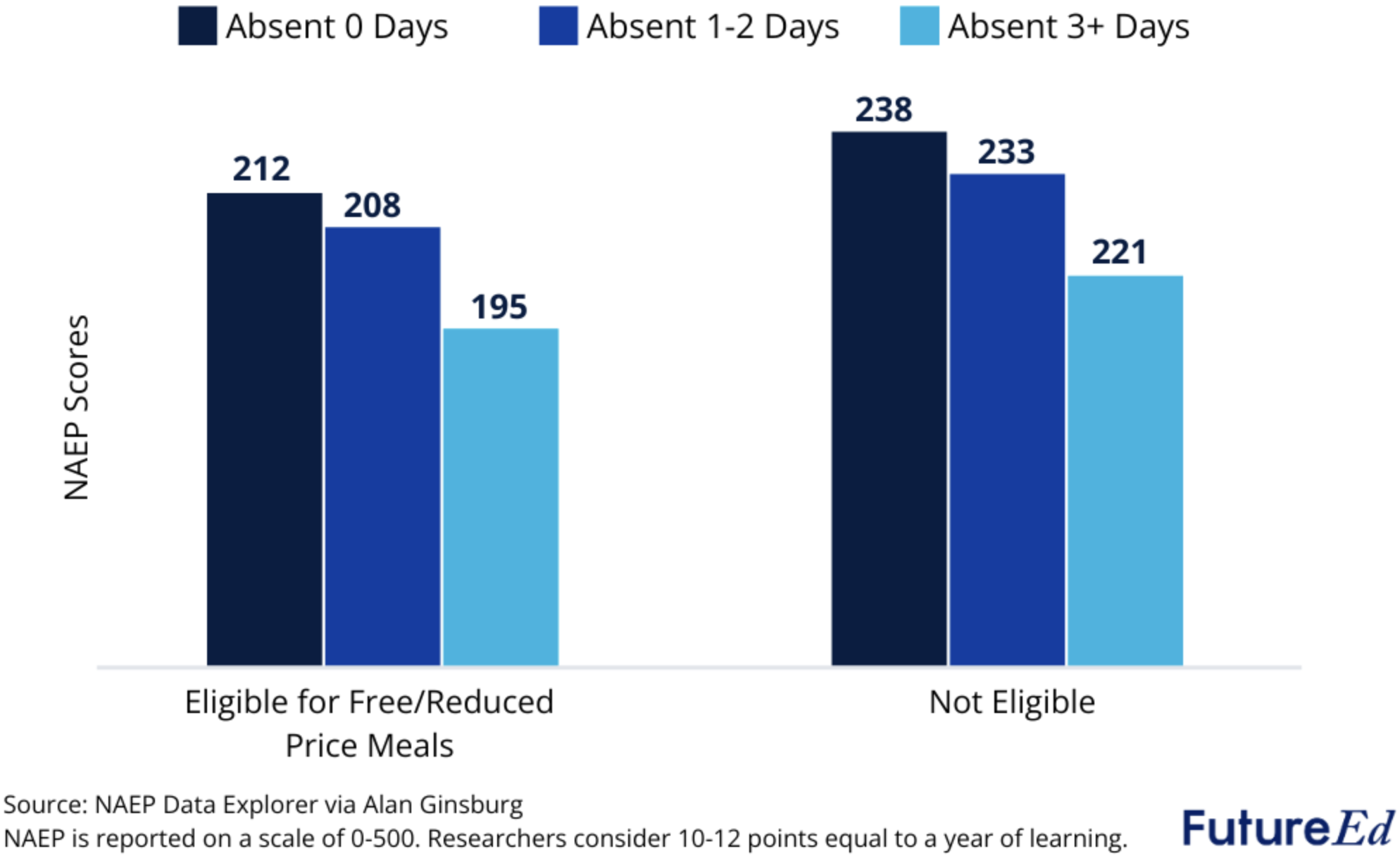
As long as chronic absenteeism remains normalized, we will not reverse the massive drops in achievement that have occurred in the past decade. In fact, a new analysis by FutureEd (see a figure from it below) suggests that missed school might be one of the driving factors behind lower test scores, which would explain why even states that returned to in-person learning sooner, such as Florida and Texas, still saw their performance levels decline. They won the battle to re-open. They lost the battle against chronic absenteeism.

Figure: NAEP fourth-grade reading scores by test-takers’ days absent in the prior month, 2022
1

So let’s get serious. Ferris Bueller’s attendance philosophy used to be called “senioritis.” In 2023, we’ve caught a scorching national case of senioritis—as parents, as educators, as students, as policy leaders, and as elected officials. Our senioritis is epidemic. If we don’t start curing it, it will be a form of long Covid that shapes a generation of kids who have endured enough already.

view

Public charter schools and the Chipotlification of education

Christy Wolfe
9.21.2023
Flypaper

Before Chipotle ushered in the phenomenon of being able to “have it your way,” the customization of a fast casual meal was relegated to condiments, not the entire entree. Nearly twenty years ago, the Washington Post wrote a piece about “Chipotlification”—the meal customization model Chipotle introduced—and how it was changing the face of fast casual eateries. In 2013, the restaurant chain boasted that there were 65,000 possible menu items—a mind boggling number of possibilities that would be exponentially more today (hello sofritos!).

“Chipotlification ” is the term I think best describes the relatively recent “unbundling” or “assembly” trends in education reform discussions nationally and in some states. These ideas refer to allowing parents to assemble educational components of their child’s education to provide them with a personalized learning experience. Unlike those wonky terms, “Chipotlification” better communicates that when customizing education, you need a bowl (or a taco or a tortilla, depending on your preferences) to hold it all together. Or as the national education nonprofit organization Bellwether describes it in their work on assembly: the “comprehensive platform” that connects parents and families to learning providers.

In the education edition of Chipotlification, a charter school could be the bowl.

While many parents would be thrilled to customize education on their own because they have the time and resources to hunt down the best music teachers, statistics classes, and pickleball teams, others will be happy to customize the last 10 percent (think guacamole or sour cream, black beans, or pinto beans), or even to follow a pre-set plan that seems to work best for their child.

Speaking as a mom, as much as I love the idea of customizing all the components of my child’s education, there is another part of me that would fear the decision making, driving, and waitlists that would invariably come with it in an area like Northern Virginia were I to do it all on my own. Many parents already do this during the summer to cobble together activities, which can be exhausting. I am sure there are many parents like me that would feel—well, honestly—a little tired when thinking of doing the “assembly” year-round to get the best options for my child, let alone for multiple children, not to mention the anxiety of whether I have assembled it correctly.

That is where charter schools—the bowls—come in. Charter schools can offer a structure for learning, but also allow for customization and independence, just like how when you want to swap out the rice for salad or tinker with the toppings, you can. Moreover, charters provide built-in accountability and funding, as well as expertise in building a personalized learning experience. Some innovative schools, GEM Prep in Idaho, are already taking the lead in demonstrating what this could look like and how it works.

GEM Prep, and others like it, allow students the opportunity for in-person and virtual learning. Students receive a mix of in-class and virtual instruction, providing students, especially in rural areas, with more access to courses and high-quality instructors. There are also charter schools, such as IEM and Springs in California, which allow students to conduct independent study at home as part of an instructor-guided learning experience, but that also includes a physical building where students can attend some classes. Springs offers students a range of settings and models, from classical to STEM. Another example is Great Hearts Nova, a virtual version of the brick-and-mortar Great Hearts classical schools with in-person microschool components. Third Future schools also personalize student learning with flexible learning modalities and schedules. Examples like these provide onramps for customization, especially for parents of students with unique learning needs that require additional services. To allow for even more customization for students, schools could provide educational grants to its families to further refine their students’ educational experiences.

Taking these approaches would leverage existing charter school accountability systems for new innovations. If a school didn’t have an orchestra or a specific foreign language option, it could enable parents to access those programs elsewhere. Ultimately the charter would be accountable for the resources used by parents who exercise their autonomy to tap into grants offered by that school. Parents could customize their child’s education, and the school would carefully curate and enable equitable access to resources.

The very concept of chartering is about assembling educational components. It is just that, typically, they are assembled at the community level, reflective of groups of parents and educators. Public charter schools provide leaders with autonomy and flexibility to offer an educational program that can be tailored down to the student level, but with educational expertise, funding, and safeguards to ensure students are learning. Charters are also a way to incrementally implement an assembled, learner-centered public education system both for parents and policymakers. Parents can add on different educational components without leaving their public schools, and policymakers can offer more options to parents while maintaining existing accountability for outcomes. Lastly, where facilities are limited, charter-based assembly could also help expand capacity in areas with high demand. Offering a mix of in-person and virtual can also help with staffing challenges.

As policymakers explore ways of expanding educational freedom, they should consider that charter schools can provide the best of both worlds when it comes to enabling a customized public education: a home base with a school culture, instructor support, and camaraderie, with flexibility to learn at home, pod, or school facility. As the recent data from CREDO show, charters have a large impact at the individual school level. The sum of its parts is greater than the whole. In the meantime, we need to increase access to charter schools that have freedom to innovate how they serve their students so more parents can find the right education that fits their child.

view

Excellence gaps: New resources and a personal history

Jonathan Plucker
9.18.2023
Flypaper

The Fordham Institute’s new report, Excellence Gaps by Race and Socioeconomic Status, authored by Meredith Coffey and Adam Tyner, is a significant addition to our growing knowledge about excellence gaps. Taken in concert with the recent report from the National Working Group on Advanced Education (of which I was a member), this work encouraged me to reflect back on over fifteen years of work on how excellence gaps form and how we can shrink and eliminate them.

The idea for the concept of “excellence gaps” first emerged while I was a fly on the wall at state-level education meetings and hearings in Indiana around 2006. Everyone was grumpy about NCLB and its implementation, but the conversations tended to focus on closing achievement gaps.

This got me wondering about two issues: Everyone was talking about “achievement gaps” as if there were just one gap; weren’t they really talking about “minimum competency gaps”? And would advocacy for advanced students be more effective if reoriented around the theme of achievement gaps? I began asking these questions of colleagues in Indiana and elsewhere, and eventually the concept of “excellence gaps”—those gaps at the top end of the achievement distribution—began to form.

Our first report on excellence gaps was released in 2010 to utter and complete silence. We couldn’t get traction with any academics, K–12 educators, or policymakers. Every major network promised to send a crew to our press conference at the National Press Club, but the only journalist who showed was from a D.C. weekly who never did a story on the report (some scars never heal!).

But things began to change. A colleague and I were walking through the hallways of the U.S. Department of Education when we noticed a program officer walk by with a copy of the report. A few weeks later, we learned that a state school chief was asking about the report. And we knew something was happening when a governor’s chief of staff called to express the governor’s displeasure “about how bad our state’s data look in your report.”

As the slow burn from the first report turned into real momentum, we produced a second report, a handful of additional papers, and even some initial thoughts on interventions. With the generous support of the Jack Kent Cooke Foundation, we produced two detailed, state-level reports on academic excellence and excellence gaps.

The intervention work led to the Excellence Gap Intervention Model, which we recently validated and improved. The model has led to projects with districts across the country as they tackle excellence gaps. My team is especially excited about our afterschool interventions, which are part of the After School Excellence Network, but all the intervention projects are making progress.

I share this timeline to make a broader point: Even a decade ago, it was not surprising to have education leaders throw up their hands when faced with excellence gaps and say, “No one knows what to do! Let’s just get rid of advanced programs and at least we won’t have huge participation gaps on our hands.” This isn’t a terribly helpful attitude (it ignores both the symptoms and disease, so to speak), but I understood where it was coming from. Despite decades of related research, we just didn’t know enough.

Fast forward to today, and we do know enough. Indeed, we know far, far more than most K–12 leaders recognize. Advances in talent identification, curriculum design, differentiation, acceleration, and several other areas have been profound, and much of this research has resulted in strategies and interventions that educators can use immediately. The National Working Group on Advanced Education report does a great job of summarizing this progress, and I was honored to play a small part in the group’s work. There is simply no excuse for the old administrator attitude of “program elimination is my only option.” We know how to do this!

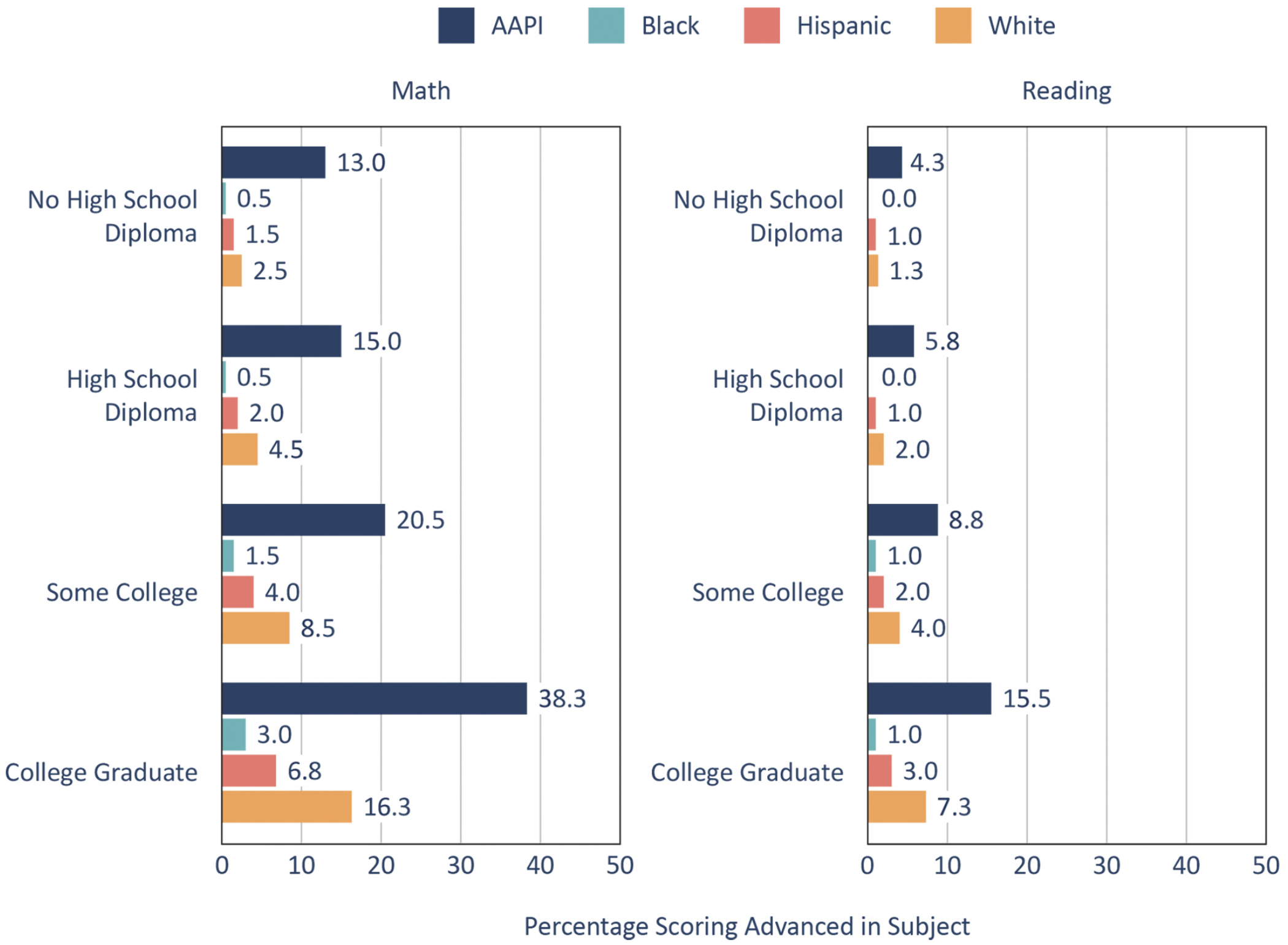
At the same time, foundational research on the nature of excellence gaps is still needed. In this regard, the report by Dr. Coffey and Dr. Tyner provides key insights. For example, excellence gaps by race or socioeconomic status have been frequently documented, yet this report also examined gaps by race and socioeconomic status. I have been playing with similar data for years and roughly knew what to expect, but seeing it depicted was still a bucket of ice water to the face (see, in particular, Figure 4 in the report, reproduced below). Among my takeaways is that racial excellence gaps get larger as one moves from lower to higher socioeconomic levels. Part of that is obvious: If there is little advanced achievement among students experiencing the lowest levels of economic security, then gaps will be relatively small. But that effect is confounded by the fact that, for Black and Hispanic students, the increase in advanced performance from low to high levels of socioeconomic status is very small; even at the highest levels, only 1 percent of Black students and 3 percent of Hispanic students score advanced. This causes me to wonder why the obvious benefits of higher economic security are correlated with higher advanced performance in some racial and ethnic groups but negligible in others. That finding alone is worth a national conversation.

Figure: Excellence gaps by race/ethnicity persist within student socioeconomic groups

1

Note from the report: “These are the [report] authors’ calculations from data representing eighth-grade achievement on the NAEP, averaged from 2015 to 2022. The measure of SES is the mother’s highest level of education. AAPI refers to Asian American and Pacific Islander students.”

Make no mistake, this will be a difficult conversation, not least because discussions involving race so easily descend into name-calling and accusations of bad faith. But as fraught as these conversations may be, we must have them.

Not to make anyone feel old, but we’re nearly a quarter of the way through this century. Since 2000, we have made amazing progress in our understanding of the nature of excellence gaps and how to address them. We can and should acknowledge this progress while noting the work yet to be done as we seek to develop the talents of all of our children. These two recent reports are important milestones and next steps on that journey, and I’m grateful to the Fordham team for their continued commitment to this work.

view

In the wake of the pandemic, time is of the essence for high school students

Victoria McDougald
9.21.2023
Flypaper

A new report released last week by the Center on Reinventing Public Education (CRPE) explores the pandemic’s impact on America’s oldest students—those in high school and the 13.5 million who recently graduated.

The State of the American Student: Fall 2023 is the second in a series of annual reports that CRPE plans to publish through 2027. It summarizes data about how today’s high schoolers are doing when it comes to academic recovery, and it paints an alarming picture. ACT college admission scores are the lowest they’ve been since the early 1990s, for example, and test scores show that it will take the average eighth grader an additional seven and a half months to catch up to pre-pandemic levels in reading, and more than nine months in math. Despite a record $200 billion in federal pandemic relief funding, the report describes how strategies for catching K–12 students up have mostly fallen short, and why there’s no time to spare to change course, particularly when it comes to high schoolers. As the report stresses, “these students have the least time to get back on track and demand our urgent attention.”

Fortunately, CRPE’s report offers compelling recommendations for getting schools and students on the path to recovery. It features essays from fourteen experts, such as National Parents Union President Keri Rodrigues and former Tennessee commissioner of education Kevin Huffman, alongside reflections and suggestions from high school students and recent graduates. They offer creative ideas and solutions for better meeting the unique needs of our current and future generations of students, including calling for more state and federal research and transparency on how students are faring, and identifying ways in which to strengthen pathways to college and career. 

In one essay, Virginia Secretary of Education Aimee Guidera writes about the state’s fueled sense of urgency and commitment to change, particularly when it comes to “breaking down the walls between education and work, blowing up the one-size-fits-all approach to education, and providing students, especially those who have been marginalized in the past, exposure to the careers of the future.” Leaders recently created an “Office of Innovation” within the Virginia Department of Education to learn from and replicate successful innovative efforts across the state. Guidera also describes Virginia’s renewed focus on parent empowerment and information, and steps to better provide parents with clear, actionable information about individual student and school performance. As she explains, “We are using data as a flashlight, not a hammer, to inform better decisions at kitchen tables, classrooms, school boards, and the State Capitol.”

In another essay, Aaliyah Samuel, President and CEO at the Collaborative for Academic, Social, and Emotional Learning (CASEL), describes innovative ways that educators are redesigning education to emphasize social and emotional learning (SEL) in the classroom, prioritizing the relationships among students and with adults, but also strengthening partnerships between schools and families. She stresses, “SEL is not a distraction from academics, but a tool that can help us build relationships so we can get to academic recovery and success.”

Full of urgency and creative ideas, CRPE’s latest report is a timely call to action and a powerful complement to another new report released last week by the Building Bridges Initiative, a group of bipartisan group of education advocates convened by Fordham and our colleagues at Democrats for Education Reform. The Initiative’s final report, A Generation at Risk, similarly concludes that today’s K–12 students need much more if they are to meet the challenges of the future. It calls for policymakers and education leaders to better track and publicly report on academic recovery efforts, to aim for a broader definition of student success, and to enable a broader set of providers (inside and outside of schools) to work together to meet students’ needs.

Given the magnitude of today’s educational crisis, both reports are a much-needed reminder that time is running out to help our nation’s students recover academically and to prepare them for successful futures, especially for students most in need of urgent solutions. As CRPE’s report concludes, “This is an all-hands-on-deck moment for the U.S. education system.” The time to take bold, collective action is now.

SOURCE: “The State of the American Student: Fall 2023,” Center on Reinventing Public Education, Mary Lou Fulton Teachers College, Arizona State University (September 2023).

view
PIRLS learning loss SR image

2021 PIRLS test results starkly illustrate global learning loss

Jeff Murray
9.18.2023
Ohio Gadfly Daily

The first pandemic-influenced data from the Progress in International Reading Literacy Study (PIRLS) test are in. Unsurprisingly, an initial analysis says the news is bad.

PIRLS is administered every five years to a representative sampling of fourth grade students in more than fifty countries and regions around the world (including the U.S. and other industrialized nations, as well as some less-developed countries). It provides internationally comparative data on how well children read; the trend data are meant to measure the big picture ups and downs in reading achievement over time. This report offers almost no nation-specific results—including for the United States.

The new study compares results from assessment rounds in 2001, 2006, 2011, 2016, and the most recent in 2021. The sample includes more than 1 million students from each administration, but represents more than 16 million boys and girls worldwide. Achievement is compared using traditional socio-demographic characteristics, but in the years since Covid disrupted education worldwide, the influence of school closures has become a new data point of extreme interest. To wit: Principals in PIRLS schools were asked to estimate the number of weeks during the testing year “where normal primary school operations have been affected by the COVID-19 pandemic.’’ As an additional measure of pandemic disruption, the researchers utilized UNESCO data on the length of government mandated school closures in countries and regions.

The researchers model the effect of school closures on student achievement by predicting the deviation of the most recent 2021 results from an estimated linear trend in reading achievement using data from the four previous testing rounds included in the analysis. They estimate each country or region’s linear trend separately—including country-level fixed effects to control for unobserved characteristics—and report the difference between the estimated and the actual outcomes. Overall, reading achievement declined by 15 points on average across countries, or 18 percent of a standard deviation (SD). Since some countries delayed test administration due to the pandemic, the researchers also adjusted their analysis to account for students of differing ages and grade levels. This effort finds an even larger decline: 27 points, or 33 percent of an SD overall, which the researchers point out is roughly equivalent to a year’s worth of learning loss. Some countries, such as India at 73 points, lost even more.

The longer schools stayed closed, the worse their students performed on the PIRLS test. Countries with no school closures per UNESCO data (such as Australia and Sweden) achieved results in 2021 that accord with predicted outcomes. That is, they saw no decline in achievement based on previous trends. With each week of full or partial school closures, though, the results decline by 0.8 points from predictions. Thus, ten weeks of full or partial closures resulted in an 8-point decline (or 9 percent of an SD), twenty-five weeks resulted in a 20-point decline (24 percent of an SD), and fifty weeks resulted in a nearly 40-point decline (47 percent of an SD). To highlight India once again, their schools were partially or fully closed for 93 weeks, and its students registered one of the largest learning losses per this international test.

There was no difference in the findings for boys versus girls, but lower-achieving students (here defined as the first decile of achievement) experienced much larger losses than their higher-achieving peers. For example, in countries with ten weeks of full or partial closures, high achievers experienced no loss, while the lowest performing students lost 12 points. But in countries with fifty weeks of full or partial closures, the best students lost 28 points, while their low-achieving peers lost 37 points. Interestingly, there was barely any difference in outcomes for countries which postponed their PIRLS administration compared to those which did not postpone. This suggests that, for up to a year, countries’ efforts to mitigate the losses experienced during the pandemic were minimally effective. 

Interested readers can peruse supplementary data, which is broken down by country/region, indicating that there is considerable heterogeneity across them, especially in terms of student achievement in the face of school disruptions. But there are no direct comparisons between countries provided by these researchers. The new report, unfortunately, leaves it at the overall finding for this one international test of reading achievement: A bleak picture of global learning loss directly tied to the length of school closures.

SOURCE: Maciej Jakubowskia, Tomasz Gajderowicza, and Harry Anthony Patrinos, “Global learning loss in student achievement: First estimates using comparable reading scores,” Economics Letters (August 2023).

view

Cheers and Jeers: September 21, 2023

The Education Gadfly
9.21.2023
Flypaper

Cheers

  • Districts and policymakers are debating the dissolution of Reading Recovery, a popular literacy intervention that’s based on dubious research. —Chalkbeat
  • “Alabama’s Piedmont City schools extended math classes, added more small group instruction, and started to routinely examine student math performance. The strategy is paying off.” —Hechinger Report

Jeers

  • Grade inflation has hit every subject, but it’s worst in math classes. —Jill Barshay
  • The U.S. is falling behind China in STEM. We no longer produce the most patents, science and engineering publications, or natural science Ph.Ds. —Mark Schneider
  • While some politicians are busy seeking solutions, too many in education are wasting their time still arguing about whether or not learning loss is even real. —Andrew Rotherham
view

What we're reading this week: September 21, 2023

The Education Gadfly
9.21.2023
Flypaper
  • The pandemic set Americans back not just in education, but in crime and mortality rates as well. —David Wallace Wells
  • Schools spend billions of dollars on training on topics such as DEI and culturally-relevant pedagogy, but have no insight into whether or not it works. —Katherine Reynolds Lewis
  • A review of Laura Meckler’s new book on Shaker Heights, Ohio, tackles questions about academic standards, tracking, and socioeconomic integration. —Richard Kahlenberg
Fordham Logo

© 2026 The Thomas B. Fordham Institute
Privacy Policy
Usage Agreement

National

P.O. Box 110
Burke, VA 22009

202.223.5452

[email protected]

Ohio

P.O. Box 82291
Columbus, OH 43202

614.223.1580

[email protected]

Sponsorship

130 West Second Street, Suite 410
Dayton, Ohio 45402

937.227.3368

[email protected]