Mobile Navigation

  • National
    • Policy
      • High Expectations
      • Quality Choices
      • Personalized Pathways
    • Research
    • Commentary
      • Gadfly Newsletter
      • Flypaper Blog
    • Events
    • Scholars Program
  • Ohio
    • Policy
      • Priorities
      • Media & Testimony
    • Research
    • Commentary
      • Ohio Education Gadfly Biweekly
      • Ohio Gadfly Daily
  • Charter Authorizing
    • Application
    • Sponsored Schools
    • Resources
  • About
    • Mission
    • Board
    • Staff
    • Career
Home
Home
Advancing Educational Excellence

Main Navigation

  • National
  • Ohio
  • Charter Authorizing
  • About

National Menu

  • Topics
    • Accountability & Testing
    • Advanced Education
    • Career & Technical Education
    • Charter Schools
    • Curriculum & Instruction
    • ESSA
    • Evidence-Based Learning
    • Facilities
    • Governance
    • Personalized Learning
    • Private School Choice
    • School Finance
    • Standards
    • Teachers & School Leaders
    • Think Again
  • Research
  • Commentary
    • Gadfly Newsletter
    • Flypaper Blog
    • Gadfly Podcast
  • Events
  • Scholars Program

The Education Gadfly Weekly

Sign Up to Receive Fordham Updates

We'll send you quality research, commentary, analysis, and news on the education issues you care about.
Thank you for signing up!
Please check your email to confirm the subscription.

The Education Gadfly Weekly: Doing educational equity right: School finance

Volume 24, Number 2
1.11.2024
1.11.2024

The Education Gadfly Weekly: Doing educational equity right: School finance

Volume 24, Number 2
view
Piggy bank and chalkboard
High Expectations

Doing educational equity right: School finance

Last week, Petrilli identified three rules for “doing educational equity right” that will result in smart policy designs and make it likelier that the political right will get on board the equity train. Now let’s apply those rules to the topic of school finance.

Michael J. Petrilli 1.11.2024
NationalFlypaper

Doing educational equity right: School finance

Michael J. Petrilli
1.11.2024
Flypaper

How to ban phones effectively

Daniel Buck
1.11.2024
Flypaper

Alternative classroom models don’t have to threaten “traditional” ones

Meredith Coffey, Ph.D. | Jeanette Luna
1.11.2024
Flypaper

Teachers who frequently refer students to the office: Who are they and how can we help them?

Amber M. Northern, Ph.D.
1.11.2024
Flypaper

Cheers and Jeers: January 11, 2024

The Education Gadfly
1.11.2024
Flypaper

What we're reading this week: January 11, 2024

The Education Gadfly
1.11.2024
Flypaper
view

How to ban phones effectively

Daniel Buck 1.11.2024
Flypaper
view

Alternative classroom models don’t have to threaten “traditional” ones

Meredith Coffey, Ph.D., Jeanette Luna 1.11.2024
Flypaper
view

Teachers who frequently refer students to the office: Who are they and how can we help them?

Amber M. Northern, Ph.D. 1.11.2024
Flypaper

view

Cheers and Jeers: January 11, 2024

The Education Gadfly 1.11.2024
Flypaper
view

What we're reading this week: January 11, 2024

The Education Gadfly 1.11.2024
Flypaper
view
Piggy bank and chalkboard

Doing educational equity right: School finance

Michael J. Petrilli
1.11.2024
Flypaper

This is the second in a series on doing educational equity right. See the introductory post, as well as ones on student discipline, advanced education, school closures, homework, grading, effective teachers, and a concluding post on doing educational equity wrong.

Last week, I identified three rules for “doing educational equity right”:

  1. When aiming for equity, we should level up instead of leveling down.
  2. We should focus on closing gaps between affluent students and their disadvantaged peers, not between high-achieving students and their lower-achieving peers.
  3. We should focus equity initiatives primarily on class, not race.

These rules will not only result in smart policy designs, but also make it likelier that the political right will get on board the equity train.

Now let’s apply those rules to the topic of school finance.

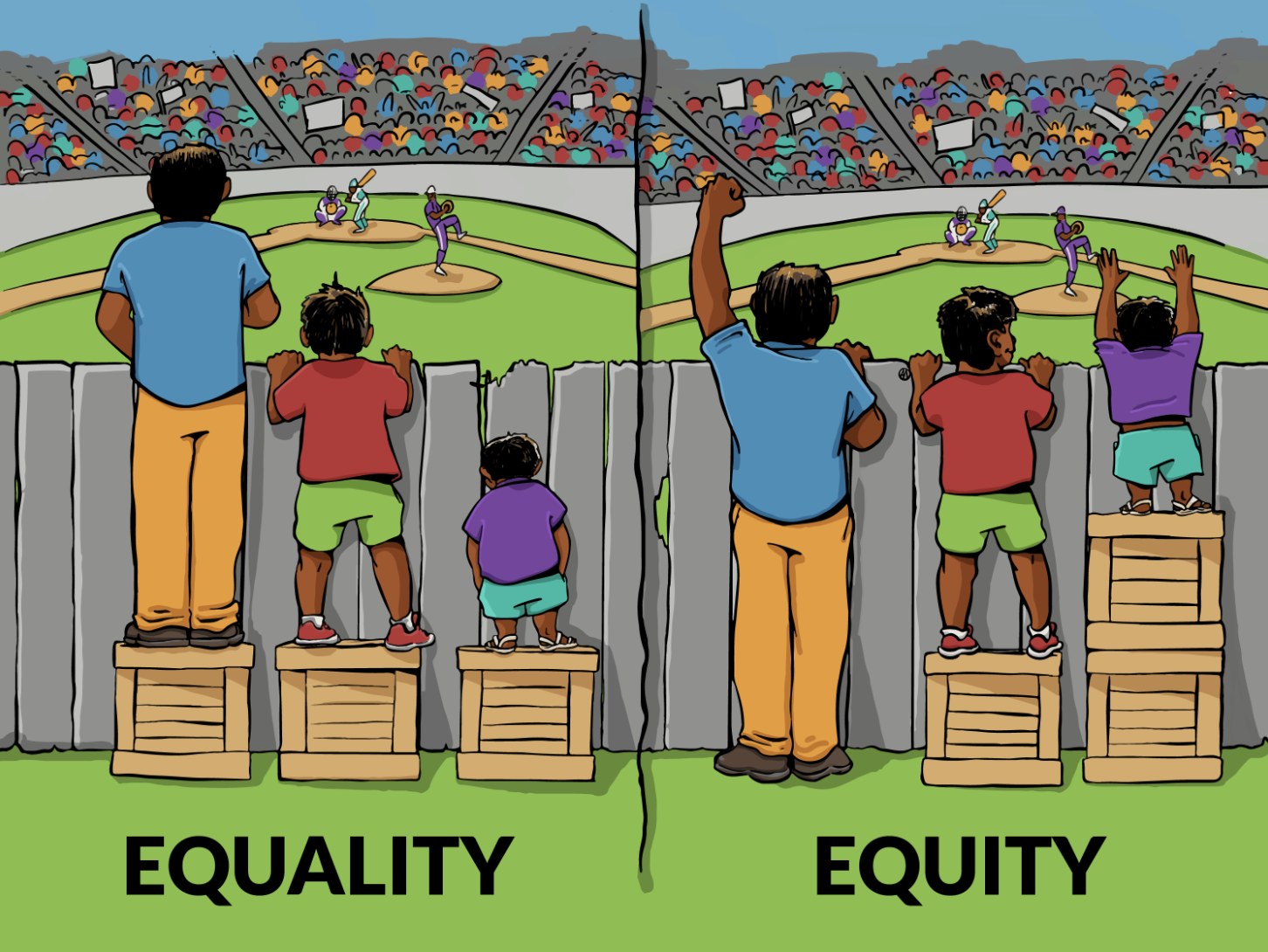
In some ways, this is the easiest issue around which to gain consensus across the political spectrum, at least conceptually. While some might assume that conservatives would oppose redistributing resources from rich areas to poor ones, in my experience, most right-of-center reformers support the idea, as long as it’s attached to mechanisms to ensure that the money is well spent. Many of us, after all, have long promoted “weighted student funding,” which is centered on the notion that disadvantaged students need additional resources in order to meet high standards (and that money should follow the child to the school they actually attend). Funding is probably the one area where conservatives can cheer the meme below, as we agree that it’s not enough to “equalize funding”; high-poverty schools need more money per pupil than affluent ones. In other words, we need to “level up.”

1

Gladly, as my colleague Adam Tyner argued in Fordham’s Think Again series last year, America’s current approach to school funding is dramatically more progressive than it used to be, and almost everywhere it already hits the mark in terms of equalizing resources across rich and poor schools. That’s a big change from the days of the “savage inequalities” that Jonathan Kozel wrote so persuasively about.

The next frontier, as Adam argues, is making our system even more progressive than it already is. If folks on the left want to have any chance to get conservatives to support that agenda, they need to pay attention to my rules number two and number three. Namely, greater progressivity in funding should be based on students’ socioeconomic status—not their achievement level and not their race.

After all, as I wrote last week, there’s no valid moral argument for focusing on low-achieving low-income kids over high-achieving low-income students. Both groups are poor, both groups come to school with disadvantages that are likely to keep them from achieving their full potential, and both groups rely on the K–12 system to help them be all they can be.

Likewise, it’s hard to argue that we should spend more dollars on schools serving middle-class Black or Hispanic students than on schools serving low-income White or Asian kids.

Focusing on students’ socioeconomic status, on the other hand, makes sense morally, politically, and educationally. Simply put, we know it costs more money to help low-income students achieve their full academic potential.

Some of that is because addressing the needs of disadvantaged kids costs real money—think of additional mental health supports for kids who have experienced trauma, for example.

But, as Adam argues, the primary reason that we need to spend more on low-income students is because of teacher labor markets. On average, teachers are less willing to teach in high-poverty schools. Maybe they don’t want to drive to low-income neighborhoods, or they fear that such schools will face greater behavioral challenges, or they just know that kids experiencing disadvantage need teachers willing to work harder and smarter in order to help them succeed. When we pay teachers the same regardless of which school they work in—the practice of the vast majority of districts in America—we end up in a situation in which high-poverty schools have lower-quality teachers, on average, than affluent ones.

There are a couple of ways to fix that, both of which involve spending significantly more money in high-poverty schools. One is to ensure, through state and local funding formulas, that high-poverty schools receive lots more revenue, so they can afford to pay their teachers more. Another way is for districts to adopt a Dallas-style or D.C.-style teacher pay initiative, in which highly-effective teachers are provided significantly larger salaries in order to teach in the highest-poverty schools—and ineffective teachers in those schools are transferred elsewhere or, ideally, out of the profession.

Now let’s be real: Many of us on the right are not crazy about increasing spending for traditional public schools. Many, if not most, such schools have a long history of squandering much of the money that taxpayers have thrown at them (see the federal ESSER funds, for example). And we can point to examples, especially from high-spending, high-tax states like New York and New Jersey, where a boatload of money hasn’t fixed dysfunctional school systems.

We view this kind of spending skeptically because we know that powerful unions tend to ensure that any extra money gets soaked up by more generous teacher contracts. Rather than targeting funding to high-need schools or to teachers willing to work in them, unions push for across-the-board raises, Cadillac-style benefits packages, and retiree health care, all of which is great for their members but largely unrelated to what’s best for kids.

So to get conservatives on board, progressives need to embrace initiatives that come with a quid pro quo. Once state policy has leveled up school funding between rich and poor districts, additional money for low-income schools should come in the form of competitive grants tied to significant reforms. If districts want more money, they should agree to (and get their unions to agree to) initiatives to recruit and retain highly effective teachers in their neediest schools via differential pay—and convince their ineffective teachers in those schools to find another line of work.

What progressives shouldn’t do is focus the school funding debate around race, as the media tends to do, or aim to allocate extra money for low-achieving students, rather than low-income kids, as Governor Newsom is doing.

If folks on the left are willing to push the unions to accept serious reforms in return for more money, those of us on the right will be willing to redistribute resources in the cause of greater equity. Sounds like a win-win to me.

view

How to ban phones effectively

Daniel Buck
1.11.2024
Flypaper

Shortly before schools—and Fordham—shuttered their doors for the holiday break, Tim Daly asked a simple question in these pages: Should schools ban smart phones?

It has been a hot topic of debate recently, and the growing consensus is that the correct answer is a resounding “yes.” Editorial boards from the Washington Post to Bloomberg have run op-eds and influential professors have published open letters arguing for stricter phone policies in schools. A majority of parents support rules that limit student access to phones, worrying that their children overuse social media, and only 16 percent of teachers believe that phones positively impact student development.

And we’re already seeing policy changes. Many districts, some states, and even entire countries have passed laws restricting access to phones during the school day. Perhaps the most notable statewide policy is Florida’s recent law that requires schools to prohibit phone use during class time and block access to social media via the school’s Wi-Fi.

None of this is entirely new. Limitations on the use of personal technology in schools reach back at least to 1989, when Maryland forbade the use of pagers and “cellular telephones” during school hours. Since then, public opinion and school rules have waffled between restriction and leniency. In the latest cycle, after a wave of techno-optimism saw schools rolling back restrictions, only 65.8 percent of schools prohibited their use during 2015–16. That share began to tick up as the effects of social media and screen time on teen mental health became clear.

This latest wave of policies present not unprecedented limitations, but stricter ones and novel approaches: homeroom teachers collecting phones and locking them up as students walk in the door; devices placed in Yondr bags at the building’s entrance; and policies that carry a consequence with the first infraction. Before, in practice, according to a Common Sense Media survey, “prohibition” covered a wide range of policies with uneven enforcement that was often left to teacher discretion.

The evidence in support of stricter policies is mounting. Several studies have confirmed that limiting phone usage during class increases performance on both standardized test scores and end-of-course exams. The gains were equivalent to an additional hour of instructional time per week. Restricting phone use outside class time also shows benefits. For example, when schools place limitations on them during recess, researchers found that students exercise far more, burning off energy, fostering physical health, and promoting later attention in class.

These findings make intuitive sense. At the cognitive level, all new information enters our brains through our working memory, the doorway to long-term memory. If that doorway clogs up with Temple Run sneakily played between textbook pages or with emotional anticipation and consideration of that fateful buzz, telling a student that their crush just texted back, students cannot focus on class content, in which case they won’t learn much of it.

I’ve worked at schools with both lenient and strict cell phone policies. At the former, it was a constant battle. The lunchroom was an eerie sight to behold: students sitting shoulder to shoulder with their necks craned down, their faces faintly lit, occasionally leaning over to show their friend a funny meme or TikTok video but never glancing up. There was little eye contact.

At the “phone ban schools,” however, the lunchroom had a healthy, boisterous energy. Students said “good morning” as they walked down the hallway. They looked and smiled at each other and their teachers. There were moments that required enforcement, but power struggles over phones were actually fewer at schools with stricter bans. Most kids complied; only a few were repeat offenders.

It seems clear that this latest trend towards stricter cellphone bans is a positive one. But how to get them right?

There’s a surprising analog with the science-of-reading movement here. Though there’s a rare point of both political and academic consensus on the benefits of explicit phonics instruction, it’s far from clear whether that agreement should result in policies altering curricula, teacher prep, grade retention policies, accountability measures, funding, or professional development; whether they’re best implemented at the classroom, district, state, or federal level; and whether more and better implementation comes via carrots or sticks.

So, too, with phones. The case for banning them is strong. Less clear are ideal policies. Do students turn them in to their homeroom teacher or can they keep them in their lockers? Are they allowed during lunch or passing time? What’s the consequence for an infraction and how quickly does it come about? How should this vary across elementary, middle, and high schools?

A hundred different policies can be imagined. But if it’s to succeed, any such policy must be based on three fundamental precepts: universality, enforcement, and a concurrent explanation to both students and parents, a PR campaign of sorts.

First, any policy must apply to the entire school. At my lenient school, administration left it up to individual teachers to choose when and if they would limit access to phones. Perhaps students had to put them away during instruction but could take them out for music during independent reading. One teacher might police their use, while another across the hall incorporated phones into the lesson. Human nature being what it is, there was an inbuilt incentive to be the lenient, cool teacher, which naturally prompted power struggles: “But Mr. Jay lets me use my phone in math!”

Second, it has to be enforced. Currently, schools are moving in the direction of behavioral permissiveness, rolling back discipline codes and consequence structures. But that can’t work for a phone ban. If a teacher confiscates one that’s being used in violation of the policy, a consequence must always follow. If not, it creates an all-win/no-lose scenario. A student always stands to benefit from uncertainty; most will take the risk of not turning in their phone.

I remember confiscating a student’s phone midday last year and watching my principal return the phone to the student a few hours later, in flagrant violation of our school’s own policy that parents must pick it up. What does that communicate to everyone in the building? The rules won’t really be enforced, what a teacher says can be ignored, and any adult who tries to enforce rules or student who follows them is a chump.

But the uniform consequence can’t be too complicated or it won’t always happen. One approach is to say that any usage gets a phone confiscated, the student receives a lunch detention, and a parent must pick up the phone. Fencing left unbuilt or full of holes provides no benefit.

Finally, some sort of PR campaign is essential. Comparisons abound between social media and hard drugs—“It’s digital fentanyl!”—but a better comparison might be cigarettes. The harms of heroin have always been clear, but fifty years ago, there was little popular knowledge of tobacco’s detrimental effect on the body. It was thought of as a light stimulant like coffee with little negative risk, so why not light up?

It’s the same story with phones. A phone provides access to friends, entertainment, and intrigue, so if a student doesn’t understand the harm of overdosing on screens, they’ll resent the bans. If they receive a few lessons on its detrimental impact, they’re more likely to buy in—however begrudgingly. Similarly, the inability to easily contact their children or the need to drive to school to pick up their child’s confiscated phone may disgruntle parents. But a few information meetings justifying the rollout will help to change minds. Concurrent with the restriction on smoke-free public spaces and higher ages for smoking was a national campaign of ads and school lessons on the harms of cigarettes. Cellphones require a similar effort.

When schools are permissive, children develop habits of inattention. They’re talking to friends while watching videos; they’re watching teachers while they have music in their ears; they’re completing math problems with a few rounds of candy crush between sets or reading a book with their phone on their desk.

Learning takes effort and sustained attention. Unfortunately, dopamine hits of social media have trained students to flee effort in search of easy, cheap entertainment.

The consequences of this rewiring are clear: stymied pandemic recovery, misbehavior, and tanking emotional health among teens. It’s time schools get serious and take away phones already.


view

Alternative classroom models don’t have to threaten “traditional” ones

Meredith Coffey, Ph.D. | Jeanette Luna
1.11.2024
Flypaper

As former teachers in a variety of settings—charter, traditional public, and “transfer” schools—we read with great interest our colleague Daniel Buck’s recent piece, “In defense of the traditional classroom.” In the essay, Buck worries that “utopian reformers” have needlessly decried what he terms the “traditional” classroom model.

He is surely right that most schooling will continue to happen within the four walls of a physical classroom. As he says, we landed on that model for good reason and are likely to stay there. One-on-one tutoring is often cost-prohibitive, a hundred kids in a room creates chaos, and virtual learning during Covid took a devastating toll on students’ academic progress and mental health. And we couldn’t agree more that there are times and places where direct instruction is most effective. There are certainly reformers, perhaps most notoriously in California, who have been too quick to abandon this established pedagogical method. For example, research shows that early learners of math, especially those who are low-achieving, benefit from explicit instruction and memorization to build math fluency.

But that doesn’t mean everything that happens in a classroom must be strictly “traditional.” In fact, both practice and research show that there are feasible, effective alternatives to direct instruction from a single teacher. What’s more, such alternatives can and should work hand in hand with traditional lessons; they do not have to be at odds.

One such alternative is inquiry-based instruction, a pedagogical style that encourages students to take an active role in their own learning. Rather than passively receiving knowledge from an instructor, students search for evidence, construct arguments, and collaborate with their peers. This mode of learning has proven to be a powerful tool both to build investment and to improve achievement, particularly in the later grades. In fact, a growing body of evidence suggests that students, especially those in middle and high school, learn better with this approach.

An oft-misunderstood part of inquiry-based learning is the role of the teacher. Yes, students drive the discussion, but they do not have unrestricted freedom. Imagine an eighth-grade science classroom beginning a unit on velocity. Rather than merely stating the definition and equation of velocity as students mindlessly jot them down, the teacher has prepared a more complex and engaging activity. Students discuss in small groups where they have heard this term and what they think it might mean. Then they engage in a short lab activity where they use measuring tape and timers to try to find the velocity of a marble rolling across the table. The teacher does not sit idly while students posit false information or scramble to get started, but rather plays the crucial role of carefully guiding student thinking toward the main idea. At the end of the lesson, students have determined the velocity of a moving object in front of them and derived the equation themselves using real-world context and gentle nudges from their instructor. They end the class with the same knowledge they would have acquired from a direct teaching lesson, yet with deeper understanding and stronger investment.

This pedagogical approach is an art, and it involves immense preparation from the instructor beforehand. But it works.

Another alternative to the traditional classroom model is co-teaching or team teaching. This runs the gamut, from decidedly “traditional” structures (with one teacher giving direct instruction while another circulates to support struggling students) to alternative setups like parallel teaching, station teaching, or small group pull-outs. The model can vary day by day and even within a single class. After a whole-class lesson, for instance, the teachers might give a brief assessment and then break the students into two groups, with one teacher leading the more advanced learners in higher-skill practice and another teacher working with the students who haven’t quite mastered the material. This is hardly a “utopian” suggestion. Indeed, it was common practice across departments in the schools where both of us taught for years—not to mention aligned with flexible ability grouping practices supported by education research.

Speaking of research, there’s a growing body demonstrating that, when implemented right, co-teaching can produce academic benefits. Multiple studies of co-taught science classrooms have revealed improved achievement for students with and without disabilities. Most recently, a 2023 study on co-taught classrooms of third- through eighth-graders found that co-teaching had positive, significant effects on math scores for all students and reading scores for students with disabilities (with no significant effects on reading scores for students without disabilities). As an added benefit, surveys suggest that co-teaching may help with teacher retention even more than financial incentives. (It’s good to have a teammate.)

Having multiple teachers in a room can also allow more opportunity for students to speak up in class. That is, if thirty kids are in a room, it’s tougher for each individual to have time to speak; if the physical space allows for two groups of fifteen, then students will have more time to participate actively. And research shows that simply speaking in class can improve reading literacy for students, regardless of socioeconomic background or gender.

Inquiry-based learning and co-teaching are just two examples of the many research-backed alternatives to a “traditional” classroom structure. Education researchers and advocates have worked for decades to study and fine-tune various pedagogical models to increase achievement and the overall educational experience for students. Far from “lov[ing] to hate the classroom,” many advocates of alternative classroom structures have called attention to approaches that serve to update and strengthen the model we’ve relied on for generations.

view

Teachers who frequently refer students to the office: Who are they and how can we help them?

Amber M. Northern, Ph.D.
1.11.2024
Flypaper

Whether school discipline falls differently on students from different racial groups is an ongoing concern for families, school and community leaders, and policymakers. Typically, the strongest school discipline literature is laser-focused on unequal consequences for similar misbehaviors, but a recent study led by the University of Maryland’s Jing Liu looks at how office discipline referrals differ by teacher and school characteristics.

Jing and co-authors draw data from a large and diverse school district in California. Though unnamed, it sounds an awful lot like San Francisco, and has very fine-grained referral records. Thirty-three percent of its pupils are Asian, 30 percent Hispanic, 7 percent Black and 12 percent White. Ten percent are multiracial. The study covers referrals between the 2016–17 and 2019–20 school years that are issued by teachers, which comprise about 92 percent of the total. (The remainder were issued by administrators and are not included in the analysis.) Their sample comprises 75,229 referrals handed out by roughly 3,000 teachers over the four school years. Analysts identify the top 5 percent of referrers in each year and their contributions to racial gaps in both referrals and suspensions. The demographics of the top referrers are similar to those of all referrers, meaning 49 percent White, 5 percent Black, 16 percent Hispanic, and 18 percent Asian.

Among all teachers in the district, 34 percent of them made at least one referral within a given year. But over half of them have an annual referral count below five. And the top 5 percent referrers issued over forty-eight referrals per year, which is roughly one every four school days. While fewer than eighty teachers in the sample were ever a top referrer, they account for 35 percent of all referrals in the four-year study period. Looking at all referrers, the Black-White referral gap is slightly above three referrals, which is similar for the Hispanic-White, and Multiracial-White gaps, but the growth of those gaps is not as fast as the Black-White referral gap. (The Asian-White referral gap is stable across time.) Focusing on the top 5 percent of referrers, the researchers find that they effectively double the Black-White and Hispanic-White and Multiracial-White gaps. In other words, even though top referrers represent a small group, they have an outsize effect on the overall racial gaps in referrals.

Next, the analysts classify the infractions that led to the referrals into three large categories: interpersonal and defiance issues; violence; and truancy and drugs. Defiance, especially among top referrers, is what drives the increase in referral gaps by race, and what many view as the most subjective infraction. The analysts also find that approximately 4 percent of office referrals convert to suspensions, such that the magnitude of suspension gaps pales in comparison to referral gaps.

Finally, analysts look at what may predict referral behavior by the teachers. They find that the racial compositions of the schools where top referrers work, along with their own characteristics, are both drivers. For instance, Black and Hispanic students are overrepresented in schools and classrooms among students who received referrals by top referrers. Teachers of color are also less likely to be a referrer or top referrer compared to their White colleagues. Specifically, a Black teacher is 4.8 percentage points less likely to be a referrer than a White teacher across grade levels. And the number of years spent teaching and the grade level taught are particularly important predictors for new teachers: Those who have taught 0–3 years at the middle school level tend to be top referrers.

There’s a lot to unpack here, but one item shouldn’t be put away: School leaders should be able to readily identify the relatively small number of teachers who need help with student discipline and offer them just that—particularly as it pertains to defiance concerns—so that they can maintain control of their classrooms without resorting to office referrals.

On an equally optimistic note (new year, new optimism!), the study’s results indicate that, even without such targeted assistance, only about 25 percent of top referrers in a given year remain that way the following year, and even fewer do so in year three. This suggests that they learn how to manage behavior better over time. Given formal identification of and supports to struggling novices, we can shrink both the number of them and the duration of their learning curves. That’s a resolution worth keeping.

SOURCE: Jing Liu, Emily K. Penner, and Wenjing Gao, Troublemakers? The Role of Frequent Teacher Referrers in Expanding Racial Disciplinary Disproportionalities, American Educational Research Association (June 2023).

view

Cheers and Jeers: January 11, 2024

The Education Gadfly
1.11.2024
Flypaper

Cheers

  • During her long and esteemed career, the late Linda Brown became one of the most influential educators in decades.—Richard Whitmire, The 74
  • Facing record-setting chronic absenteeism, some districts are getting serious again about enforcing truancy laws. —Alec MacGillis, ProPublica
  • The joy of reading out loud to students shouldn’t get lost in the reading wars. —Education Week
  • Bucking the anti-testing trend, 1,317 students at Success Academies will sit for AP Exams this year. —Wall Street Journal

Jeers

  • The Chicago Board of Education may vote to remove resource officers from schools this fall. —WBEZ Chicago
  • After dozens of selective colleges made the SAT and ACT optional for applicants, a growing number of experts are wondering if that switch was a mistake. —David Leonhardt, New York Times
view

What we're reading this week: January 11, 2024

The Education Gadfly
1.11.2024
Flypaper
  • Thousands of schools across the country, including schools in Mississippi, Baltimore, Boston, and other jurisdictions, are at risk of closing because of declining enrollment. —The 74, Mississippi Today, The Boston Globe, and The Baltimore Banner
  • Students enrolled in D.C.’s Advanced Technical Center, a CTE high school, have significantly better attendance than their peers. —Washington Post
  • As tutoring balloons as a popular education intervention, timing, staffing, and technology are key factors to success. —Jill Barshay, Hechinger Report
  • New research finds that individuals who follow the success sequence, even later in life, can find a path out of poverty. —Angela Rachidi, National Review
  • Charter schools, not school choice, have the best promise for improving American education. —Matt Yglesias, Bloomberg
  • Teachers hired on emergency licenses during the pandemic fared no worse than their traditionally-trained peers.  —Chad Aldeman, The 74
Fordham Logo

© 2026 The Thomas B. Fordham Institute
Privacy Policy
Usage Agreement

National

P.O. Box 110
Burke, VA 22009

202.223.5452

[email protected]

Ohio

P.O. Box 82291
Columbus, OH 43202

614.223.1580

[email protected]

Sponsorship

130 West Second Street, Suite 410
Dayton, Ohio 45402

937.227.3368

[email protected]