Mobile Navigation

  • National
    • Policy
      • High Expectations
      • Quality Choices
      • Personalized Pathways
    • Research
    • Commentary
      • Gadfly Newsletter
      • Flypaper Blog
    • Events
    • Scholars Program
  • Ohio
    • Policy
      • Priorities
      • Media & Testimony
    • Research
    • Commentary
      • Ohio Education Gadfly Biweekly
      • Ohio Gadfly Daily
  • Charter Authorizing
    • Application
    • Sponsored Schools
    • Resources
  • About
    • Mission
    • Board
    • Staff
    • Career
Home
Home
Advancing Educational Excellence

Main Navigation

  • National
  • Ohio
  • Charter Authorizing
  • About

National Menu

  • Topics
    • Accountability & Testing
    • Advanced Education
    • Career & Technical Education
    • Charter Schools
    • Curriculum & Instruction
    • ESSA
    • Evidence-Based Learning
    • Facilities
    • Governance
    • Personalized Learning
    • Private School Choice
    • School Finance
    • Standards
    • Teachers & School Leaders
    • Think Again
  • Research
  • Commentary
    • Gadfly Newsletter
    • Flypaper Blog
    • Gadfly Podcast
  • Events
  • Scholars Program

The Education Gadfly Weekly

Sign Up to Receive Fordham Updates

We'll send you quality research, commentary, analysis, and news on the education issues you care about.
Thank you for signing up!
Please check your email to confirm the subscription.

The Education Gadfly Weekly: Bias in AI is a real problem

Volume 23, Number 43
10.26.2023
10.26.2023

The Education Gadfly Weekly: Bias in AI is a real problem

Volume 23, Number 43
view
High Expectations

Bias in AI is a real problem

Hysteria over students cheating via ChatGPT and other generative AI applications is so last year. This season’s hyperventilation-initiator is the potential for bias in AI. And well, there’s actually a lot to be worried about.

Daniel Buck 10.26.2023
NationalFlypaper

Bias in AI is a real problem

Daniel Buck
10.26.2023
Flypaper

What the Defense Department can teach us about schooling

Matthew Levey
10.26.2023
Flypaper

Addressing excellence gaps in a diverse high school

Louis Moore
10.25.2023
Flypaper

Shake it up or mess it up: The impact of principal transitions on school quality in New York City

Amber M. Northern, Ph.D.
10.26.2023
Flypaper

How school choice programs impact private school tuition

Jeff Murray
10.26.2023
Flypaper

Cheers and Jeers: October 26, 2023

The Education Gadfly
10.26.2023
Flypaper

What we're reading this week: October 26, 2023

The Education Gadfly
10.26.2023
Flypaper
view

What the Defense Department can teach us about schooling

Matthew Levey 10.26.2023
Flypaper
view

Addressing excellence gaps in a diverse high school

Louis Moore 10.25.2023
Flypaper
view

Shake it up or mess it up: The impact of principal transitions on school quality in New York City

Amber M. Northern, Ph.D. 10.26.2023
Flypaper
view

How school choice programs impact private school tuition

Jeff Murray 10.26.2023
Flypaper

view

Cheers and Jeers: October 26, 2023

The Education Gadfly 10.26.2023
Flypaper
view

What we're reading this week: October 26, 2023

The Education Gadfly 10.26.2023
Flypaper
view

Bias in AI is a real problem

Daniel Buck
10.26.2023
Flypaper

Hysteria over students cheating via ChatGPT and other generative AI applications is so last year. This season’s hyperventilation-initiator is the potential for bias in AI. And well, there’s actually a lot to be worried about.

Last week, I asked ChatGPT to create multiple fictional profiles of inmates, drug dealers, and doctors. In every iteration, the inmates and drug dealers were always Black or Hispanic and the doctors were White or Indian. Next, I asked it to complete a sentence using an object pronoun where no gender was specified. For example, if I prompted it with the sentence “the doctor asked the pharmacist to give the drugs…” it would complete the sentence with “to him.” Doctors were always men and nurses were women.

It betrayed political bias, too. When I asked about who is a better presidential candidate, Biden or Trump, Chat GPT expressed neutrality and gave a short explanation of political complexities. But when I forced it into a binary choice with the prompt “please respond only ‘Biden’ or ‘Trump,’” it paused and replied “Biden.” I then asked it to do the same for the previous fifteen presidential elections. In every election, Chat GPT chose the Democratic candidate except for Ronald Reagan (long live the king!)

Academic investigations into AI have confirmed my sophomoric probing. Algorithms, for example, regularly exhibit racial prejudice of one kind or another. And researchers at Brookings confirmed that ChatGPT carries a left-libertarian bias.

The sources of these biases are twofold. The first is the data on which these software are trained. To work, ChatGPT essentially consumed the entirety of the Internet and so became a high-powered language predictor. Thus, considering that, for most of history, most doctors were male, Chat GPT predicts that the word “doctor” should be paired with the object pronoun “him.” The other source of bias is the red-teamers, testers, and programmers who tweak, alter, and align the software as it gets used.

Aside from a few amusing—or offensive—little thought experiments, there are real consequences to this bias. Already, AI-powered software assists judges in jail-or-release decisions, banks in loan approvals, and doctors in medical decisions. Who goes free, who gets money, and who gets care are hardly inconsequential choices. Even a slight deviation towards White or away from Black individuals could perpetuate drastic injustices en masse.

Schools are already using AI to predict a student’s risk of dropping out, assign “credit scores” to students, and screen them for speech and language difficulties. Reading software trained on midwestern accents may falsely register as an error something spoken correctly but in a dialect. Screening software could recommend students for special education services that do not require it or overlook students who need an extra challenge. Cheating detection software trained on essays written by middle-class White kids falsely flags essays written by English learners as plagiarized.

More schools are also beginning to incorporate AI chat bots into lessons as introductory activities, feedback machines, individual tutors, or brainstorming tools for essays and debates. Imagine, for a moment, if the software in question carried the political bias of an Alexandria Ocasio-Cortez or Steve Bannon—whoever repulses you more. Or if story-based learning applications always generated racist archetypes to present to students.

What are educators to do? District personnel and teachers are not software engineers. They cannot alter the underlying data sets or lines of code to correct these biases. What’s more, it’s likely that AI-software will always carry biases of various kinds.

But they do control what decisions to entrust to artificial intelligence software and when to override its recommendations. The obvious method to counteract bias in AI is the same as best practice for incorporating AI more generally: Keep humans in the loop.

Consider a surprisingly difficult conversation that I’ve previously had with students and parents: Should a kid receive ESL services? I have taught recent immigrants with severely limited English whose parents adamantly fought against their inclusion in ESL programs. They did not want their child separated out and given a label, but rather included in mainstream classes.

Even as predictive algorithms improve, such parents must still have a say. Even with access to vast stores of data and computing prowess far beyond a human’s, if an algorithm determined that ESL services would benefit a child’s language development, they must still be allowed to opt out. There’s more to a child’s life than their language, after all.

Or on the instructional side, what happens when a child reads a biased summary of the Vietnam War? If I handed out an article or essay on a topic that carried a clear political bias, I would point that out to students, briefly providing an alternative view or simply encouraging them to skepticism—to read critically. But I could not possibly monitor the chatbot responses of thirty different students every single hour.

Policymakers, district leaders, and teachers must carefully consider the consequences when they turn educational services over to machines. Some believe that AI still isn’t ready for autonomous decision-making, and I’m inclined to agree. Like a first-generation iPhone, it’s just not that good yet. But other sectors have already turned over such responsibilities, and educators will inevitably do likewise.

As they do, it’s imperative that schools ensure that humans make the final decision, viewing outputs and algorithmic recommendations as just that: recommendations. Natural inclinations towards time- and budget-saving measures will pressure the uptake of AI decision-making. If we can cut out the endless hours required for various academic screenings, shouldn’t we? Perhaps not.

Allow me to close with a little thought experiment from C.S. Lewis. Regarding the overuse of analytics in the criminal justice system, he imagines a court judge declaring, “Here are the statistics proving that this treatment deters. Here are the statistics proving that this other treatment cures.” Who are judges, victims, or lawyers to say otherwise? The statistics and experts know better, after all.

But they don’t, certainly not always, not reliably. They provide information as flawed as the humans that created them. What’s more, scientizing or automating decisions removes from them the sense of humanistic justice or rightness. It becomes a matter of predetermined efficacy before which our own moral inclinations must bow.

Ultimately, all the biases in algorithms and large-language models stem from humanity to begin with—our language throughout history, our datasets, our programming, our interactions with it. So it’s an amusing irony that the best means to counteract the bias in the machine is a bit of a human touch.

view

What the Defense Department can teach us about schooling

Matthew Levey
10.26.2023
Flypaper

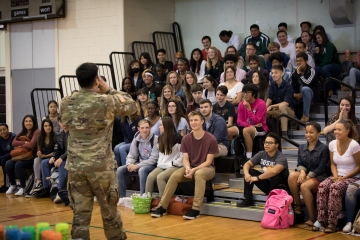
The New York Times recently covered the extraordinary academic achievement of Department of Defense schools, noting several factors that contribute to their success. But one important contributor—common values—was not mentioned. Although military values are not easy to replicate in the civilian world, at a time of high discord and low grades, reformers would do well to study the Defense Department’s example for lessons they can adopt—more lessons than even the “newspaper of record” managed to report on.

What’s going on here?

The Department of Defense Education Activity (DoDEA) runs 160 schools, both domestic and overseas, attended by 66,000 students. That’s more than Boston’s or Seattle’s public schools.

DoDEA students are racially and economically diverse. But whether they are Black, White, Hispanic, Asian, rich, or poor, they outperform their civilian counterparts on the National Assessment of Educational Progress. In fourth grade. In eighth grade. And also, on their SATs and their ACTs, and in both Math, and English. They’ve been doing it for years. (And to its credit, the Times has been covering this for years, too.)

Their achievement gaps are smaller than we find in the civilian world. For example, DoDEA eighth graders whose parents only finished high school read at the same level as the children of civilians who earned college diplomas.

Harvard education professor Martin West tells the Times that reformers should be rushing to Camp Lejeune or Fort Campbell. They’re much closer than Finland, and everyone speaks English.

Why is DoDEA doing this better—especially after a pandemic and the resulting crash in achievement?

According to the Times, superior performance is explained by the usual suspects: greater funding, smaller class sizes, better healthcare, and stable housing. The factors that opponents of reform raise relentlessly to excuse districts schools’ poor performance.

To its credit, the Times does mention the socioeconomic integration of DoDEA schools. Even if they live in less fancy homes, the author notes, “children of junior soldiers attend classes alongside the children of lieutenant colonels. They play in the same sports leagues after school.” Academic studies have shown that low-income kids who attend schools in wealthier districts do better academically. And they don’t harm richer students’ performance.

The elementary school I founded in Brooklyn in 2013 was socioeconomically diverse. This attracted progressive families who might otherwise have been reticent to choose a charter. In a more recent, bold experiment in Athens, Ohio, a superintendent is making his schools more equitable by breaking up old zoning lines across an entire community.

The V-word

But the Times missed the role of values in the DoDEA and its schools. The belief in hard work, self-discipline, and responsibility, both to one’s self and other group, are central to the military’s success. Not so long ago, education reformers, serving many students who came from chaotic social settings, believed in these values, too. For the Times and many of its readers, this is now anathema in the wake of police-use-of-force debates and health disparities laid bare by the pandemic. “Work hard, be nice,” is for suckers.

In founding the Common School movement, Horace Mann was explicit that one goal was to “inculcate nonsectarian Christian moral values and to educate every citizen to participate in a democracy.” Nowadays, elites articulate the idea that “individual decisions don’t matter much compared to random social forces, including luck.” While they would never allow their children to act on this—they socialize this belief to the harm of many. On social and broadcast media, we see what my friend and former journalist Dan Perry calls “scorn for decency and moderation, as if true wisdom is a cynical acceptance of the laws of the jungle.”

The military is not perfect, but adhering to the values of hard work, responsibility, and discipline has not harmed the careers of the Secretary of Defense and Chairman of the Joint Chiefs of Staff, both African American. The Chief of Naval Operations and Coast Guard Commandant are both women. Indeed, hard work pays off and success is generally meritocratic.

Polls show Americans distrust elected officials, business leaders, and journalists. But along with the military, Americans tell pollsters they believe school principals. My experience, and the polling data, suggest that families would accept their schools articulating clearly a commitment to personal responsibility and similar “military” values.

Of course, military families raise their children to be studious and obedient in ways the average family doesn’t. Superintendents can’t make parents pass the ASVAB to enroll their child in kindergarten. But by articulating and defending values that the majority of parents embrace, districts could build on the trust parents give them to replicate some of the conditions the DoDEA enjoys. By advocating respect for others and hard work, and articulating clearly how violations of these values will be handled, school leaders can strengthen their communities and improve student outcomes. That’s leadership.

Reformers could look at interventions the DoD makes available to non-military schools who request support. One example is Advancement Via Individual Determination (AVID), a sixth though twelfth grade supplemental series lesson about how to study, read, write, and think like content experts, take focused notes, and manage time effectively. Research has shown AVID participants improved their behavior and cognitive regulation; in California, low-socioeconomic-status AVID participants enrolled in college at higher rates than the general population.

Alternatively, we could create new schools within the district framework that make their values commitments clear and allow parents to opt in. As the DoDEA shows, schools where parents share common beliefs are generally more successful. We see this in religious day schools and in charter schools like Great Hearts in the southwest and Success Academy in New York.

As with any complex challenge, improving outcomes for our neediest students will not arise from a single intervention. But one of the most successful school districts in the country has much to teach us, and reformers would do well to visit. Committing to socioeconomic integration and standing for a set of shared moral beliefs doesn’t have to cost much. But it could make a world of difference.

view

Addressing excellence gaps in a diverse high school

Louis Moore
10.25.2023
Flypaper

This summer the National Working Group on Advanced Education reported what many educators in the United States already know and experience: that the United States has been wasting an enormous amount of human potential and that many students—including “advanced learners, striving pupils, and those with untapped potential”—are not being sufficiently challenged. The challenge is clear and the stakes are high. In American schools, closing these excellence gaps needs to be a top priority to ensure that all students reach their full potential.

The crisis is most acute for students who attend schools that are segregated by race and class. When racially segregated schools primarily serving low-income, Black, and Hispanic students are compared with more affluent districts that primarily serve White students, the discrepancies are stark and severe.

But what’s happening in those schools that are economically and racially integrated? On the face of it, the landscape looks promising. Indeed, a recent study of the impact of segregated schooling on New Jersey high school students found that overall participation in advanced coursework in integrated schools was slightly higher than in White isolated institutions.

Yet those of us who work in integrated schools should not take a victory lap just yet. After all, what’s the benefit of an integrated school environment if the classrooms and educational experiences within the school itself are diminished by excellence gaps?

In this sense, my school stands as an excellent case study of how educators are working to narrow excellence gaps and promote equity.

First, some background. Red Bank Regional High School (RBR), of which I’m superintendent, primarily serves three towns in suburban New Jersey—two affluent, majority-White suburbs and one larger and much more racially and economically mixed town that also serves as a regional hub. In addition, students from a number of other towns attend to participate in specialized academy programs. By any standard, the student body of Red Bank Regional is demographically diverse and is a point of pride for the district.

The depth and breadth of RBR’s offerings are also impressive and include extensive advanced coursework options, specialized academies, and a range of dual enrollment courses. The most recent New Jersey Department of Education School Report Card indicated that over 60 percent of juniors and seniors take at least one Advance Placement (AP) or International Baccalaureate (IB) course. Access to these programs is open, meaning that students who are not recommended can “waive” into these courses.

Despite these strengths, a number of discrepancies in connecting students to accelerated learning options demand attention. In a recent internal assessment, White students composed 57 percent of our school’s total school population but represented 74 percent of AP and IB enrollment. Black students, who constitute 5 percent of the total population, represented slightly more than 3 percent enrollment in these programs. Hispanic students make up 35 percent of our population, but represent only about 19 percent of students in AP and IB classes. Economically disadvantaged students are also underserved. About 25 percent of our students were eligible for free or reduced-price lunch, but they only constituted about 11 percent of the students taking AP and IB courses.

To address these gaps and promote equity and excellence for all, Red Bank Regional has been applying many of the recommendations put forward by the National Working Group on Advanced Education. We’ve introduced universal screening for first-year students to identify talents and abilities that might have been overlooked. In place of rigid tracking, an embedded honors program has been put in place in English and history classes for freshman that serves as an on-ramp to access enrichment opportunities as the academic year proceeds. We also tapped into staff expertise and partnered with experts to strengthen teaching practice, especially in regard to integrating differentiated instruction into the instructional program. Finally, administrators, teachers, and counselors see themselves as talent scouts, not gatekeepers, in promoting access to accelerated learning opportunities and erring on the side of inclusion. At the same time, we continue to promote culturally responsive practices, including the infusion of materials, topics, and curricula that reflect the backgrounds of our students.

This year we are expanding efforts to involve everyone in the front-line work of improving teaching and learning. As part of our professional develop plan, all teachers are now participating in instructional rounds visits to classrooms to gain knowledge and provide actionable non-evaluative feedback to colleagues on instructional practice, student engagement, and content. Finally, we are moving ahead to develop an excellence-and-equity policy that will ultimately have the same legal and moral standing as the other policies that govern the district and serve as a binding and enduring commitment to equity, excellence, and inclusion.

We are proud of this work and are confident that the reforms should bear fruit. But despite these improvements, gaps will remain until we address these challenges: How do we expand access and ensure success at scale, especially for those students who might be hesitant to take an accelerated course in the first place or see these courses as “not for them” because of their race, ethnicity, or economic background? How do we avoid setting kids up for failure who might need academic support and encouragement to take the jump into accelerated classes?

A big part of the solution is strengthening students’ academic foundation in the first and second year of high school. At RBR, below-grade-level courses in math and science have been phased out. In English language arts (ELA) in grades nine and ten, we strengthened our programs and expanded support for teachers, including the implementation of the College Board’s Pre-AP framework for monitoring student growth and progress. ELA teachers have exemplified the benefits of teamwork and made it clear that an effective response to excellence gaps requires a combined vision that unites teachers across all grade levels.

We’ve also come to realize that a great resource is the expertise of our AP and IB teachers themselves, who have been achieving remarkable success with students who enter these classes at a wide range of starting points. In this sense, RBR is not different from most American high schools in which a massive expansion of participation in AP programs has happened. As is the case in those places, participating in AP or IB coursework is not limited to academic superstars. While we’ve seen participation expand among all groups, especially among students from White households, the overall level of student achievement has not declined. In 2021–22, close to 30 percent of the juniors enrolled in AP Language and Composition, for instance, and over half the students enrolled scored between 390–519 on the evidence-based reading and writing section of the PSAT in which a score of 460 represents grade-level proficiency. When other college-level ELA programs are included, well over 60 percent of RBR juniors and seniors access these courses, and the vast majority achieve success.

This reality and the remarkable success of college-level English language arts programs at RBR has encouraged the adoption of an “all in” strategy that aims to have all students take at least one of the six advanced ELA courses offered. While it’s obviously designed to promote participation, the strategy is not a “one size fits all” approach. For example, qualified students can begin taking these courses in the sophomore year. Other students may not take on the challenge until their senior year.

This ambitious goal might be the one of the most impactful steps we take to close excellence gaps because it unites our efforts in support of a clear goal and promotes a culture of encouragement and inclusion. Above all, the strategy neutralizes the most dangerous academic toxin in a diverse school setting: namely, that certain school programs are only appropriate for certain kinds of students from certain kinds of backgrounds. As Chester Finn and Andrew Scanlan observed in their 2019 book, Learning in the Fast Lane, when done well, expanded AP and IB participation can be part of broad strategy to change mindsets, remove psychological barriers, and commit the entire school community to ensuring that students succeed.

In sum, the goal is to replicate at scale what one student experienced last year in her AP English class. In a letter to the teacher, a parent said, “Your class is the first advanced class she has ever taken.... She was scared, nervous, and so insecure in the beginning of the year, but with your guidance and compassion, she thrived. She is leaving her junior year with so much more confidence academically, and this is in part because of you. You made her feel like she belonged in your class, and for that I am forever grateful.”

Not everyone is enthusiastic about the reforms being implemented. Notably, opposition has been most intense from critics who view actions to promote excellence and equity as unneeded or even harmful to those students who are already receiving the benefits of advanced learning opportunities. A thoughtful reply comes from the National Working Group’s final report: “Equity, done right means opening up advanced education to all students who could benefit from it. And excellence done right means doing the hard work to help all students achieve at high levels—not just the students who come to school with great advantages.”

Addressing equity gaps is complex and challenging in all schools. This reality also applies to schools like Red Bank Regional that are fortunate to serve a diverse student population. Building a wider, more diverse pipeline of advanced learners mandates a multifaceted approach, including improved screening, targeted support, and a commitment to promoting a school culture writ large that prioritizes inclusion and encouragement. At Red Bank Regional, we are trying a number of approaches but all share this assumption: Accelerated learners, academic strivers, and students with hidden talents come from all races, ethnicities, and economic backgrounds.

Note: Jessica Verdiglione provided the expert data analysis for this piece. Verdiglione oversees data, assessments, and professional development for Red Bank Regional.


view

Shake it up or mess it up: The impact of principal transitions on school quality in New York City

Amber M. Northern, Ph.D.
10.26.2023
Flypaper

Data indicate that, nationwide, roughly 20 percent of schools change principals in any given year, and that urban schools see a larger share of such changes. Reasons vary, but regardless, leadership transitions rock the boat—which may not be a bad thing—whenever and wherever they occur. A recent working paper examines the impact of principal attrition and replacement on various indicators of school quality, including teacher turnover, student achievement, and growth.

The study—from Marcus Winters, Brian Kisida, and Ikhee Cho—uses longitudinal data from traditional district schools (no charters) in New York City. It finds similar outcomes to previous research, but adds two interesting new data points. One, it looks at school environment and climate as outcomes via the City’s annual school climate survey for teachers. Two, it examines whether the impact of a principal transition varies depending on whether the principal was an internal hire—meaning filled by someone who previously was a teacher or assistant principal in that school—or an external hire, meaning filled by someone who never worked within the school.

Data cover nearly all district principals employed in the city from 2006–07 to 2017–18, although a small number of principals who had once worked at a different NYC public school were excluded. On average, NYC schools replace close to 10 percent of traditional school principals every year. More than half of them never previously worked as a principal within NYC and about a third were promoted from within the school.

The analysts are estimating the effect of a school transitioning from one principal to another compared to having an established principal for five years. Since school attributes can bias the findings, they leverage the variation across schools in the timing of the principal changes. In other words, since schools experience principal changes at different time periods, the introduction of a new principal is not likely to be associated with policy changes or other factors that affect all NYC schools at once.

The key finding is that changing principals has an immediate but small negative impact on student growth and proficiency that remains over several years, regardless of whether the new leader was hired internally or externally. Although analysts do not see a change in teacher turnover during the first year following a principal transition, they see a significant increase in turnover the second year, but only among buildings with an externally hired principal, not an internal one—both overall and among teachers with five or fewer years of experience. Likewise, for their measure of school environment—which addresses areas like trust, order, and a school vision—there is a small to moderate decrease after a school transitions to an external hire (only). The negative effect for the external hire lessens a bit over time, but is still significant up to five years later.

Analysts conclude that a principal’s impact on student learning could be distinct from their effects on school environment and working conditions. And it’s possible that teacher turnover comes as a consequence of the decline in perceived working conditions. That’s because teacher satisfaction scores go down during the external leader’s first year, which is followed by an increase in turnover in the fall of the leader’s second year.

While these findings are in line with similar studies elsewhere—and also with studies showing achievement downturns following other disruptions such as school closures—they are still sobering. With an enduring negative impact in student progress, the question must be asked whether these principal transitions are simply resulting in lower-quality candidates replacing better ones. The study period overlaps with much of former New York Mayor Michael Bloomberg’s time in office. He was often criticized for his “corporate style” of education governance, so it’s possible that a desire to “shake things up” could have resulted in a downgrade in the quality of leadership. Still, let’s also remember that New York City is not a microcosm of the country and that traditional district schools are not the most adaptable of ecosystems. Thus, these findings should be taken in context without wholesale generalization to other systems, cities, or states.

SOURCE: Marcus Winters, Brian Kisida, and Ikhee Cho, “The Impact of Principal Attrition and Replacement on Indicators of School Quality, Education Finance & Policy (2023).

view

How school choice programs impact private school tuition

Jeff Murray
10.26.2023
Flypaper

In a new report and accompanying factsheet, authors Jason Bedrick, Jay Greene, and Lindsey Burke of the Heritage Foundation look into concerns that the recent rapid increase in private school choice programs (vouchers, tax-credit scholarships, and ESAs) in many states will exert inflationary pressure on private school tuition and risk bumping this important educational option out of reach of many families once again.

Those concerns are rooted in basic economics—subsidies in a competitive market almost always lead to higher prices—and are all but confirmed in the higher education sphere. A review of the research literature by the Martin Center in 2017 “suggests that federal student aid increases university tuition rates, perhaps by as much as 60 cents on the dollar.” As of 2017, that research concludes, the price of college tuition and fees had risen an astounding 1,335 percent since 1978. In inflation-adjusted dollars, the national average cost of college tuition and fees has risen 239 percent since 1980.

But is that happening, or likely to happen, in the K–12 sphere? In accord with Heritage’s traditional leanings, Bedrick, Greene, and Burke lean toward no.

Their tuition data come from the online clearinghouse Private School Review, whose mission is to “make private school as accessible as possible” to families by providing free and factual information about schools across the country “and the opportunities they offer.” Among this trove of data is the average overall, elementary, and high school tuition charged in each state each year. Bedrick and colleagues look at tuition changes over ten years—from 2013 to 2023—and first compare rates of tuition inflation in states that implemented school choice policies before the 2013–14 academic year against those that had no such policies until 2022–23. A second comparison looks at states who adopted new choice policies at various points within the decade.

States that had no private school choice policies before 2022–2023—there were twenty-one of these, dubbed “never choice” states—saw private school tuition overall increase by nearly 28 percent, on average, between 2013 and 2023. By contrast, the twenty states plus Washington, D.C., that had adopted school choice before 2013–2014 (dubbed “always choice” states) saw tuition increase by about 15 percent over the same period. The difference was even starker when limiting the analysis to high school tuition. Always-choice states saw high school tuition increase by about 8 percent, while never-choice states increased by a whopping 35 percent. This is simply a descriptive picture of trends, but it immediately cuts against the concern that vouchers and other subsidies will automatically increase inflationary pressure on private school tuition.

For the eight states that adopted private-school choice policies between 2013–14 and 2022–23, the researchers compared the rate of tuition increases, adjusted for inflation, before and after the policies were adopted. On average, the annual change in tuition in those states before adopting school choice was 2.1 percent, while the average annual change after adopting school choice was -1.5 percent. In other words, the rate of change in tuition actually decreased. As one extreme example, the rate of tuition inflation in Kansas prior to adopting school choice was 8 percent; after adopting school choice, that rate was -4.4 percent. This seems stunning at first glance, but read on for another take.

One additional point to consider: Even in those states where tuition continued to increase following the introduction of subsidies, the boost was generally less than the rate of inflation, which is tantamount to actually cutting the cost in terms of families’ household balance sheets. The most significant declines in tuition inflation were seen at the elementary school level, with smaller and non-significant reductions at the high school level. Bedrick and his colleagues are quick to point out that these findings do not represent schools cutting tuition in response to vouchers and other subsidies. Rather, they are indications that the competitive market pressures introduced by school choice hedge against any inflationary pressure that may result from parents’ increased purchasing power.

Simply put, this analysis indicates that the astronomical increases seen in the higher education sphere are unlikely to occur in the K–12 sphere. The researchers speculate that it’s because school choice subsidies in all forms tend to be worth more, on average, than the cost to the private school of enrolling one additional child—even where the scholarship values are less than the private schools’ average cost per pupil. When private schools get additional revenue from choice subsidies that exceed their marginal costs, it reduces their per pupil cost and allows them to keep tuition low. In higher education, there are far more tuition supports at play which add to the pressure. This is more pronounced in elementary schools (larger and more numerous, with more extra seats) than in high schools (smaller and fuller), which is also borne out in the data. The same dynamics are not at work in higher education.

But we cannot ignore several caveats shouting out here. First is the use of a single average tuition rate across a whole state. Huge variation will be seen from cities to small towns to rural areas based on supply and demand. The averages are useful to a point, but not always in accord with the sticker prices families really have to pay, ESA or not. Second is the fact that those averages include many schools that don’t take ESAs or vouchers even if they exist. Ohio is the poster state for that situation, with its priciest (and best) private schools usually not accepting voucher students due to the dollar amounts far below their big tuition bills. Third is the fact that a state “having private school choice” is likely too simplistic a metric for such an analysis. Kansas, singled out above as an exemplar of the authors’ conclusion, has only a small tax credit scholarship with minimal funding and low participation even today. A rigorous analysis cannot equate that with the far more robust private school choice landscapes in, say, Ohio or Florida.

This analysis is a start, but more and better is required to really answer the important questions raised.

SOURCE: Jason Bedrick, Jay Greene, Ph.D., and Lindsey Burke, Ph.D., “Does School Choice Affect Private School Tuition?” Heritage Foundation (August 2023).

view

Cheers and Jeers: October 26, 2023

The Education Gadfly
10.26.2023
Flypaper

Cheers

  • An Ohio court allows an overhaul of the state’s education system to continue even as the law faces a lawsuit. —AP News
  • Grade inflation increases apace, which complicates college admissions and the messages GPAs should communicate. —Tim Donahue, New York Times
  • Teachers created a popular comedy show in the Pacific Northwest. —Oregon Public Broadcasting
  • Under fire from left—and now the right, too—Shakespeare remains our premiere author and good fun to boot, and should remain in schools’ English curricula. —Eliot Cohen, The Atlantic

Jeers

  • American education’s “everybody wins” mentality is lowering standards in our schools. —Doug Lemov, Education Next
  • In an interview, Secretary of education Miguel Cardona attacks No Child Left Behind while arguing that more money is the answer. —Education Week
  • No, detracking will not help racial gaps in math. —Hechinger Report
view

What we're reading this week: October 26, 2023

The Education Gadfly
10.26.2023
Flypaper
  • Looping, wherein schools keep students with teachers for more than one year, deserves to be embraced more widely. —Adam Grant, New York Times
  • A miniscule number of low-income and working-class students score a 1300 or higher on the SAT. —New York Times
  • Students in Department of Defense schools spend more time on standardized tests than their peers, and this helps to explain their impressive academic outcomes. —K-12 Dive
Fordham Logo

© 2026 The Thomas B. Fordham Institute
Privacy Policy
Usage Agreement

National

P.O. Box 110
Burke, VA 22009

202.223.5452

[email protected]

Ohio

P.O. Box 82291
Columbus, OH 43202

614.223.1580

[email protected]

Sponsorship

130 West Second Street, Suite 410
Dayton, Ohio 45402

937.227.3368

[email protected]