Mobile Navigation

  • National
    • Policy
      • High Expectations
      • Quality Choices
      • Personalized Pathways
    • Research
    • Commentary
      • Gadfly Newsletter
      • Flypaper Blog
    • Events
    • Scholars Program
  • Ohio
    • Policy
      • Priorities
      • Media & Testimony
    • Research
    • Commentary
      • Ohio Education Gadfly Biweekly
      • Ohio Gadfly Daily
  • Charter Authorizing
    • Application
    • Sponsored Schools
    • Resources
  • About
    • Mission
    • Board
    • Staff
    • Career
Home
Home
Advancing Educational Excellence

Main Navigation

  • National
  • Ohio
  • Charter Authorizing
  • About

National Menu

  • Topics
    • Accountability & Testing
    • Advanced Education
    • Career & Technical Education
    • Charter Schools
    • Curriculum & Instruction
    • ESSA
    • Evidence-Based Learning
    • Facilities
    • Governance
    • Personalized Learning
    • Private School Choice
    • School Finance
    • Standards
    • Teachers & School Leaders
    • Think Again
  • Research
  • Commentary
    • Gadfly Newsletter
    • Flypaper Blog
    • Gadfly Podcast
  • Events
  • Scholars Program

The Education Gadfly Weekly

Sign Up to Receive Fordham Updates

We'll send you quality research, commentary, analysis, and news on the education issues you care about.
Thank you for signing up!
Please check your email to confirm the subscription.

Democracy, community, and school choice

Volume 14, Number 24
4.10.2008
4.10.2008

Democracy, community, and school choice

Volume 14, Number 24
view
High Expectations

Who Will Save America's Urban Catholic Schools?

America's urban Catholic schools are in crisis. Over 1,300 of them have shut down since 1990, mostly in our cities. As a result, some 300,000 students have been displaced--double the number affected by Hurricanes Rita and Katrina. This report, which includes a comprehensive survey of the attitudes of U.S. Catholics and the broader public towards inner-city Catholic schools, examines this crisis and offers several suggestions for arresting and perhaps reversing this trend in the interests of better education.

Scott Hamilton 4.10.2008
NationalReport

Who Will Save America's Urban Catholic Schools?

4.10.2008
Report

Democracy, community, and school choice

Kathleen Porter-Magee
6.11.2014
Blog

Schools educate kids; movements don’t

Joe Siedlecki
6.9.2014
Flypaper

10 things to know about the Vergara decision

6.10.2014
Flypaper

Choose the wisest wonk

The Education Gadfly
6.11.2014
Blog

The World Cup vs. Underwear Models

6.12.2014
Resource

Contexts Matter: Selection in Means-Tested School Voucher Programs

6.11.2014
Blog

Diplomas Count 2014: Motivation Matters: Engaging Students, Creating Learners

6.11.2014
Blog
view

Democracy, community, and school choice

Kathleen Porter-Magee 6.11.2014
Blog
view
Wonkathon

Schools educate kids; movements don’t

Joe Siedlecki 6.9.2014
Flypaper
view

10 things to know about the Vergara decision

6.10.2014
Flypaper
view

Choose the wisest wonk

The Education Gadfly 6.11.2014
Blog

The World Cup vs. Underwear Models

Amber M. Northern, Ph.D., Dara Zeehandelaar Shaw, Ph.D., Pamela Tatz 6.12.2014
Resource

view

Contexts Matter: Selection in Means-Tested School Voucher Programs

6.11.2014
Blog
view

Diplomas Count 2014: Motivation Matters: Engaging Students, Creating Learners

6.11.2014
Blog
view

Who Will Save America's Urban Catholic Schools?

4.10.2008
Report

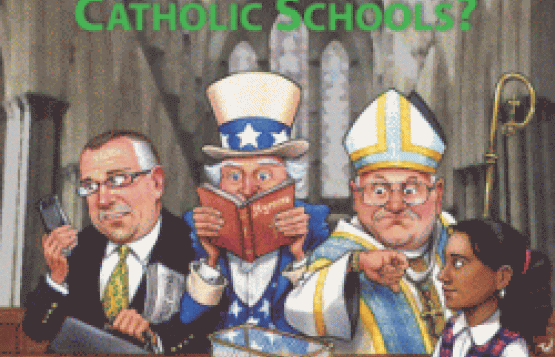
America's urban Catholic schools are in crisis. Over 1,300 of them have shut down since 1990, mostly in our cities. As a result, some 300,000 students have been displaced--double the number affected by Hurricanes Rita and Katrina. These children have been forced to attend other schools at an estimated cost to taxpayers of more than $20 billion.

Fordham's latest report, which includes a comprehensive survey of the attitudes of U.S. Catholics and the broader public toward inner-city Catholic schools, examines this crisis and offers several suggestions for arresting and perhaps reversing this trend in the interests of better education. By looking at seven case studies, the report shows that in a few cities, such as Wichita, urban Catholic education is making a comeback. However, in other cities like Milwaukee and Washington, D.C., despite public voucher programs, enrollment continues to decline and/or schools are being closed or converted into charters.

Related Resources

Full survey results

Fordham VP Mike Petrilli discusses the report on NPR, Fox Business channel, and Fordham Factor

In A Nutshell brief of the report

view

Democracy, community, and school choice

Kathleen Porter-Magee
6.11.2014
Blog

While proponents of school choice often base their case on student achievement—contending that choice-based accountability leads to school improvement and stronger pupil attainments—opponents seem likelier to argue against choice on the grounds that it fractures communities and undermines democratic values. This dynamic is unfortunate because it leaves the impression that the advancement of school choice is hostile to—or at least indifferent to—issues of community and democracy. The reality, however, is that nothing could be farther from the truth.

There is no doubt that opponents of school choice are spilling more ink than reformers on this question of education for democracy and community. It is, for instance, the mission of the new Network for Public Education to “fight to protect, preserve and strengthen our public school system, an essential institution in a democratic society.” And education historian Diane Ravitch repeatedly makes the case that the traditional public school system is “one of the foundation stones of our democracy” and that “an attack on public education is an attack on democracy.”

However, the case that the traditional school system is the only or even the best path to upholding community and democracy is remarkably weak. In fact, a close look at the history of traditional public education reveals the strongly anti-democratic strains of the common schools movement, some of which we still live with today (a topic that receives a thoughtful book-length discussion in Charles Glenn’s Myth of the Common School).

The troubling but often forgotten truth is that for over two centuries, the traditional public school system was used by a white, largely Protestant elite in the service of an agenda that was often deeply anti-Catholic, anti-black, and often anti-immigrant. Its very structure and, indeed, its hostility to parental choice was driven in part by a desire for the majority to dictate the education and values for every child in this country.

The legacy of this view can be seen in the thirty-eight state constitutions that contain so-called “Blaine Amendments,” prohibiting public funding of schools with religious affiliation. While ostensibly used to protect democratic public institutions from sectarian influences, the incorporation of such provisions was part of an explicitly anti-Catholic movement aimed at forcing children into a Protestant-led education system—forced, that is, by a majority that feared “papacy” and hoped to indoctrinate Catholic immigrants into the “American” way of life. In fact, in 1922, the voters of Oregon actually passed an initiative that made it illegal to send children to parochial schools. (The Supreme Court struck it down three years later in the famous Pierce v. Society of Sisters case.) While opponents of school choice try to portray this hostility to independent schools as obvious or normal, it is not. In fact, the norm among Western democracies like Australia, England, Germany, Italy, Israel, Ireland, the Netherlands, Sweden, Switzerland, and Wales is the advancement of public education through funding to both private and public schools.

The common-school movement was even more anti-democratic on the issue of race. Throughout its history, there has been a deep hostility to the education of African Americans, first denying them access to education outright and later using both de facto and de jure segregation to ensure that black children received an unequal education. In fact, the Alabama constitution still includes a clause explicitly prohibiting black and white students from being educated together at the same school—and moves to rescind this outdated language failed as recently as 2012.

Indeed, it was in response to the hostility of the white Protestant elite that African Americans, like Catholics, took up the task of building up their own network of schools. As Chris Stewart reminds us,

School choice is not new to us, in fact, some might say we invented it. The first charter school that I can find record of was established by Lucy Laney, an African American educator, in the 1880′s. Mary McCloud Bethune came out of Laney’s school, and started her own as well. Black educators and Northern religious societies started independent schools at a time when the State would not, or could not, educate black children. That is a story which repeats itself in a consistent line from that time until now.

Given the history of school choice as a force of liberation and equality, it’s not surprising that a survey by 50CAN found that support for “creating more competition in our school system by allowing more charter schools to open” was 2.6 times higher among black liberals as white liberals and 3.6 times higher among Hispanic liberals.

Drawing upon our rich diversity as a nation and despite the open hostility for an entrenched elite, independent schools of all kinds flourish here. For example, U.S. Catholic schools are the largest nongovernmental school system in the world, and they were built on the belief that parents should have the freedom to ensure that their education was aligned with the own values and principles of their community. Urban Catholic schools, in particular, serve as bedrocks of the communities in which they’re located. And this is true especially for urban poor and minority students they serve.

In their new book Lost Classroom, Lost Community: Catholic Schools’ Importance in Urban America, authors Margaret F. Brinig and Nicole Stelle Garnett found

…that Catholic elementary schools are important generators of social capital in urban neighborhoods. . . . Catholic school closures precede elevated levels of crime and disorder and suppressed levels of social cohesion. Conversely . . . an open Catholic school in a neighborhood (correlates) with lower levels of serious crime. . . . Catholic schools matter to urban neighborhoods not only as educational institutions—although, to be sure, they matter a great deal educationally—but also as community institutions.

If we’re serious about the role of schools in saving communities and buttressing democracy, perhaps we should talk more about giving real voice and opportunities to communities to create and support their own schools. School choice, far from being an attack on our democratic values, has historically been and remains today one of its best expressions of our democracy process at work. Reformers should be rightly proud of the achievement gains that have been secured through choice, but we should be even more proud of the way in which choice embraces a pluralistic view of what public education can and should be.

view
Wonkathon

Schools educate kids; movements don’t

Joe Siedlecki
6.9.2014
Flypaper

Here follows the tenth entry in Fordham’s “Charter School Policy Wonk-a-Thon,” in which Mike Petrilli challenged a number of prominent scholars, practitioners, and policy analysts to take a stab at explaining why some cities’ charter sectors outpace their district schools while others fall behind.

In a recent column for USA Today, AEI’s Rick Hess and Michael McShane argued that “creeping bureaucratization and regulation are endangering the entire charter school movement.” I’d argue the opposite: the real danger to the charter movement is lack of effective regulatory enforcement.

In their column, Hess and McShane put the best possible face on charter successes:

Objective analysis has also found charter schools to be successful, particularly with students from low income backgrounds. In 2013, researchers at Stanford University studied charter schools in twenty-seven states and found that, on average, students in charter schools outperform traditional public school students in reading and do about the same in math. Students below the poverty line and African American students were both found to fare better in charter than in public schools when their standardized test scores were disaggregated.

Certainly there have been sector-wide improvements since 2009, when the Center for Research on Education Outcomes (CREDO, home of the Stanford researchers cited above) issued a highly influential report, which found “a disturbing—and far-reaching—subset of poorly performing charter schools.” CREDO’s 2013 update notes important improvements and can indeed be summarized at the broadest level (as Hess and McShane have done) as positive.

But children are educated at individual schools, not by the broader charter movement, and CREDO’s 2013 report makes clear that such distinctions matter. Once you dig beneath average performance, note the researchers, “there remain worrying numbers of charter schools whose learning gains are…substantially worse than the local alternative.” Importantly, the CREDO reports also found that the schools’ quality varies significantly across states and cities.

That warning should keep charter advocates on their toes. The persistence of poorly performing charter schools (and operators who do things such as raise barriers for admission to their schools) does a disservice to families and children and puts the entire charter movement—including the substantial number of high-quality schools and charter management organizations (CMOs) working in long underserved communities—at risk. 

The reality is that governance—the right governance, not bureaucracy for bureaucracy’s sake—matters immensely. And in the charter sector, effective governance sits with effective authorizers.

Greg Richmond of the National Association of Charter School Authorizers (NACSA) makes exactly that case as part of this Fordham-sponsored charter-policy wonk-a-thon.

When one looks at CREDO’s 2009 and 2013 studies, two types of performance emerge. First, states with the best charter school performance are those with good authorizers who have maintained high standards and have closed failing schools. See New York, Louisiana and Massachusetts. The lowest quality states have been those with authorizers who have had low standards. See Texas, Ohio, and others. Second, states where overall charter performance is no different than traditional public schools have had random, often adversarial authorizing practices. See California…

We [see] again and again that authorizers have a tremendous impact on the overall quality of a charter sector in a city or state.

Exactly. Authorizing matters. A lot.

Now let’s get back to Hess and McShane’s claim about the dangers of creeping regulation, starting with a simple question: do states and cities with strong and active authorizers staunch the sector? Resoundingly, no. “Strong-authorizer” cities like New Orleans and Washington, D.C.,  have some of the largest and highest-performing charter sectors in the nation. In 2013, CREDO found that compared to their peers in traditional public schools, New Orleans charter pupils got an educational “benefit equivalent to about 28 more days of learning in reading and 72 additional days of learning in math.” In D.C., charter school students got the “equivalent educational benefit each year of 99 extra days in school.”

I’d argue that these cities’ active regulation and oversight of their sectors—including rigorous application processes, willingness to close poor performers, and attempts to streamline the growth of high performers­—not only provide better options for kids in those cities but also protect the entire movement.

Hess and McShane write that “it is time we try something different.” I agree. We should stop painting the entire sector with a broad brush and instead look at the local context. We should be identifying lax authorizers that allow the continuance and proliferation of bad schools, stripping them of their ability to “oversee” schools. We should identify those authorizers that successfully protect the public good—and, in doing so, protect the movement—and celebrate them.

Joe Siedlecki is a program and policy officer for the Michael & Susan Dell Foundation, where he directs the U.S. Education team’s Expanding Quality Schools Options portfolio. A version of this post originally ran on the Michael & Susan Dell Foundation’s blog.

view

10 things to know about the Vergara decision

6.10.2014
Flypaper

On Tuesday, a California superior court judge tentatively overturned five state laws related to the employment of teachers. The plaintiffs’ attorney called the decision “a victory for students, parents, and teachers across California.” The head of the Los Angeles teachers union said, “This decision today is an attack on teachers.” The court ordered a stay on the decision, pending appeal. Here are ten things worth knowing as the case moves on.

  1. The plaintiffs, a group of students and school districts, argued that several state statutes stood in the way of all students receiving the education guaranteed to them under the California constitution. “Plaintiffs claim that the Challenged Statutes result in grossly ineffective teachers obtaining and retaining permanent employment, and that these teachers are disproportionately situated in schools serving predominantly low-income and minority students. Plaintiffs’ equal protection claims assert that the Challenged Statutes violate their fundamental rights to equality of education by adversely affecting the quality of the education they are afforded by the state.”
  2. The judge agreed. He found “that the Challenged Statutes impose a real and appreciable impact on students’ fundamental right to equality of education and that they impose a disproportionate burden on poor and minority students.”
  3. This was essentially a civil-rights case, and the court underscored that point, starting its opinion by referencing Brown vs. Board of Education and then quoting the famous passage that education “is a right which must be made available to all on equal terms.”
  4. State courts have, in recent years, frequently intervened in public education by requiring that state governments more “equitably” or “adequately” fund schools. This decision referenced several previous California cases related to money, including the Serrano decision, which found “the then-existing school finance system to be a violation of the equal protection clause of the California Constitution.” 
  5. This case is different because a court has decided that it’s not only unfair funding statutes that can render a public education system unconstitutionally discriminatory and unjust: unfair education statutes of other types, including employment laws, can be overturned for the same reason. (Not all conservatives are happy with this approach to policy-making; see this analysis from Education Next, for instance. judge made this clear by noting that money isn’t all that matters: “This Court is directly faced with issues that compel it to apply these constitutional principles to the quality of the educational experience.” (Emphasis added.) 
  6. Like just about every groundbreaking decision, this one includes dramatic language to make its point (and likely help sustain it on appeal). “Evidence has been elicited in this trial of the specific effect of grossly ineffective teachers on students. The evidence is compelling. Indeed, it shocks the conscience.”
  7. The court described one of the overturned statutes as “bizarre,” noting that it could leave an “applicable district with a non-credentialed teacher with tenure.” This law did not “provide nearly enough time for an informed decision to be made regarding the decision of tenure…both students and teachers are unfairly, unnecessarily, and for no legally cognizable reason (let alone a compelling one), disadvantaged by the current Permanent Employment Statute.” Importantly, the court was moved by the fact that the statute in effect forced districts to part ways with some new teachers if they had any doubt of the teachers’ effectiveness; districts don’t want to take any chances because later removal of a tenured teacher is so difficult.
  8. The judge was persuaded that the time and cost required to remove an ineffective educator was fundamentally unfair to students. “The evidence this court heard was that it could take anywhere from two to almost ten years and cost $50,000 to $450,000 or more to bring these cases to conclusion under the Dismissal Statutes, and that given these facts, grossly ineffective teachers are being left in the classroom.” Interestingly, a defense witness conceded that between 1 and 3 percent of teachers in the state are “grossly ineffective.” The court noted that this amounted to as many as 8,000 teachers having “a direct, real, appreciable, and negative impact” on students.
  9. The court also overturned LIFO (last-in first-out) rules, which govern layoff and re-staffing decisions, explaining that “The lack of effective dismissal statutes and LIFO affect high-poverty and minority students disproportionately.”
  10. Early reaction from major players include the following: The New York Times called Vergara “a decision that hands teachers’ unions a major defeat in a landmark case.” The Washington Post reported that the court decided “tenure, seniority and other job protections for teachers have created unequal conditions in public schools and deprive poor children of the best teachers.” Secretary of Education Arne Duncan issued a subdued statement nnoting that the plaintiffs are “just nine out of millions of young people in America who are disadvantaged by laws, practices and systems that fail to identify and support our best teachers and match them with our neediest student.” He hopes that “today’s decision moves from the courtroom toward a collaborative process in California that is fair, thoughtful, practical and swift.” AFT president Randi Weingarten tweeted, “Sad day in Cali- but not unexpected that lower court would find that for students to win, teachers have to lose.”
view

Choose the wisest wonk

The Education Gadfly
6.11.2014
Blog

Admission into New York City’s most selective public high schools is based on middle schoolers’ results on a single exam: the Specialized High Schools Admissions Test. Civil-rights advocates, pointing out the relatively small number of black and Hispanic students to be found in the city’s top high schools, have sought to change this system—but their efforts are not gaining political traction. Gadfly would welcome a more holistic review of candidates in Gotham (as we see in most exam schools nationwide. But that won’t solve the problem that worries the civil-rights advocates; while these institutions use “multiple measures” to assess their candidates, they still struggle to enroll significant numbers of black and Hispanic students, just as Harvard and Stanford do.

After Hurricane Katrina, the state-run Recovery School District (RSD) took over all of New Orleans’s schools but the best ones. Now, according to the Hechinger Report, RSD charter schools are beginning to inch past those schools that were historically top performers, making impressive gains for the most disadvantaged students in the area. This certainly attests to a strong and well-led charter sector. But what’s the secret sauce? To learn what policy wonks think makes some charter sectors successful, check out our Charter School Policy Wonk-a-Thon—and vote for your favorite wonk.

The World Cup vs. Underwear Models

6.12.2014
Resource

Amber and Michelle talk teacher tenure, selective high schools, and the stunning upset of Eric Cantor. Dara takes over the Research Minute with a study on whether vouchers "cherry pick" the best students.

Amber's Research Minute

“Contexts Matter: Selection in Means-Tested School Voucher Programs,” by Cassandra M. D. Hart, Educational Evaluation and Policy Analysis 26(2), June 2014: 186–206.

view

Contexts Matter: Selection in Means-Tested School Voucher Programs

6.11.2014
Blog

A common gripe among choice kvetchers is that private schools that participate in voucher and tax-credit scholarship programs “cherry pick” the best students. This research by University of California professor Cassandra Hart finds evidence to the contrary. After comparing the 2,764 elementary-aged students who applied to the Florida Tax Credit (FTC) scholarship program (participants) to the 555,271 students who were eligible but chose not to apply (nonparticipants), Hart found that participants disproportionately came from public schools with lower academic quality and higher rates of violence than nonparticipants. What’s more, participating students had significantly lower math and reading scores than their nonparticipating peers, giving the lie to the “cherry-picking” argument. Interestingly, Hart also found that, relative to students who did not participate in the voucher program, participants were more likely to attend school in areas with stronger private-school options and weaker charter and open-enrollment alternatives. This suggests that, rather than looking for religious or private schooling in particular, many parents are searching for a better alternative than their zoned school and might avail themselves of quality public-school choices, if such existed. 

SOURCE: Cassandra M. D. Hart, “Contexts Matter: Selection in Means-Tested School Voucher Programs,” Educational Evaluation and Policy Analysis 26(2), June 2014: 186–206.

view

Diplomas Count 2014: Motivation Matters: Engaging Students, Creating Learners

6.11.2014
Blog

For this year’s “Diplomas Count,” an annual Education Week special issue, researchers surveyed teachers and administrators for their opinions on student engagement in their schools. The results were unsurprising and straightforward: the educators overwhelmingly agreed on how to identify engaged students (they’re the ones with good attendance, who participate frequently in class, and who get good grades).  Yet just 40 percent believed that the majority of the students in their school were engaged. Perhaps that’s because the educators themselves don’t know how to engage their students; fewer than half reported receiving any pre-service training on the topic, and only 58 percent reported learning about student engagement via in-service training While none of this is particularly shocking, the accompanying commentary by Ed Week’s journalists, informed by the survey results, is thoughtful enough to deserve your engagement.

SOURCE: Education Week, Diplomas Count 2014: Motivation Matters: Engaging Students, Creating Learners (Bethesda, MD: Editorial Projects in Education, June 2014).

Fordham Logo

© 2026 The Thomas B. Fordham Institute
Privacy Policy
Usage Agreement

National

P.O. Box 110
Burke, VA 22009

202.223.5452

[email protected]

Ohio

P.O. Box 82291
Columbus, OH 43202

614.223.1580

[email protected]

Sponsorship

130 West Second Street, Suite 410
Dayton, Ohio 45402

937.227.3368

[email protected]