
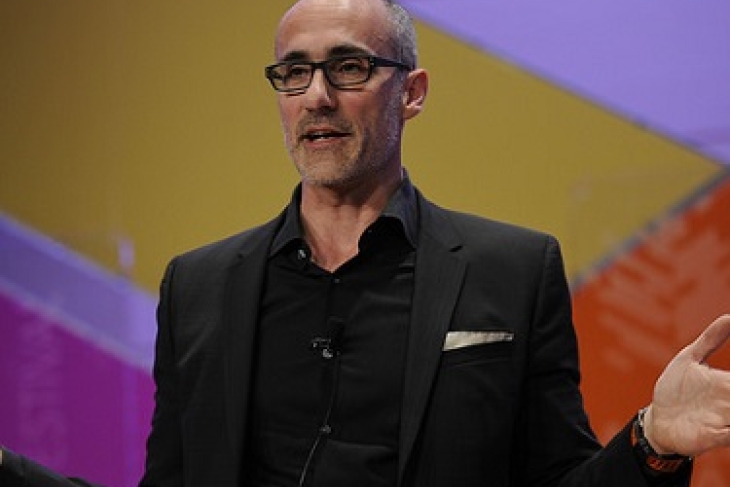
In AEI’s latest Vision Talks video, Arthur Brooks, its president and the happiest man in the think-tank world, argues that public-policy advocates need to make a better case: one that is moral, about people, and to the point. This talk could not be better suited for conservatives, especially as presidential hopefuls are (sigh) already campaigning. Many acknowledge that conservatives must talk about issues in a better way if they plan on expanding their base to young voters and minorities. But Arthur Brooks would have made a better case for conservatives if he hadn’t used education reform as his example.
Brooks makes some very valid points: Public policy advocates should discuss moral (not a materialistic or economic) goals; public policy is about helping people; and ideas should be communicated quickly. (And he adds in some the nifty fact that communicators have seven seconds to win someone over before the listener’s brain tells him move on.) But this doesn’t work with ed reform because, for the most part, we’re already there. From “A Nation at Risk” to “content, character, and choice” to having the “right to rise,” politicians have made that to-the-point and emotional leap. Blogger Alexander Russo rightly noted that this is “something that pretty much everyone in education advocacy has come to understand at this point.” Some groups, including the PIE Network and Education Cities, have been on that case for years with messaging advice to talk to parents and use emotional language.
Just look to New York City, where charter school advocates mobilized thousands of parents to fight for their kids (or, to get wonky, to stop Mayor de Blasio from banning co-locations of charter schools). Wearing “My child, my choice” shirts and with advocates talking about “standing unified” for “great schools,” that march was about everything Brooks said education reform needed to do.
Common Core, however, appears to be the exception; on that front, reformers could be doing much more to connect with moral arguments. Politico’s Stephanie Simon wrote as much with the raw headline, “Moms winning the Common Core war.” Mike Petrilli is quoted in the story saying that “[w]e’ve been fighting emotion with talking points, and it doesn’t work. There’s got to be a way to get more emotional with our arguments if we want to win this thing. That means we have a lot more work to do.” Perhaps more inflammatory than the Politico story was the hoopla it kicked up, especially when AEI’s resident education-policy czar Rick Hess accused education reformers as being patronizing. Rick’s boss might disagree!
Regardless, there are a lot of lessons to learn from this Vision Talks speech. Let’s hope conservatives and Common Core supporters are willing to listen.
