

Editor’s note: This was first published by the American Enterprise Institute.
Introduction
Student learning depends on classrooms that are safe, orderly, and focused. Yet managing student behavior proves a challenge in school districts across the country, especially in districts serving high shares of low-income students, where schools experience higher rates of widespread disorder, fights, and theft.1 Low-income students often rely on schools as a pathway to upward mobility. The education system fails them when it tolerates persistent misbehavior and does not correct it, exposing students to harsher consequences in adulthood.
When I’ve interviewed educators and students about the current state of discipline in schools, it has appeared that schools have been doing everything except addressing misbehavior directly. Teachers have described receiving little to no support from administrators when dealing with fights, consistent disruptive behavior, and even threats. Schools have often resorted to behavior-management approaches that had weak evidence or focused on rewards rather than accountability for persistent misbehavior.2 Students have noticed this avoidance, too, questioning why their district is spending money on metal detectors when they could directly address the problem by suspending the offending students.3
More new programs or technologies aren’t going to address the problem if behavioral expectations aren’t enforced consistently, but correcting behavior and maintaining order in schools is an essential precondition for learning. New teachers’ bills of rights could delineate more clearly policies for managing misbehavior and thereby secure orderly classrooms.
The causes and consequences of misbehavior
Classroom disorder impedes student learning. Research consistently shows that students experience negative spillover effects when they are exposed to disruptive peers. Test scores fall. Nondisruptive students also become more likely to act disruptively themselves.4 Some researchers even estimate that exposure to disruptive peers can reduce future earnings by $80,000, “suggesting large efficiency losses due to disruptive students.”5
Teachers are also finding student misbehavior increasingly unmanageable. In a 2026 Education Week survey, nearly 60 percent of teachers from pre-K to third grade said student behavior had worsened over the past two years.6 Annual RAND surveys consistently find that teachers identify student misbehavior as the top stressor, even above low teacher pay.7 Teachers end up diluting instructional materials because they spend so much time managing behavior.8
A variety of factors are contributing to increased disorder. Some point to changes in parenting. Others cite smartphones.9 It may also be that the past decade’s shift toward more lenient school discipline has given parents less incentive to reinforce appropriate behavior, particularly if they believe that disciplinary decisions can be negotiated after misconduct occurs. Whatever the cause, misbehavior deteriorates a school’s culture, and so schools cannot be places that tolerate it.
Ineffective policies
Federal, state, and local governments all play a role in public school discipline policy. At the federal level, the focus is generally on protecting students’ civil rights and setting broad incentives. By contrast, school boards in 47 states have broad authority to set discipline policies for their districts.10 States establish minimum discipline requirements, setting rules for serious offenses such as possession of drugs or weapons.11
Faulty assumptions underlie most of the problems in school discipline policy. Out of concern for the “school-to-prison pipeline,” for example, schools often focus on the needs of a few disruptive students at the expense of the majority of students who have done nothing wrong.12 This approach fails to account for the costs imposed on other students and teachers. It also emphasizes the perceived harshness of punishment without considering how clear standards and consistent consequences can prevent future infractions.
Another pervasive assumption is that the presence of disparities in disciplinary outcomes automatically means discrimination has occurred. Disparities by themselves do not establish that schools are disciplining students unfairly. In reality, unenforced discipline in the name of equity subjects nondisruptive minority students to chaotic school environments.
These ideas then inform ineffective policies. Some states like California and Massachusetts either prohibit suspensions for willful disobedience or impose prerequisites on suspensions, essentially deterring administrators from using this means of discipline.13 Concern over discipline disparities and parental complaints can make administrators reluctant to support classroom removals, even when district policies allow them. A common scenario is that a teacher will send a disruptive student to the principal’s office, only for that student to return quickly to class, undermining the teacher’s authority.14 Student removal procedures, therefore, need clarification and standardization.
Teachers’ bills of rights
One kind of proposal gaining traction to address classroom disorder is state policies that standardize discipline procedures. Their names vary, but these policies are often referred to as “teachers’ bills of rights.” These policies are meant to strengthen teachers’ ability to maintain classroom order by clarifying when teachers may remove students, establishing principal responsibilities, and formalizing student reentry procedures. (See Table 1.)
Strong laws clearly spell out when teachers may remove students for disruptive or violent behavior, require plans for managing student behavior, and prevent school administrators from automatically returning a student to a teacher’s classroom without following student reentry procedures. In Alabama, teachers must follow a classroom management plan that’s submitted for approval to the school’s principal at the beginning of the school year.15 The state requires only that these plans exist and does not dictate what’s in the plan.16 If the classroom management plan is exhausted, teachers “may exclude” an offending student from their classroom, and the excluded student “may be readmitted to the classroom only after the principal . . . provides written certification to the classroom teacher” that explains to the teacher what disciplinary action was taken, if any.17
States have adopted different approaches to when removal authority should be exercised. Alabama relies on an escalatory approach, where persistent misconduct can lead to the harshest consequence approved by a district. This could include placement in alternative education facilities.18 In Texas, students can be removed after a single incident of bullying, interference, or behavior that is unruly, disruptive, or abusive. This approach may be justified for severe incidents like abuse but can risk overuse for vague, broad incidents like student “interfere[nce].”19
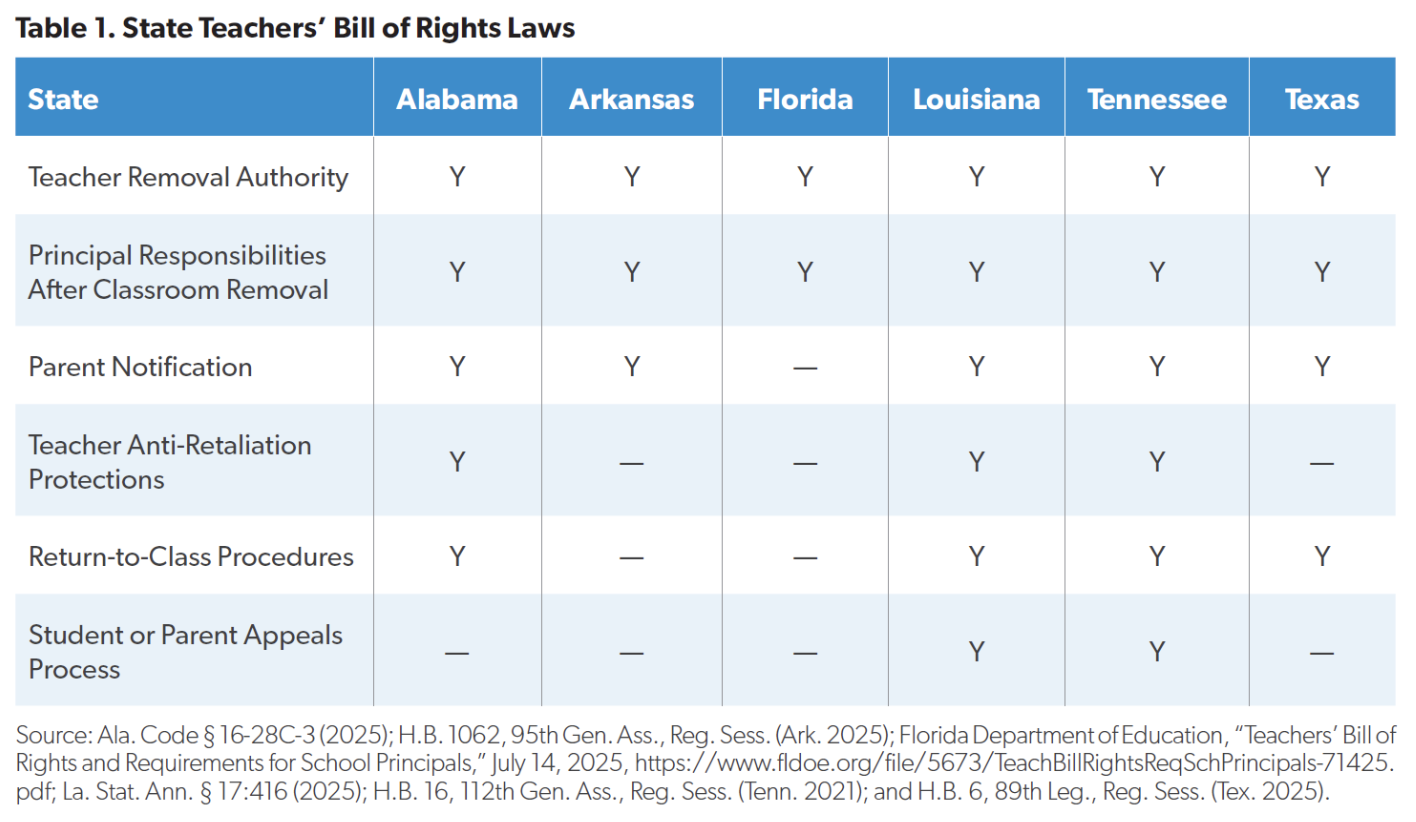
Some of these bills risk becoming merely symbolic when they simply state that teachers have disciplinary rights or when they restate laws that already exist. But even weak bills can be politically useful if a state’s politics requires incremental rather than sweeping steps. Tennessee passed its Educator’s Bill of Rights in 2017, with such unenforceable provisions as a teacher’s right to “be treated with civility and respect” and “have his or her professional judgment and discretion respected.”20 The Professional Educators of Tennessee described the initial bill as a “framework that . . . can be built upon in the future.”21 By 2021, the state passed the Teacher’s Discipline Act, which operationalized disciplinary procedures between the teacher and principal.22
State lawmakers should also scrutinize measures that prescribe appropriate discipline, as weak interventions could undermine the effectiveness of otherwise clear procedures provided by teachers’ bills of rights. Louisiana, for instance, requires principals to implement “at least one” disciplinary measure before a student can be readmitted to class. “Restorative justice practices” qualify as one of these measures.23 State lawmakers should be aware that such practices don’t yet “have [their] own evidence base,” according to the co–executive director of the Midwest Positive Behavioral Interventions and Supports (PBIS) Network, a regional hub of the US Department of Education’s Center on PBIS.24 Furthermore, schools often use restorative practices to replace consequences.25 So even if state law establishes a clear student removal and return process, administrators may satisfy state requirements without adequately addressing misconduct.
A well-designed teachers’ bill of rights can help close the gap between district-level discipline policies and their implementation. Because many of these bills were passed recently, their practical effects will take time to assess. Still, they show promise and should be viewed as a step toward restoring order.
Best state approaches to discipline
State governments should establish baseline expectations for school safety, outline the responsibilities of various actors, ensure accountability through quality data collection, and not compel leniency by requiring restorative justice programs or prohibiting suspensions. Students should be able to access orderly classrooms regardless of where they happen to live.
A conservative approach to school discipline begins with a simple premise: A school’s primary purpose is to educate students, and quality education requires order. States are well within their rights to establish minimum standards for the public schools under their authority.
When large numbers of students fail to receive a proper education because schools are unsafe or disorderly, everyone pays the price. We risk raising citizens who are poorly informed about our country. We weaken the future workforce. And more young people face dangers that could have been addressed earlier in a lower-stakes environment like school.
___________
Notes
- Riley Burr et al., Crime, Violence, Discipline, and Safety in U.S. Public Schools: Findings from the School Survey on Crime and Safety: 2021–22, US Department of Education, Institute of Education Sciences, National Center for Education Statistics, January 2024, https://nces.ed.gov/use-work/resource-library/report/first-look-ed-tab/crime-violence-discipline-and-safety-u-s-public-schools-findings-school-survey-crime-and-safety-2021.
- Neetu Arnold, “The High Costs of Classroom Disorder,” City Journal, Summer 2025, https://www.city-journal.org/article/classroom-disorder-student-learning-schools-discipline.
- Neetu Arnold, “Philly Schools May Not Be ‘Following the Research’ on School Safety,” RealClearPennsylvania, February 26, 2024, https://www.realclearpennsylvania.com/articles/2024/02/26/philly_schools_may_not_be_following_the_research_on_school_safety_1014373.html.
- Scott E. Carrell and Mark L. Hoekstra, “Externalities in the Classroom: How Children Exposed to Domestic Violence Affect Everyone’s Kids,” American Economic Journal: Applied Economics 2, no. 1 (2010): 211–28, https://www.aeaweb.org/articles?id=10.1257/app.2.1.211.
- Scott E. Carrell et al., “The Long-Run Effects of Disruptive Peers,” American Economic Review 108, no. 11 (2018): 3377–415, https://www.aeaweb.org/articles?id=10.1257/aer.20160763.
- Elizabeth Heubeck, “Toileting and Tying Shoes: Young Students Increasingly Lack Basic Skills,” Education Week, March 13, 2026, https://www.edweek.org/teaching-learning/toileting-and-tying-shoes-young-students-increasingly-lack-basic-skills/2026/03.
- Elizabeth D. Steiner et al., Teacher Well-Being, Pay, and Intentions to Leave in 2026: Selected Findings from the 2026 State of the American Teacher Survey, RAND Corporation, June 8, 2026, https://www.rand.org/pubs/research_reports/RRA4404-2.html; and Elizabeth D. Steiner et al., Teacher Well-Being, Pay, and Intentions to Leave in 2025: Findings from the State of the American Teacher Survey, RAND Corporation, June 24, 2025, https://www.rand.org/pubs/research_reports/RRA1108-16.html.
- US Department of Education, Institute of Education Sciences, National Center for Education Statistics, “Teachers’ Reports of Disruptive Student Behaviors and Staff Rule Enforcement,” September 2023, https://nces.ed.gov/programs/coe/indicator/a11.
- Jackie Mader, “What’s Behind Explosive Student Behavior?,” The Hechinger Report, February 18, 2026, https://hechingerreport.org/whats-behind-explosive-student-behavior/.
- Ballotpedia, “Local School Board Authority Across the 50 States,” accessed June 26, 2026, https://ballotpedia.org/Local_school_board_authority_across_the_50_states.
- Bryan Kelley et al., “50-State Comparison: School Discipline Policies,” Education Commission of the States, May 17, 2021, https://www.ecs.org/50-state-comparison-school-discipline-policies/.
- Max Eden and Seth Barron, 10 Blocks, podcast, “The School-to-Prison Pipeline,” City Journal, January 10, 2018, https://www.city-journal.org/multimedia/the-school-to-prison-pipeline.
- Neetu Arnold and Daniel Buck, “Why Southern States Are Outperforming Others in Education,” City Journal, December 22, 2025, https://www.city-journal.org/article/mississippi-louisiana-alabama-education-schools-southern-states.
- Wisconsin Institute for Law & Liberty, “A Growing Behavior Crisis in Wisconsin Classrooms,” YouTube, May 4, 2026, https://www.youtube.com/watch?v=qMLYoyvQDoQ.
- For example, see Raymond L. Young Elementary School, “Classroom Management Plan,” https://www.youngelem.net/apps/pages/index.jsp?uREC_ID=4452197&type=d&pREC_ID=2707011.
- Alabama Department of Education, “Teachers’ Bill of Rights,” September 23, 2024, https://resources.finalsite.net/images/v1727281452/acsk12org/emadi8zvoiuedqfcmxf2/GBG-TeachersBillofRights.pdf.
- Ala. Code § 16-28C-3 (2025).
- Ala. Code § 16-28C-3 (2025).
- H.B. 6, 89th Leg., Reg. Sess. (Tex. 2025).
- Tenn. Code Ann. § 49-5-209 (2024).
- Professional Educators of Tennessee, “Educator’s Bill of Rights,” accessed July 7, 2026, https://www.proedtn.org/page/EducatorsBillofRights.
- Marta W. Aldrich, “Tennessee Teachers Could Seek to Remove Unruly Students Under Bill Approved by Legislature,” Chalkbeat, March 11, 2021, https://www.chalkbeat.org/tennessee/2021/3/11/22326158/tennessee-teachers-could-seek-to-remove-unruly-students-under-bill-approved-by-legislature/.
- La. Stat. Ann. § 17:416 (2025).
- Arnold, “The High Costs of Classroom Disorder.”
- Jennifer Weber, “Restorative Justice Didn’t Deliver. Why?,” Education Next 26, no. 1 (2026), https://www.educationnext.org/restorative-justice-didnt-deliver-why-teachers-say-focusing-students-social-emotional-wellbeing-address-discipline/.
