
Mobile Navigation

  • National
    • Policy
      • High Expectations
      • Quality Choices
      • Personalized Pathways
    • Research
    • Commentary
      • Gadfly Newsletter
      • Flypaper Blog
    • Events
    • Scholars Program
  • Ohio
    • Policy
      • Priorities
      • Media & Testimony
    • Research
    • Commentary
      • Ohio Education Gadfly Biweekly
      • Ohio Gadfly Daily
  • Charter Authorizing
    • Application
    • Sponsored Schools
    • Resources
  • About
    • Mission
    • Board
    • Staff
    • Career
Home
Home
Advancing Educational Excellence

Main Navigation

  • National
  • Ohio
  • Charter Authorizing
  • About

National Menu

  • Topics
    • Accountability & Testing
    • Advanced Education
    • Career & Technical Education
    • Charter Schools
    • Curriculum & Instruction
    • ESSA
    • Evidence-Based Learning
    • Facilities
    • Governance
    • Personalized Learning
    • Private School Choice
    • School Finance
    • Standards
    • Teachers & School Leaders
    • Think Again
  • Research
  • Commentary
    • Gadfly Newsletter
    • Flypaper Blog
    • Gadfly Podcast
  • Events
  • Scholars Program
Flypaper

A sobering explanation for stalled racial progress, in one chart

Michael J. Petrilli
8.28.2013

Today’s commemoration of the March on Washington—including President Obama’s much-anticipated speech—will no doubt bring discussions of how far we’ve come in closing white/black divides—and how far we still have to go. My hope is that the President has the courage (as he has before) to mention one of the biggest drivers of continued inequality: the huge chasm in single-parent families by race.
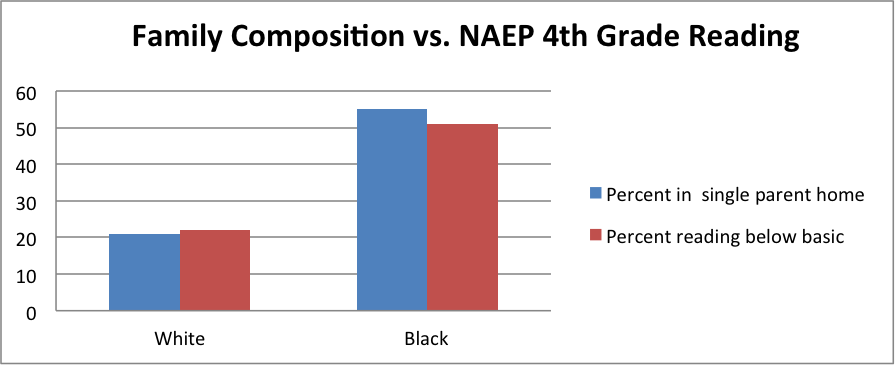
Family Composition v. 4th Grade NAEP Reading

(Reading data are from the National Assessment of Education Progress; family composition data are just out from the Census this week.)

To be sure, there are many reasons for the high rate of “fatherless families” among blacks: eye-popping incarceration rates, significant teenage-pregnancy rates, poor job prospects, etc. Thankfully, some of these indicators are starting to trend in the right direction.

But let us not partake in the soft bigotry of low expectations. Virtually everyone in America—regardless of race, class, or educational background—agrees that children generally do better in stable, two-parent families. That ideal is not always possible. But the expectation should be clear: Young people need to finish their education, find a job, get married, and then start a family, in that order. This “success sequence” is the surest route to reducing child poverty, alleviating income inequality, and closing our still-stark racial gaps. Here’s hoping the President will say so.

Tags: National Assessment of Educational Progress Reading Washington

President, Thomas B. Fordham Institute

Michael J. Petrilli is president of the Thomas B. Fordham Institute, executive editor of Education Next, editor in chief of the Education Gadfly Weekly, host of the…

View Full Bio
Fordham Logo

© 2026 The Thomas B. Fordham Institute
Privacy Policy
Usage Agreement

National

P.O. Box 110
Burke, VA 22009

202.223.5452

[email protected]

Ohio

P.O. Box 82291
Columbus, OH 43202

614.223.1580

[email protected]

Sponsorship

130 West Second Street, Suite 410
Dayton, Ohio 45402

937.227.3368

[email protected]