
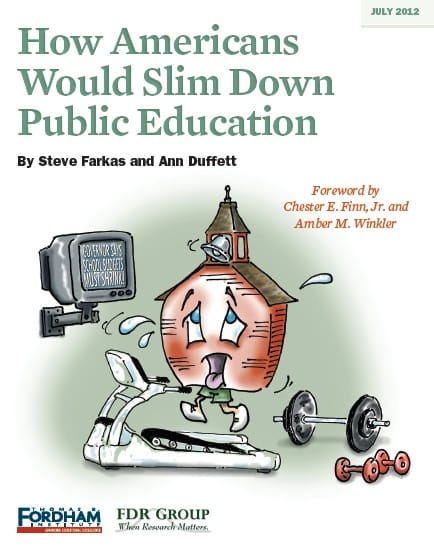
 A year ago, Fordham delved into American special education, finding “a field in flux” with a hefty bill: Between 1996 and 2005, 40 percent of all new education spending went to special-education services. How comfortable is the public paying that tab? Fordham’s latest report, How Americans Would Slim Down Public Education, offers some insights by providing the findings of a nationally representative survey of the public. What we learned:
Americans support spending more to teach students with special needs. Eighty-three percent of respondents said that Americans have a “moral obligation” to educate special-needs students, even if it’s challenging and expensive.
The public is skeptical of what schools call “special needs.” More than three quarters (76 percent) of those surveyed said that too many children are being incorrectly classified as special-education students when the real issue is behavior or inadequate teaching in the past.
Spending should have limits. Those surveyed were asked to consider a hypothetical situation:
John is a blind eighteen-year-old who suffered traumatic brain injury as a baby. He rarely responds to instruction and has been unable to learn more than a few words. Because the district doesn’t have the ability to meet his needs, it sends him to a residential facility that costs the district $100,000 a year.
Given this scenario, 62 percent of respondents thought the imaginary district had gone too far, agreeing that “there has to be a limit on the costs” of educating such a student.
While the public takes schools’ responsibility to educate all students seriously, and is willing to pay more to ensure those with greater needs are well served, Americans also displayed skepticism of the special-education status quo. Keep an eye out for a report next month on how states can reimagine special-education spending and download How Americans Would Slim Down Public Education for more on how the public views this crucial issue.
