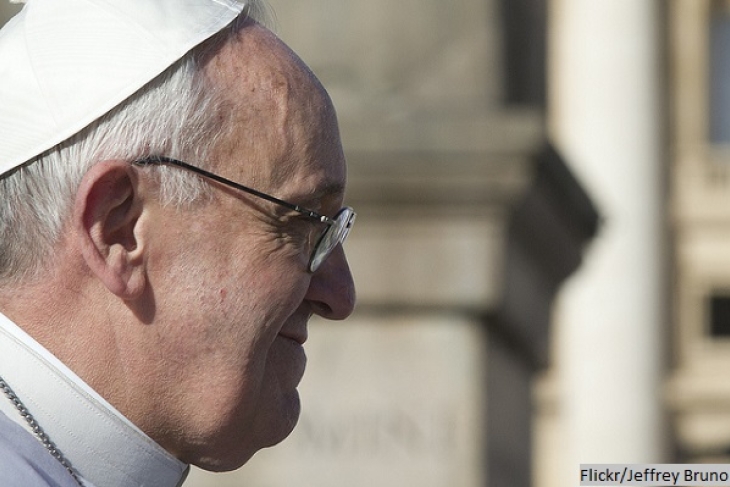
Pope Francis is exhorting church leaders across the globe to join the school choice movement.
Earlier this month, Pope Francis issued the second apostolic exhortation of his papacy, Amoris Laetitia (“The Joy of Love”). The document is not official church doctrine, but rather a public teaching of the pope that calls the faithful to action on a particular subject—in this case, the modern family. Given that this pope has issued only two apostolic exhortations in his three-year papacy, the inclusion of school choice speaks volumes about Francis’s priorities.
In Amoris Laetitia, the pontiff reiterates the church’s teaching that choice in education is a fundamental right of parents “of which no one may claim to deprive them”—meaning the state must not deny parents the right to select their children’s educational path, be it public or private, regardless of their financial means.
Francis calls upon the state to provide educational opportunities for all families, but he emphasizes that “parents themselves enjoy the right to choose freely the kind of education—accessible and of good quality—which they wish to give their children in accordance with their convictions” (paragraph eighty-four).
Amoris Laetitia comes in response to last fall’s “Synod on the Family,” a weeks-long global meeting of Catholic Bishops that stirred conversation related to the church’s relationship with the modern family. Like much of Francis’ papacy, the synod challenged the church to extend greater mercy toward families, particularly the most vulnerable in society and those who may feel unwelcomed in the church.
Francis’s words on parental choice challenge both church and state leaders to ensure the poor are not left on the margins of educational opportunity. This message is not new for Francis; nor is it new for the Catholic Church as a whole. But with tuition costs averaging $10,000 for high school freshmen, the pope has repeatedly implied that Catholic schools in the United States and across the globe have strayed from this mission.
In November of last year, Francis candidly referred to Catholic education as “too selective and elitist,” referring to how the rising cost of tuition makes educational opportunity inaccessible to the masses. Francis commented that “there is always the ghost of money—always. It seems that only those people or persons who are at a certain level or have a certain capacity have the right to an education.”
In the 1960s (the height of Catholic education in the United States), the Second Vatican Council paid close attention to the conversation on school choice, reminding us that the church “offers its educational service to the poor or those who are deprived of family help.” Along those same lines, American bishops have contended that “special attention” needs to be paid during the conversation around school choice to “those in our country who suffer most from educational disadvantage” (To Teach as Jesus Did, paragraph 149).
In the end, Amoris Laetitia does not stray from the church’s longstanding message about educational choice; it affirms the church’s age-old belief that these matters should first and foremost consider the poor and marginalized, and that every parent has an inalienable right to decide the best option for his or her child.
Catholic schools were never intended to be places of exclusivity. With Amoris Laetitia, Pope Francis challenges church and state leaders as well as the public to do more to ensure that these educational opportunities are accessible—and parental rights are protected—for all.
Renée N. Stoeckle is a lifelong advocate of Catholic education. She is deeply passionate about providing educational opportunities to at-risk students and has spent her career assisting Catholic schools in fulfilling that mission. She currently serves as the Step Up for Students expert on all things Catholic.
Editor’s note: This piece was originally posted in a slightly different form at RedefinEd.