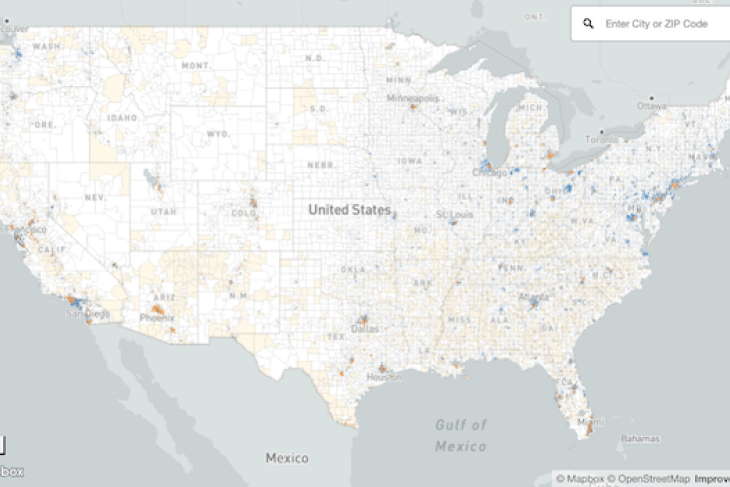
In April, we published a report by Andrew Saultz and colleagues—along with an interactive website—that mapped the locations of “charter school deserts” across the country. These are high poverty areas that could use additional options for disadvantaged students but nonetheless lack charter schools. The website enables users to look at every neighborhood in the country to identify underserved areas. And from the looks of it, journalists, education wonks, and curmudgeonly teachers alike took advantage of the unique opportunity to eyeball their neighborhoods and come to their own conclusions. We also heard from charter operators who used the map to identify areas ripe for expansion.
We were pleased to see all of that. But one critique we received was that the map did not show the locations of private schools—obviously a critical additional “option” for poor kids, particularly so in the areas that operate private school choice and tax-credit scholarship programs. So with a little help from our friends at the American Federation for Children, we’re back with an updated map that includes not just traditional and charter public schools, but private schools as well. Using data from the U.S. Department of Education’s Private School Universe Survey, we “geolocated” every private school in that dataset—which comprises 81 percent of them—and plotted each on the map. With this update, users can now identify the private schools in their neighborhoods, and areas that lack not only charter schools but private options as well.
Of particular interest to those who support private school choice is whether voucher and tax-credit scholarship programs serve as oases in the charter school deserts on our map. And indeed, there’s evidence that they do.
Consider the contrast between Milwaukee and the Minneapolis-St. Paul metro areas represented in Figure 1. Milwaukee has one of the nation’s oldest voucher programs, beginning with legislation passed in 1990, as well as a statewide voucher program in Wisconsin. The Twin Cities areas are bereft of these programs. Just as one might expect in a city with a broad and longstanding voucher program, Milwaukee’s private schools appear to be serving diverse populations, with some located in the suburbs, but many also operating in high-poverty charter school deserts.
In the Twin Cities, the picture is much different. Despite having large swaths of high-poverty charter school deserts, very few private schools are located in them.
Figure 1: Milwaukee has private schools serving many types of neighborhoods, but the Twin Cities area has few private schools serving high-poverty charter school deserts
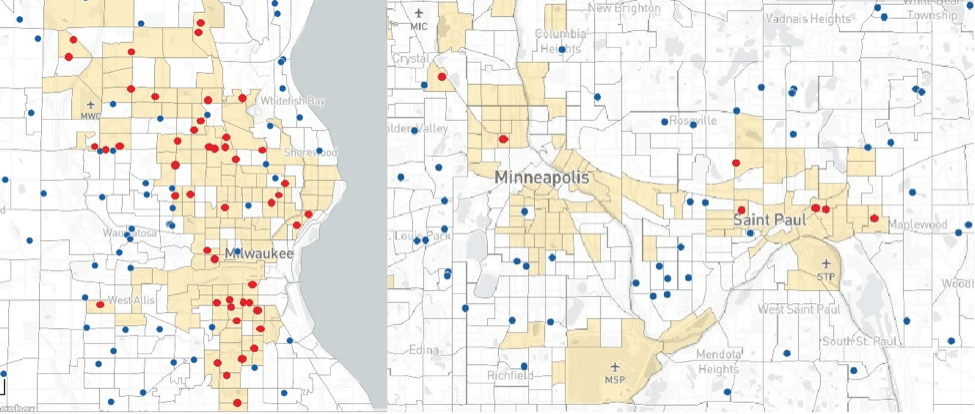
Note: The shaded areas are charter school deserts, which are areas with high poverty and no charter schools. The dots on the map represent private schools. Red dots represent private schools falling in charter school deserts, and blue dots denote those outside the deserts.
Many of the private schools in Milwaukee’s charter school deserts have opened since the city’s voucher program was initiated in the early 1990s. For example, St. Joseph Academy, which serves neighborhoods in high-poverty southern Milwaukee, began as a Catholic day care, but since 2009 has expanded to provide an elementary school serving 312 students in pre-kindergarten through fourth grade, according to U.S. Department of Education data. In recent years, the school has expanded to serve middle schoolers, too.
Of course the existence of private schools does not guarantee access. Admission policies, low voucher amounts, and enrollment caps all impact entry. But in cities like Milwaukee, voucher programs appear to be increasing choices for students in high-poverty areas by helping private schools to thrive and enabling new schools to open in the neighborhoods that need them the most.