Mobile Navigation

  • National
    • Policy
      • High Expectations
      • Quality Choices
      • Personalized Pathways
    • Research
    • Commentary
      • Gadfly Newsletter
      • Flypaper Blog
    • Events
    • Scholars Program
  • Ohio
    • Policy
      • Priorities
      • Media & Testimony
    • Research
    • Commentary
      • Ohio Education Gadfly Biweekly
      • Ohio Gadfly Daily
  • Charter Authorizing
    • Application
    • Sponsored Schools
    • Resources
  • About
    • Mission
    • Board
    • Staff
    • Career
Home
Home
Advancing Educational Excellence

Main Navigation

  • National
  • Ohio
  • Charter Authorizing
  • About

National Menu

  • Topics
    • Accountability & Testing
    • Advanced Education
    • Career & Technical Education
    • Charter Schools
    • Curriculum & Instruction
    • ESSA
    • Evidence-Based Learning
    • Facilities
    • Governance
    • Personalized Learning
    • Private School Choice
    • School Finance
    • Standards
    • Teachers & School Leaders
    • Think Again
  • Research
  • Commentary
    • Gadfly Newsletter
    • Flypaper Blog
    • Gadfly Podcast
  • Events
  • Scholars Program

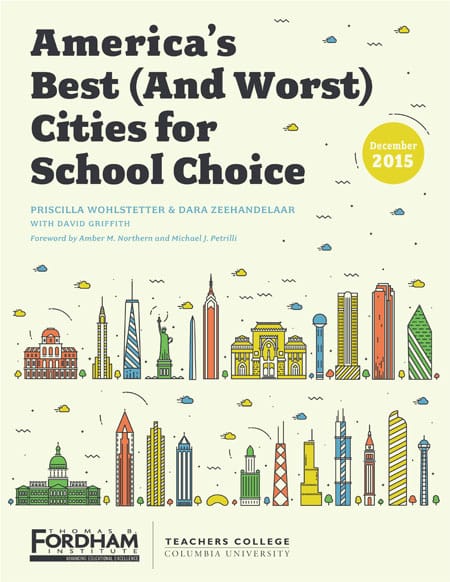
America's Best and Worst Cities for School Choice (EMBARGOED until 12:01 E.D.T. on December 9, 2015)

Priscilla Wohlstetter, Ph.D. Dara Zeehandelaar Shaw, Ph.D. David Griffith, Ph.D.
12.9.2015
Reading
Download an embargoed copy of the report.

More than twelve million American students exercise some form of school choice by not attending a traditional public school and instead going to a charter, magnet, or private school, or opting for homeschooling. Countless others are doing so using district-wide lotteries, attendance waivers, or interdistrict transfers to attend public schools other than the one in their neighborhood.

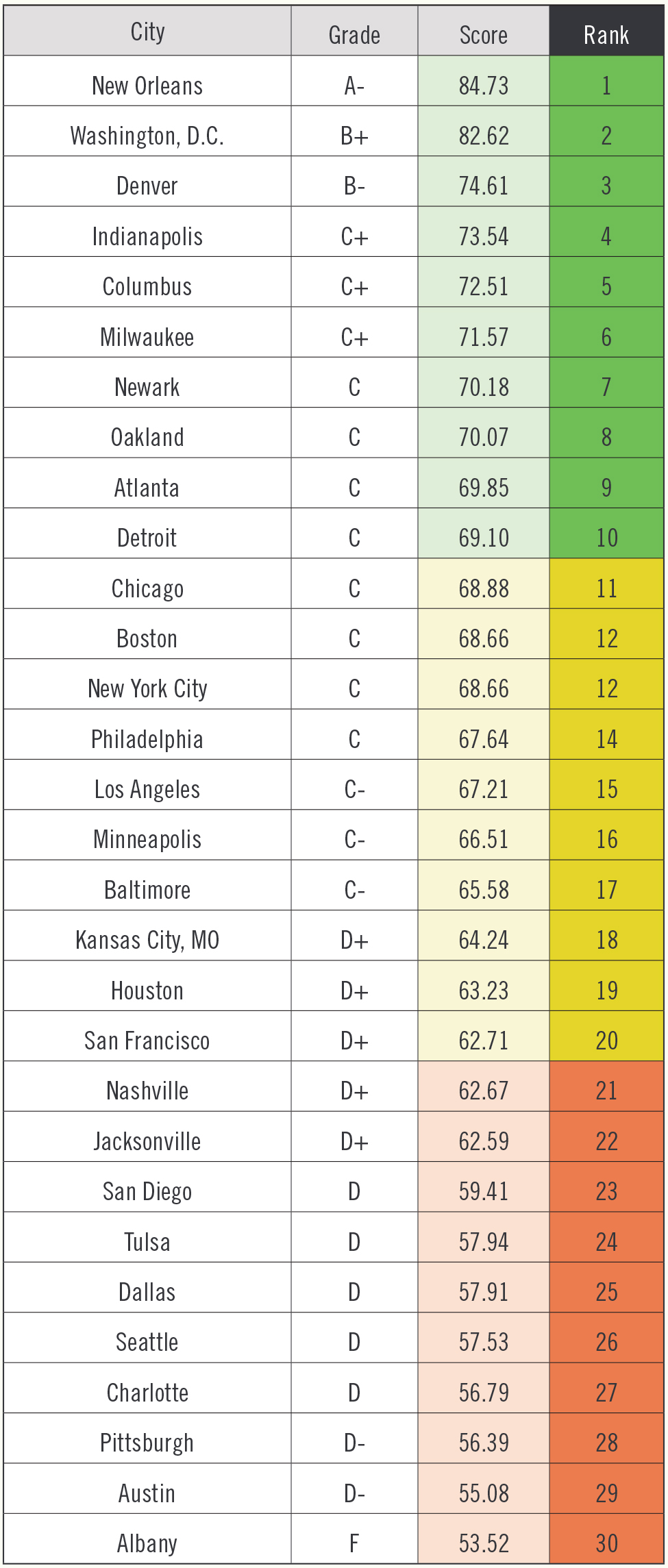
But some cities are significantly more “choice-friendly” than others…and some are downright hostile. Using nearly fifty markers of “choice friendliness,” we show which American cities—thirty in all—are the best and worst for school choice.

What makes a city choice-friendly?

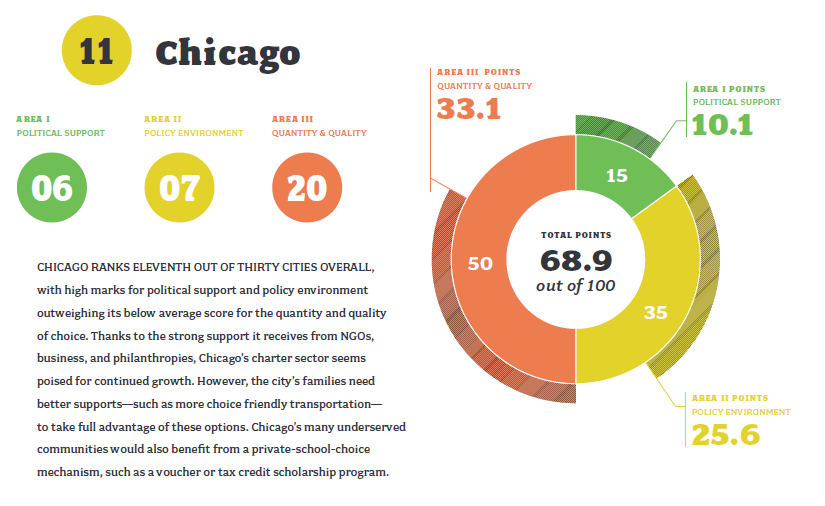
First, POLITICAL SUPPORT:

Politics reigns supreme: Is the city council supportive of choice in Newark or Chicago? Does the superintendent in San Diego advocate for choice? How about the one Atlanta? Here we get the lowdown from observers in each city about whether their political heavy hitters support school choice.

Second, the POLICY ENVIRONMENT:

It’s nearly impossible for choice to flourish without supportive policies and practices. Here we examine topics like whether the city’s major school district has a policy for closing schools with low enrollment. In fact, sixteen do. One is Chicago. And, how easy is it for parents to apply to schools of choice? (Answer: Not very, unless you're one of the six cities with a broad common application).

Third, the QUANTITY AND QUALITY of choices:

The question of how many choices exist for students—and if they are any good—obviously matters a great deal. Here we examine factors like whether students are allowed to attend schools in nearby districts. And if so, can the district choose to say no by opting out? That’s the case in Oakland. Perhaps you’d like to know where else? 

As you’ll read, some cities’ overall rankings come as no surprise—the gold, silver, and bronze go to choice hot-spots New Orleans, Washington, D.C., and Denver. Albany ranked dead last. But New York City, a roaring engine of choice under Mayor Bloomberg, is now sputtering and fails to crack the top ten (blame the “de Blasio effect”). And how did Atlanta—marred by a cheating scandal--end up surprising us in the ninth position?

There's lots more to learn in this most comprehensive look at urban school choice to date.
Each city is profiled as follows. Download the report to learn more about each city’s ranking.
Tags: Albany Atlanta Bill de Blasio Chicago Denver New Orleans New York Newark Oakland Washington
+5 More Show Less
Priscilla Wohlstetter, Ph.D.

Dara Zeehandelaar Shaw was the national research director at the Thomas B. Fordham Institute, where she oversaw Fordham’s research pipeline, designs and executed new studies, managed ongoing projects, and conducted quantitative and qualitative research until the beginning of 2017. Her areas of study include education governance and school boards; finance and teacher pensions; policy design and implementation (…

View Full Bio

David Griffith is the National Research Director at the Thomas B. Fordham Institute, where he manages or authors reports on various subjects including charter schools, …

View Full Bio
Fordham Logo

© 2026 The Thomas B. Fordham Institute
Privacy Policy
Usage Agreement

National

P.O. Box 110
Burke, VA 22009

202.223.5452

[email protected]

Ohio

P.O. Box 82291
Columbus, OH 43202

614.223.1580

[email protected]

Sponsorship

130 West Second Street, Suite 410
Dayton, Ohio 45402

937.227.3368

[email protected]