
As I write in my brand-new book The Diverse Schools Dilemma, gentrification has supplied us with the best opportunity in a generation to create socioeconomically-mixed public schools. But is that opportunity being seized? We know that lots of neighborhoods are gentrifying. But are demographic changes in communities leading to demographic changes in their schools?
To find out, I had Greg Hutko, our research intern, sift through national education data to pinpoint the ten public schools that have seen the biggest decrease in their share of poor students (defined as those eligible for a free or reduced-price lunch) over the past three years. Here’s what we found:
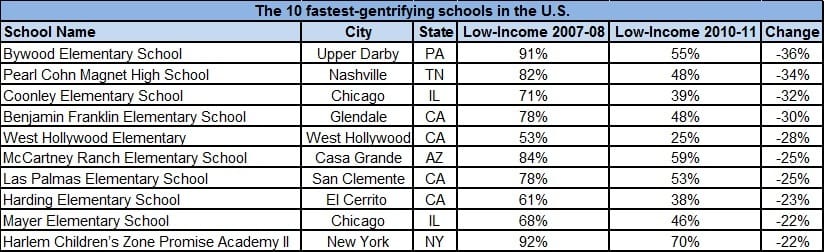 The 10 fastest-gentrifying schools |
What to think of this list? First, I was surprised that the two neighborhoods thought of as the Ground Zero of gentrification—D.C.’s Capitol Hill and NYC’s Brooklyn—didn’t have any schools make the cut. And it’s telling that suburban schools outnumber urban ones on the list. (As Atlantic Cities just reported, the suburbs are where you find the nation’s most diverse neighborhoods.)
Most of these are inner-ring suburbs—Upper Darby, Pennsylvania, outside of Philadelphia; Glendale and West Hollywood, bordering L.A.; El Cerrito in Northern California’s East Bay. But two exurbs make the cut, too: Casa Grande, Arizona (between Phoenix and Tucson) and San Clemente, California (between L.A. and San Diego). In both cases, middle-class commuters appear to be turning what used to be relatively poor towns into bedroom communities.
Two magnet schools appear—Pearl Cohn High School in Nashville* and Benjamin Franklin in Glendale. And one charter school—Geoffrey Canada’s second Promise Academy, located eighteen blocks north of Central Park—is in the club, too (though it remains the poorest school on the list, with 70 percent of its students eligible for a free or reduced price lunch).
That means that just two of the ten are center-city neighborhood public schools—and both are on Chicago’s North Side. Interesting!**
What else do you notice? The comments section is open. And don’t forget: If you want to read about the education implications of these demographic shifts, buy my book!
[*] UPDATE, 11/19/12: In the case of Pearl Cohn High School, the federal data seems to have been incorrect.
[**] UPDATE, 11/15/12: Alexander Russo informs me (correctly) that Mayer Elementary in Chicago is a magnet school, too.
