Mobile Navigation

  • National
    • Policy
      • High Expectations
      • Quality Choices
      • Personalized Pathways
    • Research
    • Commentary
      • Gadfly Newsletter
      • Flypaper Blog
    • Events
    • Scholars Program
  • Ohio
    • Policy
      • Priorities
      • Media & Testimony
    • Research
    • Commentary
      • Ohio Education Gadfly Biweekly
      • Ohio Gadfly Daily
  • Charter Authorizing
    • Application
    • Sponsored Schools
    • Resources
  • About
    • Mission
    • Board
    • Staff
    • Career
Home
Home
Advancing Educational Excellence

Main Navigation

  • National
  • Ohio
  • Charter Authorizing
  • About

Ohio Menu

  • Topics
    • Accountability & Testing
    • Advanced Education
    • Career & Technical Education
    • Charter Schools
    • Curriculum & Instruction
    • ESSA
    • Evidence-Based Learning
    • Governance
    • Personalized Learning
    • Private School Choice
    • School Finance
    • Standards
    • Teachers & School Leaders
  • Research
  • Policy
  • Commentary
    • Ohio Gadfly Newsletter
    • Ohio Gadfly Blog
    • Events

The Education Gadfly Weekly

Sign Up to Receive Fordham Updates

We'll send you quality research, commentary, analysis, and news on the education issues you care about.
Thank you for signing up!
Please check your email to confirm the subscription.

Ohio Gadfly—Will “temporary” guarantees persist under the new school funding formula?

Volume 17, Number 8
4.11.2023
4.11.2023

Ohio Gadfly—Will “temporary” guarantees persist under the new school funding formula?

Volume 17, Number 8
view
Guarantees blog image
School Funding

Will “temporary” guarantees persist under Ohio’s new school funding formula?

A basic principle of school funding is that dollars ought to follow students to the schools they actually attend. Funds shouldn’t be directed to the schools that children attended last year or the year before. That’s because the schools serving students today bear the responsibility—and costs—of educating them today.

Aaron Churchill 4.11.2023
OhioOhio Gadfly Daily

Will “temporary” guarantees persist under Ohio’s new school funding formula?

Aaron Churchill
4.11.2023
Ohio Gadfly Daily

A reminder that third grade reading retention is right

Jessica Poiner
4.3.2023
Ohio Gadfly Daily

Kids can learn from robots—with a lot of help from humans

Jeff Murray
4.11.2023
Ohio Gadfly Daily

More accurate identification of low-performing schools through math

Jeff Murray
4.6.2023
Flypaper
view
Retention redux blog image

A reminder that third grade reading retention is right

Jessica Poiner 4.3.2023
Ohio Gadfly Daily
view
Competent robots SR image

Kids can learn from robots—with a lot of help from humans

Jeff Murray 4.11.2023
Ohio Gadfly Daily
view

More accurate identification of low-performing schools through math

Jeff Murray 4.6.2023
Flypaper
view
Guarantees blog image

Will “temporary” guarantees persist under Ohio’s new school funding formula?

Aaron Churchill
4.11.2023
Ohio Gadfly Daily

A basic principle of school funding is that dollars ought to follow students to the schools they actually attend. Funds shouldn’t be directed to the schools that children attended last year or the year before. That’s because the schools serving students today bear the responsibility—and costs—of educating them today.

Another precept of school funding is that state dollars should be targeted more heavily to districts with lesser capacity to generate funds locally. Almost everywhere, Ohio included, state policy establishes a baseline per-pupil funding level throughout the state but the funds themselves are mixture of state and local dollars. Where a locality has limited capacity to raise funds through taxation—low property values, for example, or concentrated poverty among residents—the “state share” should increase.

Ohio has long struggled to follow these principles and ensure that funds flow strictly through formulas that are predicated on current enrollments and measures of local wealth. One major obstacle has been legislators’ repeated practice of enacting “guarantees” that provide districts with excess funds when their current formula prescriptions fall short of their previous funding levels. This situation typically occurs when districts are losing enrollments and/or increasing in wealth—and thus in less need of state aid at the present time according to the formula.

While politically popular, these guarantees—sometimes called “hold harmless” provisions—have serious downsides. For one, they short-circuit the state’s own formula and provide special subsidies for certain districts. (It’s not wrong to call them a form of “pork barrel” politics.) That’s unfair to the districts that are funded strictly via formula or those that receive fewer dollars than their formula prescriptions through the use of caps. Such caps, the opposite of a guarantee and also long employed in Ohio, limit funding increases called for by the formula when districts have growing enrollments and/or declining wealth. Guarantees are also unfair to taxpayers, who foot the bill for the inefficient spending. They are, in short, like paying unemployment benefits long after a person has found a job.

Ohio’s new funding formula, which first went into effect in 2021, rightly promised to move away from guarantees. In fact, one of the “critical values” undergirding the model is that “dollars flow directly to where students are educated.” Early projections from advocates indicated that one in six districts would remain on a guarantee during the transition to the new system (down from more than half). One school group official predicted that, over the longer haul, “a need for a guarantee should go away.” But how well is the new formula actually accomplishing this? Is the model moving districts off guarantees, as it was intended to do, and solely onto the formula?

Let us first understand that the new formula included at least three guarantees of its own.[1] Despite their labels, legislators didn’t specify any sunsets or phase-outs of these funding streams, and the introduced version of this year’s state budget would continue them into the next biennium—again, without an expiration date.

  • Temporary Transitional Aid: Guarantees that districts do not receive less state funding than in FY 2020.

  • Formula Transition Supplement: Guarantees that districts do not receive less state funding than in FY 2021.

  • Supplemental Targeted Assistance: Provides certain districts extra dollars based on their FY 2019 enrollments. Though not technically a “guarantee,” this funding stream functions like one by providing a special subsidy for districts that have historically lost enrollments as students exited for charter and private-school options.

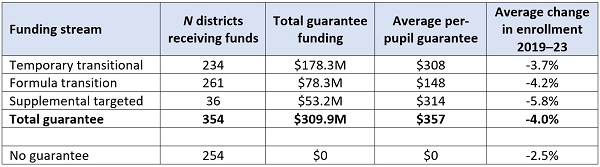
Table 1 displays an overview of these guarantees. In FY 2023, more than half of Ohio districts—354 out of 608—are on at least one guarantee (some are on multiple). In total, these “outside-of-the-formula” funding items cost the state nearly $310 million this year, or $357 per pupil. While not an astronomical sum in the context of the full state budget, this is more than the $160 million that the state spent this year on career-tech, English learner, and gifted categorical funding combined. In comparison to 2018–19—the last year that the old formula was used—slightly more districts are on a guarantee today: 354 versus 335 districts in FY 2019. The total cost of guarantees has also risen from $257 to $310 million.

Table 1: Breakdown of guarantee funding for Ohio districts, FY 2023

Guarantees blog Table 1
Note: The per-pupil calculations include only students in the districts receiving a guarantee.

This lack of progress on guarantees—and even some steps backwards—seems to boil down to three factors:

  1. Most obviously, they are still included in the new funding system. Back in 2021, lawmakers likely felt a need to protect districts from any abrupt funding cuts caused by structural changes in the formula. That was probably fine. But these guarantees were supposed to be “temporary” and “transitional.” Yet now, under the governor’s proposal, they will continue in FY 2025 and 2026, and there has been almost no talk of phasing them out or removing them.

  2. The recent slide in district enrollments has also been a factor. This trend means that the formula—as it should—yields lower funding totals for some districts than in prior years. As Table 1 indicates, districts on a guarantee tend to have larger enrollment declines from 2019 to 2023 than their non-guarantee counterparts (-4.0 versus -2.5 percent). In a system that shields declining districts from funding reductions, we’d expect this pattern. East Cleveland, the state’s largest beneficiary of guarantees, is a vivid example. Over the past four years, the district lost a staggering 24 percent of its enrollment.[2] Under a rational, enrollment-driven formula, East Cleveland should have its funding substantially reduced. But instead, the state propped it up with an additional $3,364 per pupil in guarantee funding this year.

  3. Increasing local wealth has also reduced the formula amounts of some districts, which the guarantee then overrides by providing excess funds. The impacts of increasing wealth, however, are made worse by the mechanics of the new formula, which (as discussed in another piece) does a poorer job than the prior formula in controlling for system-wide inflation in property values and incomes. In fact, a recent analysis from the state’s Legislative Service Commission projects that, due in part to continuing increases in local wealth,[3] “temporary transitional” guarantee funding will skyrocket from $178 to $554 million by FY 2026.

Touted as the “Fair School Funding Plan,” the new state funding formula was intended to create a more even playing field in which the vast majority of Ohio school districts would be funded on the same formula. To achieve this, the plan promised to move away from guarantees. But the results thus far haven’t turned out that way. As the budget debates continue this spring, lawmakers should begin asking more questions about why this is happening—and what steps might be needed to correct course.


[1] There is also a guarantee within the transportation formula, a staffing minimum guarantee inside the base cost formula that benefits low-enrollment districts, and a guarantee that provides high-wealth districts a minimum amount of state aid.

[2] East Cleveland’s wealth did not increase from 2019 to 2023, so its guarantee funding is being driven by enrollment declines (perhaps even predating 2019, as past guarantees pushed its funding upwards).

[3] In a complex issue, LSC notes that the increased guarantees are also related to the continuing phase-in of the new formula proposed under the governor’s plan. For most districts, the phase-in increases their funding to more closely meet the formula prescriptions. But for some districts—likely those on a guarantee—the phase-in is actually a “phase-down” from higher historical funding levels to the lower current prescription. A higher “phase-down” percentage would thus increase their guarantee funding.

view
Retention redux blog image

A reminder that third grade reading retention is right

Jessica Poiner
4.3.2023
Ohio Gadfly Daily

In 2012, Ohio lawmakers enacted the Third Grade Reading Guarantee, a significant early literacy reform package. Under the initiative, schools must administer diagnostic reading assessments to students in grades K–3. If students are identified as off track, schools must notify their parents and create improvement plans. The policy also requires schools to retain students who, based on state assessments or state-approved alternative exams, aren’t meeting reading standards by the end of third grade. To improve their reading skills, schools must provide such students with intensive interventions such as summer reading programs or tutoring.

In the ten years since the Guarantee became law, there have been multiple attempts to water down or eliminate the retention provision. The latest effort, House Bill 117, aims to repeal the requirement by prohibiting districts from holding students back based on their scores on state assessments. Backers of the bill argue that the state should be emphasizing literacy instead of standardized tests, and claim that retention has a negative impact on students.

There are a few issues with these arguments. First, state leaders are emphasizing literacy. On top of the policy’s existing focus on improvement efforts from kindergarten through the end of third grade, Governor DeWine recently unveiled a plan to significantly strengthen the state’s early literacy efforts, and recommended investing $174 million in additional state spending to do so. The governor’s plan would require schools to use curriculum and materials that are aligned with the science of reading, cover the cost of professional development for teachers, and provide literacy coaches to schools and districts with the lowest reading proficiency scores.

Second, implying that standardized tests and early literacy are mutually exclusive is wrong. Assessments are a crucial part of any early literacy effort. Without them, it’s impossible to gauge how well students can read. Local tests—including those that are teacher-designed and -administered—are important, as they offer immediate feedback to help teachers plan lessons and identify which students need extra help. But state assessments are equally important because they serve a different purpose. Unlike classroom assessments, state tests track growth (or lack thereof) over time. They’re comparable across districts and regions, which makes it possible to identify and measure achievement gaps. They also objectively measure student performance against state standards—benchmarks that are designed to gauge whether students are reading on grade level and will be ready to succeed in the upper grades.

Third, critics are ignoring a trove of data that refutes their claims that retention hurts students. In fact, research conducted in several states indicates that retention, in combination with intensive supports, has a positive impact on students’ short-term and long-term success. Let’s take a look at a few examples from around the nation.

Florida

It’s imperative to talk about Florida when talking about early literacy. Like Ohio, the Sunshine State requires schools to identify K–3 students who exhibit a “substantial deficiency” in reading, notify their parents, and provide intensive interventions like a minimum of ninety minutes of daily reading instruction and summer reading camps. Florida has also retained students who score below a certain threshold (with some exceptions) on the state reading test since 2002. In the two decades since, research studies have found positive impacts from retention. Consider the following:

  • A 2015 study, completed by Guido Schwerdt, Martin West, and Marcus Winters, and updated in 2017, found that retention in third grade increased students’ high school GPAs, led them to take fewer remedial courses, reduced retention probabilities in future years, and had no negative impact on graduation.

  • A 2018 report on the costs and benefits of test-based promotion found that the threat of retention led to “statistically significant and substantial” improvements in math and reading performance within third grade prior to retention. It also led to significant and substantial gains in eighth grade math and reading, and increased the probability that students would earn a diploma.

  • A 2019 study focusing on English language learners who were held back in third grade found significant academic gains for those who were retained, as well as reductions in later remedial course-taking.

Mississippi

Mississippi passed its early literacy policy in 2013. Much like Ohio’s, it requires students who don’t reach a minimum score threshold on state tests to be retained and receive additional support and interventions. In the decade since, the Magnolia State’s impressive academic progress has been dubbed a “learning miracle.” Improvement on the National Assessment of Educational Progress (NAEP) has been particularly noteworthy; from 2011 to 2022, Mississippi ranked first among states in fourth grade reading gains.

According to a working paper from the Wheelock Educational Policy Center at Boston University, retention played a big part in these overall improvements. The results show that students who were held back via the state’s retention policy scored more than 1 standard deviation higher relative to their barely promoted peers by the end of sixth grade. In other words, students who were retained scored, on average, around the 62nd percentile in English language arts when they were in sixth grade. Meanwhile, comparable students who weren’t held back scored, on average, in the 20th percentile.

A recently published analysis identifies two reasons why the state’s “purposeful retention” policy has been crucial to its success. First, it’s much more than simply repeating a grade. By law, students receive plenty of extra support and interventions, including a minimum of ninety minutes in reading instruction based on the science of reading. Second, it acts as “an accountability tool for the system’s adults, designed to support them in changing their practice.” Mississippi didn’t just retain struggling readers. It also heavily invested in the adults who are responsible for helping them by adopting high-quality curricula and materials, offering professional development in the science of reading, providing literacy coaches, and changing teacher preparation programs. In short, retention played a crucial role in “aligning the system’s adults—teachers, parents, and administrators—around meeting the needs of students.”

Indiana

Ohio’s neighboring state of Indiana has had a retention policy since the 2011–12 school year. Like Mississippi, struggling receive additional support that’s based on the science of reading. And like Mississippi and Florida, Indiana offers evidence that retention can have a positive impact. A report published by the Annenberg Institute at Brown University used a regression discontinuity design to compare retained students to those who barely passed the state’s promotional threshold. They found that, in the fourth grade, retained students earned much higher state test scores than their peers who weren’t held back in both reading and math. These gains persisted through seventh grade, though the magnitude faded somewhat over time. There were no significant impacts from retention on disciplinary or attendance outcomes. 

***

After seeing all these data, one might wonder why Ohio—which has had a retention policy for over a decade—hasn’t seen similar progress. Although there were noticeable improvements in state assessment data prior to the pandemic, 40 percent of Ohio third graders currently aren’t proficient in reading. NAEP scores have also been largely flat.

The lack of progress is likely due to Ohio’s long history of backing off on policies that set high standards for students and schools, including in early literacy. Annual attempts to water down and eliminate the Third Grade Reading Guarantee are influencing implementation efforts, which in turn impacts student outcomes. It’s also important to recognize that Ohio’s current early literacy policy isn’t as comprehensive as those in other states. Mississippi, for example, didn’t just identify struggling readers and intervene. State leaders went all in on the science of reading and flooded teachers and schools with support. Ohio, on the other hand, hasn’t championed the science of reading or made any effort to ensure that schools are following the research.

Governor DeWine’s recently proposed early literacy plan would cover many of the areas that the Guarantee did not address. Its defining characteristics—adopting high-quality curricula and offering teacher professional development aligned with the science of reading, as well as providing literacy coaches—were instrumental to Mississippi’s success. But so, too, was retention. If Ohio lawmakers go through with their latest attempt to eliminate the Guarantee’s retention provision, they won’t just be ignoring research and positive results from other states. They’ll be undercutting Ohio’s promising push on early literacy. For the sake of Ohio’s students, let’s hope they change their minds. 

view
Competent robots SR image

Kids can learn from robots—with a lot of help from humans

Jeff Murray
4.11.2023
Ohio Gadfly Daily

Could robots be part of the answer to alleviating teacher shortages (and other staffing issues) in the future? Lots of folks think so, and new research indicates kids might already be primed to accept a non-human information source.

A group of researchers from Concordia University in Montréal, Canada, ran two experiments with groups of three- and five-year-old children, all recruited from a database of existing research participants. Families received gift cards and the children received certificates of merit for participating. Approximately half the sample was white, a quarter of the sample was mixed race, and the remainder consisted of various other ethnic groups (such as African, Asian, and South American). Nearly 60 percent of participants were from high-socioeconomic-status (SES) households (earning more than $100,000 annually), just over 26 percent were middle-SES households ($50,000–$100,000), and the remainder came from low-SES households. Because the experiment took place during Covid lockdowns, all trials occurred over Zoom, with parents providing minimal assistance to set up the video connection.

In the first experiment, a human and a small robot with humanoid features told children the names of three familiar objects (car, ball, cup). The robot called them by the correct terms; the human by familiar but incorrect terms (book, shoe, dog). Then the children were presented with three unfamiliar items (the top of a turkey baster, a roll of twine, and a silicone muffin container). Again, the human and the robot told children the names of those objects, but each used a different set of nonsense words to do so (“mido,” “dax,” etc.). The children were then asked what each of the unfamiliar objects was called, choosing from either the label offered by the robot or by the human. While the three-year-olds showed no clear preference for one “informant” over another, the five-year-olds were much more likely to side with the robot, which had given the correct names of the familiar objects, than the human, who hadn’t. The researchers say that both outcomes indicate that children are attributing similar characteristics to human and mechanical informants, although the three-year-olds are focused only on the fact that these similarities exist. By the age of five, however, children are also paying attention to the content coming from their informants and can, when the conditions are right, tell who is a competent informer and who is not.

The second experiment, with new participants in each group, was the same as the first except that the humanoid robot was replaced by an even smaller and less-anthropomorphized machine. The results were the same, showing that tech-informants don’t even have to look like humans for children to pay attention to, and in the case of the older children, believe them.

The upshot: There are likely capacity and efficiency benefits to be gained by embracing machine-based teaching and learning in certain contexts. But don’t fear the robotic dystopian classroom just yet. Take note that all mechanical and robotic instruction described here was created, programmed, and set in motion by people. And that the kids needed specific background knowledge as a prerequisite to the robots’s success—knowledge that came from parents, caregivers, libraries, and daycare staffers. So it seems a very long time before such machines evolve beyond helpers—however vital—to teachers and parents.

SOURCE: Anna-Elisabeth Baumann et al., “People Do Not Always Know Best: Preschoolers’ Trust in Social Robots,” Journal of Cognition and Development (March 2023).

view

More accurate identification of low-performing schools through math

Jeff Murray
4.6.2023
Flypaper

As school accountability systems reset following pandemic disruptions, an opportunity arises to improve their accuracy and make sure the intended responses to data resulting from them are properly tuned. A new study from the U.S. Department of Education’s Institute of Education Sciences looks at a way in which academic proficiency rate calculations for small schools and small subgroups of students might be sharpened and improved.

School-level data for each year from 2015–16 through 2018–19 come from the Pennsylvania Department of Education (PDE), and comprise all of the elementary, middle, and high schools in the state that were included in ESSA accountability calculations in those years. Which means we’re looking at schools examined for possible inclusion in Targeted Support and Improvement (TSI) and Additional Targeted Support and Improvement (ATSI) under state-adopted subgroup performance criteria. Many schools, however, had subgroup sizes below twenty. Those subgroups had traditionally been excluded from the TSI and ATSI calculations due to concerns over unreliability (termed “instability” by researchers) of data derived from such a small sample. The researchers theorized that there was a way to improve the proficiency rate calculation of smaller subgroups in these schools using Bayesian hierarchical modeling, a statistical method used to make inferences about a population based on a number of individual observations. (Lots of information on the model can be found here and here. It is used in fields as diverse as astronomy and marketing.) The eight subgroups examined in each school were Asian students, Black students, Hispanic students, White students, multiracial students, economically disadvantaged students, students with disabilities, and English learners. (Despite targeting this research on improving the measurement of very small subgroups, Native American/Alaska Native and Hawaiian/Pacific Islander student groups were simply too tiny to be included.)

Analysts looked at the percentage of students scoring at or above the state’s threshold for academic proficiency in each school-subgroup combination and the number of tested students in English language arts and math for each school-subgroup combination in each year, looking to stabilize the proficiency rate data for each. They found that their stabilized proficiency rates showed more consistent variation across subgroup sizes, indicating that they are more reliable than unstabilized rates. Thus, use of Bayesian stabilization could allow for inclusion of smaller subgroup sizes with similar statistical reliability as larger samples.

They then reran PDE’s data using a minimum subgroup size of ten to produce a new list of schools with low-performing student subgroups as determined by state criteria. The new calculations moved one subgroup above the proficiency cutoff for ATSI designation in nine out of the 193 schools originally identified. Specifically, the subgroup of White students in six schools and economically disadvantaged students in three other schools all were raised above ATSI designation. Their conclusion: The schools were misidentified and funding to support students in those subgroups in those schools was not necessary, diverting money from schools and students who needed it more. Small potatoes in one state, perhaps, but potentially much more important writ large.

The researchers note two limitations of their study. The first is a lack of student-level data, which they surmise could allow for even sharper stabilization of proficiency rates. Second is that most of the subgroups whose status changed were very close to the ATSI proficiency cutoff. PDE has discretion on borderline cases like these, and while the researchers set inflexible cutoffs, they assume that state officials would have simply kept the classifications as originally calculated, making their work moot in the real world.

Despite these limitations, the Pennsylvania Department of Education was encouraged by the results of this experiment and partnered with the researchers to incorporate data stabilization into the state’s actual ATSI calculations for 2022. No outcomes have been announced yet, but the researchers believe that not only will this correct for measurement errors in the past, but will also help smooth out data collection gaps experienced in 2020 and 2021 due to pandemic-induced testing disruptions. Surely many eyes will be trained on the Keystone State whenever results are released.

SOURCE: Lauren Forrow, Jennifer Starling, and Brian Gill, “Stabilizing Subgroup Proficiency Results to Improve the Identification of Low-Performing Schools,” Institute of Education Sciences, Regional Educational Laboratory Mid-Atlantic (February 2023).

Fordham Logo

© 2026 The Thomas B. Fordham Institute
Privacy Policy
Usage Agreement

National

P.O. Box 110
Burke, VA 22009

202.223.5452

[email protected]

Ohio

P.O. Box 82291
Columbus, OH 43202

614.223.1580

[email protected]

Sponsorship

130 West Second Street, Suite 410
Dayton, Ohio 45402

937.227.3368

[email protected]