Mobile Navigation

  • National
    • Policy
      • High Expectations
      • Quality Choices
      • Personalized Pathways
    • Research
    • Commentary
      • Gadfly Newsletter
      • Flypaper Blog
    • Events
    • Scholars Program
  • Ohio
    • Policy
      • Priorities
      • Media & Testimony
    • Research
    • Commentary
      • Ohio Education Gadfly Biweekly
      • Ohio Gadfly Daily
  • Charter Authorizing
    • Application
    • Sponsored Schools
    • Resources
  • About
    • Mission
    • Board
    • Staff
    • Career
Home
Home
Advancing Educational Excellence

Main Navigation

  • National
  • Ohio
  • Charter Authorizing
  • About

Ohio Menu

  • Topics
    • Accountability & Testing
    • Advanced Education
    • Career & Technical Education
    • Charter Schools
    • Curriculum & Instruction
    • ESSA
    • Evidence-Based Learning
    • Governance
    • Personalized Learning
    • Private School Choice
    • School Finance
    • Standards
    • Teachers & School Leaders
  • Research
  • Policy
  • Commentary
    • Ohio Gadfly Newsletter
    • Ohio Gadfly Blog
    • Events

The Education Gadfly Weekly

Sign Up to Receive Fordham Updates

We'll send you quality research, commentary, analysis, and news on the education issues you care about.
Thank you for signing up!
Please check your email to confirm the subscription.

Ohio Gadfly—It’s time to dump Reading Recovery

Volume 17, Number 17
7.21.2023
7.21.2023

Ohio Gadfly—It’s time to dump Reading Recovery

Volume 17, Number 17
view
Reading recovery in Ohio blog image
Standards & Accountability

It’s time for Ohio to dump Reading Recovery

Led by Governor DeWine, Ohio lawmakers made early literacy a big priority in the recently signed state budget bill. The legislation requires schools to use high-quality instructional materials aligned to the

Aaron Churchill 7.21.2023
OhioOhio Gadfly Daily

It’s time for Ohio to dump Reading Recovery

Aaron Churchill
7.21.2023
Ohio Gadfly Daily

Here’s how the state budget addresses teacher shortages

Jessica Poiner
7.20.2023
Ohio Gadfly Daily

Universal eligibility with equity: A closer look at Ohio’s sliding scale for private school scholarships

Aaron Churchill
7.17.2023
Ohio Gadfly Daily

Even school choice opponents should support open enrollment

Jessica Poiner
7.14.2023
Ohio Gadfly Daily

A fifty-state analysis of non-district students’ access to district-provided services

Jeff Murray
7.25.2023
Ohio Gadfly Daily

The path to four million apprentices

Jeff Murray
7.20.2023
Flypaper
view
Teachers in the budget blog image

Here’s how the state budget addresses teacher shortages

Jessica Poiner 7.20.2023
Ohio Gadfly Daily
view
Sliding scale edchoice blog image

Universal eligibility with equity: A closer look at Ohio’s sliding scale for private school scholarships

Aaron Churchill 7.17.2023
Ohio Gadfly Daily
view
School choice opponents and OE blog image

Even school choice opponents should support open enrollment

Jessica Poiner 7.14.2023
Ohio Gadfly Daily
view
Public-Education-Your-Way-Report SR image

A fifty-state analysis of non-district students’ access to district-provided services

Jeff Murray 7.25.2023
Ohio Gadfly Daily
view

The path to four million apprentices

Jeff Murray 7.20.2023
Flypaper
view
Reading recovery in Ohio blog image

It’s time for Ohio to dump Reading Recovery

Aaron Churchill
7.21.2023
Ohio Gadfly Daily

Led by Governor DeWine, Ohio lawmakers made early literacy a big priority in the recently signed state budget bill. The legislation requires schools to use high-quality instructional materials aligned to the science of reading, an approach to reading instruction that emphasizes phonics for building foundational literacy skills and knowledge-rich curricula to support vocabulary and comprehension. The bill also explicitly prohibits three-cueing. This discredited instructional method, already barred in several other states, wrongly encourages children to guess at words rather than sounding them out.

Attention now turns to implementation. For state officials, one key step will be creating a catalog of approved curricula. In the area of core reading instruction, a number of excellent options should sail through the approval process (e.g., Core Knowledge, Wit and Wisdom, and EL Education). One hopes that flawed curricula such as Fountas & Pinnell’s Classroom and Lucy Calkins’ Units of Study are kept off the list.

Yet it’s not just core curricula that require vetting. Policymakers also need to examine the intervention programs that schools use to support struggling readers. In this realm, one of the most popular—but controversial—models is Reading Recovery. The program provides low-achieving first graders with twelve to twenty weeks of daily, supplemental one-on-one instruction with a trained teacher. It’s based on the theories of New Zealand’s Marie Clay—an early proponent of three-cueing—and was introduced in the U.S. by Ohio State University professors in the 1980s. The university continues to be affiliated with Reading Recovery, and a group that promotes it is based in the Columbus area.

Right off the bat, Reading Recovery shouldn’t pass muster under Ohio’s new literacy law because it incorporates three-cueing. But its advocates may still pressure state officials to approve it by citing research that has been done on the program. If that is the case, it’ll be critical for policymakers to have a solid—and up-to-date–understanding of what the studies show. Spoiler alert: It’s not as rosy as its supporters often claim. In fact, according to the most recent analysis, the program actually does more harm than good over the long haul.

The vast majority of the research on Reading Recovery sheds no light on program effectiveness. Some analyses lack comparison groups, so we don’t know whether Reading Recovery is any better than other interventions. Others are simply case studies or surveys. A 2013 review by the What Works Clearinghouse found just three out of 202 studies on Reading Recovery met its standards for high-quality evidence. That review did report somewhat positive effects, but the three small-scale studies included just 105 total participants. None of the studies tracked long-term impacts. They only evaluated results immediately after the intervention.

Since that time, two larger-scale studies have been undertaken. In a report published in 2018, researchers analyzed program effects on approximately 3,400 Reading Recovery participants in about 1,000 U.S. schools. The results were largely positive and heralded by proponents. But like the earlier research, this study did not track longer-term outcomes; it only assessed results right after the intervention.[1] The results may have also been stacked in favor of Reading Recovery: 39 percent of the comparison group received no extra reading help whatsoever, while the rest received “some form of supplemental literacy support” (the research did not evaluate the program vis-à-vis another specific intervention).

That brings us to the most recent study on Reading Recovery. Led by the University of Delaware’s Henry May, co-author of the analysis discussed just above, a 2023 study finally provides much-needed evidence on long-term impacts. This large-scale research tracks through fourth grade roughly 5,500 U.S. students who participated in the program as first graders.

Results are grim. While Reading Recovery is again shown to provide a short-term boost, the gains quickly evaporate—and actually turn negative by third and fourth grade. The adverse effects are substantial, equivalent to falling behind one-half to a full grade level compared to peers who did not participate in Reading Recovery. A lack of follow-up intervention isn’t the culprit for the freefall, as the analysts find that participants were somewhat more likely to receive extra support in subsequent grades than the comparison group. 

Why the negative long-term impacts? The study authors theorize that Reading Recovery’s poor alignment to the reading science adds to students’ struggles in later grades.

The practices and strategies within Reading Recovery may produce large impacts on early literacy measures (i.e., reading first-grade books), but those practices and strategies do not translate to skills needed for continued success in later grades.

More specifically, Reading Recovery does not include isolated, systematic phonics instruction that is advocated by some literacy experts. As such, the program lacks a scope and sequence of sound-spelling patterns to be decoded, encoded, and read aloud in books.... It is plausible that students who participate in Reading Recovery may not develop sufficient decoding and orthographic mapping skills that lead to success with larger words in second and third grade texts.

In other words, Reading Recovery is more like a quick fix than a permanent foundation for reading fluency over time. It might even give some parents and students a sense of false hope. One Michigan teacher said it this way: “[Reading Recovery] actually reinforces strategies that struggling readers use. It’s actually harmful to kids. They end up doing worse. They might do OK for first grade but end up hitting the wall in third grade.”

Literacy scholars have been raising alarms about Reading Recovery for decades. In 2002, a group of thirty-two reading experts wrote to Congress, urging it not to approve funding for the program. Louisa Moats, a well-regarded expert, has said, “The whole approach is based on ideas that have not held up to scientific scrutiny.” Others have questioned the astronomical costs of Reading Recovery. In a recent Fordham publication, the National Council on Teacher Quality recommended that Ohio “discontinue the use of Reading Recovery,” and encouraged the use of other interventions such as SIPPS. Recent media reports indicate that districts around the country, including Columbus City Schools, are dropping the program.

The research is clear: Explicit, systematic instruction in phonics is essential to building children’s foundational reading skills. But such instruction is missing in Reading Recovery, and the latest research reveals its long-term consequences. It’s long past time for Ohio to abandon Reading Recovery and work to implement interventions that follow the science of reading.


[1] The control group in the study participated in Reading Recovery later in the school year, so the analysts were unable to assess long-term impacts.

view
Teachers in the budget blog image

Here’s how the state budget addresses teacher shortages

Jessica Poiner
7.20.2023
Ohio Gadfly Daily

Earlier this spring, the Ohio Department of Education published in-depth data insights into Ohio’s teacher workforce. The data offered some tantalizing clues about teacher shortages, including that Ohio has seen a troublesome decline of newly licensed teachers statewide at the same time that Baby Boomers are retiring. Anecdotal evidence from districts already pointed to hiring difficulties and worrisome teacher pipeline shortfalls. But confirmation via state data that fewer young people are entering the profession, that teacher attrition rates have risen, and that troubling shortages exist in specific grades and subject areas hammered home the need for policymakers to do something.

Many advocates—including Fordham—hoped that state legislators would take advantage of the budget cycle to address teacher pipeline issues. Fortunately, they did. Here’s an overview of the four ways the state budget aims to bolster Ohio’s teacher workforce.

1. Improving teacher pay

In school districts, teacher salaries are determined via negotiations between school boards and the teachers union. This makes it difficult for state policymakers to directly influence teacher pay. But there are a few steps that lawmakers can take to encourage districts to raise salaries, and they took several of them in this year’s budget.

First, they increased the amount of state aid that districts (and charter schools) receive by 12 percent from FY 2023 to FY 2025. This overall increase in state funding could help schools raise teacher pay.

Second, lawmakers boosted the state-mandated minimum starting salary amount for first-year teachers. State law requires districts to adopt teacher salary schedules that increase pay based on years of service and training. Although exact amounts are decided by districts and vary from place to place, lawmakers set baseline amounts that all districts must meet. The state will officially increase the first-year minimum teacher salary from $30,000 to $35,000, and will adjust its minimum salary schedule for teachers with more experience in accordance with the change. This bump will impact a relatively small number of teachers—just 3,400 are currently under the new state minimums—but ensuring a higher floor could push salaries upward in some districts.

Third, increases in charter school funding should lead to increased salaries for charter school teachers. Despite being public schools that outperform comparable districts on state tests, charters have long been underfunded. Charters in Ohio’s largest cities receive approximately 75 cents on the dollar compared to districts. This funding shortfall prevents charters from paying their teachers competitive salaries, making recruitment and retention efforts difficult. This year’s budget should ease the pain, as lawmakers boosted charter funding via the Quality Community School Support Fund, a brand-new equity supplement, and increased facilities funding. Taken together, these increases (along with higher amounts in foundation aid) mean that the average high-quality charter school will receive roughly $4,000 more per student in FY 2025. That’s a huge boost, and it’s likely that charters will use a good portion of those funds to increase pay for the teachers who are the backbone of their success.

2. Expanding the pool of substitute teachers

Last year, a piece in The Atlantic argued that America is desperate for substitute teachers. A few months later, NPR covered a story about schools in Illinois that were holding one-day trainings just to get short-term subs into classrooms. Ohio isn’t immune to these struggles. In fact, the Buckeye State’s most significant teacher shortage might actually be with substitutes, not full-time staff. Ohio lawmakers used the budget to address the substitute teacher shortage in two ways.

First, the state board of education has been tasked with establishing a new pre-service teacher permit. Teacher candidates enrolled in Ohio’s educator preparation programs will be required to obtain this three-year permit before they can participate in student teaching or other training experiences involving students. The permit application process requires pre-service teachers to submit to a criminal records check, which the Department of Education and Workforce will then use to enroll the applicant into the fingerprint database. But the permits can be used for more than just clearing candidates for student teaching. Districts and schools can also employ anyone who holds a permit as a substitute teacher, and like traditional substitutes, permit-holders can be paid for their work. As I argued in my initial analysis of the proposal, this policy has the potential to be a win for everyone. Districts, many of which already have relationships with teacher preparation programs thanks to student teaching requirements, can immediately bolster their substitute teacher pipelines. Pre-service teachers can benefit from additional classroom teaching experience and income. And students can benefit from having a substitute teacher who is familiar with state standards, curricula, and up-to-date instructional strategies.

Second, the legislation makes permanent a pandemic-era provision aimed at expanding the substitute teacher pool by allowing schools to hire substitutes who do not hold a post-secondary degree, so long as they also meet other criteria, like passing a background check. The budget also calls for the creation of a one-year temporary substitute teaching license for these individuals, and requires the state board to establish a procedure for renewing that license.

3. Investing in Grow Your Own programs

Grow Your Own (GYO) programs are so named because they focus teacher recruitment efforts on people living in local communities: paraprofessionals and substitute teachers who already work in schools, college graduates who are looking to change careers, and high school students who are interested in education as a future career. Among their many potential benefits, GYO programs can help bolster teacher pipelines by recruiting and training more educators, especially in hard-to-staff subjects or grade levels and rural communities.

Ohio has already dipped its toes in the GYO program pool. But as I argued earlier this year, state leaders can and should be doing more. Fortunately, lawmakers incorporated important provisions from House Bill 667 (which was unveiled last spring but languished in committee) into the budget. Finalized budget language establishes the Grow Your Own Teacher Program, under which eligible high school seniors and certain employees, who commit to teaching in a qualifying school for at least four years after graduating from a teacher training program, can be awarded scholarships of up to $7,500 for up to four years. The bill appropriates $5 million in FY 2024 and $10 million in FY 2025. Assuming every applicant receives the maximum scholarship amount, the program could help pay training costs for over 600 teachers in its first year and double the following year.

4. Making teacher licensure more flexible

Although teacher licensure plays an important gatekeeping role, state licensing policies can also be needlessly complicated and end up keeping good teachers out of classrooms. State lawmakers took a crack at streamlining a few of Ohio’s teacher licensure policies in the following ways:

  1. Licensure grade bands. Under previous state law, Ohio educators were required to obtain a license to teach in one of three grade bands: pre-K–5, 4–9, and 7–12. In an effort to provide schools with more flexibility, the budget reduces the grade bands from three to two: one for grades pre-K–8 and a second for grades 6–12. The budget also permits public schools to allow educators to teach up to two grade levels outside the grade band designated on their license for up to two years at a time. Relaxing the grade band rules will allow school leaders to more easily deploy teachers to meet classroom needs if they face a shortage in a certain grade.

  2. Licensure for out-of-state teachers. State law allows out-of-state teachers to obtain an Ohio teaching license if they meet certain criteria. But several of these criteria are unnecessarily burdensome. For example, out-of-state teachers interested in obtaining one of the licenses for early- and middle-childhood grades, as well as those who wish to work as an intervention specialist, have traditionally been required to pass Ohio’s Foundations of Reading exam. They’re also required to complete at least six of the state’s required twelve hours of coursework in the teaching of reading through an accredited college or university before they can be issued a license, and they have to complete the remaining six hours before they can advance or renew that license. Teachers can apply undergraduate coursework toward this requirement. But educators who come from states that don’t emphasize early literacy coursework might not have all the credit hours they need—in which case they would have to pay out of pocket to complete them if they want to teach long-term in Ohio’s schools. The budget addresses this roadblock by exempting teachers who are applying for a one-year nonrenewable out-of-state license and have passed Ohio’s Foundations of Reading exam on the first try from completing at least six of the twelve hours of coursework. There are still several reciprocity issues that were left unaddressed by the legislature (see here for our recommendations), but this is a good start.

  3. Alternative licensure. Ohio offers two licenses for novice teachers: a resident educator license, which is available for teachers trained in traditional teacher-preparation programs housed at colleges or universities, and the alternative resident educator license, which is available for nontraditional candidates. In the past, both licenses required teachers to complete the Ohio teacher residency program—a four-year, entry-level program that offers mentoring from experienced teachers and requires candidates to pass a performance-based exam—before they move on to a professional license. But in 2021, Governor DeWine signed legislation that reduced the duration of the resident educator license and the residency program from four years to two. This year’s budget made the same change for the alternative resident educator license. This means that nontraditional candidates, like their traditionally-trained peers, only have to teach under their initial license for two years before being permitted to move on to a professional license. The budget also makes the alternative resident educator license renewable without requiring teachers to advance to a professional license to keep teaching (which wasn’t previously the case), and removes a burdensome mandate that required teachers with an alternative resident license to complete at least twelve additional hours of college coursework just to maintain their license. These are hugely important changes that will eliminate barriers for nontraditional candidates and potentially expand the teacher pipeline as a result.   

***

Teacher shortages are complex. Their size and scope—and even their very existence—varies widely across Ohio. The policy changes summarized above won’t address every single issue that schools have faced over the last several years, but they are certainly a promising start for efforts to bolster Ohio’s teacher pipeline.

view
Sliding scale edchoice blog image

Universal eligibility with equity: A closer look at Ohio’s sliding scale for private school scholarships

Aaron Churchill
7.17.2023
Ohio Gadfly Daily

In early July, Governor DeWine put the finishing touch on a landmark state budget by signing House Bill 33 into law. One of the noteworthy advances within a historically significant education budget is the move to universal eligibility for private-school scholarships across the Buckeye State. Starting this fall, all Ohio students will be eligible for state-funded scholarships through the EdChoice program. Previously, only low-income students and those attending low-performing public schools were eligible. (Under separate programs, students living in Cleveland and children with disabilities continue to be eligible for private school scholarships.)

Until these changes were made, most middle-income families were shut out of the EdChoice program—no matter how urgent their children’s needs for different schools. They either had to stretch to pay tuition or forego private school options altogether. For instance, a two-parent family in which dad worked as a firefighter and mom as a nurse likely had combined earnings that put them over the previous income limit. That changes under the new law: with universal eligibility, all Ohio families will be empowered to seek schools that best meet their children’s needs.

But would moving to universal choice shift the focus away from the state’s neediest students and toward families who need the dollars less? Fair question. So recognizing the importance of continuing to advance equity (and not over-stretching the state budget), Ohio lawmakers created a “sliding scale” for EdChoice. This mechanism, which will first be used in FY25,[1] gradually reduces scholarship amounts as household incomes rise. In a nutshell, here’s how it works.

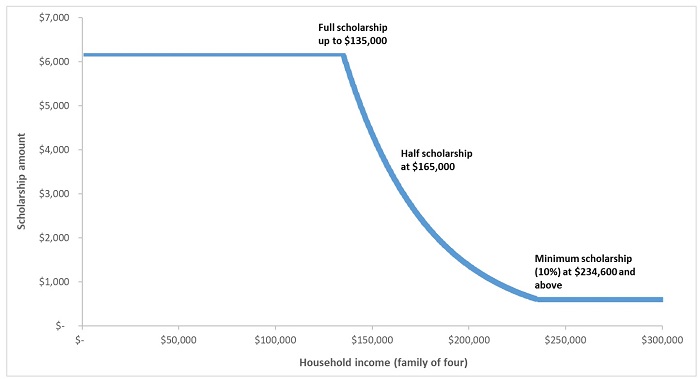
  • Full scholarships will be available for families whose earnings are at or below 450 percent of the federal poverty level (FPL). This is currently $135,000 for a family of four. In school year 2023– 24, that amount is expected to be $6,165 in grades K–8 and $8,407 in high school.  

  • Reduced scholarships will be available for families with higher incomes. At 450 percent of FPL, the “sliding scale” kicks in. For example, a family earning exactly 550 percent FPL will receive a grade K–8 scholarship worth half the full amount ($3,083). At 650 percent FPL ($195,000 for a family of four) it goes down to one quarter of the full amount ($1,541 in grades K–8).

  • Minimum scholarships worth 10 percent of the full amount—$617 for grades K–8—will be available for families with incomes above 782 percent FPL.[2]

The mechanics of this sliding scale are complicated, but Figure 1 shows the expected results. A majority of Ohio families—likely around 70 percent—will be eligible for full EdChoice scholarships, while others qualify for lesser amounts. This approach should ease the minds of those worried that a universal program amounts to a “subsidy for millionaires.” It also reduces the expense of extending scholarships to the 90,000 some students who previously paid full tuition and had never received public support for their educations.

Figure 1: EdChoice scholarship amounts (grades K–8) for a family of four, by household income

Sliding scale edchoice blog figure 1
Note: This figure is based on projections by the Ohio Legislative Service Commission that the full scholarship amount for grades K–8 will be $6,165. Though not displayed, the sliding scale works the same in high school.

Ohio has a proud history of being on the forefront of the educational choice movement, and the state’s private-school choice programs have steadily expanded over the past couple decades. With passage of this biennial budget, the legislature made eligibility universal. But it did so in a smart way that continues to recognize the importance of supporting low-income families who struggle to access private school options.[3] Kudos to Governor DeWine and Buckeye lawmakers for opening EdChoice eligibility to all in a fair and sensible way.


[1] In FY24—this coming school year only—the state will provide full scholarships up to 450 percent FPL, and then apply income “brackets” to reduce scholarships above that point (e.g., 450 to 500 percent FPL = $5,200 scholarship in grades K-8; 500 to 550 percent FPL = $3,650 scholarship).

[2] Continuing former policy, higher-income families above 450 percent FPL remain eligible for an unreduced scholarship through the “performance-base” EdChoice program if their children would otherwise attend a low-performing public school.

[3] Moving forward, legislators should consider further differentiation in scholarship amounts below the 450 percent threshold. For instance, they could create a “poverty weight,” akin to the DPIA component of the public school funding formula. This might provide 125 percent of the full scholarship amount for families below 200 percent FPL. That work, of course, is for another day.

view
School choice opponents and OE blog image

Even school choice opponents should support open enrollment

Jessica Poiner
7.14.2023
Ohio Gadfly Daily

Now that the latest state budget is officially in the books, it’s safe to say that school choice stole the show. Every student in Ohio is now eligible for an EdChoice voucher, though higher-income families will receive reduced scholarship amounts. Charter schools, which have long been underfunded compared to their traditional district counterparts, received much-needed funding boosts via the Quality Community School Support Fund, a brand-new equity supplement, and increased facilities funding. Lawmakers also tackled school transportation, which has traditionally been a sore spot for choice programs, and held the line on charter school accountability. 

These changes will provide thousands of families with more high-quality choices. But not everyone is pleased about parents and kids having more options. Long-time school choice critics called the voucher expansion “bad public policy.” And although traditional school districts received a 12 percent boost in foundation aid, the Ohio Federation of Teachers is still claiming that Ohio’s voucher “scheme” will decrease state support for public schools. Choice opponents often make similar claims about charters, even though studies from Ohio and elsewhere show that school choice programs don’t hurt district achievement or funding. In fact, Ohio data demonstrate that per-pupil funding actually increased between 2000 and 2019 in districts with higher concentrations of charters and private schools.

Over the years, Fordham has spilled plenty of ink arguing that Ohio’s education system should be student-focused and not system-focused. Being student-focused means recognizing that kids aren’t dollar signs and that no school, regardless of its governance structure, is entitled to students or the funding that comes with them. It also means acknowledging that different kids have different needs, and that sometimes their neighborhood public school isn’t the best place to meet those needs. But for some advocates of traditional public education, that’s sacrilege. They seem to believe that district schools—and only district schools—should get to educate kids. Which is exactly why they should wholeheartedly support making open enrollment mandatory in Ohio.

As a reminder, open enrollment is a school choice model that allows students to attend public schools other than the one they’re assigned to by their district of residence. There are two types: intra-district open enrollment, which allows students to transfer from one school to another within their resident district; and inter-district, which allows students to attend a school in a district other than the one in which they live. Ohio has allowed districts to admit students who live outside their residential boundaries since 1989, but district participation has always been voluntary. It’s up to local school boards to determine whether nonresident students can enroll, and districts that choose to participate can also decide whether to accept students from only neighboring districts, or from anywhere in the state.

Approximately four in five Ohio districts accept students via inter-district open enrollment. In 2022, just under 80,000 students open enrolled, adding up to nearly 5 percent of Ohio’s public school student population. Many of the districts that refuse to enroll nonresident students are located in affluent suburban areas surrounding the state’s largest cities. The students living in these cities are largely low-income and Black or Hispanic—the precise student demographics that a 2017 Fordham study found benefit most from open enrollment. But because more than one hundred districts surrounding Ohio’s urban areas refuse to participate, thousands of students are locked out of opportunity thanks to district boundary lines that aren’t sacrosanct but are treated as such despite their troubling history. Even more worrisome, districts’ refusal to participate in open enrollment can perpetuate patterns of segregation. It’s educational redlining.

If traditional district advocates are serious when they say that Ohio’s future depends on all kids receiving a great education regardless of their race, zip code, or family income, then they should throw open their doors and welcome all families, not just those who can afford to move. If they’re being honest when they claim that traditional public schools are open to everyone, then they should prove it by supporting open enrollment. If they’re as concerned about school diversity as they claim to be in their ongoing voucher lawsuit, then mandatory open enrollment should be right up their alley, as it would allow disadvantaged students to attend school with more advantaged peers. And if lawmakers’ efforts to bolster charters and private school choice during the recent state budget are raising concerns about the future of public schools, then open enrollment presents the perfect opportunity for the education establishment to champion district schools and show Ohioans all that they have to offer.

For some folks, this might be their first foray into supporting school choice. What can they do to push for expanded open enrollment? A recent report from the national education nonprofit EdChoice (which is distinct from Ohio’s voucher program) is a great place to start. Based on the report’s findings, here are a few recommendations.

1. Require all Ohio districts to participate in inter-district open enrollment.

Instead of allowing districts to opt out, state law should require all districts to opt in, unless the district is already at capacity. Declining enrollment in many districts across Ohio will likely ameliorate capacity concerns, but it’s important for state policy to acknowledge them.

2. Ensure that parents can easily find which schools have open seats.

Districts should be required to consistently and clearly update their current open enrollment status on their websites. Lawmakers should consider following the lead of states like Arizona, Florida, and Oklahoma, where districts are required to post their open seats by school and grade level, and to update those numbers periodically.

3. Ensure that open enrollment is available to all students, without them needing to meet certain criteria.

Once they start accepting enrollment applications from nonresident students, districts should be required to follow what the EdChoice report refers to as an “equitable selection process.” A lottery system, for example, to allocate available seats to open enrollees could help ensure fairness. Lawmakers should also prohibit discrimination. For example, districts should be forbidden from asking parents to disclose their student’s IEP status when applying for open enrollment.

4. Address transportation barriers.

Like many other forms of choice, one of the biggest barriers for open enrollment is transportation. If students can’t get to a school, then it doesn’t matter whether they’re able to enroll. State lawmakers could address this issue by reimbursing parents for transporting their children. Ohio already does this for families of students attending charter and private schools when their resident district deems it “impractical” to transport them, but does not offer a payment in lieu of transportation for open enrollees.

***

For school choice opponents focused on systems and not kids, this year’s budget likely feels like a loss. It doesn’t matter that districts received a 12 percent bump in funding, that charter schools in Ohio are more accountable for their results than traditional public schools, or that Ohio’s private school choice program hasn't made the sky fall. If the options offered to parents aren’t traditional district schools, then they’re a no-go.

But Ohio’s inter-district open enrollment program is comprised of traditional district schools. Research shows it has a positive impact on disadvantaged students. And if public school advocates mean it when they say that every child deserves a great education, then they have to acknowledge that for some kids, that education will come from somewhere other than a zoned public school. If they’re not ready to admit that charter and private schools can meet students’ needs, fine. But their failure thus far to fully support open enrollment is direct evidence that they’re putting systems and adult interests ahead of kids. 

view
Public-Education-Your-Way-Report SR image

A fifty-state analysis of non-district students’ access to district-provided services

Jeff Murray
7.25.2023
Ohio Gadfly Daily

Traditional district schools have become providers of many services and benefits for students. The list is nearly endless, but includes food provision (both in school and on weekends/summer break), athletics, the arts, computer and tech education, medical care, summer camps, and counseling. However, the burgeoning of school choice has created a bifurcated (or trifurcated) structure in some areas, where families who choose non-public or homeschooling options can be shut out of these benefits or, at the very least, have to work much harder to access them. Believing that all students should have access to the services provided in public schools, the national nonprofit organization yes. every kid. recently released a report looking at which states are addressing the divide.

Analysts Lily Landry and Sam Niederholzer examined the education statutes of all fifty states to find answers to a dozen questions regarding access to districts’ courses, services, and extracurriculars. These questions cover access (or lack thereof) for non-public and homeschool students, as well as for non-district-residents, which includes charter and district students living across attendance lines. They also examine funding structures, limitations, and any instances where districts can exercise discretion to impose access limits.

Only one state checks the boxes in all twelve categories: Idaho. The Gem State’s statute—which explicitly spells out the universality of access to public schools for all students regardless of which school they attend—is particularly lauded. (Of course, just because the statute says something doesn’t mean it happens smoothly every time, but the report does not go into that level of detail.) Four other states are also highlighted for positive statutory efforts around this issue. New Hampshire’s statute uses “shall” and not “may” language to spell out what courses and activities must be made available to parents, and to enshrine the idea that minimal barriers can be erected around them. Iowa law specifies that offerings available to non-district students should be provided at the same level as those provided for full-time enrolled students and includes core curriculum, electives, and all extracurriculars. Alaska and Washington State go a step further, making sure that non-district families will not be charged more than resident families would be for courses, activities, and services. Among the ten top-rated states, wide access to academic courses is the most common plus point. Access to extracurricular activities is second.

On the other end, a baker’s dozen states check no boxes on the questionnaire. As a corollary to the above, that doesn’t mean that students outside a district’s borders can’t or don’t access courses or services at all; just that state law doesn’t make an affirmative stand for access. In these states, it is likely an ad hoc process driven by parents and families who possess the wherewithal to advocate strongly and persistently on behalf of their children. Nine other states check only one box. The most common single item spelled out in statute is guaranteed access to extracurricular activities for homeschool students, likely a result of nearly decade-long efforts to pass “Tim Tebow laws” around the country.

Ohio checks the homeschooler box and just one other: Giving public school students explicit access to another public school’s services. This is reflective of both interdistrict open enrollment, a longstanding and widely popular school choice option, and a more recent effort to make sure charter school students can access extracurriculars in the district where they reside if their own schools don’t offer the same activity.

Landry and Niederholzer conclude with a message of hope that more states will take after the four exemplars that actively seek to erase the hard lines between school choice and availability of public services to children and families. It is probably an uphill fight, even in states where school choice is growing, but it is a worthwhile effort.

SOURCE: Lily Landry and Sam Niederholzer, “Public Education Your Way,” yes. every kid. (July 2023).

view

The path to four million apprentices

Jeff Murray
7.20.2023
Flypaper

For folks who question the value of a traditional four-year college degree—whether they have done so for ages or have only recently lost faith—apprenticeships seem like a promising alternative for young people leaving high school. They provide immediate pay, in-demand job skills training, mentorship from an experienced professional, and conclude with a nationally-portable credential. Why, then, has the United States lagged behind its international peers in creating, promoting, and filling apprenticeship slots? And can those barriers be overcome to finally supercharge the model here? A recent brief from the Progressive Policy Institute (PPI) tries to find out.

Author Taylor Maag focuses on formal, federally-registered apprenticeship efforts, which allows for comparison to other countries like the United Kingdom and Germany. Unfortunately, it also leads immediately to roadblock number one: Historically, the United States has favored college matriculation over career education for high school graduates (and for non-graduates seeking to return to complete their education, too), and federal expenditures reflect this favoritism. Pre-pandemic, Maag reports, the federal government spent roughly $149 billion per year on higher education versus $58 billion for workforce-related education and training. And even that latter category included Pell Grants and education programs for veterans, most of which also went to traditional higher education institutions. Maag estimates that the U.S. only spent about $16 billion, spread across seventeen separate federal programs, to provide workforce-focused education, employment, and training assistance. Apprenticeships comprised just a fraction of that.

Roadblock number two: lack of employer buy-in. Apprenticeships are costly to start up, onerous to maintain at a high level, and require a lot of time and oversight. All of this for what could be minimal yield from the pool of potential apprentices, or apprentices who may not stick around once their program is finished.

Roadblock number three, meanwhile, is political. Specifically, Maag states that an effort by President Trump to make apprenticeships simpler to set up and run (via executive order) was opposed so broadly and vehemently that previous bipartisan agreement on the issue was ripped asunder. While that sounds like a very specific and recent point of contention, quickly rescinded upon the change of leadership, historic levels of buy-in on both sides of the aisle will surely be necessary to make an impact.

Currently, just 0.3 percent of all workers in America are apprentices. PPI is looking to boost those numbers significantly to more closely match the percentages of apprentices in the workforce of other countries (2.7 percent in the U.K. and 3.7 percent in Germany, to name two examples), and that means adding 1 million U.S. apprentices annually until the goal of 4 million is reached and maintained. PPI’s recommendations to achieve this lofty goal lead off with federal expenditures of approximately $4 billion a year (based upon a 2015 analysis that showed a single registered apprenticeship cost $4,000 per year to create, oversee, and maintain). The additional money would be carved off from current higher education funding, which makes sense, given that most potential apprentices would be young people diverted from attending college.

But even with that logic, and the fact that the total would represent a tiny reduction in the higher ed line, Maag does not explain why PPI believes the federal government should be footing the entire bill. If employers will receive significant benefit (for every dollar spent on apprenticeship, she writes, “employers get an average of $1.47 back in increased productivity, reduced waste of time and cost, and greater front-line innovation”), surely they should be ponying up some fraction of the seed money as other exemplar countries do. 

PPI also recommends an expansion of recipients of federal support, including what are termed “intermediaries” (public organizations, nonprofit groups, labor unions, and for-profit service providers), who would help employers set up and maintain their apprenticeship programs. Additionally, the brief calls for “encourag[ing] alignment and partnership” across government programs to ensure this new apprenticeship paradigm doesn’t become siloed at the federal level, and to make sure that K–12, higher education, and workforce systems are all on the same page at the state and local levels, too.

The policy brief concludes that this proposal is a “smart way to grow a high-quality, evidence-based career path” with the aim of “leveling the playing field between degree and nondegree workers while also ensuring strong returns on investment through outcomes-based funding and industry-driven partnerships.” If the college degree premium is waning, then PPI is probably right. Nevertheless, it stills feels like a huge swing for the fences either way.

SOURCE: Taylor Maag, “Strengthening America’s Workforce: The path to 4 million apprenticeships,” Progressive Policy Institute (May 2023).

Fordham Logo

© 2026 The Thomas B. Fordham Institute
Privacy Policy
Usage Agreement

National

P.O. Box 110
Burke, VA 22009

202.223.5452

[email protected]

Ohio

P.O. Box 82291
Columbus, OH 43202

614.223.1580

[email protected]

Sponsorship

130 West Second Street, Suite 410
Dayton, Ohio 45402

937.227.3368

[email protected]