
In Ohio, where policymakers and educators are working to boost student outcomes, ensuring that kids show up to school is critical. Students who have never been chronically absent[1] are six times more likely to read on grade level by the end of third grade and nine times more likely to graduate from high school on time. Being chronically absent, meanwhile, can negatively impact both academic and social-emotional development.
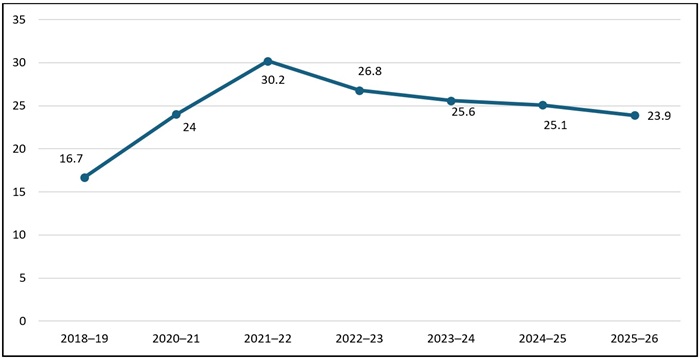
During the height of the pandemic, Ohio’s statewide chronic absenteeism rate skyrocketed to 30 percent. It has yet to return to pre-pandemic levels. Figure 1, which displays the statewide chronic absenteeism rate over time, shows that the biggest drop since the pandemic was just over 3 percentage points in 2022–23. Since then, Ohio has been stuck in the mud. Each year, the statewide rate ticks downward by roughly 1 percentage point. If progress doesn’t accelerate, Ohio won’t return to its pre-pandemic rate until 2033. That’s 11 years after the initial spike and nearly the entire length of a student’s K–12 career.
Figure 1. Ohio’s statewide chronic absenteeism rate, 2018–2026
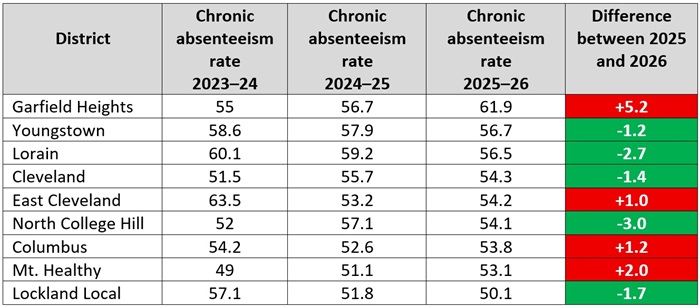
It’s deeply concerning that almost a fourth of Ohio students were chronically absent during the 2025–26 school year. But it’s especially worrisome that in some districts, absenteeism rates are even higher. Table 1 identifies nine locales that registered rates above 50 percent during the 2025–26 school year. These same districts also had rates above 50 percent during the two previous school years (with the exception of Mt. Healthy, which had a rate of 49 percent in 2023–24). That’s three straight years of more than half of the student population missing at least 10 percent of instructional time. Moreover, four of them actually got worse in 2025–26: Garfield Heights, East Cleveland, Columbus, and Mt. Healthy.
Table 1. Districts with chronic absenteeism rates above 50 percent in 2025–26
To their credit, state leaders have attempted to address Ohio’s sky-high numbers. In 2024, the Department of Education and Workforce (DEW) published the Ohio Attendance Guide, which outlined district and school practices for early intervention. That same year, Ohio joined more than a dozen other states in pledging to cut chronic absenteeism by half. In 2025, policymakers revamped state law and required districts to update their absence policies accordingly. And earlier this year, DEW launched a new statewide attendance dashboard that helps local leaders and the public track attendance trends and chronic absenteeism rates by district, school building, and grade level.
It will take some time to determine if the more recent efforts have an impact. (The 2026–27 school year is the first full year of implementation for both the revamped law and the dashboard). In the meantime, lawmakers might be tempted to put chronic absenteeism on the back burner. But that would be a mistake. Although attendance is largely a local issue, state policymakers play a critical role in creating an environment where schools can successfully boost attendance. With that in mind, here are three proposals lawmakers should implement as soon as possible.
1. Beef up accountability for attendance.
State report cards currently include chronic absenteeism as one of several indicators on the Gap Closing component. There are two ways schools receive credit for this indicator: meeting the statewide target rate, or reducing their chronic absenteeism rate from the previous year. Although it makes sense to give schools credit for reducing their rates, the current bar for reduction is far too low. Districts with rates above 36 percent—more than one-third of their students are chronically absent—need only reduce their rate by just 1.1 percentage points. Under this standard, several of the districts identified in Table 1 received full credit from the state for “closing the gap” on absenteeism even though they posted rates above 50 percent for a third consecutive year. To improve Ohio’s attendance numbers, DEW should increase the required absenteeism reduction rate to 5 percentage points for a school or district to receive credit on the state report card.
2. Meet families where they are.
In 2024, researchers at Brookings found that less than half of caretakers with a child at risk of being chronically absent reported being concerned about it. Remember, research is clear that chronic absenteeism can negatively impact both academic and social-emotional development. If families aren’t worried about absenteeism, it’s likely because they don’t realize why they should be.
One way to get that message across is to go out into the community and meet families where they are. In the spring of 2021, state leaders in Connecticut launched a home-visit initiative called the Learner Engagement and Attendance Program. As part of the program, 15 high-need districts were provided with funding to pay for school staff and community organizers to visit nearly 8,700 chronically absent students in their homes. A mixed-methods evaluation conducted by the Center for Connecticut Education Research Collaboration indicates that the program had a meaningful impact.
Connecticut’s initial investment cost roughly $10 million.[2] Ohio could mirror this try-it-and-see approach by establishing a pilot project for a small number of districts. Asking interested districts to apply would ensure local buy-in. And using the state’s attendance dashboard to closely track absenteeism rates among all applicants—districts that were accepted into the pilot, as well as those who applied but didn’t receive funding—would allow for a genuine evaluation of the program’s effectiveness.
3. Help schools do the heavy lifting.
Another innovative way state leaders could combat chronic absenteeism is by investing in attendance coaches. As with the home-visit initiative, state leaders could establish a pilot program that invites interested districts to apply for a state-funded attendance coach to work in their district. Coaches could collaborate with administrators to analyze real-time data provided by the state’s dashboard, evaluate current prevention and intervention efforts, identify ways to improve, and train staff on effective implementation. They could support teachers by managing communication with the families of chronically absent students. And they could support students by building relationships with those who are frequently absent and working alongside them and their families to dismantle barriers to attendance. As part of its early literacy initiative, Ohio has sent more than 100 literacy coaches into schools to support science of reading implementation. Why not try something similar to boost attendance?
***
It’s disheartening that Ohio has made so little progress on chronic absenteeism in recent years. But now isn’t the time to bury our heads in the sand and accept the much higher post-Covid absenteeism rates as the new normal. There are practical and innovative solutions available that could bolster efforts that are already underway. Now is the time for policymakers to act—Ohio kids and families deserve it.
[1] Chronic absenteeism is defined as missing at least 10 percent of instructional time for any reason.
[2] Initially, Connecticut designated just over $10 million in federal Covid-relief funding to support these 15 districts. State lawmakers went on to appropriate additional funds—$7 million in 2022 and another $7 million in 2023—to sustain operations through December 2026.