
Three years ago, Ohio policymakers established a statewide science of reading initiative aimed at boosting reading achievement. The sweeping effort requires public schools to use state-approved high-quality instructional materials (HQIM), expects teachers and administrators to complete professional development, provides reading coaches for school-based support, and audits educator preparation programs to ensure future teachers are well-trained. To bolster implementation, regionally based instructional implementation teams will soon conduct mandatory reviews of low-performing schools and offer their services to any school seeking an independent review.
Consistent, rigorous implementation of these policies should produce reading achievement gains. State report cards for the 2025–26 school year, which were released last week, offer the latest look at Ohio’s progress. The results reveal both good and bad news.
First, the good news: Statewide proficiency numbers are creeping upward. Table 1 shows the number of students who scored proficient or above on the state’s English language arts (ELA) exams during the last four school years. The final column identifies the difference between 2025 and 2026 results, with green shading indicating improvement and red indicating a decline. In most grade levels, proficiency rose by roughly 2 percentage points. The improvement in third grade is noteworthy, as those students have been at the center of Ohio’s science of reading effort. Eighth grade saw the highest jump, with an increase of almost 4 percentage points. Meanwhile, although fourth and seventh grade results both inched backward, the decline was small.
Table 1. Percentage of students scoring at least proficient on English language arts state tests
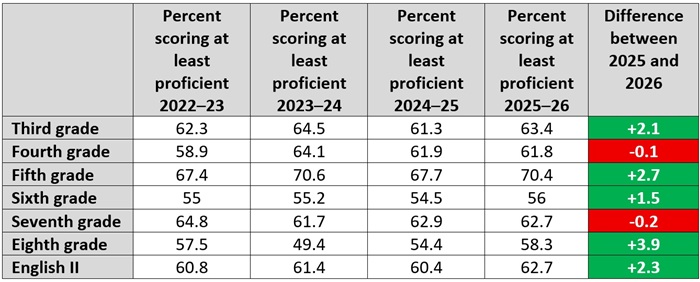
The overall state report card trumpets similar progress. Proficiency numbers in ELA were up in every single demographic, including economically disadvantaged students (+2.7), students with disabilities (+1.2), English learners (+1.2), Black students (+3.4), and Hispanic students (+3.5). These aren’t monstrous gains, but they do reflect improvement. Remember, Rome wasn’t built in a day. Two years into full implementation of a complex statewide effort, these scores are a positive sign. If Ohio schools continue faithfully implementing the science of reading, we should continue to see higher achievement.
Unfortunately, there’s also some bad news. Although more students reached proficiency in 2026, at least one-fifth of students in nearly every grade level scored in the lowest category, or “limited.” Moreover, in three grades, the percentage of students who scored limited actually went up from last year.
Table 2 identifies the percentage of students in grades 3–8 and high school who scored limited during the last four school years. The final column identifies the difference between 2025 and 2026 results, with green shading indicating improvement (fewer students scoring limited) and red shading indicating a regression (more students scoring limited).
Table 2. Percentage of students scoring limited on English language arts state tests
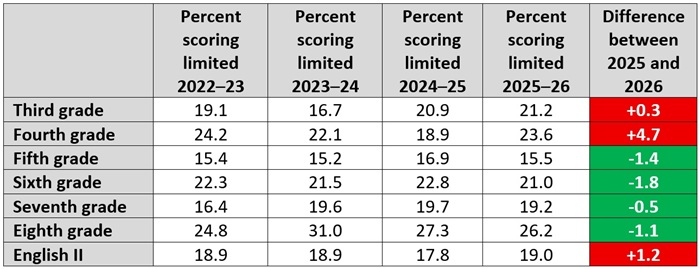
An increase in the number of “limited” students is never good, as scoring in the lowest category is a clear sign that students are falling behind. But it’s worrisome that two of the three grades that saw increases are third and fourth—students at the tail end of elementary school, where most of Ohio’s reading improvement efforts are focused. It’s especially worrisome that the jump in fourth grade is nearly 5 percentage points. That increase brings the number of Ohio fourth graders scoring limited to nearly 24 percent, or one-fourth. In raw numbers, that’s over 29,000 fourth graders who scored at the lowest level.
What makes these results particularly disheartening is the fact that they could have been avoided. Under the Third Grade Reading Guarantee, Ohio schools were required (with limited exceptions) to hold back third graders who fell short of a state-defined “promotional score” on the state’s reading exam or an alternative test. Students who were retained under this provision were required to receive intensive intervention from their schools to help them catch up to their peers. Between 2016 and 2019, when the retention provision of the Guarantee was in place, the percentage of students who scored “limited” declined from 27 percent to 14 percent. According to my colleague Aaron Churchill, this “substantial decline in struggling readers suggests that retention—and the accountability it provided—increased schools’ sense of urgency and obligation to help children meet state reading targets to avoid holding them back.” Moreover, a rigorous analysis from the Ohio Education Research Center showed that retained students scored significantly higher on state exams into middle school than their peers who narrowly met the state’s promotional threshold in third grade.
The upshot? Retention decreased the percentage of students who scored limited and benefited retained students in the long run. However, despite this evidence—and additional proof showing that retention worked in other states, too—Ohio lawmakers gutted the policy in 2023. Three years later, despite concentrated efforts to boost early literacy outcomes, the share of students scoring limited among third and fourth graders is rising.
The latest round of state report cards indicates that Ohio is making progress with the science of reading. But there are also warning signs that must be heeded if we’re going to move the needle. We have clear evidence that students performed better when Ohio had a retention policy in place. If state leaders truly believe that boosting reading achievement is imperative, then it’s time to bring back retention.