Amid plunging enrollment and budgetary woes, Ohio’s urban districts have moved to permanently close dozens of school buildings. Rightsizing their physical footprint is a necessary step, but in so doing, districts are skirting legal provisions requiring them to offer buildings to public charter schools. These violations of state law—the intent for sure, if not the plain lettering—demand legislative action that ensures compliance with state requirements.
As a policy refresher, districts must offer for sale or lease an “unused” facility to nearby charter schools. Such facilities have either been entirely unused for one year—sitting vacant—or less than 60 percent utilized for instruction during the previous year. Charter schools located within a district’s boundaries are eligible to bid on an unused facility, with priority given to high-performing charters. If no bidders emerge from this process, a district is then allowed to pursue other options—e.g., selling it to a private developer—or simply keep the facility in its possession. In addition to this mandatory disposal process for “unused” facilities, districts—when voluntarily seeking to offload a facility—must also first offer it to charter schools before soliciting other bids.
These laws make perfect sense. Keeping facilities open as public schools honors the original purpose of the building and the taxpayer investments in it. Moreover, by handing the keys to a charter school, it ensures the facility receives maintenance and care, while serving children in a community. This is a much better option than allowing districts to mothball facilities and leave them to crumble and become urban blight. Lastly, the law assists charter schools, which have long struggled to secure adequate facilities due to policies that deny them access to local bond revenues and state construction grants. Through the processes outlined in state law, charters have an avenue to obtain a building at a more affordable cost.
With these legal requirements and districts downsizing, we should be seeing more charter schools gaining access to facilities. But that’s not happening, as districts are sidestepping procedures set forth in state law. We at Fordham have repeatedly raised concerns about possible noncompliance—as has Governor DeWine—and this piece provides more examples of questionable behavior.
Columbus
Last December, the Columbus school board voted to demolish four school buildings after the 2025–26 school year. When asked about their right to bid on the buildings, board president Michael Cole told the Dispatch, “I don't know that if I were a charter school, that I would want that facility—we closed it for a reason.” But speculating on whether charters may or may not be interested is irrelevant. What the school board was obligated to do was offer the buildings and actually find out if any charters had use for them—and indeed, Andy Boy, a Columbus charter-school leader, suggested interest in the Dispatch story. Unfortunately, due to the district’s lack of cooperation, these facilities will be torn down when they could have received new life under charter school ownership.
Another apparent violation of state law relates to buildings that Columbus operates, despite having utilization rates under 60 percent—the threshold that obligates a district to offer a half-empty building to a charter school for lease or sale. According an October 2025 board meeting presentation, administrators identified 15 buildings with utilization rates under 60 percent. In that very same presentation, the district also strangely indicated that the 60 percent rule was not current law, even though the provision has been in effect since 2022. Whether this reflects legal incompetence or was an intentional misrepresentation of statute is unclear. But the fact remains that these severely underutilized schools should be on the offer to Columbus charter schools.
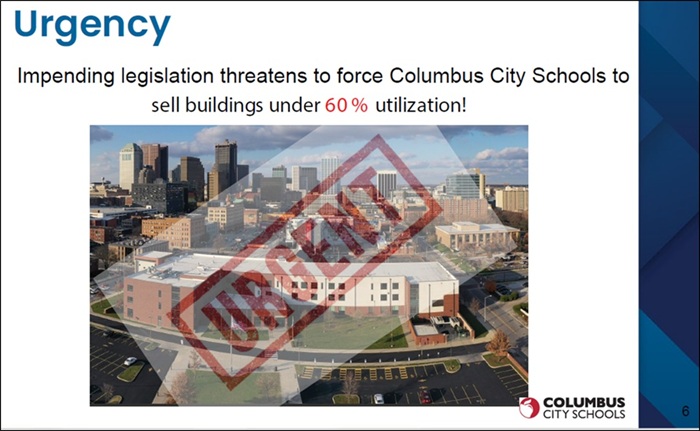
What is happening with these underutilized schools? While none of them were among the four building slated for demolition, three will continue operating in 2026–27 and permanently close next spring. A fourth, Fairwood Elementary, closed at the conclusion of the 2025–26 school year. In a recent article, the principal said, “Hopefully, we’ll be able to keep the building or refurbish the building or do something in this space that will be of a benefit to the community.” A nice parting thought, but the quote evidences no whiff of possible charter ownership. As for the other 11 underutilized buildings, they were all in operation through 2025–26, and one might reasonably assume they will continue operating next school year as district-run schools—seemingly in defiance of state law, if the buildings were not first offered to charter schools.
Cleveland
Turning northwards, Cleveland has made news for its aggressive plan to close some two dozen schools. A recent Signal Cleveland article indicates that several buildings will remain district property, while others may be handed over to the municipal government. For 12 other buildings, the district in partnership with the city is looking to sell them to developers. This is all well and good, but the legal question remains: Did the district offer these facilities first to city charter schools before keeping these buildings in their possession or engaging private developers? On the redevelopment side, the city’s Request for Qualifications makes no mention of having fulfilled state requirements to offer the vacant buildings to charters before seeking other development opportunities. The omission is not proof positive, but word on the street is that the buildings were never offered to the city’s charter schools.
Senate Bill 311
The intent of state law is clear: Taxpayer-funded school buildings should be used to educate Ohio students. When school districts aren’t using these public assets, they are responsible for making good-faith efforts to transfer ownership of the building (or lease it) to a public charter school. But whether out of fear of competition or outright hostility toward charters, districts are playing keep-away games with facilities.
Introduced earlier this year, Senate Bill 311 takes aim at curbing the abuse through stronger statutory language. The legislation, which Fordham supports, would do the following:
- Clarifies the 60 percent rule by setting an unambiguous capacity standard;[1]
- Clarifies that districts cannot demolish a facility before offering it to charter schools, and adds a fine for noncompliance;
- Clarifies that districts cannot offer a facility to another municipal government before offering it to charter schools;
- Requires the state to publish an annual list of districts’ unused facilities; and
- Includes several commonsense exceptions to mandatory disposal.[2]
In addition to these provisions, Senate Bill 311 also increases the likelihood that an offered facility will be purchased or leased. It allows high-performing charter schools located outside of a district to bid on an unused facility (with secondary priority behind local high-performing charters); private schools are added to the mix, as well, given third-tier priority alongside non-high-performing local charter schools. Finally, the bill contains language intended to make an unused facility more affordable for charters to actually purchase.
* * *
Public school officials are supposed to uphold the law and model for young people how to be law-abiding citizens. But when it comes to state laws regarding unused school facilities, some administrators seem to be taking them as suggestions—not legal imperatives. This gamesmanship not only sets a poor example, but also keeps half- to fully-empty buildings out of the hands of educational entities that are helping students succeed. It’s time to stop the games and ensure that taxpayer-funded buildings are used to educate Ohio students.
[1] Specifically, for the past two school years, a building is “unused” if enrollment is less than 60 percent of the building’s maximum enrollment per its certificate of occupancy or its highest enrollment over the past ten years.
[2] For instance, if a facility is less than ten years old or is undergoing significant renovations.