
Research demonstrates that teachers are the single most important input in public schooling. Students with more effective teachers experience improvements in a whole range of education and life outcomes relative to students exposed to average (or worse) teachers. Attracting and retaining the most talented teachers is likely the most effective way to help students realize their potential.
That’s why teacher salaries are important. The more schools pay, the more likely they are to attract and retain talented teachers. Headwinds such as recent falloffs in school climate—as well as a long-term decline in the prestige of the teaching profession—make financial incentives even more important in recruiting and retaining effective teachers.
Unfortunately, as Chad Aldeman recently documented, inflation-adjusted teacher salaries have been flat since 2002. Meanwhile, spending on U.S. public schools increased by over 30 percent, adjusted for inflation, over the same time period. The Fordham Institute’s Michael Petrilli recently argued that the reason for stagnant teacher wages is that school districts—under pressure from teachers unions—have focused on hiring more teachers and other staff as opposed to increasing salaries.
Are Ohio’s teacher salaries also stagnant? If so, is it a district management issue, or has public funding become less generous? To answer these questions, I analyzed funding, salary, and staffing data at both the teacher and school levels.
The results in a nutshell: Adjusting for inflation, funding for Ohio public schools has consistently increased, but teacher salaries have declined since the 2018-19 school year. Further analysis indicates that this decline occurred because local districts have failed to downsize, refusing to reduce the number of teachers and (to a lesser degree) the number of schools, to align with declining student enrollment. If we wish to strengthen Ohio schools by recruiting the best and the brightest, districts must overcome local political forces that put adults’ jobs ahead of student needs.
School-level spending and teacher salary trends in Ohio
Table 1 (below) reveals that a decrease in public funding is not to blame for the decline in teachers’ salaries. The average Ohio school experienced an inflation-adjusted increase of 4 percent in total non-capital spending ($545 per pupil) between 2018-19 and 2023-24. Looking more narrowly at instructional expenditures (expenditures on salaries for teachers and aides working directly with students), we find a similar 4 percent increase ($360 per pupil) over that same span.
Table 1. School-level spending and average salaries (inflation adjusted, 2024 dollars)
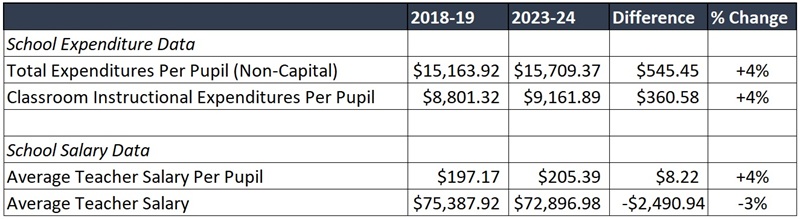
The school expenditure data line up with school-level teacher salary data, which indicate a 4 percent increase in the average teacher salary per pupil. Yet, the average teacher salary in these schools declined by 3 percent (approximately $2,500 lower in 2018-19 than in 2023-24). How can this be?
Teacher salaries declined because schools’ teaching staffs expanded relative to enrollments
Statewide, enrollments in district schools declined by 4.9 percent between 2018-19 and 2023-24 (from approximately 1.55 million to approximately 1.47 million students). To right-size a district’s staff and portfolio of schools, the number of teachers and schools also needed to decline by 4.9 percent. Doing so would have enabled districts to increase their teacher salaries by at least 4 percent (the increase in per-pupil public funding indicated in Table 1).
Unfortunately, statewide, the total number of district teachers declined by only 0.7 percent over that span (from approximately 97,800 to approximately 97,100). School closures also failed to keep pace with enrollment losses, as the number of district schools declined by approximately 2.4 percent (from 3,064 to 2,992 between 2019 and 2024). Because the total number of Ohio teachers and schools did not decline by the necessary 4.9 percent, the average school now has more teachers and fewer students than it did during the 2018-19 school year.
The school-level analysis in Table 2 illustrates the consequences precisely. The average public school now has a 2 percent larger teaching staff than the average school in 2018-19, and it has an enrollment that is 2 percent lower. In other words, the failure to right-size means more teachers in schools that remain open, as well as emptier buildings. Together, these differential trends led to a 6 percent reduction in the average student-teacher ratio in the average district school—one fewer student per teacher.
Table 2. School-level staffing and enrollments
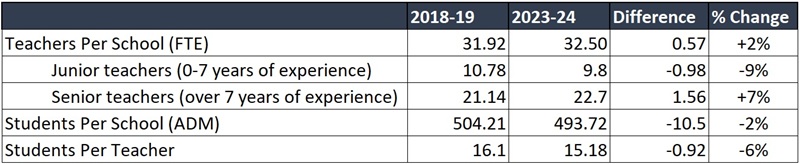
Importantly, the data indicate that districts protected the jobs of (relatively expensive) senior faculty, with junior teachers being let go first. The number of senior teachers (those with over seven years of experience) increased by 7 percent whereas the number of junior teachers (those with less than seven years of experience) declined by 9 percent.
Local school governance needs to be fixed
The 3 percent decline in inflation-adjusted average teacher salaries occurred even as total spending on teacher salaries increased by 4 percent. Suppose that districts had kept student-teacher ratios steady since 2019. With the same total budget, the average school could have given all teachers a $3,000 raise, which translates to a raise of 5.3 percent for the average junior teacher and a raise of 3.6 percent for the average senior teacher. Or, even better, suppose they gave the raises to the top 50 percent most effective teachers by rank. That would have been nearly $6,000 per teacher—about 11 percent for relatively effective junior teachers and over 7 percent for relatively effective senior teachers. But Ohio districts didn’t do that. Rather than investing in teacher quality and the long-term future of the educator workforce, they chose to protect the jobs of more senior teachers.
This poor personnel and financial management is unsurprising. District administrators lack managerial discretion. They are constrained by teacher tenure, which makes it difficult (if not impossible) to dismiss even atrocious senior teachers. Thus, predictably, districts were forced to thin their teaching forces by letting go or failing to hire new junior teachers. Current Ohio law also requires districts to adopt salary schedules based on years of experience and education. That means that essentially everyone with the same training and experience must be paid the same amount, regardless of their effectiveness. In other words, even if they wanted to, district administrators generally could not target larger raises to attract or retain the most talented teachers.
Moreover, Ohio’s collective bargaining law enables teachers unions to prescribe in detail how personnel must be managed—the pay schedule, class sizes, procedures for hiring and firing (last in, first out), and procedures for evaluation and classroom assignments. Collective bargaining agreements also often dictate the procedures for closing schools. Pile on top of that unions’ political power (they essentially help elect their own bosses to school boards) and Ohio’s superintendents are almost helpless in their efforts to direct resources toward their most productive ends.
There’s no easy fix. Reforming teacher tenure laws and salary schedules would be a great start. More fundamentally, reforming collective bargaining would be the most effective option, as it is the source of political power that maintains the status quo at the state and local levels. But public-sector unions are formidable political opponents and state lawmakers don’t seem to have the stomach to take them on again. It appears the best we can hope for in the short term is that the need for budget cuts as stimulus money dries up will provide political cover for administrators to let go of the least effective teachers and close half-empty schools. That could free up some funds to better compensate our most talented teachers going forward.