Mobile Navigation

  • National
    • Policy
      • High Expectations
      • Quality Choices
      • Personalized Pathways
    • Research
    • Commentary
      • Gadfly Newsletter
      • Flypaper Blog
    • Events
    • Scholars Program
  • Ohio
    • Policy
      • Priorities
      • Media & Testimony
    • Research
    • Commentary
      • Ohio Education Gadfly Biweekly
      • Ohio Gadfly Daily
  • Charter Authorizing
    • Application
    • Sponsored Schools
    • Resources
  • About
    • Mission
    • Board
    • Staff
    • Career
Home
Home
Advancing Educational Excellence

Main Navigation

  • National
  • Ohio
  • Charter Authorizing
  • About

Ohio Menu

  • Topics
    • Accountability & Testing
    • Advanced Education
    • Career & Technical Education
    • Charter Schools
    • Curriculum & Instruction
    • ESSA
    • Evidence-Based Learning
    • Governance
    • Personalized Learning
    • Private School Choice
    • School Finance
    • Standards
    • Teachers & School Leaders
  • Research
  • Policy
  • Commentary
    • Ohio Gadfly Newsletter
    • Ohio Gadfly Blog
    • Events

The Education Gadfly Weekly

Sign Up to Receive Fordham Updates

We'll send you quality research, commentary, analysis, and news on the education issues you care about.
Thank you for signing up!
Please check your email to confirm the subscription.

Ohio Gadfly—The Washington Post got its facts wrong on Ohio’s school governance debate

Volume 17, Number 23
10.17.2023
10.17.2023

Ohio Gadfly—The Washington Post got its facts wrong on Ohio’s school governance debate

Volume 17, Number 23
view
Ed governance overhaul context blog image
School Funding

The Washington Post got its facts wrong on Ohio’s school governance debate

Recently, The Washington Post published an article purporting to summarize Ohio's current legal battle over education governance. “Ohio governor and elected education leaders both say they're in charge,” blares the headline.

Jessica Poiner 10.17.2023
OhioOhio Gadfly Daily

The Washington Post got its facts wrong on Ohio’s school governance debate

Jessica Poiner
10.17.2023
Ohio Gadfly Daily

An overview of Ohio’s new teacher apprenticeship program

Jessica Poiner
10.12.2023
Ohio Gadfly Daily

Reforming collective bargaining could put Ohio public schools—and the teaching profession—on top

Stéphane Lavertu
10.9.2023
Ohio Gadfly Daily

Basic facts undermine the arguments of private school choice critics

Aaron Churchill
10.6.2023
Ohio Gadfly Daily
view

An overview of Ohio’s new teacher apprenticeship program

Jessica Poiner 10.12.2023
Ohio Gadfly Daily
view
Collective Bargaining blog form Stephane image

Reforming collective bargaining could put Ohio public schools—and the teaching profession—on top

Stéphane Lavertu 10.9.2023
Ohio Gadfly Daily
view

Basic facts undermine the arguments of private school choice critics

Aaron Churchill 10.6.2023
Ohio Gadfly Daily
view
Ed governance overhaul context blog image

The Washington Post got its facts wrong on Ohio’s school governance debate

Jessica Poiner
10.17.2023
Ohio Gadfly Daily

Recently, The Washington Post published an article purporting to summarize Ohio's current legal battle over education governance. “Ohio governor and elected education leaders both say they're in charge,” blares the headline. The subhead claims that “the state passed a law wresting authority over education policy from voters.”

If you stopped reading after that, you might assume that Ohio voters no longer have any say in education policy, and that “the state” now has some kind of unfettered ability to do what it wants in Ohio schools. Neither are true.

Let's start with the facts. Earlier this year, Ohio Governor Mike DeWine and the General Assembly enacted legislation that overhauls K–12 education governance at the state level. For many years, a state board of education that’s roughly half-elected, half-appointed has controlled the state’s education department. Unfortunately, this board has been dysfunctional and often fails to keep the focus of Ohio schools on student achievement. Fed up with its inconsistent leadership, Ohio lawmakers took steps to reduce the role of the state board and shift control of policy implementation to the governor’s office. The state’s education chief is now appointed by the governor (with the advice and consent of the Senate) and serves as a cabinet member. Even though this move more closely aligns Ohio with the education governance structures of other states (and the federal government, too), it has upset some of the elected state board members, who filed a lawsuit seeking to block the reforms. 

The sensibility of these reform efforts is likely lost on Washington Post readers for several reasons. First, the paper’s headline writers strategically place the term “elected” in front of “education leaders.” The state board of education members who are referenced here are, indeed, elected. But so, too, is the governor. Despite what the phrasing subtly implies by associating just one of the two sides with the will of the people, officials on both sides of the debate are elected. In a similar vein, the “state” referenced in the subheading isn’t some nefarious entity operating in the shadows and wresting away control from voters. The “state” is comprised of state-level lawmakers who are also elected by the people.

All three of these groups—the state lawmakers who passed the governance overhaul, the governor who signed it into law, and the state board members who are now trying to stop it—were elected to their positions. All three qualify as education leaders. All three must answer for their actions at the ballot box. And yet, in an attempt at a drop-the-mic moment in the final paragraph of the piece, the Washington Post offers this quote:

“For decades, parents in Ohio have gone to the voting booth to exercise their right to elect representatives empowered to advocate for them at the state level,” the plaintiffs said in a joint statement when they filed the lawsuit last month. “We will not sit back and let stand such a brazen power-grab that flies in the face of Ohio residents who value local input and control over their children's education.”

The implication here is that the governance overhaul would make it impossible for parents to do what they've done for decades—specifically, go to the voting booth and exercise their right to elect representatives charged with advocating for them. But that's not true. Ohioans will still elect members of the state’s General Assembly—representatives and senators who are charged with advocating for them at the state level, including in matters of education policy. They will also continue to elect a governor. Under the new structure, the governor—regardless of his or her political party—would appoint the leader of the revamped education department. In doing so, the governor would become more directly responsible to voters for educational decisions and student progress. In Ohio, that will create more public accountability for the overall direction of K–12 education, not less.

It’s equally important to note that eliminating the state board changes virtually nothing about local decision making. Quoting an accusation from a national advocacy group that the overhaul will “undermine the ability of school districts or school boards [or] elected leaders...to exercise their judgment over public education” is blatant fear mongering. It completely ignores that local school board elections across Ohio will continue to be held just as they have for decades. Local school boards exert considerable power over local schools: They establish academic policies and priorities, adopt curricula and instructional materials, sign collective bargaining agreements, manage the district's budget, and decide when to go to taxpayers to ask for additional funding. Parents and community members directly elect these local officials. Overhauling the governance of the state department of education won’t change any of that.

The rebuttal to these facts is likely an argument that the state board offered parents and voters a special privilege: Elected officials who were responsible only for education policymaking, and thus could focus all their attention on doing what's best for kids. Even if parents still have a say in education—and obviously, despite the clickbait headline, they do—it’s not as much of a say as they had under the state board. But that argument overlooks two important realities.

First, the myth that state board members are somehow better or more efficient than other elected officials because they only have to focus on education has been repeatedly disproven by the actions of board members themselves. Over the last few years, the board has been so busy miring itself in controversy and engaging in “psychological games” and public backbiting that it isn’t doing the work it should be. Laura Hancock, writing for Cleveland.com, said it best: “The board spends significant portions of time in confusion and arguing over parliamentary process. The board is ideologically divided and spends hours arguing over resolutions that don’t directly affect student achievement, even though Ohio kids are behind because of the pandemic.”

Second, there are several glaring historical examples of the state board refusing to do what's best for kids because doing so would require holding adults accountable. For example, in 2010, state lawmakers established a new set of graduation requirements that thoughtfully and purposely raised the bar for students to ensure that they were ready for what comes after high school. By the spring of 2017, the state board was trying to circumvent that law and advocating for a set of alternative requirements that would allow students to earn a diploma based on things like attendance, capstone projects, and volunteer hours. These measures have little to do with the knowledge and skills that most colleges and employers are looking for, and would likely have resulted in students earning meaningless diplomas. It’s hard to argue that state board members are doing what’s best for kids when they champion policies that don’t expect kids to learn.

None of this history of dysfunction was mentioned in the Washington Post article. Instead, the piece attempts to argue that Republicans overhauled education governance because they’re thirsty for power and actively trying to undercut the will of voters. Actions taken by Republicans in other states are provided as evidence, as is the fact that three Democrats recently won seats on the board. No mention is made of the fact that these three Democrats did not shift the board’s majority (Republicans still had control regardless of losing those seats.)

Also conspicuously absent from the piece is any mention of 2008, when Democrat Ted Strickland was governor and also proposed taking control of the education department away from the state board and putting it under the control of a director of education. This director would be appointed by the governor, approved by the Senate, and would serve in the governor’s cabinet—the exact same structure that Republicans recently put into law. In his 2008 State of the State address, Strickland noted that “the most important duty of the state should not be overseen by an unwieldy department with splintered accountability. This change in organizational structure will ensure, like higher education, that there is a direct line of responsibility and accountability in K–12 education. It will ensure that our elected and appointed leaders are working together to strengthen education in Ohio.”

Sounds an awful lot like what Republicans have been saying, doesn’t it? And yet, the Washington Post would have you believe that this is a partisan effort.

For those who care more about kids than political posturing, this piece from the Washington Post is yet another in a long list that puts adult interests above student needs. Ohio's state board of education is not a bastion of democracy, no matter what self-interested members of the board say. Ignoring facts, local history, and the board’s many issues and failings is either a hugely significant oversight or it’s cherry-picking. Claiming that voters have been disenfranchised when they haven’t is terribly misleading. And the Washington Post should do better.

view

An overview of Ohio’s new teacher apprenticeship program

Jessica Poiner
10.12.2023
Ohio Gadfly Daily

Teacher shortages have been a hot topic in Ohio for years. But the true size and scope of the problem didn’t begin to take shape until the Ohio Department of Education published in-depth data this spring confirming that fewer young people are entering the profession, teacher attrition rates have risen, and troubling scarcities exist in specific grades and subject areas.

Something needed to be done, and policymakers took a big step forward by using the state budget bill to implement several solutions aimed at addressing shortages. They include improving teacher pay, investing in Grow Your Own programs, and making teacher licensure more flexible. More recently, Governor DeWine unveiled another promising initiative: a teacher apprenticeship program.

Apprenticeship programs offer workers job-related classroom training and on-the-job learning experience under the supervision of an experienced mentor. These programs are widely considered to be a win-win for both employers and employees. Employers benefit from the opportunity to grow their own workforce, train employees how they want, and potentially reduce turnover costs and improve retention. Employees, meanwhile, learn valuable skills in both a classroom and work setting, get their foot in the door of a long-term career, are paid for their time, and typically avoid student debt. In Ohio, the new teacher apprenticeship model will largely be aimed at employees already working in schools—staff like teachers’ aides, librarians, and bus drivers. Randy Gardner, chancellor at the Ohio Department of Higher Education, told the media that the program is a way to help non-teaching staff who are interested in teaching “get that degree, [get] paid to be employed, and to help pay potentially the cost of that degree.”

Ohio isn’t the only state investing in teacher apprenticeships. Tennessee led the initial charge in 2022. With federal funding and support ramping up interest—and with national guidelines for K–12 teacher registered apprenticeships approved by the U.S. Department of Labor—twenty-one states now have at least one registered apprenticeship program for teachers. Ohio makes it twenty-two, as DeWine’s new initiative adds K–12 teaching to the state’s list of 163 registered apprenticeship occupations. The Ohio Departments of Education and Higher Education, along with the Ohio Department of Job and Family Services, collaborated to develop standards for the state’s teacher apprenticeship model, which aligns “leading practices in educator preparation and development with the rigors of a registered apprenticeship program.”

Specifically, the model empowers postsecondary teacher preparation programs and K–12 districts to establish partnerships that will offer apprenticeships as an additional career pathway into teaching. These apprenticeships will provide flexibility to teacher candidates with various levels of experience and schooling, provide credit for prior experiences that count toward instruction and on-the-job training requirements, and pair candidates with teachers who will model best practices. Participants will also be eligible to apply for the Grow Your Own teacher scholarships that were included in the budget, which provide up to $7,500 per year for four years to candidates who commit to teaching in a qualifying Ohio school for at least four years.

The state has already released the application for teacher preparation programs and districts interested in forming a partnership. It contains several important requirements worth mentioning, as they indicate what the state’s priorities are in regard to the teacher apprenticeship model.

First, the application notes that to be considered an Ohio registered apprenticeship, programs must adequately comply with the apprenticeship requirements of the Ohio Administrative Code. The program requirements section of the code mandates that apprentices receive at least 145 hours of related instruction and at least 2,000 hours of on-the-job training—well beyond what’s required for prospective teachers through field experiences (a minimum of 100 hours prior to supervised student teaching) and student teaching (a minimum of twelve weeks) at traditional preparation programs.

Second, partnerships must use the Ohio Standards for the Teaching Profession while developing on-the-job training experiences and evaluating whether apprentices have completed the training requirement. Apprentices must be proficient in each category before completing their apprenticeship.

Third, apprentices must be paid a progressively increasing schedule of wages based on a percentage of the local starting salary schedule for teachers. Wages must be equal to or higher than the pay rate for paraprofessional staff.

Lastly, to earn a teaching license while completing an Ohio teacher apprenticeship program, apprentices must meet several criteria. They include:

  • Meeting state credential requirements—including passing the required Ohio Assessments for Educators—to become a licensed teacher.
  • Fully completing related instruction.
  • Fully completing a structured, on-the-job student teaching experience.
  • Meeting any other criteria that partnerships may require as part of their apprenticeship program.

Taken together, these requirements make it clear that state leaders are attempting to forge a new path into the classroom without lowering expectations for teacher candidates. Even better, Ohio’s model honors what’s best about apprenticeships—namely, significant on-the-job training and paying apprentices for their time—while still giving preparation programs and districts the freedom to design their own initiatives. Obviously, it will take time for these efforts to bear fruit. But for Ohio, this is a huge step forward.

view
Collective Bargaining blog form Stephane image

Reforming collective bargaining could put Ohio public schools—and the teaching profession—on top

Stéphane Lavertu
10.9.2023
Ohio Gadfly Daily

Public-sector collective bargaining—whereby governments negotiate with employee unions over compensation and management practices—has enabled teachers unions to put a stranglehold on Ohio school districts. Research has clearly established that unions across the U.S. have a profound influence on K–12 education, in large part because of their outsized influence on politics at all levels of government. That’s no different here, as state collective-bargaining law has made teachers unions particularly influential in Ohio schools. 

Ohio was late to the game in granting collective-bargaining rights to public-sector employees, but it eventually enacted the “the strongest public-sector employee statute in the nation.” The Ohio Public Employee Collective Bargaining Act of 1983 made it easy to establish a union representative for a bargaining unit (e.g., only 50 percent of district employees had to vote affirmatively for the state to certify the representative); required school districts to bargain with that union representative using mutually agreed procedures (which the state enforced with a powerful new government agency); prescribed mediation procedures that essentially split the difference between union and district preferences during negotiations; and provided certain public employees (notably teachers) the right to strike if mediation failed—a source of significant bargaining power for unions. So, although the law merely permitted collective bargaining, these features led teachers in the vast majority of Ohio districts to establish union representation and negotiate collective-bargaining agreements by 1990. 

Today, nearly all Ohio school districts have collective-bargaining agreements on file with the State Employee Relations Board. These agreements typically last three years and can deal with virtually all aspects of school district management. Most prominently, they establish rigid pay schedules that set teacher salaries according to seniority and degrees, and they prescribe, in detail, staff benefits, such as health insurance and leave time. They also set teachers’ work conditions, such as maximum class size, how their performance will be evaluated, how much time they have each day to prepare lessons or eat lunch, and so on. What has gotten perhaps the most attention is how thoroughly they prescribe personnel management practices, such as strict procedures that make it almost impossible to fire incompetent teachers or to assign effective teachers to schools and students that need them the most. I encourage anyone to look over their local district’s teacher collective-bargaining agreement (available here, by downloading the version for bargaining unit “T”) to get a sense for just how prescriptive these contracts are and how little management discretion they allow school leaders. 

In spite of what a “balanced” accounting of political debates might have you believe, rigorous research consistently finds that the management constraints that teachers unions impose via collective bargaining have a negative impact on student outcomes.[1] For example, student achievement declines when collective-bargaining agreements become more restrictive, and states’ adoption of collective-bargaining laws led to declines in cognitive skills and earnings. Most relevant, Yale Professor Barbara Biasi's analysis of Wisconsin’s Act 10—which rolled back some collective-bargaining rights, including disallowing the establishment of rigid pay schedules through collective-bargaining agreements—indicates that districts with newfound flexibility were able to increase pay and recruit more effective teachers. Importantly, these changes led to significant increases in student achievement. 

Wisconsin’s collective-bargaining reform was disruptive in initial years, as many teachers retired early to secure retirement benefits, districts competed over a limited supply of effective teachers, and ineffective teachers left the profession. But economist E. Jason Baron, who documented the initial negative impacts, later completed a follow-up study in which he found that four years after its implementation, Act 10 eventually led to a 20 percent increase in the number of teaching degrees awarded by selective schools (defined by their acceptance rates and students’ ACT scores) and improved student achievement by that same magnitude.[2] His research suggests that, by enabling districts to sharply increase the wages of promising entry-level teachers, more talented individuals went into teaching, and in turn, student achievement increased significantly across the state. 

My 2021 study with Jason Cook (a professor at the University of Utah) and Corbin Miller (an economist at the U.S. Department of the Treasury) found that Ohio districts also benefited when union influence was limited.[3] Using a rigorous, plausibly causal research design, we found that when collective bargaining enabled Ohio teachers unions to meddle in districts’ allocation of funds (because new revenue arrived at the same time collective bargaining was taking place), teacher pay increased but student achievement did not. When unions were less able to meddle (again, because of the timing of revenue increases relative to collective bargaining), teacher pay did not increase but student achievement did. The take-home point of our study is this: Collective bargaining led districts to spend money in ways that yielded no discernable benefits in terms of academic outcomes, and it may have imposed financial obligations that required them to obtain yet more revenue from local taxpayers.[4]

What collective-bargaining reform should entail

The rigorous studies on Wisconsin’s Act 10 suggest that, at minimum, Ohio should disallow collective bargaining over compensation schemes. The research convincingly shows that providing districts the authority to negotiate pay with individual teachers can yield substantial academic benefits while strengthening the teaching profession. Specifically, Wisconsin’s Act 10 limited collective-bargaining negotiations to inflation adjustments to base wages; other changes to compensation were up to the districts. In response, about half of districts decided to eliminate rigid salary schedules that compensated teachers based on credentials and seniority. Districts that took advantage of this flexibility primarily adopted performance pay policies based on teacher evaluation ratings (not value-added test scores) and used bonuses to attract promising teachers in hard-to-staff positions. In other words, districts were able to direct resources toward individuals who best met their needs, as opposed to paying all district teachers the same rate regardless of their effectiveness or district needs. 

My study links collective bargaining over teacher salaries to lower student achievement in Ohio, but it also suggests that any reduction in union influence over the allocation of district resources could improve student outcomes. For example, limiting Ohio teachers’ right to strike would reduce their bargaining power. Some of Wisconsin’s other reforms, such as disallowing dues deductions from employee paychecks and requiring unions to hold regular certification elections, could also serve this function. It is not clear, however, what impact these attempts to limit union power would ultimately have. Thus, although my study suggests any reduction in union bargaining power would provide districts with flexibility that might enable them to better meet kids’ needs, the most conclusive evidence points to the value of providing districts with discretion in determining teacher compensation. 

Is there a path toward collective-bargaining reform in Ohio? 

Ohio came close to reforming collective bargaining much like Wisconsin did. Shortly after Governor Scott Walker led the charge in Wisconsin, Governor John Kasich and the Ohio General Assembly enacted reforms to public-sector collective bargaining in 2011. Among other things, the Ohio law prohibited strikes by government workers, disallowed collective bargaining over healthcare and pensions, required performance-based teacher pay, eliminated agency fees, and lowered the vote threshold that public employees needed to reach to decertify their union. But, unlike Wisconsin, public-sector unions in Ohio prevailed when they secured a repeal of the law via a ballot initiative that same year. Ultimately, support for the repeal was bipartisan, which led to significant political moderation among Ohio lawmakers in subsequent years. 

Given this humbling defeat, why should Ohio consider collective-bargaining reform now? First, low pay and teacher shortages have become policy concerns of both Democrats and Republicans. As the research above reveals, Wisconsin’s reforms to collective bargaining led to significant increases in pay and increased the recruitment of talented individuals to the profession. Second, pandemic-related learning loss is a very real threat to Ohioans’ economic well-being and should be a policy concern near the top of policymakers’ agenda. The research cited above clearly establishes that collective-bargaining reforms can lead to substantial increases in student achievement. Third, Ohio’s 2011 law affected all public employees (Wisconsin’s reforms focused primarily on teachers, as opposed to police and firefighters) and sought to impose cuts to compensation and benefits. The political feasibility of collective-bargaining reforms would be greatly enhanced if they focused primarily on education and if they were paired with Ohio’s considerable increases in school funding. 

I want to emphasize that teachers are not the problem. Research leaves no doubt that they are by far the most important in-school educational input. Sadly, the state of the teaching profession has reached its lowest level in fifty years, as job satisfaction is low and the talented people we need in the classroom are less drawn to the profession. Ohio’s collective-bargaining law likely contributes to these problems, and reforming it could help solve them. Effective teachers are worth way more than they are paid right now, but school district leaders are unable to raise the pay of talented and hardworking teachers in a way that is commensurate with their contributions to student learning. That’s hardly a recipe for high morale and increased student achievement. 

Stéphane Lavertu is a Senior Research Fellow at the Thomas B. Fordham Institute and Professor at The Ohio State University’s John Glenn College of Public Affairs. The opinions and recommendations presented in this editorial are those of the author and do not necessarily represent policy positions or views of the John Glenn College of Public Affairs or The Ohio State University. 


[1] There is one fairly convincing 2020 study by Eric Brunner, Joshua Hyman, and Andrew Ju that finds that districts in states with stronger unions were more likely to increase school funding and teacher salaries, and that this higher funding corresponded to higher student achievement. However, the study cannot speak to whether achievement gains per dollar would have been greater in the absence of collective bargaining.

[2] A more involved and open-access version of his analysis is available here.

[3] An open-access, pre-print version of the paper is available here.

[4] The analysis also reveals that Ohio’s collective-bargaining agreements have become lengthier over time, from an average of 17,000 words in 1999 to over 24,000 words in 2019. Research indicates that the length of agreements is a decent proxy for how much they restrict district management.

view

Basic facts undermine the arguments of private school choice critics

Aaron Churchill
10.6.2023
Ohio Gadfly Daily

For nearly two decades, Ohio’s EdChoice program has unlocked private school options for tens of thousands of students by offering state-funded scholarships. Students slated to attend low-performing schools have long been eligible for the financial assistance, and over the last decade, depending on their grade level, low- and middle-income students have become eligible, as well. In this year’s state budget bill, lawmakers expanded eligibility to include every student in the state, regardless of their assigned school or household income, with poorer families receiving larger scholarships than more affluent ones. In part because the program now covers private school students who hadn’t previously received state support, universal eligibility is expected to increase state expenditures on all scholarship programs from about $600 million in FY23 to $1.1 billion by FY25.

All this has further intensified the incessant complaining from private school critics, who are already suing the state over EdChoice. They continue to portray school funding as a zero-sum game, with the growth in scholarship support being framed as depleting the resources available to public schools. Dan Heintz, a school board member of Cleveland Heights-University Heights—a district that spent a whopping $23,000 per pupil in FY22—griped, “A billion dollars a year is being diverted to families using private schools.” Union boss Scott DiMauro of the Ohio Education Association muttered, “A dollar more for private school vouchers is a dollar less for public schools.” Tanisha Pruitt of the liberal, union-backed Policy Matters Ohio grumbled, “We're putting too much money into one system (private) while we're neglecting the other.”

The facts, however, simply don’t square with the rhetoric. Students in public schools continue to receive far more taxpayer support than scholarship students, and funding for the public school system has never been higher in Ohio. Moreover, state outlays for districts will continue to rise this school year and next. Hardly the “neglect” or “diversion” that is regularly alleged. But don’t just take my word for it—here are the data.

Fact 1: School district funding easily outpaces scholarship amounts

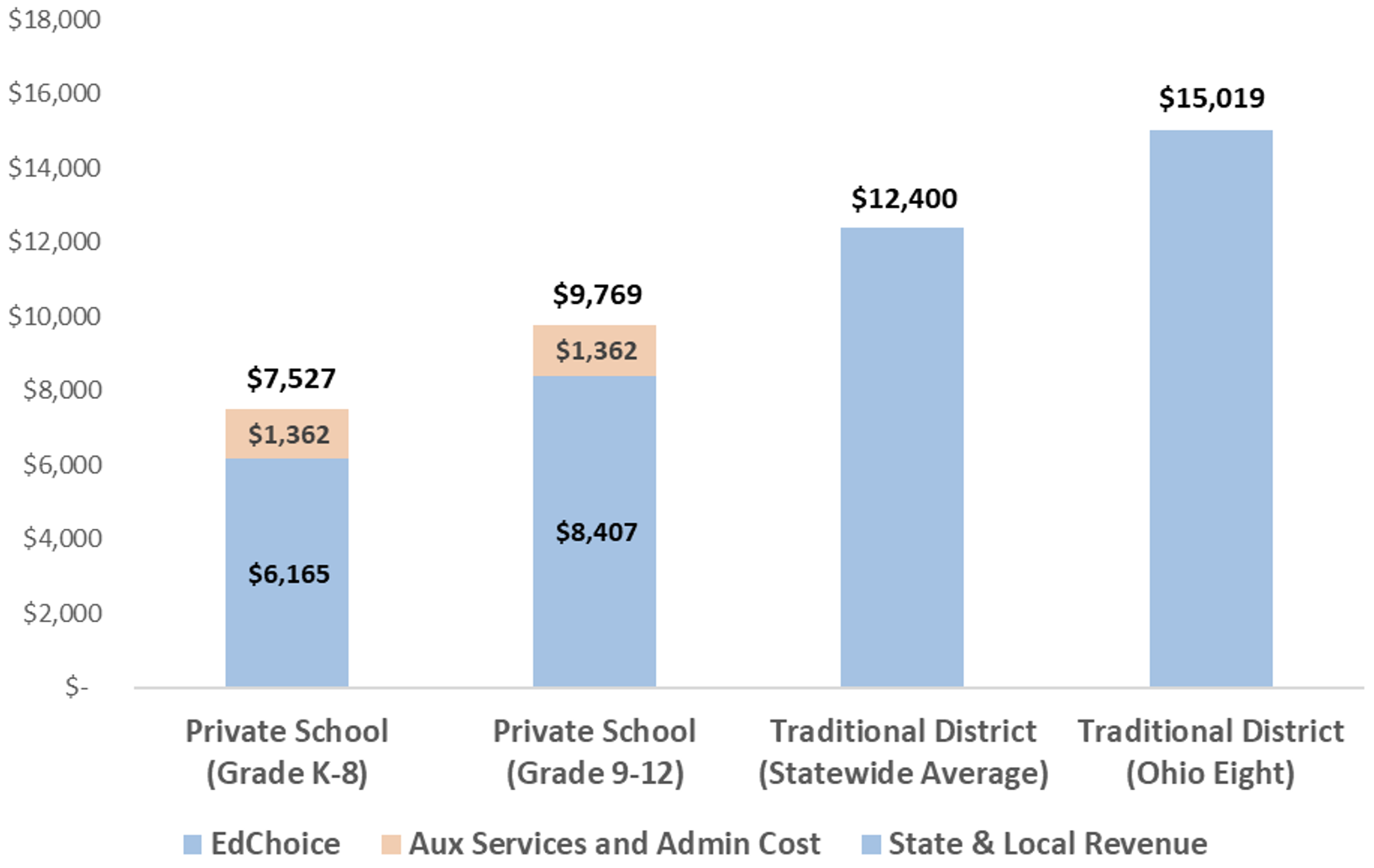
When examining the totality of taxpayer support for Ohio districts, it’s hard to say with a straight face that they are being shortchanged. Figure 1 shows overall taxpayer funding for districts statewide, as well as for the Ohio Eight districts—the places that have historically had the largest numbers of students using an EdChoice scholarship (the largest of the eight, Columbus, is also a plaintiff in the lawsuit). The district numbers include state and local taxpayer revenue,[1] the latter of which includes a minimum 20 mill (or 2 percent) state-required property tax. That baseline tax is accounted for in the state’s funding formula, thus explaining the relatively modest “direct” state aid that wealthier districts usually receive. The chart also displays the public subsidy for private-school students’ education, inclusive of both the current full EdChoice scholarship amounts and two small state funding streams that private schools receive (auxiliary services and administrative cost).

On average, districts statewide received $12,400 per pupil in state and local funding in FY22, well above the amounts for scholarship students who receive roughly $7,500 and $9,800 in public support depending on grade level. The Ohio Eight districts receive even higher funding than the average district (just over $15,000 per pupil). Thus, the funding differentials in Ohio’s big cities are quite large, with scholarship students—most of whom are likely from low-income households—getting the short end of the stick. 

Figure 1: Private school (full scholarship amount) versus statewide district and Ohio Eight district per-pupil funding
1

Notes: The year of data used for this chart vary depending on data availability. EdChoice scholarship amounts are for FY24, while auxiliary services and administrative cost reimbursement totals are for FY23. The state and local revenue totals for traditional districts are from FY22, the most recent year of complete fiscal data (the differentials would be larger if more recent data were used). Average statewide and Ohio Eight transportation expenditures per pupil from FY22 are subtracted from district revenues, as they are responsible for providing transportation to private school students. The Ohio Eight districts are Akron, Canton, Cincinnati, Cleveland, Columbus, Dayton, Toledo, and Youngstown.

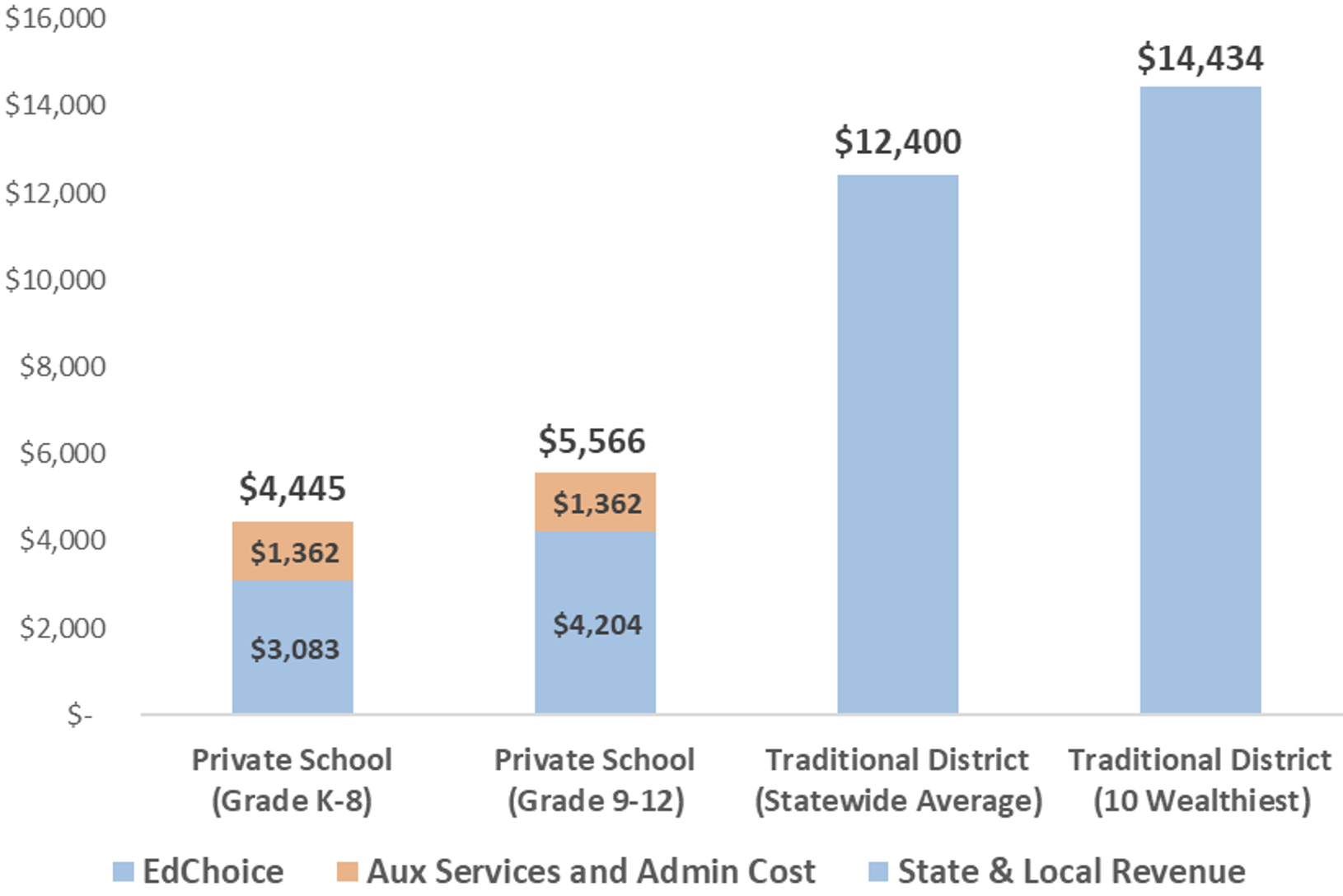
The funding differences tend to be even wider for wealthier students whose EdChoice scholarships are reduced via the sliding scale that lawmakers put in place as they expanded eligibility to all. For a student receiving a “half scholarship”—which would apply to families of four earning $165,000—their total public subsidy is about $4,500 for K–8 and $5,500 for high school. As figure 2 indicates, students attending one of the state’s wealthiest school districts receive more than $14,000 in taxpayer support. Arguably, it’s less critical to make up the gap for wealthier private school students, but the fact remains that state and local taxpayers far more heavily subsidize their public school counterparts’ education. 

Figure 2: Private school (half scholarship amount) versus statewide district and wealthiest district per-pupil funding
2

Note: The ten wealthiest districts had the lowest percentages of economically disadvantaged students in FY22.

Fact 2. District funding continues to rise

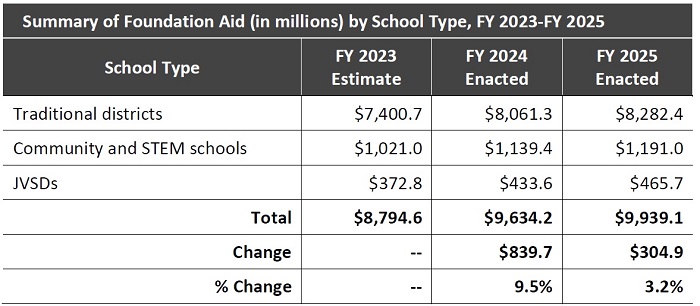
As noted above, some of the recent criticism of EdChoice centers on the increase in state outlays that helps fund universal eligibility, with the suggestion that districts’ funding was also somehow cut (“a dollar less for public schools”). But that’s nonsense. The table below appears in the Ohio Legislative Service Commission’s analysis of the enacted budget. It shows the aggregate “foundation aid”—the main pot of state money that is allocated to K–12 education—that school districts, public charter schools, and joint-vocational school districts (career-technical providers) receive this year and next.

It’s clear that district funding increases significantly over the biennium—from $7.4 billion in FY23 to $8.3 billion by FY25, amounting to a $882 million, or 12 percent, increase in state aid. If joint-vocational districts are added, the increase reaches $975 million over the biennium.[2] Bear in mind, too, that this total doesn’t even include the additional $170 million in state funding dedicated to early literacy initiatives and some $250 million more in career-technical education spending—all of which is non-foundation funding. The vast majority of those set-asides will go to traditional districts, leaving their total increase north of $1 billion. At the end of the day, state lawmakers grew the size of the pie for all types of Ohio schools. That’s something to cheer—not disparage.

Table 1: Increase in state spending for traditional districts in FY24–25
Silencing private school choice critics again blog table 1

Source: Ohio Legislative Service Commission.

Fact 3. Ohio is spending record amounts on public schools

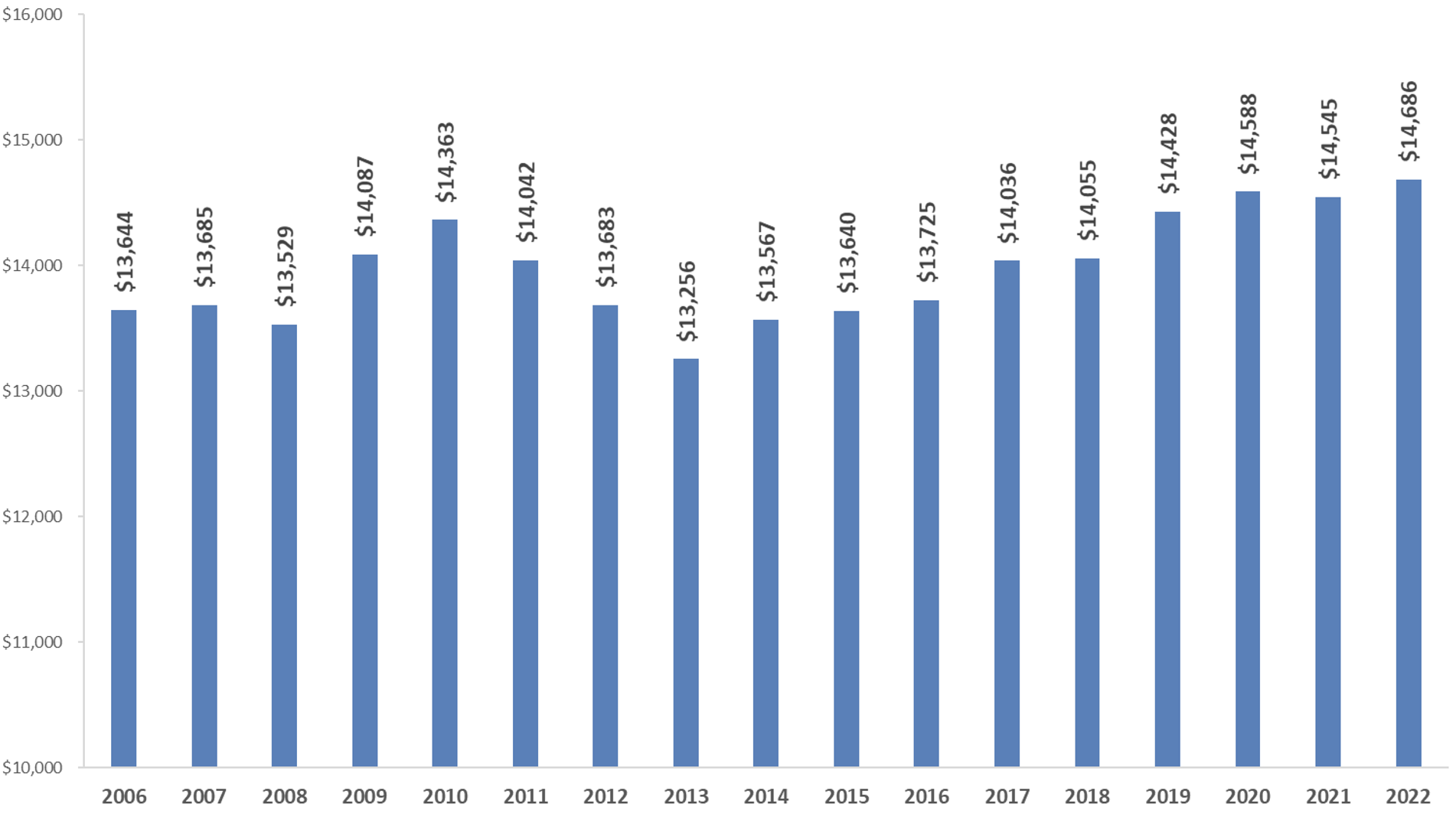
What is almost never said by private school opponents is the simple fact that Ohio spends more now—even adjusted for inflation—than it ever has on public schools. In FY22, average district spending reached $14,686 per pupil, the highest on record since 2006. My report from a couple years ago has spending data stretching further back—to 1990—and there is no year during the 1990s and early 2000s when spending was higher than in recent years. The long-term trend of increased public school spending is yet another indicator that public schools are not being systematically “defunded” as educational choice expands in Ohio. As additional evidence, a rigorous analysis of EdChoice’s fiscal impacts from its launch in 2006 to 2019 determined that growth in scholarship participation had no impact on districts’ per-pupil spending. Bottom line: Traditional districts now have more resources than ever to create the type of learning environments that help students succeed.

Figure 3: Per-pupil expenditures, Ohio public schools, 2006–2022
4

Note: Spending data from 2006–2021 are adjusted for inflation (to 2022 dollars) using the consumer price index. This chart relies on expenditure data (while figures 1 and 2 use revenue data) because, historically—until FY22—Ohio reported inflated per-pupil revenue data for some districts due to the former use of a “pass through” method to fund charters and most private school scholarships. Now that choice programs are “direct funded” from the state, districts’ per-pupil revenues are accurately reported as of FY22.

Celebrated free-market economist Thomas Sowell was recently asked what changed his mind about Marxism, and he promptly replied, “Facts. If you pay attention to them, you realize that they don’t square with what’s being said.” In our small corner of education policy in Ohio, some people are saying lots of things about school choice programs and their alleged impact on public school funding. But when we look more closely at the basic facts, their claims amount to nothing more than tall tales.


[1] I exclude districts’ federal revenues, which account on average for about 10 percent of total funding, as well as non-tax revenues (e.g., fees and sales of assets), to ensure a clearer picture of Ohio taxpayer contributions to education.


[2] Public charter schools are not usually seen as “traditional” public schools and are also a common target of the school establishment.

Fordham Logo

© 2026 The Thomas B. Fordham Institute
Privacy Policy
Usage Agreement

National

P.O. Box 110
Burke, VA 22009

202.223.5452

[email protected]

Ohio

P.O. Box 82291
Columbus, OH 43202

614.223.1580

[email protected]

Sponsorship

130 West Second Street, Suite 410
Dayton, Ohio 45402

937.227.3368

[email protected]