Mobile Navigation

  • National
    • Policy
      • High Expectations
      • Quality Choices
      • Personalized Pathways
    • Research
    • Commentary
      • Gadfly Newsletter
      • Flypaper Blog
    • Events
    • Scholars Program
  • Ohio
    • Policy
      • Priorities
      • Media & Testimony
    • Research
    • Commentary
      • Ohio Education Gadfly Biweekly
      • Ohio Gadfly Daily
  • Charter Authorizing
    • Application
    • Sponsored Schools
    • Resources
  • About
    • Mission
    • Board
    • Staff
    • Career
Home
Home
Advancing Educational Excellence

Main Navigation

  • National
  • Ohio
  • Charter Authorizing
  • About

Ohio Menu

  • Topics
    • Accountability & Testing
    • Advanced Education
    • Career & Technical Education
    • Charter Schools
    • Curriculum & Instruction
    • ESSA
    • Evidence-Based Learning
    • Governance
    • Personalized Learning
    • Private School Choice
    • School Finance
    • Standards
    • Teachers & School Leaders
  • Research
  • Policy
  • Commentary
    • Ohio Gadfly Newsletter
    • Ohio Gadfly Blog
    • Events

The Education Gadfly Weekly

Sign Up to Receive Fordham Updates

We'll send you quality research, commentary, analysis, and news on the education issues you care about.
Thank you for signing up!
Please check your email to confirm the subscription.

Ohio Gadfly—Five education issues to watch in the budget bill conference committee

Volume 17, Number 15
6.26.2023
6.26.2023

Ohio Gadfly—Five education issues to watch in the budget bill conference committee

Volume 17, Number 15
view
Conference committee blog image
School Funding

Five K–12 education issues to watch in the budget bill conference committee

The process of creating a new state budget is quickly drawing to a close, with key lawmakers set to hammer out the final legislation in conference committee. Those negotiations are ongoing, with the budget for FYs 2024–25 likely to pass by Friday.

Aaron Churchill, Jessica Poiner 6.26.2023
OhioOhio Gadfly Daily

Five K–12 education issues to watch in the budget bill conference committee

Aaron Churchill | Jessica Poiner
6.26.2023
Ohio Gadfly Daily

Ohio’s budget bill seeks to hold teacher preparation programs accountable for the science of reading

Jessica Poiner
6.23.2023
Ohio Gadfly Daily

Don’t weaken accountability for Ohio’s charter sponsors and online schools

Aaron Churchill
6.23.2023
Ohio Gadfly Daily

Ohio lawmakers should ensure low-income kids aren’t priced out of private schools

Jessica Poiner
6.22.2023
Ohio Gadfly Daily

Lawmakers can still go further in Ohio’s historic effort to narrow charter funding gaps

Aaron Churchill
6.22.2023
Ohio Gadfly Daily

One size does not fit all: Alternative education campuses in the charter sector

Jeff Murray
6.26.2023
Ohio Gadfly Daily

Bravo to Ohio legislators for finding the way forward on student transportation

Jeff Murray
6.13.2023
Ohio Gadfly Daily
view
Teacher prep early literacy blog image

Ohio’s budget bill seeks to hold teacher preparation programs accountable for the science of reading

Jessica Poiner 6.23.2023
Ohio Gadfly Daily
view
Sponsor evaluations blog image

Don’t weaken accountability for Ohio’s charter sponsors and online schools

Aaron Churchill 6.23.2023
Ohio Gadfly Daily
view
EdChoice expansion and equity blog image

Ohio lawmakers should ensure low-income kids aren’t priced out of private schools

Jessica Poiner 6.22.2023
Ohio Gadfly Daily
view
Charter equity blog image

Lawmakers can still go further in Ohio’s historic effort to narrow charter funding gaps

Aaron Churchill 6.22.2023
Ohio Gadfly Daily
view
NAPCS alternative ed charters report SR image

One size does not fit all: Alternative education campuses in the charter sector

Jeff Murray 6.26.2023
Ohio Gadfly Daily
view
Senate bill transpo quick hit blog image

Bravo to Ohio legislators for finding the way forward on student transportation

Jeff Murray 6.13.2023
Ohio Gadfly Daily
view
Conference committee blog image

Five K–12 education issues to watch in the budget bill conference committee

Aaron Churchill | Jessica Poiner
6.26.2023
Ohio Gadfly Daily

The process of creating a new state budget is quickly drawing to a close, with key lawmakers set to hammer out the final legislation in conference committee. Those negotiations are ongoing, with the budget for FYs 2024–25 likely to pass by Friday.

As usual, this new budget bill is the vehicle for significant policymaking in the realm of K–12 education. From the unveiling of Governor DeWine’s spending plan and the subsequent discussions in the House and Senate, one thing is clear: Primary and secondary education is a major priority for Buckeye State leaders. Schools across the state, both public and private, are set to receive significant funding increases in the coming biennium. Along with this extra money will come numerous policy reforms that seek to improve the quality of education Ohio students receive, most notably literacy initiatives that would require schools to align instructional practices to the science of reading.

Yet several significant issues remain unsettled as the House and Senate bills head to conference committee. Let’s take a look at five of them. (We discuss a  couple important charter school issues, as well as student transportation, in separate pieces.)

Third grade retention

Just over a decade ago, Ohio lawmakers enacted the Third Grade Reading Guarantee, a package of early literacy reforms that aim to ensure that all children have the foundational reading skills needed to succeed in the upper grades. One of its cornerstones is a requirement that schools retain students who are still struggling to read fluently by the end of third grade. Rigorous research finds that Ohio’s retention policy significantly boosts the achievement of retained pupils. But under political pressure from the education establishment, House lawmakers chose to ignore the benefits for students and voted to ditch the policy in their budget plan and in separate legislation. The Senate, however, disagreed and maintained this component of the Guarantee in its budget. Retention is bound to come up in conference committee, and our view at Fordham—along with other reform groups—is that Ohio must preserve the requirement. Without it, there will no longer be any “guarantee” that struggling students receive the extra time and supports needed to become fluent readers.

School governance reform

One of the Senate’s priorities this year was to pass a school governance overhaul. Leaders incorporated their original proposal, which previously passed via standalone legislation, into their version of the budget. It consists of several significant changes that include refocusing the Ohio Department of Education as the Department of Education and Workforce (DEW), requiring DEW to be led by a director appointed by the governor (instead of being a State Board of Education hire), and transferring most of the responsibilities of the state board to DEW. The overhaul appears to be on track for passage, as two of the “big three” at the negotiating table—the Senate and the governor—have made clear their desire for governance change. The House is a little more of a mystery, but based on similar revamping attempts in the past, there seems to be support in that chamber as well. Here at Fordham, we’ve supported these changes and argued that they will create a more accountable state education agency, strengthen educational leadership in Ohio, and more closely connect education and employment efforts, all while preserving reasonable checks and balances.

School funding formula

The hottest topic of the previous budget cycle in 2021 was the state’s school funding formula, with legislators ultimately green-lighting the much-discussed “Cupp-Patterson” model for use in FYs 2022–23. Its formula prescribes much higher state expenditures on K–12 education—so large, in fact, that the spending increases had to be phased-in to be affordable—and one of the questions going into this cycle was whether the new model would stick. Likely reflecting flush state coffers, state lawmakers this year are poised to keep this formula intact. House lawmakers proposed to continue phasing in the funding increases, as well as updating the “inputs” (e.g., teacher salary data) in the “base cost” model. Both of those proposals help maintain the formula, but at a $1 billion-plus expense to the state. The Senate largely stuck with the House plan, but added some tweaks that improve the functioning of the formula and rein in some of the costs. Most notably, the chamber removed an unnecessary component known as supplemental targeted assistance, as well as two guarantees based on district funding levels in FY 2020 and 2021 (though it also added a new one based on FY 2023). The Senate also made a tweak to the state share computations by removing one of the two income measures of district wealth. This probably reduces some of the formula costs and creates a more straightforward calculation of local capacity.[1]

All this means that overall K–12 education spending is bound to go up as a result of this year’s state budget. By how much—and whether the Senate modifications to the formula will hold—are the questions to keep watch on in the final budget.

Private school scholarships

At this point, there is little doubt that there will be a significant expansion of EdChoice eligibility. The question now is whether lawmakers will go the universal-eligibility route, per the Senate plan, or restrict access above a certain income level, as the governor and House proposed (400 and 450 percent of the federal poverty level, respectively). All three options ensure that more Ohio families will have access to private school education, and that is to be celebrated.

Beyond questions of eligibility, lawmakers must still consider the following: First, they should remove a provision added by the Senate that reverses a current requirement for private schools to accept EdChoice scholarship amounts as full tuition for low-income families (incomes at or below 200 percent of the federal poverty level, or below an annual income of $60,000 for a family of four). Eliminating this policy would allow private schools to charge low-income families amounts above the voucher amount, which could place valuable options for them out of their financial reach again (for a closer look at this topic, see here).

Second, because many parents will have more educational options at their fingertips, they will need more complete information about private school quality. To that end, we continue to recommend that a student growth measure be added that shines a light on the academic progress students make year-to-year in private schools. The state already reports basic point-in-time proficiency data, as private schools are required to administer standardized exams to scholarship students. Publishing growth results alongside the existing test data would provide a more holistic picture of quality, and assist parents in making decisions on behalf of their children.

Interventions for struggling students

The Senate put forward new provisions that require schools to take steps to improve the achievement of students who are significantly behind. Specifically, schools would be required to provide, either directly or through a contracted vendor, interventions to any student scoring at the lowest achievement level (“limited”) on state exams in math, science, or English language arts. The bill isn’t prescriptive on what those interventions must be; tutoring, extended learning time, or “any other academically centered support service” can all serve the purpose. That flexibility makes sense, given the range of needs low-achieving students may have. The proposal also includes some important reporting and monitoring requirements. Schools must report to the state education agency about the progress such students are making (e.g., through diagnostic assessments), and the agency is supposed to monitor their progress. The bill also requires the agency to survey schools to determine if indeed they are providing intervention services, and submit a report to lawmakers detailing the results.

These are all promising measures that legislators should keep in place. Especially in the wake of pandemic-related learning loss, state leaders have an obligation to ensure that students who are struggling get the help they need. Requiring schools to provide intervention supports and report what they’re doing is a critical step in that direction.

***

It’s been a busy budget season filled with debates over school choice, early literacy, and a wide variety of important education-related policies. The finish line is in sight, but there are still a few more key decisions to be made. If lawmakers can keep the focus on kids and families while deciding on the issues outlined above, Ohioans can look forward to a brighter future for Buckeye students.


[1] Specifically, the Senate removes the income measure based on the median income of districts’ residents multiplied by the number of tax returns and divided by district enrollment. The other income measure—total federal gross adjusted income of district residents per pupil—is retained, as is the measure of property wealth per-pupil.

view
Teacher prep early literacy blog image

Ohio’s budget bill seeks to hold teacher preparation programs accountable for the science of reading

Jessica Poiner
6.23.2023
Ohio Gadfly Daily

For better or worse, Ohio does most of its education policymaking during the biennial budget process. This year is no different. The current budget legislation is chock full of education provisions, and some of the most significant are in the realm of early literacy. Specifically, Governor DeWine has proposed revamping reading instruction in Ohio schools to align with the science of reading. His plan focuses on curriculum reform—schools would be required to use high-quality curricula and materials that have been vetted by the Ohio Department of Education (ODE)—and providing professional development for current teachers to support rigorous implementation.

For the most part, the House and Senate commendably kept this plan intact. Even better, the House went one step further and added provisions that would allow the state to exercise more significant oversight over teacher preparation programs. This oversight specifically focuses on early literacy and ensuring that programs teach prospective educators scientifically-based reading practices. The Senate maintained the House’s additions, and since they dovetail perfectly with the governor’s agenda, they are likely to be included in the final budget.

So what would these teacher-prep reforms do? Their main purpose is to establish a transparency and accountability framework that doesn’t currently exist. First, on the transparency side, the budget bill requires ODE and the Ohio Department of Higher Education (ODHE) to create metrics that will ensure every teacher preparation program is teaching “evidence-based strategies for effective literacy instruction aligned to the science of reading.” ODHE will then develop an audit process to review each institution’s alignment with these metrics. The results will be used to create summaries of the reading instruction strategies and practices being used in each program. The departments must complete and publicly release these annual summaries by March 31. The bill also requires the departments to develop a public dashboard that reports the first-time passage rates of students, by institution, on the Foundations of Reading exam, which many prospective teachers must pass to be licensed. Tracking this data is crucial, as first-time pass rates are important markers of how rigorously preparation programs are training aspiring educators (as opposed to only reporting rosy overall passing rates that count candidates who need to take exams multiple times).

These are big steps forward in transparency. But the legislation also focuses on accountability, too. After the initial audit, programs will be reviewed every four years to ensure their continuing alignment with the established metrics. Those that are found to be out of alignment and that fail to address audit findings within one year will have their approval revoked by the chancellor of ODHE. That’s a big deal, as it will help ensure that programs aren’t ignoring reading science in their training.

The draft budget also requires the departments to identify approved vendors that can provide scientifically-based professional development to any educator responsible for teaching reading, including the faculty of preparation programs.

It’s hard to overstate just how important these teacher preparation reforms are to the success of Ohio’s early literacy efforts. The governor’s initial plan wisely sought to address the knowledge and skills gaps that many current teachers have in the area of scientifically-based reading instruction. That’s a critical step in the right direction, as Ohio’s current workforce will be responsible for teaching tens of thousands of kids to read over the next few years. But supporting current teachers isn’t enough. To sustain Ohio’s literacy reforms, the state also needs to ensure that future teachers are well-trained.

Unfortunately, recent research indicates that too many of Ohio’s preparation programs (and many in other states, too) aren’t aligning their training with the science of reading. In May, Fordham published a report outlining an NCTQ analysis of how well (or, sadly, how poorly) Ohio’s teacher preparation programs incorporate reading science into their coursework. Just nine out of twenty-six elementary programs provide adequate coverage of all five components of reading science (phonemic awareness, phonics, fluency, vocabulary, and comprehension). Six programs, including Kent State University’s graduate program and Miami University of Ohio’s undergraduate program, adequately cover just one component, or none at all. And more than half promote multiple approaches that are contrary to research-based methods—things like three-cueing, which encourages students to guess at words rather than actually read them and would thankfully be disallowed under the governor’s proposals.

Those are troubling findings. When considered alongside Ohio’s low reading proficiency rates, they demonstrate a clear need for the state to step up and ensure that teacher preparation programs are following the science of reading. Failing to do so would hamstring the proposed early literacy reforms in K–12 education. It would also make the millions of dollars set to be invested in the current teacher workforce a short-term investment with limited payoff, as schools would need to retrain many incoming teachers all over again.

Fortunately for Ohio’s students, state leaders seem to recognize the importance of holding teacher preparation programs accountable for teaching the science of reading. Kudos to leaders in the House, especially, for supporting the governor’s early literacy initiative and seeing the need to align higher education with K–12. Let’s hope that the final piece of legislation keeps all of these important literacy reforms intact.

view
Sponsor evaluations blog image

Don’t weaken accountability for Ohio’s charter sponsors and online schools

Aaron Churchill
6.23.2023
Ohio Gadfly Daily

As this year’s budget process races to the finish line, state lawmakers are the midst of making decisions about what stays and what goes. The current, Senate-passed version of the budget bill has dozens of provisions that would move K–12 education in the right direction. These proposals, which include improved charter school funding and early literacy initiatives, will hopefully sail through conference committee. But one provision related to charter sponsor evaluations should definitely be scrapped. It would significantly alter the way in which the Ohio Department of Education (ODE) calculates a sponsor’s academic rating. If enacted, it would unacceptably weaken accountability, especially for online charter schools.

By way of background, charter sponsors, or “authorizers,” are the gatekeepers of quality in the charter sector. They allow a charter school to open, keep checks on the school’s performance, and have the authority to close a school should it underperform. Various entities, including the Fordham Institute’s sister organization, the Thomas B. Fordham Foundation, serve as sponsors in Ohio.

To ensure that sponsors rigorously hold their schools accountable for results, state lawmakers created a system in the mid-2010s that evaluates sponsors. It consists of three equally-weighted components:

  • Academics—based on the report card results of the schools a sponsor oversees;

  • Compliance—based on a review of compliance with laws and regulations; and

  • Quality practices—based on a review of sponsors’ adherence to best practices.

The academic dimension, in particular, is critical to holding sponsors accountable for authorizing quality schools. To compute the academic rating, ODE currently calculates an average that weights schools in a sponsor’s portfolio according to their enrollment. This is exactly the right approach. The weighted-student average ensures that all students matter and are accounted for in a sponsor’s portfolio. It also ensures that each school is given appropriate emphasis in the calculations. Larger schools carry more weight—as they should—than smaller ones.

Unfortunately, a provision in the Senate budget would require ODE to calculate two scores—and use the higher of the two to determine the academic rating of a sponsor. The first calculation would still be the weighted-student average, as described above. But the second would weight each school equally—a straight-up average that counts each school as if they had the same enrollment. This approach ignores the fact that some schools are larger—much larger, in some cases—than others. It’s akin to saying that Ohio should get the same number of electoral college votes as tiny Delaware.

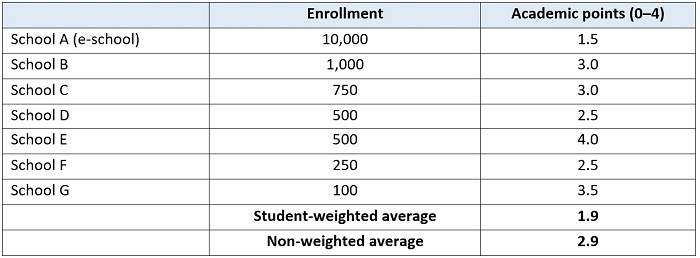
The worrisome implication of the proposal is that it could mask the poor performance of larger schools, particularly online charters that enroll thousands of students each year. By allowing the straight-up average to be applied instead of the student-weighted one, online schools—and their sponsors—would get off the hook if their academic performance is poor. Consider how the results change when using some illustrative data for a fictitious sponsor that authorizes a big e-school. (Note: The two largest online charters in Ohio enrolled 14,591 and 5,696 students in 2021–22; both posted low ratings on their report cards.)

Table 1: Illustrative calculation of a sponsor’s academic rating

Sponsor evaluations blog Table 1
Note: Based on a school’s overall performance on the report card, ODE assigns 0–4 points (at half-point increments) to each school for the purposes of calculating a sponsor’s academic rating.

Table 1 illustrates that, under current policy, the results of a large, underperforming e-school receive appropriate emphasis in the overall academic rating. The school in this example enrolls 76 percent of the students in the sponsor’s portfolio, and its results are correctly reflected in the student-weighted average. However, the non-weighted average inflates the sponsor’s score (2.9 instead of 1.9) and allows the low performance of the e-school to be papered over, even though it’s responsible for serving far more students than the other schools.

This is wrong for a couple reasons. First, students should be at the center of accountability systems. The current academic calculations do exactly that by treating students (as opposed to schools) on equal terms. If the proposal is approved, however, online students will actually count much less than their peers in other schools. Doesn’t their learning matter just as much as a student attending a brick-and-mortar charter school? Remember, in school district accountability, the state doesn’t equally weight schools of varying sizes and then compute an average for the entire district. Rather, it looks at each student enrolled in the district and counts them all equally. The same should apply to the portfolio of sponsors.

Second, accountability systems should drive improvements that benefit students. The academic component of the present evaluation system adheres to this notion. Should a sponsor authorize a large underperforming e-school, it’s incentivized to: (a) take steps to ensure that the e-school improves and (b) offset its results by authorizing high-performing brick-and-mortar charters. Those healthy incentives go away under this proposal. Sponsors’ academic ratings will go up artificially, taking the pressure off to demand improved online education while also ensuring the rest of their schools are high-performing.

Those steps backwards would threaten the tremendous progress Ohio has made in charter school accountability, and would do nothing to help solve the problem of low-performing e-schools, whose struggles have damaged the sector’s reputation in the past and continue to bog down overall charter performance. We shouldn’t go back to the dark ages of accountability, and this idea would be a regrettable reversal of sound policy.

The sponsor evaluation system remains the linchpin for overall charter sector quality. To be sure, the quality practices and compliance components of the evaluation are not perfect. There are provisions in the budget that could potentially reduce the unnecessary paperwork burdens on sponsors by requiring ODE to seek external support to review the system. However, the academic component is strong and should not be watered down. The charter sector is poised for exciting growth through long-awaited equitable funding, but legislators still need to keep the focus on providing high-quality schools for students by maintaining strong charter accountability.

view
EdChoice expansion and equity blog image

Ohio lawmakers should ensure low-income kids aren’t priced out of private schools

Jessica Poiner
6.22.2023
Ohio Gadfly Daily

Since 2005, Ohio has provided state-funded EdChoice scholarships, or vouchers, to help eligible students cover the cost of attending private schools. Over the years, lawmakers have steadily expanded eligibility and increased funding levels for the program via the state budget. This year’s budget cycle is continuing the trend, but with the added wrinkle of eliminating a portion of current policy aimed at making private school choice more accessible for low-income families.

Under current law, families with incomes at or below 250 percent of the federal poverty level, or about $75,000 for a family of four, are eligible for income-based EdChoice scholarships, as are students who would otherwise attend low-performing public schools. When Governor DeWine released his budget recommendations in January, he proposed raising the threshold for income-based EdChoice to 400 percent. This would allow a family of four with an annual household income of $120,000 (think two parents, each making a solidly middle-class income of $60,000 or below) to be eligible. In its version of the budget, the House proposed raising the threshold to 450 percent. The Senate, meanwhile, took things even further by eliminating income restrictions entirely. Under its version, every family in Ohio would be eligible for income-based EdChoice, though families with incomes above 450 percent ($135,000 for a family of four) would be subject to a sliding scale—the higher their annual income, the smaller their scholarship amount.

One of the primary benefits of expanding EdChoice is that it gives more families access to more school options. Ohio has some amazing traditional public schools, but parents have to be able to afford to buy a house or pay rent within district boundaries in order to enroll their children in some of the most coveted ones. Meanwhile, average private school tuition in Ohio clocks in at around $7,600. Divided across twelve months, that’s a hefty monthly bill of over $630—and that’s just for one child. By expanding EdChoice eligibility, lawmakers make it possible for more families to make decisions based on what their kids need, rather than what they can afford.

It’s also important to remember that school choice is about more than just money. Families consider a lot of characteristics when they choose a school. Academics, school quality, culture, safety, and extracurricular opportunities can all make or break whether a school is the right choice for their child. Sometimes, it’s not a matter of their public school being “bad.” It’s just a matter of it not being the right fit. Expanding EdChoice eligibility empowers more families to find the right fit.

For these reasons, the Senate’s EdChoice expansion is great news. But buried among the budget’s many provisions is a seemingly small change that could have a big impact on Ohio’s lowest-income families’ ability to access private school options. In doing so, it could dull the luster of otherwise positive changes.

Under current law, for families whose income is at or below 200 percent of the federal poverty guidelines (that would be an annual income of $60,000 or less for a family of four), private schools are prohibited from charging tuition that is greater than the EdChoice scholarship amount. In other words, if the state scholarship doesn’t cover the entire cost of tuition, schools aren’t allowed to ask low-income families to pay the leftover amount. By requiring private schools to accept EdChoice scholarship amounts as full tuition, the state ensures that Ohio’s low-income students aren’t shut out of private school choice just because their families can’t afford to make up the difference between the voucher amount and tuition.

It’s a smart policy. Given that one of the key aims of EdChoice is to give economically disadvantaged families access to private schools they otherwise couldn’t afford, it seems wise to ensure that schools can’t charge low-income families tuition that would put private school out of their financial reach. And yet, the Senate’s version of the budget eliminates this requirement. Unless something changes in the coming days, private schools will soon be allowed to charge low-income families amounts above the voucher allocation.

If you’re wondering why the Senate would do this, you’re not alone. There are a few possible explanations. One is that lawmakers believe the current tuition cap discourages some schools from participating in EdChoice. The average private school tuition in Ohio might be around $7,600, but there are plenty of schools that charge far more than that. During the 2023–24 school year, EdChoice scholarships will be worth up to $5,500 for grades K–8 and $7,500 for grades 9–12. If a private school charges more than that—say, $15,000—then the school will have to make up a difference that amounts to half of a typical tuition bill for every low-income student it accepts. At some point, the argument goes, private schools won’t be willing to cover the cost, and it will be financially smarter for them to just refuse to accept EdChoice scholarships. The more schools that decide to do this, the fewer options there will be for families.

There may be some truth to that argument. But it’s not worth risking the possibility that private schools will begin charging tuition to low-income kids and push them out of potentially life-changing educational opportunities. Between the higher voucher amounts slated for approval in this year’s budget (approximately $6,165 for K–8 and $8,407 for 9–12) and the fact that many private schools located in high-poverty communities will want to avoid charging tuition so as not to risk losing students, schools have some incentives to serve disadvantaged children. Nevertheless, we must ensure that EdChoice continues to explicitly prioritize giving economically disadvantaged families more opportunities.

Another explanation is that lawmakers believe they’ve already created a solution to the potential problem of schools pricing out low-income families. In 2021, the General Assembly passed legislation that permitted the creation of Scholarship Granting Organizations, or SGOs. Nonprofits that meet certain eligibility criteria can be certified as an SGO and collect donations on behalf of participating private schools that will then use the funds to provide scholarships to students. State law requires SGOs to prioritize awarding scholarships to low-income students, which the Ohio Administrative Code defines as those from families with household incomes under 300 percent.

In theory, these entities could help low-income families make up any differences between EdChoice scholarship amounts and tuition. Right now, SGOs don’t help families with incomes at or below 200 percent because they don’t need to; private schools can’t charge these families additional tuition, so there’s no need for additional scholarship funds. That would change if the provision prohibiting private schools from charging tuition gets eliminated, and lawmakers might see SGOs as a backstop. Sure, private schools might start charging low-income families tuition, but SGOs could fill in the gaps and keep private education affordable for Ohio’s neediest families.

The operative word, though, is “could.” Private schools aren’t required to work with SGOs. And SGOs are dependent on donations, which determine how many families they can help and how much financial assistance they can provide. If private schools are permitted to charge low-income families tuition, SGOs could help. But that doesn’t mean they will. It would be better if current law were maintained for low-income families, and SGOs could work to fill the tuition-voucher gap for families between 200 and 400 percent of the federal poverty level.

***

Almost two decades ago, EdChoice was created to ensure that all families have access to private school options. These scholarships were, first and foremost, intended to help economically disadvantaged families access private school options that had previously been out of reach. Thousands of low-income students have benefitted as a result. Eliminating a provision that protects these students from being priced out of a program designed to give them access is wrong, and lawmakers should reconsider.


view
Charter equity blog image

Lawmakers can still go further in Ohio’s historic effort to narrow charter funding gaps

Aaron Churchill
6.22.2023
Ohio Gadfly Daily

Despite serving tens of thousands of students each year—most of whom are low-income—Ohio has a regrettable track record of underfunding its public charter schools. Since their advent in the late 1990s, brick-and-mortar charter schools have received on average roughly 25 to 30 percent less funding per pupil than the districts in which they’re located.

This funding gap puts charters at a serious disadvantage when it comes to offering competitive teacher salaries and providing much-needed student supports and enrichment. Moreover, though Ohio’s brick-and-mortar charters provide a superior education—and some of the finest charters have waitlists—the funding disparities have throttled their growth, as they are left with less capacity to expand and serve more students.

Don’t just take my word for it. Consider the testimony of school leaders from several of Ohio’s best charter schools—schools our sister organization is proud to oversee as their sponsor. Andrew Boy, founder of the United Schools Network, a group of high-performing charters in Columbus, discussed the challenges of fully meeting the needs of low-income students on shoestring budgets:

Limited resources make it difficult to offer certain programs and provide the unique support our students need. At stake here is...the life outcomes of vulnerable students and families who receive less per-pupil funding, if they exercise their right to choose a school that better meets their needs.

Dave Taylor, superintendent of Dayton Early College Academy, one of best urban high schools in the state, noted the difficulties of retaining talented teachers with fewer dollars:

Each year we watch our traditional public school counterparts raise their salaries and poach our best, most talented teachers. Too many times, we had teachers tell us that they will have to leave because the next district is offering $5,000, $10,000, or even upwards of $15,000 more than we can offer them.

To their credit, state lawmakers are poised to make historic progress in bridging charter funding gaps via the biennial budget for FYs 2024–25. A quick recap of the action thus far (the bill is currently pending in conference committee).

  • High-quality charter funding: In his budget, Governor DeWine proposed a healthy boost to the extra aid that high-quality charters receive via a supplemental funding program launched in 2019. Both the House and Senate have commendably approved his proposal.

  • Charter facilities allowance: The governor also wisely increased the state’s per-pupil charter facility funding. Both the House and Senate have approved the increased allowance from $500 to $1,000 per pupil, an amount that will help charters more adequately cover building expenses.

  • Charter equity supplement: In a new funding component, the Senate has proposed a $400-per-pupil supplement for every brick-and-mortar charter school. This critical addition recognizes the basic need to fund all charter students more equitably.

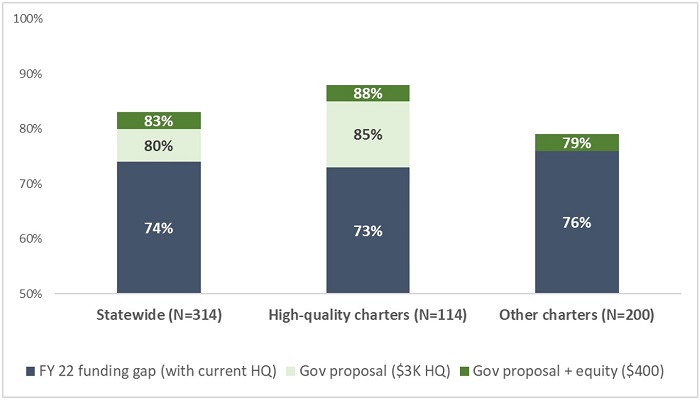
What is the impact of these funding measures? As figure 1 indicates, the average brick-and-mortar charter in Ohio currently receives 74 percent of the funding of their local district—but that’s slated to increase to 83 percent should the Senate version of the budget pass. Put another way, the statewide charter funding gap would narrow from a 26 to 17 percent shortfall. Meanwhile, due to the big increase in high-quality allotments, the gap would decrease even more substantially for the highest-performing schools—from 27 to 12 percent. Note, facilities are not included in this figure because the gaps are based on operational expenditures, which exclude capital outlay.

Figure 1: Average brick-and-mortar charter funding relative to districts—current gap versus gap under Senate-passed budget

Charter equity blog Figure 1
Note: This figure displays the percentage of funding received by the average charter school compared to the funding received by the districts in which they are located. E-schools are not included in this figure; facility dollars are also excluded. More details about the calculation are discussed in this piece.

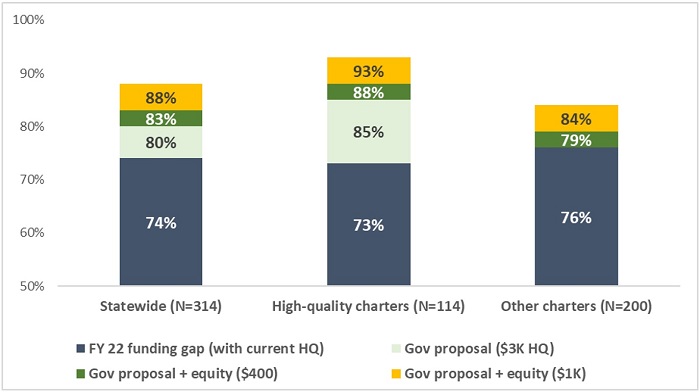
While this is remarkable progress, a sizeable funding gap still remains. In the waning days of this year’s budget process, state lawmakers should ratchet up the equity supplement to the $1,000 per pupil that we at Fordham have previously recommended. As figure 2 indicates, this enhanced amount would bring the average charter funding statewide to 88 percent of districts’. For high-quality charters, it would put them at 93 percent, just a 7 percent shortfall relative to local districts. An enhanced equity supplement would be especially helpful for charters that do not currently qualify for the high-quality funds, as many of them serve at-risk adolescents who have dropped out or specialize in serving children with disabilities.

Figure 2: Average brick-and-mortar charter funding relative to districts—current gap versus gap under Senate-passed budget (with enhanced equity supplement)

Charter equity blog Figure 2

* * *

Under the Senate bill, high-quality charters are slated to receive roughly $2,400 per pupil in additional supplemental state aid—and that could rise to $3,000 per pupil should the legislature further enhance the equity amount. These dollars will help charters serve additional students in even more effective and individualized ways. If legislators can seal the deal and level the playing field, thousands more Ohio students will get the education they need to succeed in school and in life.

view
NAPCS alternative ed charters report SR image

One size does not fit all: Alternative education campuses in the charter sector

Jeff Murray
6.26.2023
Ohio Gadfly Daily

One purpose of charter schools is to serve as laboratories of innovation for public education—a deliberate effort to do things differently than the long-entrenched traditional district model. That includes serving students who are at high risk of dropping out of school—or indeed have already done so—by educating them in separate schools or programs designed to address their needs. A new issue brief from the National Alliance for Public Charter Schools provides a detailed overview of this approach, which the authors call “alternative education campuses” (AECs).

Different states use their own terms—such as transfer school, second chance, dropout prevention and recovery, or options school—to denote a building or program intended to serve students who have had difficulty progressing to completion in a typical education environment. Among other constituents, AECs are commonly employed to serve students who are pregnant or parenting, with criminal records, who are overage and lacking credits, and who have experienced chronic homelessness. AEC placements are meant to help students overcome these roadblocks while also helping them move forward to achieve their academic goals. Often in AECs, the goals themselves vary based on individuals’ experiences and current needs.

The issue brief focuses on stand-alone AECs in the thirty-four states (and the District of Columbia) that had charter school laws on the books during the 2021–22 school year. It does not include district, charter, or state-run programs held within larger, non-AEC, general education schools. In the 2021–22 school year, 2,756 AEC campuses operated in these states, and 555 (20 percent) were charter schools. As of fall 2021, a total of 336,393 students were enrolled in these AECs, with 141,669 (42 percent) of them in charter AECs. As charter schools serve just 7.2 percent of all public school students nationally, the high percentage of charter AEC schools and students is striking.

Looking specifically at charter AEC students, 95 percent were in high school grades, though students as young as fourth grade were included in the analysis. Approximately half of the students were female, 74 percent were students of color—including 47 percent who identified as Hispanic—68 percent were from low-income households, 16 percent were students with disabilities, and 10 percent were English Learners.

It’s difficult to tell how well charter AECs serve these students, as accountability measures run the gamut from traditional high school test scores and graduation rates to less conventional GED and career certification completion. Different states, different school types, different student compositions, and different ages result in a maze of measures that are difficult to directly compare. But the analysts did an admirable job untangling them.

To wit: They were only able to gather consistent cohort graduation data for AECs in ten states which reported four-, five-, and six-year rates. This ends up being a small subset of the total for both charter and district AECs, but the data indicate that students who remain enrolled in AECs for a longer time are more likely to graduate (though charter AECs slightly lag their district counterparts for each cohort). Similarly, in states where data were available and direct comparisons could accurately be made, the average state test score proficiency rates among charter AECs for the 2020–21 school year were 24 percent for English language arts and 14 percent for math. These (very low) rates are slightly better than those of district AECs.

AECs often have very different goals for the students they serve, however, including credentialing, job training, and catching up with high school course credits previously missed. Improving state test scores, analysts suggest, is often a less-pressing concern for AEC leaders and students. While the issue brief does not recommend eliminating such traditional measures from AEC accountability structures, it does call for a wider and more diverse set of metrics, including measures based on the goals of any given AEC. That is, if students earning high-demand industry credentials is a central part of the AEC mission, then which credentials and how many their students earn should be as important—or maybe even more important—than test scores or high school diploma attainment.

In the end, the recommendations are a mix of the flexibility described above and some across-the-board standardization in terms of both identification of AECs and defining accountability structures. The authors point to the work of the National Charter Schools Institute’s Advancing Great Authorizing and Modeling Excellence (A-GAME) initiative, in which the Fordham Foundation participates. A-GAME focuses specifically on charter authorizers, and its AEC-related recommendations include having a clear and standardized definition of which schools are identified as AECs, as well as making sure that authorizers partner with AECs to develop evaluation goals. At the same time, those evaluation goals should include as many non-traditional measures and assessments as are possible and relevant (including universals like school climate and student engagement), focus on both growth and achievement when using with traditional test score data, and include school site reviews as a way to observe school quality.

The brief describes a unique prescription for the most specialized of schools, and one its authors feel that charters are far more adept to fill than districts.

SOURCE: Issue Brief, “Going the Extra Mile: An overview of charter school alternative education campuses,” National Alliance for Public Charter Schools (June 2023).

view
Senate bill transpo quick hit blog image

Bravo to Ohio legislators for finding the way forward on student transportation

Jeff Murray
6.13.2023
Ohio Gadfly Daily

For several years, thousands of charter, private, independent STEM, and district students across the state have suffered at the hands of a broken transportation system. Blame for the trouble has been laid at the feet of mediocre pay for drivers, burgeoning school choice, software and logistical woes, and insufficient funding.

The Ohio Department of Education and the General Assembly have been trying to solve the issue with legal mandates and fines. These are an appropriate first response, as they ensure that school districts—which are currently responsible for almost all student transportation—understand that the state is serious about making sure kids get to school safely, reliably, and on time. Unfortunately, districts have responded by tying those sanctions up in litigation that might just get resolved before the youngest students who are currently transportation-eligible reach high school. In the meantime, the wrecked system continues apace, while districts demand fewer service requirements and/or giant cash infusions from the state.

Kudos, then, to Ohio lawmakers who are offering some creative proposals to tackle the state’s transportation woes. Yes, the state budget bill does propose significantly increasing funding for student transportation, but it also contains numerous measures to make systems more modern, nimbler, and more responsive to the students and families who depend on them. Here are a few of those important proposals, which can be found in the current iteration of the state budget bill:

  • ESC pilot program: The House budget created—and the Senate budget refined—plans for a pilot program to permit two Educational Service Centers (ESCs) serving Franklin and Montgomery Counties to provide transportation services for charter and private schools in their areas. The pilot would allow the ESCs to arrange all buses and drivers needed to serve students, collaborate with choice schools on their daily start and end times to build effective routes, and receive state funding for the costs associated with these efforts. By decoupling charter and private school transportation from districts—especially large ones with lots of school choice users—the state would allow districts to concentrate solely on the students enrolled in their buildings. Choice families will also benefit, as they would have a transportation system focused only on them and their needs—rather than being treated like second-class citizens by their district. The new proposal also requires ODE to issue a report at the end of the pilot, which, if it contains positive results, could influence all future transportation in the state.
     
  • Making bus driver positions full-time jobs: Complaints about a shortage of bus drivers ignore the fact that the job is, generally, a part-time one with tricky hours. Low pay may be part of the equation, but so is the early-morning/late-afternoon schedule with the giant hole in the middle. Drivers could get second jobs to fill those intervening hours, but in today’s job market, it’s much easier to get one job that pays the same (or higher) and also provides more typical hours. The Senate proposes that ODE create a model that would support bus drivers who seek to work a full eight- to ten-hour shift “by doing either a morning or afternoon bus route and spend[ing] the remainder of the work day working as an educational aide or student monitor at a school.” This hiring model will help schools recruit more drivers and more hands to help with student and building needs during the day. Win-win.

  • Flexibility in vehicle size: A House provision allows school districts to transport private school students using a van designed for nine passengers or less, rather than a traditional yellow bus, with appropriate safeguards for vehicle safety. The Senate budget extends this allowance to districts to transport charter students, as well. Moreover, the Senate opens the door wider to charter and private schools to begin providing their own transportation by allowing them to use vans in certain circumstances. Vans are more flexible to use on city streets and cost far less to buy, operate, and maintain than huge diesel buses. Perhaps most importantly, van drivers do not need a commercial drivers license (CDL) to operate them—a major barrier to recruiting bus drivers—thus opening the pool of potential drivers to adults with a traditional license, proper training, and a clean driving record.

  • Changing payment in lieu of transportation: The Senate proposes tightening the rules around districts’ ability to determine which students are “impractical to transport.” Specifically, the bill requires districts to review an “impracticality” ruling at least every two years, or annually if a parent’s situation changes. They also propose boosting the maximum payment given to families if busing their students is deemed impractical from the current $1,077 to $2,500 per year (although the minimum payment is still determined in the same manner as current law: 50 percent of the average transportation expense, which was just $539 per student in FY23). If all else fails, and families must provide their own transportation to and from school every day, they would likely recoup more of their out-of-pocket costs under this proposal.

There are several more transportation proposals in the bill as it stands right now, both large and small, for which our legislators are to be commended. If all of them are enacted, families across Ohio should quickly see an enormous improvement in the availability, flexibility, and reliability of transportation services.

Fordham Logo

© 2026 The Thomas B. Fordham Institute
Privacy Policy
Usage Agreement

National

P.O. Box 110
Burke, VA 22009

202.223.5452

[email protected]

Ohio

P.O. Box 82291
Columbus, OH 43202

614.223.1580

[email protected]

Sponsorship

130 West Second Street, Suite 410
Dayton, Ohio 45402

937.227.3368

[email protected]