Mobile Navigation

  • National
    • Policy
      • High Expectations
      • Quality Choices
      • Personalized Pathways
    • Research
    • Commentary
      • Gadfly Newsletter
      • Flypaper Blog
    • Events
    • Scholars Program
  • Ohio
    • Policy
      • Priorities
      • Media & Testimony
    • Research
    • Commentary
      • Ohio Education Gadfly Biweekly
      • Ohio Gadfly Daily
  • Charter Authorizing
    • Application
    • Sponsored Schools
    • Resources
  • About
    • Mission
    • Board
    • Staff
    • Career
Home
Home
Advancing Educational Excellence

Main Navigation

  • National
  • Ohio
  • Charter Authorizing
  • About

Ohio Menu

  • Topics
    • Accountability & Testing
    • Advanced Education
    • Career & Technical Education
    • Charter Schools
    • Curriculum & Instruction
    • ESSA
    • Evidence-Based Learning
    • Governance
    • Personalized Learning
    • Private School Choice
    • School Finance
    • Standards
    • Teachers & School Leaders
  • Research
  • Policy
  • Commentary
    • Ohio Gadfly Newsletter
    • Ohio Gadfly Blog
    • Events

The Education Gadfly Weekly

Sign Up to Receive Fordham Updates

We'll send you quality research, commentary, analysis, and news on the education issues you care about.
Thank you for signing up!
Please check your email to confirm the subscription.

Ohio Gadfly Biweekly—Nixing universal ACT or SAT testing would hurt Ohio’s smart, poor students

Volume 13, Number 16
7.9.2019
7.9.2019

Ohio Gadfly Biweekly—Nixing universal ACT or SAT testing would hurt Ohio’s smart, poor students

Volume 13, Number 16
view
ACT SAT universal admin
School Funding

Nixing universal ACT or SAT testing would hurt Ohio’s smart, poor students

For many Ohio students, taking college entrance exams is a key milestone on the path from high school to college. Yet countless thousands have foregone these exams, effectively slamming the door on their opportunity to attend four-year colleges and universities.

Aaron Churchill 7.9.2019
OhioOhio Gadfly Daily

Nixing universal ACT or SAT testing would hurt Ohio’s smart, poor students

Aaron Churchill
7.9.2019
Ohio Gadfly Daily

Why “local control” won’t fix Ohio’s struggling school districts

Vladimir Kogan
7.11.2019
Ohio Gadfly Daily

Perkins career-technical pilot programs are good news for Ohio

Jessica Poiner
7.15.2019
Ohio Gadfly Daily

Little rhyme or reason in special needs designations for students

Jeff Murray
7.10.2019
Flypaper
view
Kogan Local control

Why “local control” won’t fix Ohio’s struggling school districts

Vladimir Kogan, Vladimir Kogan 7.11.2019
Ohio Gadfly Daily
view
Perkins pilot programs

Perkins career-technical pilot programs are good news for Ohio

Jessica Poiner 7.15.2019
Ohio Gadfly Daily
view

Little rhyme or reason in special needs designations for students

Jeff Murray 7.10.2019
Flypaper
view
ACT SAT universal admin

Nixing universal ACT or SAT testing would hurt Ohio’s smart, poor students

Aaron Churchill
7.9.2019
Ohio Gadfly Daily

For many Ohio students, taking college entrance exams is a key milestone on the path from high school to college. Yet countless thousands have foregone these exams, effectively slamming the door on their opportunity to attend four-year colleges and universities. As recently as the graduating class of 2017, 44 percent of students skipped the ACT, the predominant entrance exam used in Ohio. Less advantaged students were overrepresented among the missing: 60 and 54 percent of economically disadvantaged and black students, respectively, bypassed the ACT.

To ensure participation in in these gateway exams, twenty-five states, including Ohio, now require all students to take an exam. The Buckeye State is something of a latecomer. It didn’t begin requiring, and paying for, universal administration of the ACT or SAT until the class of 2018, almost two decades  behind the pioneering states of Colorado and Illinois. Unfortunately, anti-testing legislation introduced earlier this spring would reverse this policy and turn back the clock to an era of uneven test administration.

The problem with a test-optional policy is that it fails to identify students who could succeed in college, particularly those from lower socioeconomic backgrounds. Having not even been identified as academically prepared, these students won’t seek admission into four-year colleges, which could be a better match than other post-secondary options. Due to this “undermatching” at an important juncture of their lives, they may not reach their full career potential, likely settling for less satisfying jobs.

Research shows that this problem is real. My Fordham colleague Jessica Poiner has cited studies from the ACT and Kentucky indicating that statewide assessment encourages capable students, who otherwise wouldn’t have considered college, to rethink their post-secondary plans once they see their scores. A study by Joshua Hyman of the University of Connecticut finds that Michigan’s universal-testing policy helped flag large numbers of low-income students as ready for college, resulting in a bump in four-year college enrollment. Commenting on the results of this study, University of Michigan professor Susan Dynarski concludes, “Universal and free testing can help to level the playing field, uncovering disadvantaged students who can benefit from college.”

If legislators still remain skeptical about the wisdom of universal ACT or SAT testing, they should consider yet another study showing the opportunities lost when exams are made optional. In a new analysis, University of Virginia researchers Emily Cook and Sarah Turner explore the ramifications of Virginia’s test-optional policies for its graduating class of 2014. A couple eye-opening findings emerge.

First, mirroring Ohio’s pre-universal-testing data from the class of 2017, the authors report that 44 percent of Virginia’s students skipped the SAT, the entrance exam overwhelmingly taken in that state.[1] Students from poor rural areas were more likely to forgo the exam than their peers. And Cook and Turner report that a sizeable portion of them of them fared well on their state exam results. While we don’t know why exactly they opted out of their SATs, these potentially able students let a great chance to demonstrate college readiness slip by.

Second, based on statistical models that make use of students’ eighth-grade state test scores, the authors predict how non-test-taking students would have fared on the SAT had they participated. They find that 24 percent of non-participants—representing 8,002 students—would have posted SAT scores of 1,000 or above, making them competitive applicants at “broad-access” four-year universities, such as Virginia Commonwealth or James Madison. Meanwhile, 5 percent of non-participants would have earned scores above 1,200, high enough to compete for admission into top-tier colleges, like the University of Virginia or William & Mary. For these students—many of whom were low-income—passing up the SAT exam was an opportunity lost in their quest to climb the economic ladder.

No one should have to look back and kick themselves for skipping their college entrance exams. This is especially true for those who would have earned scores that can open doors to college and, later, great careers. Akin to universal screening for gifted identification, statewide ACT or SAT assessment ensures that students don’t fall through the cracks. Rescinding Ohio’s universal-college-exam policy would be a terrible mistake, most tragically for smart, low-income students.


[1] The authors note that just 2 percent of students in Virginia’s class of 2014 took the ACT only.

view
Kogan Local control

Why “local control” won’t fix Ohio’s struggling school districts

Vladimir Kogan
7.11.2019
Ohio Gadfly Daily

NOTE: The Thomas B. Fordham Institute occasionally publishes guest commentaries. Their views do not necessarily reflect those of Fordham.

As Ohio lawmakers struggle to agree on a budget for the next two years, the future of state efforts to turnaround our most struggling public school districts remains a key sticking point. At the heart of this debate is a fundamental disagreement about “local control”—whether key school governance and policy decisions should remain in the hands of school boards elected by local voters when struggling districts fail to improve student achievement.

The State House approach doubles down on “local control,” eliminating the current academic-distress-commission model, and takes as an article of faith that, armed with expert advice (and perhaps additional resources), local school boards will do what is necessary to improve student outcomes. Some state senators, on the other hand, point out that local control is what got low-performing districts into their current predicament, so simply preserving the status quo is unlikely to produce the academic growth students desperately need.

In my view, a fair reading of the evidence is closer to the latter perspective: “Local control” is a worthy principle, but is unlikely to fix Ohio’s struggling schools. Here is why.

Voters don’t reward achievement

In a study published several years ago, my colleagues and I examined school board turnover in Ohio school districts between 2002 and 2013, as well as the results of school board elections in the state’s largest metro areas.

Our findings were striking. We found no evidence that voters punish school board members for low student performance. Indeed, we found no relationship between student achievement and local school board election outcomes—or turnover on school boards—at all. Without electoral accountability at the ballot box, it’s not obvious why we should expect “local control” to create pressure for boards overseeing failing schools to take steps to improve them.

Although we were initially surprised by these results, they seem obvious in retrospect. Public schools are there to serve the interests of students. But students don’t vote. Local elections may be a good mechanism to ensure that voter interests and preferences drive public policy, but the model breaks down when the most important constituents cannot participate in the political process.

Voters don’t look like students

Readers at this point will probably roll their eyes and think, “Of course kids don’t vote! But their parents do, isn’t that enough to incentivize school boards to provide a good education?”

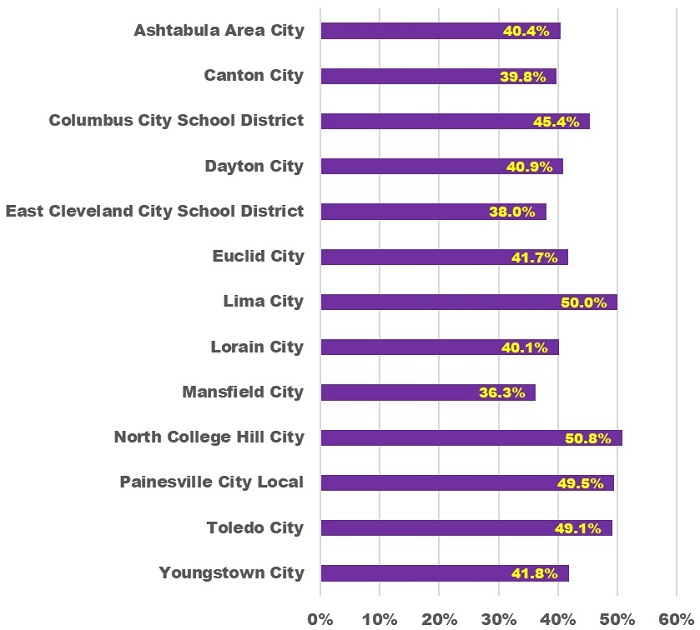
Except it turns out that parents are not a pivotal voting bloc in Ohio school board elections either. Figure 1 summarizes the composition of the November 2017 electorate in each of Ohio’s F-rated districts with an elected board. The figure combines data from the Ohio state voter file, which indicates which voters turned out on which election dates, as well as additional information about these voters from one of the country’s leading micro-targeting firms. Rarely did voters identified as “likely parents” based on commercial data make up a majority of the voting population. In Youngstown and Lorain, the first two districts to be taken over by an appointed academic distress commission, six in ten voters had no children in their household.

Figure 1: Percentage of voters who chance of being parents is “likely” or “possible,” November 2017, by district
 

Kogan local control figure 1​

Note: Parent status is estimated by Catalist, a micro-targeting firm, which commercially available data to determine how likely each voter is likely to have a child in the household.

In Ohio, school boards are elected during low-turnout, odd-year elections, and as we’ve shown in another study, the electorate during these elections tends to be disproportionately elderly.

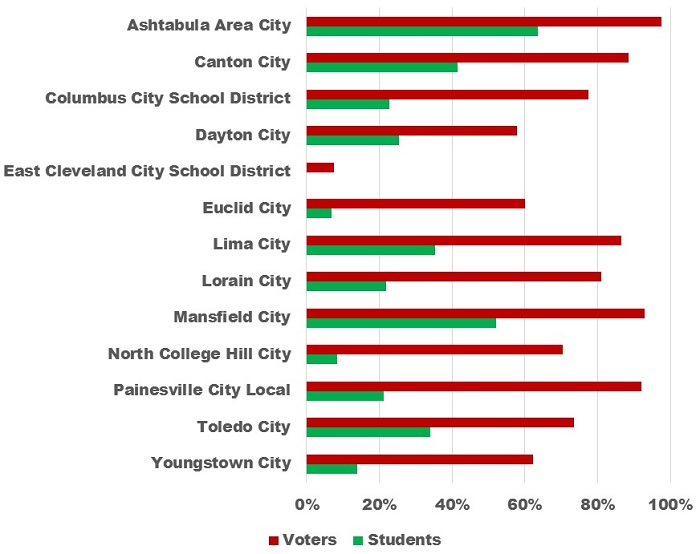
As a result of this age-skew, most voters who elect school boards in Ohio’s lowest-performing districts don’t actually use the public schools—and, more importantly, these voters look nothing like the students these schools educate. During the last school board elections, for example, white voters accounted for more than 70 percent of the electorate in these districts, although nearly 75 percent of the students enrolled there were non-white.

Figure 2. Percentage of students and school-board-election voters who are white, 2017, by district
 

Kogan local control figure 2​

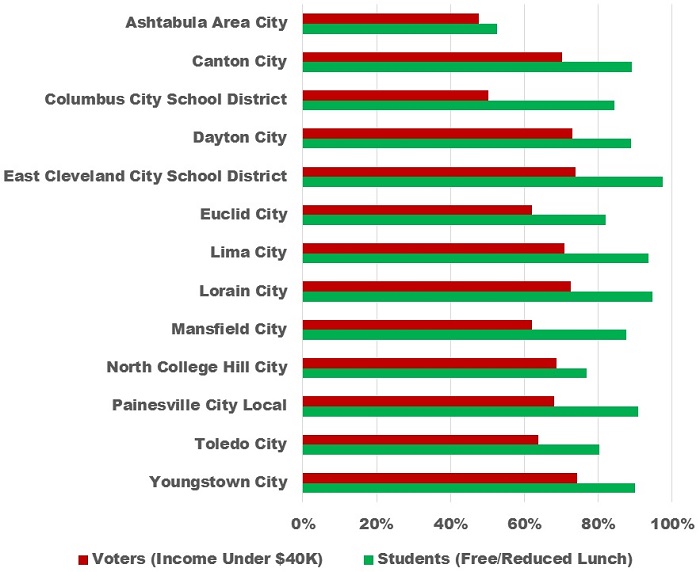
There is a similar, though smaller, gap in terms of socioeconomic status. In the average F-rated district, 85 percent of the students qualified for free or reduced-price lunch in 2015. By contrast, only about 66 percent of the voters in 2017 had a family income of under $40,000, the rough cutoff for reduced-price-lunch eligibility for a family of typical size.

Figure 3. Percentage of school-board-election voters with a family income under $40,000 in 2017, versus percentage of students qualifying for free or reduced-price lunch in 2015, by district
 

Kogan local control figure 3​

Note: Free-or-reduced-price-lunch status data are taken from the Stanford Education Data Archive, with the numbers imputed for districts that participate in the Community Eligibility Provision program to provide free lunch to all students regardless of income.

In local democracies, adult interests trump kids’ needs

Although there’s much worth celebrating about democracy, it’s an imperfect system when it comes to the provision of high-quality public education. When school boards must pander to their constituents to get reelected—and when board members who don’t are simply replaced by those who do—we get a system that is much more suited to serving the interests of the adults who pay attention to local politics and vote in local elections.

That is one reason why school boards spend so much time on adult issues like collective bargaining and contracting. Those who work in local schools or sell goods and services to them care a lot about who sits on school boards, so these interest groups are particularly likely to take part in local elections and to show up at school board meetings and make their opinions known. Although parents might show up when an item on the agenda deals specifically with their schools or programs their children participate in, there is no organized constituency demanding overall improvement and reform.

As one recent book by Clarence Stone and Jeffrey Henig about failed education reform efforts in America’s largest cities presciently concludes, “That these bursts of attention proved ephemeral and ineffective was not because various sectors of the city were indifferent, but because diffuse concerns and scattered activities never generated a community synergy that could be sustained in the face of slow progress and competing demands on the public’s attention and purse.”

For everyone who wants to improve student outcomes—particularly for our most disadvantaged kids—this is an important lesson that too often gets overlooked. More “local control” won’t fix our schools because it will not create the accountability and incentives necessary to drive real change.

Vladimir Kogan is an associate professor at the Ohio State University Department of Political Science and (by courtesy) the Glenn College of Public Affairs. His research focuses on educational governance and local democracy.


view
Perkins pilot programs

Perkins career-technical pilot programs are good news for Ohio

Jessica Poiner
7.15.2019
Ohio Gadfly Daily

Ohio has been locked in the jaws of a busy budget season for months. There’s been no shortage of debate on a variety of education policies, including graduation requirements, academic distress commissions, and school choice.

Meanwhile, a few other, equally important education policy developments have been lost in the shuffle. Chief among them is Perkins V, the long-awaited reauthorization of the Carl D. Perkins Career and Technical Education Act of 2006. This federal law governs how states implement and expand access to CTE programs, and provides over a billion dollars in funding to states, districts, and community colleges.

Although the bill was signed into law last summer, it didn’t officially go into effect until July 1 of this year. Ohio submitted a one-year transition plan to the U.S. Department of Education back in May. That plan has since been approved, and will guide the Buckeye State’s implementation of Perkins V until the full, four-year state plan—due to the feds in April of 2020—is approved.

The plan contains plenty of important provisions. But there are two pilot programs, in particular, that are worthy of discussion and of praise.

Work-based learning

Work-based learning (WBL) is designed to help students master a combination of academic, technical, and professional skills. After the passage of Perkins V, officials at the U.S. Department of Education highlighted WBL as one of the best methods by which states could “rethink” CTE and improve outcomes for young people.

Ohio already has a WBL system in place. Participating students are jointly supervised by an employer and a representative from their school, and the state has a framework that schools must follow to grant high school credit to students who demonstrate subject competency through their WBL experience. The state also provides a Work-Based Learning toolkit.

Prior to the passage of Perkins V, Ohio was upgrading its WBL system as part of the New Skills for Youth initiative. Now state officials are extending these efforts to focus on providing more and better resources. According to the transition plan, the Ohio Department of Education will use the next year to “pilot a statewide system to assist educators, students and employers in coordinating high-quality work-based learning for students.” There aren’t any details about what this pilot program will look like, so it’s hard to predict how widespread—or how effective—it will be. But there’s no doubt that it’s needed. Thousands of Ohio students could benefit from WBL, but they lack both access to and information about various workplace opportunities. This pilot could be instrumental in helping Ohio solidify and improve its WBL system. 

Regional equity labs

Perkins V contains provisions that require states to complete local comprehensive needs assessments and to increase stakeholder engagement, similar to what happened with ESSA stakeholder meetings. The new law also requires states to focus more on meeting the needs of special populations and improving equity. Ohio will address these issues simultaneously by piloting an initiative for secondary CTE programs known as the Regional Equity Lab Strategy.

These labs will be facilitated by the Ohio Department of Education, but participants will be identified by career-technical planning districts (CTPDs), of which there are ninety-one in Ohio. State law requires all school districts and charter schools to be members of a CTPD, and Ohio’s transition plan requires each CTPD to identify a team to participate in an equity lab, so the pilot should include representatives from every corner of the state. Teams that are identified by CTPDs will include local educators and administrators, workforce development professionals, school counselors, and other staff and stakeholders.

The task before these groups is to analyze data in three main areas—access, engagement and enrollment, and student outcomes—and identify gaps that exist between student subgroups. Teams will use these data to create goals and action plans that will be included as part of the local needs assessments. Although the devil will be in the details, these equity labs and the action plans they produce could be instrumental in helping CTE programs identify data-driven solutions to close access, performance, and equity gaps.

***

Pilot programs are double-edged swords. They can be a great way to test a reform idea, ease into a big change, or identify solutions to complicated problems. But they can also fall by the wayside pretty quickly when things get busy, and without careful attention, even positive outcomes could get lost. The pilot programs identified in the state’s Perkins V transition plan are no different. They have a lot of promise, and done well, they could drive improved CTE program quality and equity. Let’s not let them get lost in the shuffle.

view

Little rhyme or reason in special needs designations for students

Jeff Murray
7.10.2019
Flypaper

A designation of special needs for a K–12 student can generate a sigh of relief from some parents and a howl of outrage from others. Such a designation can also be the basis of a successful outcome for some students and the beginning of a long struggle for others to attain proper supports. A recent study published in the journal Society and Mental Health attempts to locate the source of variability in special needs designations as a basis for untangling these divergent scenarios.

Authors Dara Shifrer of Portland State University and Rachel Fish of New York University use the term “designation” rather than “diagnosis” deliberately. While most students’ special needs designations are given by a medical professional (school nurse, psychologist, neurologist, family doctor, etc.), research suggests there is also a non-medical component due to the “inextricable involvement” of teachers, parents, principals, and counselors in detection and referral. While medical diagnoses are precise and scientific (learning disabilities, ADHD, physical handicap, autism, and intellectual disabilities), school districts’ special needs categorizations are far less precise and can fall into subjective areas such as behavioral problems and lack of self-regulation. Shifrer and Fish are interested in teasing out ways in which school-based factors—non-medical subjectivity—can lead to inconsistencies in special needs designation between otherwise similar students. 

The study examines yearly data collected by the school district and state education agency on 378,919 children in grades pre-kindergarten through twelve in an unnamed “large urban district in the southwestern United States” between 2006–07 and 2011–12. Students in the study were those with only one category of special needs diagnosis; those with multiple designation were excluded, as were students who moved in and out of the district so much as to disrupt data collection. The final N-size was 346,957 students, of whom approximately 80 percent were economically disadvantaged. Sixty percent of students were Hispanic, 25 percent were black, and 30 percent English language learners (ELLs). The teaching population was similarly diverse, about 25 percent of teachers were white, 40 percent black, and 25 percent Hispanic.

The topline finding is probably not surprising. Shifrer and Fish found a huge amount of variability in special needs designation among otherwise similar students. By controlling for a number of school level variables, they were able to dig down and differentiate children’s likelihood of designation based on some specific factors. For example, the likelihood of designation was higher in schools with more resources—such as smaller class sizes and a student population of relatively higher socioeconomic status—and in schools of choice. Additionally, findings suggested that children’s likelihood of designation may also be higher if they are distinctive relative to other students in their school along certain dimensions such as race or ELL status. In other words, two similar ELL students in different schools face a differing likelihood of special needs designation based on how many other ELLs are in their respective buildings. And those differences were not always predictable. While low achievers, black students, and ELLs were all more likely to be designated as special needs students in schools where they were distinctive in these traits from their peers, the opposite was true of Hispanic students.

Shifrer and Fish conclude that teachers and counselors may be interpreting similar “symptoms” differently depending on the context, and they may be responding to those symptoms differently as well. Singling out the “different” kids in a school or classroom for special needs designation is just as troubling as ignoring the real needs of students so as to avoid singling them out.

Recent news reports that too many students are being designated in some states and too few in others, along with ongoing stories of inadequate provision of services press home just how important it is that all the adults involved in special education get this right. Shifrer and Fish’s research indicates that the basis for designation—and thus for provision of services—is likely built on shaky ground.

SOURCE: Dara Shifrer and Rachel Fish. “Contextual Reliability in the Designation of Cognitive Health Conditions among U.S. Children,” Society and Mental Health (May 2019).

Fordham Logo

© 2026 The Thomas B. Fordham Institute
Privacy Policy
Usage Agreement

National

P.O. Box 110
Burke, VA 22009

202.223.5452

[email protected]

Ohio

P.O. Box 82291
Columbus, OH 43202

614.223.1580

[email protected]

Sponsorship

130 West Second Street, Suite 410
Dayton, Ohio 45402

937.227.3368

[email protected]