Mobile Navigation

  • National
    • Policy
      • High Expectations
      • Quality Choices
      • Personalized Pathways
    • Research
    • Commentary
      • Gadfly Newsletter
      • Flypaper Blog
    • Events
    • Scholars Program
  • Ohio
    • Policy
      • Priorities
      • Media & Testimony
    • Research
    • Commentary
      • Ohio Education Gadfly Biweekly
      • Ohio Gadfly Daily
  • Charter Authorizing
    • Application
    • Sponsored Schools
    • Resources
  • About
    • Mission
    • Board
    • Staff
    • Career
Home
Home
Advancing Educational Excellence

Main Navigation

  • National
  • Ohio
  • Charter Authorizing
  • About

Ohio Menu

  • Topics
    • Accountability & Testing
    • Advanced Education
    • Career & Technical Education
    • Charter Schools
    • Curriculum & Instruction
    • ESSA
    • Evidence-Based Learning
    • Governance
    • Personalized Learning
    • Private School Choice
    • School Finance
    • Standards
    • Teachers & School Leaders
  • Research
  • Policy
  • Commentary
    • Ohio Gadfly Newsletter
    • Ohio Gadfly Blog
    • Events

The Education Gadfly Weekly

Sign Up to Receive Fordham Updates

We'll send you quality research, commentary, analysis, and news on the education issues you care about.
Thank you for signing up!
Please check your email to confirm the subscription.

Ohio Education Gadfly Biweekly - Volume 11, Number 3

Volume 11, Number 3
1.18.2017
1.18.2017

Ohio Education Gadfly Biweekly - Volume 11, Number 3

Volume 11, Number 3
view
Standards & Accountability

On the Right Track: Ohio’s charter reforms one year into implementation

Ohio House Bill 2 (HB 2) was signed into law on November 1, 2015. It was a landmark piece of legislation that significantly altered the framework governing the state’s charter schools.

Aaron Churchill, Jamie Davies O'Leary, Chad L. Aldis 1.18.2017
OhioReport

On the Right Track: Ohio’s charter reforms one year into implementation

1.18.2017
Report

Good charters are good choices: Farah’s story (Columbus Collegiate Academy)

Jamie Davies O'Leary
1.30.2017
Blog

Turnarounds rarely work; close dysfunctional schools instead

Aaron Churchill
1.30.2017
Blog

2017 National School Choice Poll

Jessica Poiner
1.25.2017
Blog

You’re invited to a panel discussion on the facilities challenges facing Ohio charter schools

Ohio Education Gadfly
1.30.2017
Blog

Ohio’s ESSA plan: Identifying low-performing schools

Jessica Poiner
1.30.2017
Blog

Ohio's charter reforms are on the right track

Aaron Churchill | Jamie Davies O'Leary | Chad L. Aldis
1.18.2017
Flypaper
view

Good charters are good choices: Farah’s story (Columbus Collegiate Academy)

Jamie Davies O'Leary 1.30.2017
Blog
view

Turnarounds rarely work; close dysfunctional schools instead

Aaron Churchill 1.30.2017
Blog
view

2017 National School Choice Poll

Jessica Poiner 1.25.2017
Blog
view

You’re invited to a panel discussion on the facilities challenges facing Ohio charter schools

Ohio Education Gadfly 1.30.2017
Blog
view

Ohio’s ESSA plan: Identifying low-performing schools

Jessica Poiner 1.30.2017
Blog
view

Ohio's charter reforms are on the right track

Aaron Churchill, Jamie Davies O'Leary, Chad L. Aldis 1.18.2017
Flypaper
view

On the Right Track: Ohio’s charter reforms one year into implementation

1.18.2017
Report
Ohio House Bill 2 (HB 2) was signed into law on November 1, 2015. It was a landmark piece of legislation that significantly altered the framework governing the state’s charter schools. The comprehensive legislation sought to right a sector that has struggled since Ohio’s first charter schools opened in 1998, while also protecting the very school-level autonomy that is essential to the charter model.
 
HB 2 aimed to reverse years of poor oversight and to put Ohio’s charter schools on the road to redemption through tougher oversight of sponsors, the entities that hold charter schools accountable (also commonly known as “authorizers”); strengthening of charter governing boards, the bodies that oversee school operations and management; and requiring greater transparency from charter operators.
 
Now that more than a year has passed, we take a first close look and how these charter reforms are being implemented—with vigor and care, or with neglect? Are there any early indications that the reforms are improving sector performance? Alternatively, are any unintended consequences becoming clear?
 
Download the full report now to see for yourself.
view

Good charters are good choices: Farah’s story (Columbus Collegiate Academy)

Jamie Davies O'Leary
1.30.2017
Blog

Parents make choices about their child’s schooling based on a variety of factors: location, safety, convenience, academics, extracurriculars, support services, and more. Many families choose their school by moving to the neighborhood of their preference, thus exercising “choice” when making homeownership decisions. It’s important to recognize that not all families have the same luxury. In fact, many don’t. For the most part, parents living in poverty can’t just up and move themselves to a neighborhood with higher-performing, better-programmed, safer schools. Yet their children deserve high-quality educational opportunities, too, in schools that work for them based on their unique learning styles, interests, and needs.

If we believe that parents of all income levels and backgrounds deserve the same choices we exercise for ourselves and our own children, then Ohio’s high-performing charter schools deserve our unwavering support. The 21,000+ events held across the nation last week for National School Choice Week demonstrate the pressing need—and support for—quality school options. Columbus Collegiate Academy (Dana Avenue campus), one of the city’s highest-performing middle schools, helps its eighth graders achieve math and science proficiency at a rate that’s more than double what the district achieves. Meanwhile, its eighth-grade reading proficiency rate is thirty-seven points higher than the district’s. It achieves this despite nearly all of its students being economically disadvantaged. 

Impressive data only tell part of the story. Hearing directly from parents and students sheds much needed light on how life-changing a good charter school option can be. Consider the story of just one student, Farah, who in the video below shares how she felt unsupported and was “made fun of” at a past school. (Given that one in five students reports being bullied, we know Farah is not alone.) Switching to Columbus Collegiate Academy gave Farah a sense of safety—arguably a prerequisite for learning given that we know bullying increases a child’s risk of having poor sleep and facing anxiety, depression, and other hardships.

[[{"fid":"117993","view_mode":"default","fields":{"format":"default"},"type":"media","attributes":{"style":"width: 500px; height: 310px;","class":"media-element file-default"},"link_text":null}]]

But Farah, like many students from similar backgrounds, was far behind academically. She admits, “I was ‘an all Fs kid.’” Columbus Collegiate’s culture of high expectations, hard work, and relentless commitment to the idea that all children can and will learn helps Farah find a sense of self-efficacy and visualize a path to success.

Take a look at Farah’s inspiring story about the difference a good charter has made in her life.

For more student perspectives, check out Shyanne’s story, as well as profiles on several other students attending high-performing charter schools. 

view

Turnarounds rarely work; close dysfunctional schools instead

Aaron Churchill
1.30.2017
Blog

“Winners never quit and quitters never win.” There's a lot of truth in that cliché, but it doesn't seem to apply to education. When it comes to chronically low-performing schools, in many cases, the better – and more courageous – course is to “quit” and close a school that is simply beyond repair.

In recent years, attempts to turn around failing schools are most closely linked to the Obama Administration’s supercharged School Improvement Grant (SIG) program. Between 2010 and 2015, the federal government spent $7 billion in efforts to turnaround low-performing schools. In exchange for these funds, grantee schools pledged to implement prescribed interventions, such as replacing personnel or changing instructional practices.

The returns: Not much—or perhaps not clear—according to a massive study by Mathematica and the American Institutes for Research (AIR). The study examined schools in the 2010 SIG cohort and tracked pupil outcomes through three years of implementation. Using data from twenty-two states, their analysis found that SIG had no significant impact on students’ state math or reading test scores. Nor did they find any evidence that SIG increased pupils’ likelihood of high school graduation or college enrollment. Further, the analysts didn’t even uncover an effect of SIG on the practices of participating schools.

Even with large sums of new money tied to well-meaning mandates, SIG turnaround schools could not appreciably move the achievement needle.

Now, what to do? One option is to keep trying to fix bad schools. We’ve been down that road with precious little to show for the time, effort and dollars spent.

Another approach is to close low-performing schools, while also launching excellent new schools to replace them. Andy Smarick, arguably the staunchest proponent of this view, writes:

We’ve tried to fix these deeply troubled schools for eons to no avail. … The wiser course of action is to make persistently underperforming institutions go away and then start new institutions in their place.

His position has been criticized as a “crusade” against SIG, and perhaps it is. Interestingly, though, in SIG’s own program design, one possible “intervention” was to close the school and have students enroll in another one. Predictably, almost no SIG schools took up the offer to voluntarily go out of business. But what if SIG had somehow induced the closure of more low-performing schools, and instead diverted billions of dollars to new school formation? Would kids’ outcomes have been any different?

We certainly don’t know the answer to this counterfactual. But a growing body of research (unrelated to SIG) suggests that students might have benefitted had their low-performing schools closed. In The 74, Matt Barnum highlights recent research from New Orleans that finds students made academic gains when low-performing schools closed. This mirrors Fordham’s own research, conducted by Deven Carlson and Stéphane Lavertu, which found displaced students from Ohio’s urban areas made significant gains on state exams, post-closure. Another study, this one from New York City, revealed that closing low-performing high schools increased the likelihood of students graduating from high school. Though closures may be politically difficult, studies now indicate that students benefit when a low-performing school closes and they relocate to a better one.

The Obama Administration’s parlay on intervention mandates and school turnarounds yielded little pay off for many thousands of children attending low-performing SIG schools. That demands some different thinking on how to lift outcomes in America’s neediest communities. Of course, it would be naïve to think that we can simply close our way to success. Done judiciously, shutting the lowest-performing schools while focusing resources on promising startups, might be our surest bet.

This piece originally appeared on the Real Clear Education blog.

view

2017 National School Choice Poll

Jessica Poiner
1.25.2017
Blog

The American Federation for Children (AFC) recently released its third annual poll on school choice. The national poll surveyed just over 1,000 likely November 2018 voters early this January via phone calls.

To determine general support and opposition, AFC posed the following question: “Generally speaking, would you say you favor or oppose the concept of school choice? School choice gives parents the right to use the tax dollars associated with their child’s education to send their child to the public or private school which better serves their needs.” By and large, the findings indicate broad support for school choice—68 percent of those surveyed support school choice compared to 28 percent who oppose it. These numbers are similar to AFC results from previous years: 69 and 70 percent of likely voters who expressed support for school choice in 2015 and 2016, respectively.

In addition to overall percentages, AFC broke out the survey numbers by specific demographic groups. Seventy-five percent of Latinos and 72 percent of African Americans support school choice compared to 65 percent of Whites. In terms of political affiliation, 84 percent of Republicans support school choice (up slightly from 80 percent in 2016), compared to 55 percent of Democrats (down from 65 percent in 2016); 67 percent of Independents voiced support for choice. Of the four generations surveyed, Millennials had the highest level of support for choice with 75 percent. 

The AFC survey also finds that seven types of choice gain majority support. They include: special needs scholarships (83 percent support), public charter schools (74 percent support), scholarship tax credit programs (73 percent support), education savings accounts (69 percent support), opportunity scholarships (58 percent support), virtual learning (59 percent support), and school vouchers (51 percent support).

Pollsters also questioned respondents on their support for “two potential school choice proposals that may be introduced in Congress.” Seventy-two percent of potential voters expressed support for a federal scholarship tax credit, and 51 percent of voters supported Trump’s proposal of a $20 billion school choice program.

It’s worth noting that the way pollsters ask questions matters. While the report did mention wording for a few questions, the majority of questions aren’t provided. Nevertheless, other national polls find similar levels of support for school choice. 

SOURCE: “2017 National School Choice Poll,” American Federation for Children, (January 2017). 

view

You’re invited to a panel discussion on the facilities challenges facing Ohio charter schools

Ohio Education Gadfly
1.30.2017
Blog

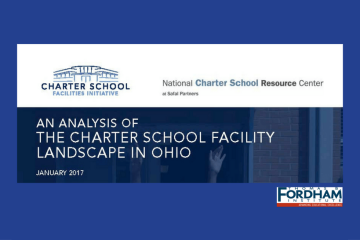
Ohio charter schools have long reported struggling in their efforts to secure school facilities. A soon-to-be released report, “An Analysis of the Charter School Facility Landscape in Ohio,” from the Ohio Alliance for Public Charter Schools, the National Charter School Resource Center, the Charter School Facilities Initiative, managed by the Colorado League of Charter Schools, and the National Alliance for Public Charter Schools surveys school principals to get the most detailed look to date of Ohio charter school facilities. The survey, which includes data from 81 percent of Ohio's brick and mortar charter schools, examines multiple aspects of charter facilities including the size, uses, and cost per student of each.

Please join Fordham and the Callender Group to hear the report’s authors share the data and Ohio charter schools/school networks talk about what the report means on-the-ground.

Thursday, February 2, 2016
8:30 - 10:00 am

Chase Tower - Sixth floor conference room B
100 East Broad Street
Columbus, OH 43215

PRESENTERS:
Kevin Hesla, National Alliance for Public Charter Schools and report co-author
Jessica M. Johnson, Esq., Colorado League of Charter Schools and report co-author

PANELISTS:
Tiffany Adamski, Regional Director Midwest at iLEAD
Andrew Boy, Founder and Chief Executive Officer, United Schools Network
Lyman Millard, consultant at Breakthrough Schools

MODERATOR:
Mark Real

Doors open at 8:00 am and a light breakfast will be served.

SPACE IS LIMITED, SO REGISTER TODAY

view

Ohio’s ESSA plan: Identifying low-performing schools

Jessica Poiner
1.30.2017
Blog

One of the hallmarks of school accountability is the identification of and intervention in persistently low-preforming schools. Under No Child Left Behind (NCLB), schools were required to make adequate yearly progress (AYP); if they fell short, they were subject to a set of escalating consequences. Much of the backlash against NCLB was a result of these consequences being imposed from afar with little flexibility. So when Congress geared up for reauthorization, it wasn’t surprising that the new law, the Every Student Succeeds Act (ESSA), shifted the responsibility of identification and intervention to the states.

Last week, the Ohio Department of Education (ODE) released an overview of its proposed ESSA state plan. This isn’t the entire plan—the full draft will be released for public comment in early February. In future posts, we’ll do some deep dive analyses of the key areas and potential impacts of the full draft. But in the meantime, there’s plenty in the overview to explore—including how the Buckeye State plans to identify its lowest-performing schools.

ESSA requires states to identify at least two categories of schools: comprehensive support schools (which include the lowest-performing schools in the state) and targeted support schools (which include schools struggling with certain subgroups). Although ESSA requires only two categories, ODE’s plan proposes to carry over the three categories it currently uses that were a part of its federal waiver under NCLB/ESEA: priority schools, focus schools, and watch schools. Identification of these schools will begin at the end of the 2017-18 school year and, per ESSA requirements, the list of identified schools will be updated every three years. Let’s take a closer look at Ohio’s proposal for each of these categories.

Priority Schools

Priority is the name ODE plans to give to schools that fall under ESSA’s category of comprehensive support. There are three ways to fall onto this list:

  • Schools that receive an overall report card grade of F. Although Ohio hasn’t assigned a summative rating to schools in recent years, state law currently requires (but federal law no longer does) overall grades starting in 2018. ESSA requires that schools identified in this category include the lowest-performing 5 percent of Title I schools. Ohio’s plan notes that if less than 5 percent of schools receive an F, the next lowest-performing schools as determined by the overall report card grade will be added to meet the ESSA requirement.
  • Schools with a four-year graduation rate of less than 67 percent. It is an ESSA requirement that Ohio label such schools as comprehensive support schools (or in the case of Ohio, priority schools).
  • Schools with one or more subgroups performing at a level similar to the lowest 5 percent of schools.[1] According to ESSA, these types of schools start out under the targeted support label. If, however, a school fails to meet state-determined exit criteria within a certain number of years, it must transition into the priority category. Ohio already disaggregates some of its report card results based on certain subgroups (e.g., English language learners or race/ethnicity), but ESSA ups the ante by adding homeless students, foster care students, and children of active duty military personnel to the list of required subgroups for accountability. ODE’s plan also proposes to adjust its N-size for subgroups from 30 students to 15.

In order to move off of the priority schools list, schools must accomplish each of the following:

  1. Based on the overall report card grade, achieve school performance higher than the lowest 5 percent of schools for two consecutive years
  2. Earn a four-year graduation rate of more than 67 percent for two consecutive school years (if applicable)
  3. Have no student subgroups performing at a level similar to the lowest 5 percent of schools

Focus Schools

Focus is the name ODE proposes to give schools that fall under ESSA’s category of targeted support. There are three types of schools that will be labeled as focus schools:

  • Schools that earn a grade of D or F for the Gap Closing report card component for two consecutive years
  • Schools that have one or more student subgroups that fail to meet specific locally determined improvement goals for three consecutive years
  • Schools that do not meet multiple student subgroup performance benchmarks

In order to move off of the focus list, schools must earn an overall report card grade of C or better, earn a C or better on the Gap Closing component, and meet subgroup performance goals outlined by the state.

Watch Schools

Ohio’s additional category, watch schools, consists of schools that “struggle to meet the needs of one or more student subgroups.” ODE’s overview includes little detail about these schools, but the forthcoming plan is sure to offer more.

Although school identification is typically associated with low-performing schools, it’s worth noting that Ohio already identifies high performers. The state plans to continue these efforts under ESSA—even though it’s not required—in order to “honor and celebrate school districts that grow and achieve.” These recognition categories include schools that accomplish sustained achievement and substantial progress while serving a significant number of economically disadvantaged students and schools that exceed expectations in student growth for the year.

ODE’s plan for identifying low-performing schools shouldn’t be big news—other than changing the names of the categories and opting to have three categories instead of two, Ohio follows ESSA’s identification provisions pretty closely. The real drama is going to come with the news of which schools have been identified and how districts will select and implement improvement plans that actually work.


[1]This is based on individual subgroup performance.

view

Ohio's charter reforms are on the right track

Aaron Churchill | Jamie Davies O'Leary | Chad L. Aldis
1.18.2017
Flypaper

On the college football field, Ohio and Michigan are bitter rivals. But in the charter school world they share something in common: Both states’ charter sectors have been saddled with the unflattering label of the “wild west.” Recently, this characterization—generally meant to describe a state without proper accountability policies—has been used in critiques of Michigan native and charter supporter, Betsy DeVos, president-elect Trump’s appointee for secretary of education.

What’s clear is that this label and accompanying narrative are hard to shed, even though both states have significantly strengthened their charter laws. On these Gadfly pages, Daniel Quisenberry has described how Michigan is improving its charter sector. In a Fordham report released today, we show how Ohio’s era of stagecoaches and saloons is starting to give way to a more modernized charter sector.

In On the Right Track, we examine the early implementation of recently enacted charter reforms in our home state of Ohio. Bottom line: The Buckeye State’s reforms are being implemented with rigor and fidelity, bringing promising changes to one of the nation’s oldest, largest, and most notorious charter sectors.

In autumn 2015, Governor John Kasich and Ohio legislators passed a landmark, bipartisan charter reform bill (House Bill 2). This legislation sought to strengthen accountability and transparency, align incentives to ensure quality schools, and rid the sector of conflicts of interest and loopholes that had threatened public trust. House Bill 2 was legislation that we at Fordham strongly supported and were pleased to see enacted into state law.

Among its myriad provisions, the legislation:

  • Ratchets up state oversight over its numerous charter authorizers (more than sixty as of last year). Among the key accountability tools is Ohio’s sharpened authorizer evaluation system that now includes revocation for a poor rating.
  • Eliminates “authorizer hopping.” While Ohio’s plethora of authorizer options allowed schools to find one that fits their needs, it also allowed low-performing schools to escape accountability by switching authorizers. Ohio’s charter reforms now prohibit this, with few exceptions.
  • Empowers charter governing boards to exercise independent control over their schools—and puts safeguards in place to reduce the likelihood they are being controlled by a management company.

But as studies and vast amounts of experience have taught us, whether these legislative reforms bear fruit or wither on the vine hinges largely on implementation. Now that a year has passed since Governor Kasich signed the legislation, we thought it was time to take a first close look. How are these reforms being implemented—with vigor and care, or with neglect? Are there any early indications that the reforms are improving sector performance? Alternatively, are any unintended consequences becoming clear?

To analyze these questions, we looked at several key data points, including trends in Ohio’s charter school closures and startups. We also reviewed each House Bill 2 provision, searching for evidence of implementation or enforcement by state authorities. Three key findings emerge:

  • Ohio’s charter sector is becoming more quality focused. In 2016, twenty-one charters closed across the state, among the highest numbers of school closings on record in Ohio. The schools had received low ratings on state report cards, suggesting that Ohio’s tougher accountability policies are—as they should—decreasing the likelihood that underperforming schools will just go on forever. Additionally, a very small number of new charter schools opened in fall 2015 and 2016—just eight new startups in both years—the lowest numbers of new school openings in Ohio’s charter history. This indicates that authorizers are vetting new schools more diligently as the pressure rises to open schools that promise quality. However, this also raises the troubling possibility that reforms are impeding charter growth, perhaps even deterring potentially excellent schools from entering the sector.
  • Ohio’s rigorous authorizer evaluation system has teeth. In October 2016, the Ohio Department of Education released its first round of high-stakes authorizer ratings under a revamped evaluation system. (Initial evaluation legislation passed in 2012, but that iteration had not been thoroughly implemented.) Twenty-one out of sixty-five total authorizers received an overall Poor rating—the lowest possible—while another thirty-nine were rated Ineffective, the second lowest rating. Authorizers rated Poor had their rights revoked, pending appeal, while Ineffective authorizers are now subject to a quality improvement plan overseen by the state and are prohibited from opening new schools. Poor rated authorizers represent only a small portion of the overall sector—responsible for just 8 percent of Buckeye charter schools; Ineffective entities authorize the majority of charters (62 percent).
  • State authorities are implementing forty-nine out of fifty of the House Bill 2 provisions in a verifiable way. Many of the legislative provisions require state agencies—e.g., the Ohio Department of Education or State Auditor—to enforce or verify adherence to the new charter law. To their credit, these executive agencies are taking their responsibilities seriously and carrying out the new charter law.

The hard work of implementation is, of course, far from done in Ohio. Policy makers still need to make some important adjustments to its authorizer evaluation system, and they must find a way to balance the tighter accountability environment with the need to grow new schools that give families and students the quality options they deserve. Ohio’s charter sector, for instance, would greatly benefit from more generous startup investment dollars—not to mention more equitable operational and facilities funding—to help quality schools replicate or launch promising startups from scratch. Lastly, empirical research will be required to help us grasp whether Ohio’s sector performance, post-reform, improves compared to prior studies that uncovered disappointing results.

In the end, we offer some good news: The implementation of major charter reform in Ohio is off to a strong start. Yes, we know that bad reputations are hard to shake. But before making broad generalizations, come and take a closer look at the changes—for the better—happening right here in America’s heartland.

Fordham Logo

© 2026 The Thomas B. Fordham Institute
Privacy Policy
Usage Agreement

National

P.O. Box 110
Burke, VA 22009

202.223.5452

[email protected]

Ohio

P.O. Box 82291
Columbus, OH 43202

614.223.1580

[email protected]

Sponsorship

130 West Second Street, Suite 410
Dayton, Ohio 45402

937.227.3368

[email protected]