
Last month, we looked at the recently released state assessment data from the 2021–22 school year. The results are sobering: Student achievement remains depressed in the wake of the pandemic, and gaps between disadvantaged pupils and their peers have widened. The results are especially alarming in Ohio’s cities, where student proficiency has dropped significantly and just one in four children now meet grade-level math and reading standards.
The setbacks on state tests have been less severe in Ohio’s wealthier suburban communities. That’s little surprise given the more abundant at-home resources that allowed students to better weather the storm. But educational damage occurred in suburbia, too. We just have to look elsewhere for its effects: college-readiness data.
This article focuses on the percentage of high school students who achieve college-remediation-free scores on their ACT or SAT exams. It’s a high bar, as it requires students to achieve solid marks on both the English and math components of their college-admissions tests. Yet achieving this target is an important indicator of post-secondary readiness (and a point of pride for many suburban districts), as achieving these benchmarks predicts success in freshman coursework.
Sure enough, the news on this front is glum. Statewide, just 22 percent of Ohio’s class of 2021 met this rigorous standard, down from 25 percent for the (pre-pandemic) class of 2019. In percentage terms, that’s a decline of 12 percent. But that’s nothing compared to the drops experienced by many suburban districts.
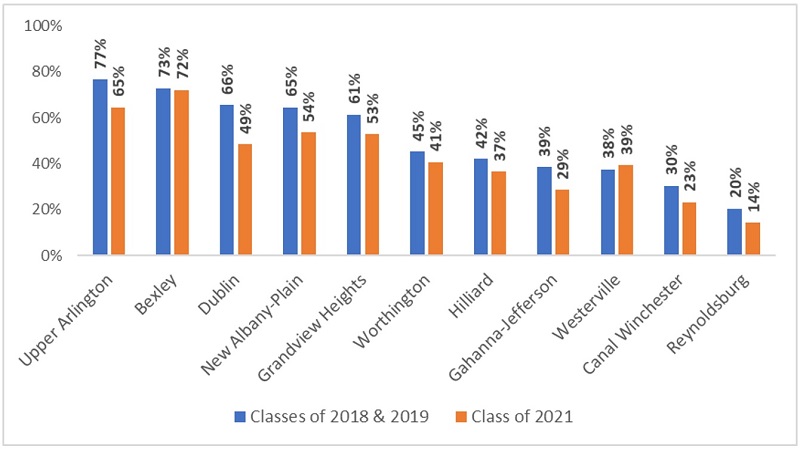
Figure 1 displays the readiness rates of suburban Columbus districts. In Upper Arlington, for example, 77 percent of its graduating classes of 2018 and 2019 met college-ready standards but its rate fell to 65 percent for its class of 2021. Notable declines are also evident in Dublin (-17 points), Gahanna-Jefferson (-10 points), New-Albany Plain (-9 points), and Grandview Heights (-8 points). Of these districts, Westerville is the only one to register an increase.
Figure 1: College readiness rates, Columbus-area suburban districts
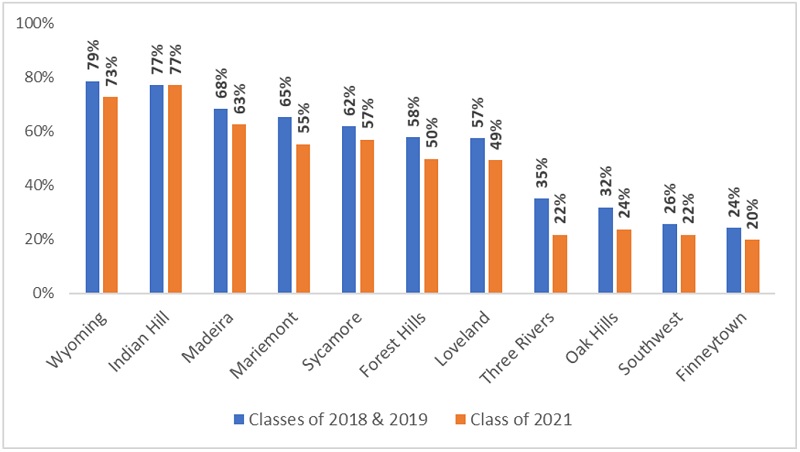
A similar decline in college readiness is seen across suburban Cincinnati districts. Three Rivers posted the largest decline (-13 points), with substantial dips as well in Mariemont (-10 points), Forest Hills, Loveland, and Oak Hills (-8 points each), and Wyoming (-6 points).
Figure 2: College readiness rates, Cincinnati-area districts
The slide in college readiness indicates that the pandemic also took a toll on learning in wealthier communities, too. It disrupted the tail end of the class of 2021’s junior years, and their senior years were likely chaotic, as well. Some students who were previously on pace for college may have lost their edge as they struggled through remote learning or lengthy quarantines. Schools may have also weakened their focus on rigorous academics and been more reluctant to push their best and brightest to excel in the midst of turmoil. Lower-than-usual test participation rates could be a factor, too. That said, the vast majority of these suburban districts recorded 90-plus percent ACT or SAT participation rates for the class of 2021, and non-participants were probably less likely to meet the college-ready benchmark in the first place. One final possible explanation is colleges’ decision to make scores optional during the pandemic; that may have discouraged some students from studying hard for these exams.
Students everywhere have suffered over the past couple years. All Ohio schools, even traditionally high-performing suburban ones, need to work quickly to reverse the slippage. Without it, fewer students will be ready to tackle college coursework, and more are likely to drop out. The future of Ohio lies in the hands of today’s students. For those with college aspirations, let’s make sure they have the academic foundation needed for higher education.