
Earlier this week, the Senate released its version of the biennial state budget, which includes education proposals on school funding, literacy and math, career pathways, and more. A previous piece examines how Senate lawmakers handled the funding formula—the mechanism used to allocate the bulk of state aid to districts and public charter schools. This analysis takes a closer look at how the Senate addressed several important charter-specific issues.
In short—relative to the House-passed budget—the Senate went backward by reducing the charter facility and equity supplements, and by allowing for possible reductions to high-quality charter funding. But it went forward by restoring strong performance criteria for the high-quality charter funding and expanding access to unused district facilities.
Before diving into details, some context is required, as it may have slipped the minds of policymakers and readers during the budget hullabaloo.
Ohio has long underfunded its charter schools, expecting them to operate on fewer dollars. Historically, they received about 70 cents on the dollar compared to similar district schools. Such a large gap was egregiously unfair to charter school students—disproportionately economically disadvantaged—who were shortchanged simply because of their choice in public school. This system also made it much harder for charters to compete for talented educators and limited their capacity to provide extra supports to students. Meanwhile, districts received billions in public resources for facilities, while charters got nothing—putting yet another constraint on their ability to serve more students.
Under the leadership of Governor DeWine and recent General Assemblies, Ohio has taken praiseworthy steps to rectify these inequities. Initiatives include a high-quality charter fund, an equity supplement for all brick-and-mortar charters, and a facilities allowance that helps cover a portion of building costs. The state has also attempted to support facility needs by requiring districts to offer underutilized buildings to charters for purchase or lease.
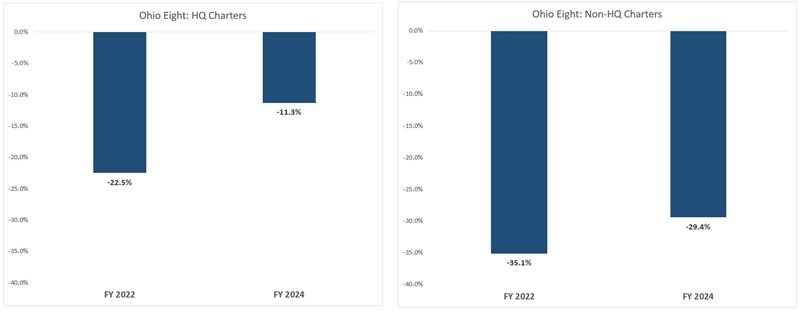
On the operating (non-facilities) side, the high-quality and equity supplements have put a significant dent in the funding gap. The figure below shows that urban charters qualifying for the high-quality funds faced an average shortfall of 11 percent relative to local districts in FY24. This was a much smaller gap than two years prior, and reflects the enhanced quality supplements passed in the last budget. Charters not meeting the criteria for quality dollars still face a sizeable gap relative to districts (-29 percent). However, some of that disparity has been filled by a $650 per pupil equity supplement, which was first provided to all brick-and-mortar charters in FY24.
Figure 1: Average funding shortfall relative to local districts, Ohio Eight charters by high-quality (HQ) status
As for facilities, Ohio provides charters with a $1,000 per-pupil facility allowance. While this allotment has grown since the program was first enacted during the Kasich era, the current amount still falls short of fully covering charters’ facility needs as well as matching traditional districts’ annual spending on operating and maintaining buildings ($1,781 per pupil, excluding construction and debt service). Adding to the challenges, charters have largely been unable to access underused district buildings, as districts have played games to skirt provisions in state law.
In this year’s budget plan, Governor DeWine did another commendable job pushing charter policy in the right direction. He proposed maintaining current funding levels for the high-quality program (and the stringent performance bar to qualify) as well as the equity supplement. The governor also recommended an impressive boost in the facility allowance—upping it to $1,500 per pupil—and put forward a rewrite of the unused facility law that could free more buildings for charters.
To its credit, the House preserved the governor’s proposed funding amounts for the high-quality, equity, and facilities programs. But it erred by stripping out the unused facilities changes. It also included troubling carveouts that would allow more charters to receive quality-school funds even if they fall short of the current criteria.
How did the Senate do? As noted above, its plan is a mixed bag.
Steps forward
- Unused facilities: The Senate wisely restored the governor’s strengthened language that adds clarity and sunlight to the process that districts must follow when they have an unused facility (vacant or less than 60 percent occupied). In response to concerns about mandatory disposal in legitimate cases of underutilization, the Senate included some smart guardrails and an appeal process to the state. The Senate also added new language allowing private schools, which face similar resource constraints, to bid on an unused facility alongside charters.
- High-quality charter funding—performance criteria: The Senate wisely undid the House’s modifications to the performance criteria that would make it easier for mediocre schools to qualify for the dollars. As did the governor and House, the Senate maintained the current per-pupil funding amounts.
Steps backward
- High-quality charter funding—possible “proration”: The Senate prohibits the Ohio Department of Education and Workforce from requesting additional funds from the state controlling board, should the program appropriation be insufficient to pay the full per-pupil allotment. Instead, under the Senate plan, the per-pupil amounts must be reduced (“prorated”) if more charters than expected achieve the performance marks. This would be an unfortunate cut—which has occurred in the past—just because more charters receive strong state ratings.
- Equity supplement: Both the governor and House maintained the current $650 per pupil equity supplement in their budget proposals. The Senate, however, reduced the amount to $500 and $400 per pupil in FY26 and FY27, respectively. This would be a setback in the progress that Ohio has made to fund all brick-and-mortar charter schools more equitably.
- Facilities allowance: The governor proposed and the House approved a significant increase in the facilities allowance to $1,500 per pupil. The Senate reduced those amounts to $1,100 and $1,200 per pupil in FY26 and FY27, respectively. While that’s still a bump over the current funding level, it’s disappointing that the Senate slashed the proposed increase.
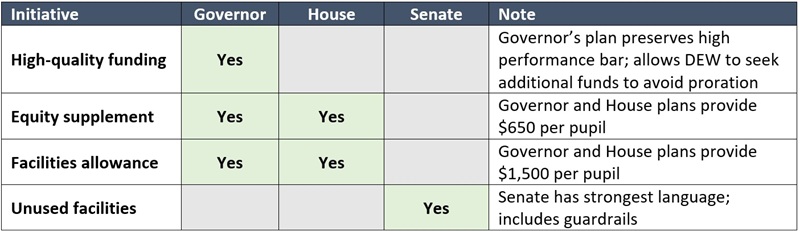
The table below sums up which of the legislative proposals are best when it comes to these four charter initiatives. The green boxes marked “yes” are the ones lawmakers should approve as they hammer out the final budget.
Table 1: Recommended charter proposals for the final budget bill
* * *
In a budget cycle in which lawmakers are clearly seeking to stretch taxpayer dollars to support proven, cost-effective programs, brick-and-mortar charter schools remain a strong investment. As a recent Fordham study on the high-quality program demonstrates, charters have wisely stewarded these funds to strengthen their educational delivery, and students benefited in turn. In the coming weeks, Ohio lawmakers should recommit to excellence and equity by finalizing a state budget that holds charters to high standards and provides fair funding for their students.