Ohio’s school districts receive and spend more money than ever before. Hard to believe, given headlines about “starving” public schools, but it’s true.
In fiscal year 2025, public schools spent on average $16,976 per student, or 17 percent above spending in 2013 (adjusted for inflation). In urban districts such as Columbus and Cleveland, spending exceeded $25,000 per pupil—amounts that we’re more accustomed to seeing in high-tax coastal states like New Jersey and New York. Even in some rural areas of Ohio, spending has passed the $20,000 mark: $20,449 per pupil in Zanesville, $20,479 in Lima, and $23,609 in Mansfield.
But none of this has stopped the public school establishment from clamoring for more money—billions more. In their bid for more funding, they have pushed a narrative of state “disinvestment” in public education. In one press release, picked up by a major news outlet, district officials claimed that the “state’s share of K–12 school funding has fallen to a historic low near 32 percent.”
The statistic is pure deception. As discussed in an earlier piece, the 32 percent “state share” refers to an obscure mechanism inside the funding formula, not the actual percentage of funding provided by the State of Ohio versus the amounts raised locally. When accounting for all state funds for school districts, the true “state share” was 44 percent in 2024–25, which is in line with historic norms.
But even this percentage (44 percent) understates the true role of state government in financing public education. One policy that often goes unacknowledged by critics is the state-required minimum local property tax. While not officially “state revenue,” these dollars are guaranteed under state law and remain an essential element of districts’ foundation funding. But what exactly is this indirect form of state aid and how much does it generate for districts?
Under Ohio law, school districts must maintain a property tax rate of at least 20 mills (or 2 percent) to receive state formula funding. In essence, the provision guarantees that all Ohio districts receive baseline local tax support, as districts can remind voters they must approve this minimum tax rate, lest they forfeit millions in state aid. Furthermore, state law establishes a millage floor at 20 mills to protect districts from having their tax rates reduced below this mark due to tax reduction factors—longstanding state policies that shield citizens from tax hikes due to property inflation.
Taken together, these state laws establish a minimum local tax effort. In practice, every district today levies at least 20 mills of property tax, with many districts taxing at rates above the floor with voter approval. Because districts generate widely varying sums based on their property base, Ohio’s progressive funding formula sends more “direct” state aid to property-poorer districts (and less to wealthier ones).[1] Public charter schools and private schools receive zero local tax revenues,[2] so the state itself shoulders full responsibility for funding these options.
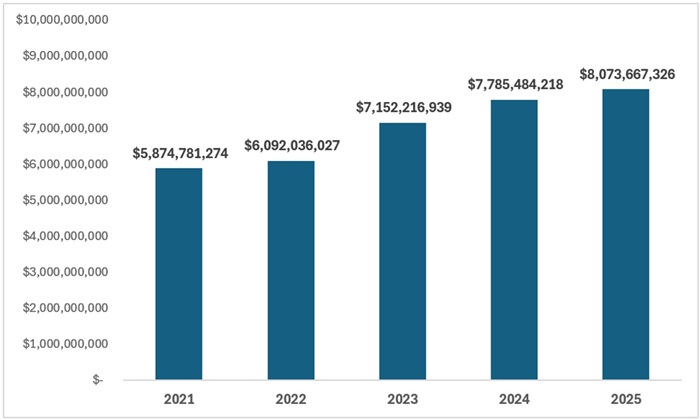
How do the 20 mills translate into dollars and cents? As Figure 1 shows, the minimum tax requirement generated $8.1 billion for school districts in 2025, or $5,514 per student. This is well above the $5.9 billion collected through the 20 mills in 2021—a reflection of rapidly increasing property values as well as property development.[3] In percentage terms, district revenues from the 20 mills rose by 37.4 percent from 2021 to 2025, more than doubling the general inflation rate (up 16.1 percent, as measured by CPI).
Figure 1: Funds received by Ohio school districts via state-required 20 mill property tax
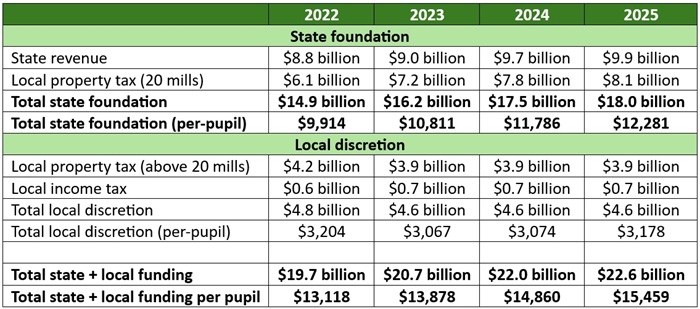
Direct state support combined with the 20 mill property tax provided Ohio school districts with $18.0 billion in total foundation funding in 2025—about $3.1 billion more than they received through these funding components in 2022. As noted earlier, districts can further supplement by asking voters to approve tax rates above the millage floor or a local income tax. During this period, these local “optional” dollars amounted to $4.6 billion to $4.8 billion dollars, boosting districts’ total state-and-local haul to $20 billion to $23 billion per year.
Table 1: Funding broken down by revenue source, Ohio traditional school districts
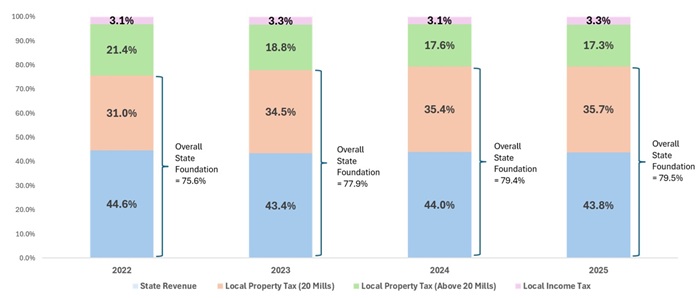
As Figure 2 indicates, the indirect state aid generated via 20 mills plus direct state revenues add up to 75 to 80 percent of district funding—a far cry from the 32 percent “state share” that critics have peddled. Only 20 to 25 percent of districts’ funding could be viewed as purely discretionary local funding.
Figure 2: Percentage of district funding generated by “direct” state revenue plus state-required local millage
Claims that the State of Ohio “starves” or “underfunds” school districts unravel in light of a proper understanding of the overall funding system. State law effectively guarantees districts 20 mills of property taxes, a rate that generates billions to educate students. These dollars must not be forgotten or ignored in debates over the state’s overall investment in public education.
[1] As an example, Upper Arlington (wealthier) received $1,098 per pupil in state formula funding in 2026, while Whitehall (poorer) received $11,699 per pupil in state formula funding. Upper Arlington, however, generated $9,081 per pupil on the 20 mill property tax, while Whitehall generated $2,296 per pupil.
[2] The only exception is a handful of partnership charter schools located in Cleveland that receive a modest sum in local tax revenue.
[3] During this period, residential and agricultural values (class I property) rose from $233 to $331 billion statewide, while class II property (commercial, industrial, mineral, and railroad) values increased from $61 to 72 billion.