The mundane but critical task of transporting students to school has stirred controversy over the past few years. Districts have chafed at their longstanding responsibility under state law to transport resident students who attend public charter and private schools, even though the state subsidizes their transportation. Meanwhile, charter and private school leaders—parents, too—have lodged legitimate complaints about getting the short end of the stick. Districts’ reluctance to provide reliable transportation—or any transportation at all—has caused unnecessary headaches for families choosing non-district options, and has even aggravated the chronic absenteeism crisis.
Simmering tensions erupted into public view last fall with Columbus City Schools blatantly refusing to transport hundreds of Columbus students to charter and private schools just before the year started. One school board member intimated that denying busing might be an underhanded way to get students to enroll in the district. “If you are a charter school parent and you’re struggling and your child can’t get to school, Columbus City Schools is a great option for your family,” he said. The shenanigans caught the attention of Attorney General Dave Yost who sued the district on behalf of impacted families (the case is ongoing).
State lawmakers have also noticed these long-running disputes and enacted provisions that aim to improve cross-sector relations and ensure reliable transportation. In 2021, they passed a law requiring charter and private schools to notify districts of their bell schedules well before the next year begins in order to assist with route planning. Two years later, the General Assembly authorized districts to use vans to transport charter and private school students. Lawmakers also increased state aid for pupil transportation ($519 million to $797 million from 2021 to 2025). And they even added a “weight” inside the transportation formula to send extra dollars to districts with more students attending schools of choice.
But one area lawmakers have not yet tackled, and which remains a source of many problems, is the state’s “impractical to transport” provisions. But what are they? And why must they be addressed?
As a quick refresher, since 1965, Ohio has required school districts to provide transportation to resident students, no matter whether they attend a district or private school (and later, charters, too). The requirement makes sense. Parents, many of whom are heading to work in the mornings and at their jobs in the afternoons, rely on school systems to transport their kids safely and on time. They also pay sizeable sums in local taxes to their local districts, and some of their state taxes also subsidize district transportation. Rather than creating hardships on parents and increasing safety hazards and inefficiencies, the legislature thought it best to charge districts with busing all resident students (with the help of state funding).
There are exceptions to the general rule, however. Districts are not obligated to transport students living within two miles of their school, nor private and charter students attending schools more than thirty minutes away from their assigned public school (commonly known as the “thirty-minute rule”). Districts are also not required to transport high school students, no matter their school of choice.
Those are sensible allowances, but statute also contains a more problematic impractical to transport exception, which gives local school boards the power to deny transportation to otherwise eligible students. Here, all they must do is “consider” six factors that render it “impractical”—in their own estimation—to transport a student.[1] When this happens, the district relieves itself of transportation duties and must offer the impacted family a payment in lieu of transportation, which is a measly $607 at present, or just half the average per-pupil cost of district transportation.[2]
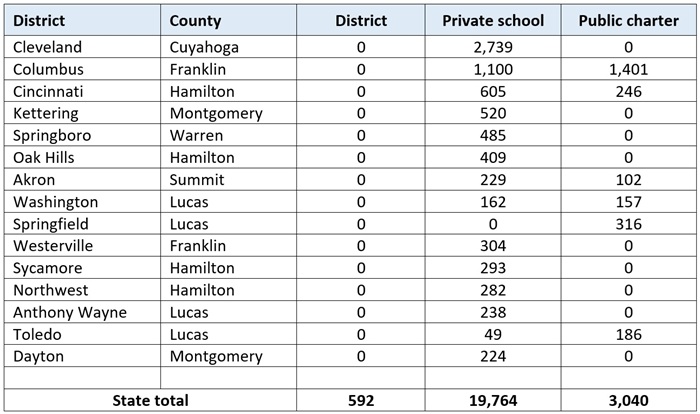
Ohio districts have used this loophole to deny transportation to thousands of public charter and private school students—and this was the way Columbus ducked their transportation responsibilities last year. Table 1 shows that statewide, almost 23,000 charter and private school students were declared impractical last year (roughly 8 percent),[3] while only 592 out of more than 1.4 million district students—a miniscule fraction—were deemed as such. In other words, non-district students were nearly 200 times more likely to be denied transportation than students attending district schools. The table also displays the fifteen districts that declared the most charter and private school students impractical. In these places, not a single eligible district student was denied busing, even though some likely attended magnet schools or resided in remote parts of the district. Meanwhile, hundreds of their peers attending schools of choice were determined to be “impractical.”
Table 1: School district “impractical to transport” declarations by the type of school students attend, 2024–25
What appears to be happening in some (though not all) districts is a systemic exclusion of charter and private school students from district transportation service. This is hardly fair and arguably discriminatory. No one thinks a fire department should be allowed to ignore fires at restaurants it doesn’t like, or the police to disregard certain neighborhoods. But that’s what districts are effectively doing—denying a basic governmental service to citizens they find inconvenient to serve.
Ohio lawmakers should take action to close the impracticality loophole. A couple of options include:[4]
- Tighten the language and increase the payment in lieu of transportation to deter districts from impracticality determinations. Lawmakers could require districts to “prove” impracticality against measurable standards—not just “consider” factors—in order to deny transportation to a student. This might mean, for example, providing evidence that it takes more than twenty minutes to bus a student and that the cost is significantly more than the already enhanced amount the district receives to transport choice students. In addition, lawmakers could also increase the cost to districts of declaring impracticality by tying the “payment in lieu” to the state average per pupil cost of transportation—not just half of it.
- Repeal the impracticality exemption but preserve the “thirty-minute” rule. A cleaner but potentially more politically controversial approach is outright repeal of the impracticality exemption. This would clarify the state’s expectation—and strengthen the requirement—that districts provide all eligible students transportation service. If going this route (or pursuing the option above, too), legislators should preserve the existing exemption from transporting charter and private school students excessively long distances. The “thirty minute” rule should remain intact, as well the other exemptions mentioned earlier in this piece.
Pupil transportation is a nuts-and-bolts service that Ohio requires of its school districts. Rightfully so, as thousands of parents rely on school systems to get their kids to class. Many districts do provide reliable service, but an increasing number are avoiding their responsibilities, most notably to children attending schools of choice. When districts fail to fulfill their obligations, lawmakers need to step in to ensure that all students receive the busing services they are entitled to.
[1] Such factors include time/distance, cost, and whether bussing a student “disrupts current transportation schedules.”
[2] Parents may refuse payment and request mediation before the Ohio Department of Education and Workforce.
[3] This percentage includes all charter and private school students in the denominator, not a more precise number of transportation-eligible students. The percentage of charter and private school students who do receive transportation—13 and 19 percent, respectively—is also much lower than the 46 percent of district students who receive transportation (percentages are, again, relative to their total enrollments).
[4] Another possibility—perhaps limited to areas with widespread problems—is to create countywide pupil transportation systems that remove busing responsibilities (and commensurate funding) from districts. In 2023, the legislature called for pilot projects in Franklin and Montgomery counties that explore this option.