
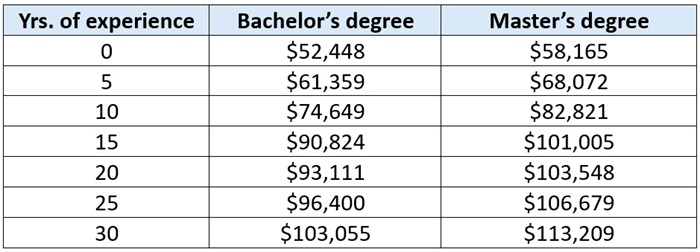
How are Ohio’s public school teachers paid? Not how much. But on what basis are their salaries determined? For decades, the answer has been seniority and degrees earned. Following requirements in state law, school districts simply plop teachers into a “step-and-lane” salary schedule to determine their pay for the year. The table below displays a simplified example based on Columbus City Schools’ salary schedule.
Table 1. Illustration of a step-and-lane salary schedule
This rigid pay model has many perverse incentives. It pushes younger teachers out of the profession, as they are locked into lower salaries no matter what they do. Because there is no pay differentiation based on school assignment, talented teachers have no incentive to teach at high-poverty schools, which leaves many of our neediest students with the least effective instructors. Schools are prone to losing teachers with high-demand skills, such as math and science or career-technical educators, because they can use their talents to earn more elsewhere. It discourages teachers from putting in extra effort, as there is no monetary reward for sharpening their practice or going above and beyond for students.
A pay model based on seniority and degrees earned also defies the evidence. Research indicates that teachers’ effectiveness plateaus after about a decade of experience, so there’s no reason to automatically pay a 30-year teacher more than a 20-year educator, as Columbus and others do. As for graduate coursework, this system heavily incentivizes teachers to spend time and money chasing master’s degrees that research indicates have negligible impacts on effectiveness.
A recent report from the National Council on Teacher Quality (NCTQ) reaffirms the absurdity of Ohio’s teacher pay system. In this study, the NCTQ analysts examine whether states implement pay structures that provide teachers with additional salary based on effectiveness, working in a hard-to-staff school, or being certified in a hard-to-staff content area. It also looks at whether states mandate pay increases based on a master’s degree, which NCTQ rightly considers bad policy.
The upshot: Ohio is one of just six states that received an embarrassing zero on the NCTQ teacher pay analysis.[1] The Buckeye State can’t claim to have any policy or initiative on the books that promotes strategic compensation for teachers. That’s a policy failure, folks.
Helpfully, NCTQ features several states moving toward more sensible approaches to teacher pay. A couple worth highlighting include:
- Texas. In 2019, lawmakers created the Teacher Incentive Allotment (TIA), which increases teachers’ compensation based on their classroom performance and their schools’ demographics. Participation is voluntary, but about 80 percent of Texas districts opt in. Studies of TIA’s early impacts find increased teacher retention as well as improved student achievement. As also detailed by NCTQ, Utah has already replicated a teacher merit-pay program based on the impressive Texas model.
- North Carolina. In 2013, lawmakers repealed automatic pay increases for master’s degrees. The legislation “grandfathered” teachers holding master’s degrees or pursuing the degree at that time, but moving forward, the state no longer awards automatic raises based on the degree.[2] Instead of subsidizing and incentivizing graduate coursework, North Carolina has invested in an Advanced Teaching Roles program that provides salary increases to effective teachers who take on instructional leadership roles or teach larger classes.
Ohio should take a page from the playbooks of Texas and North Carolina. A merit-pay program, which also includes heftier bonuses for teachers in high-need schools, would both reward instructional excellence and advance educational equity. Repealing the state mandate for districts to pay master’s degree supplements would free money to boost salaries for other purposes such as retaining promising junior teachers, compensating teacher-leaders, or recruiting advanced math and science instructors.
Lockstep salary schedules treat teachers like widgets rather than professionals who deserve to be rewarded for their productivity, talents, specialization, and willingness to work with the neediest students. They also hardwire complacency into public schools—teachers receive predetermined salaries no matter what—which does nothing to advance student learning. The clock is ticking for another generation of Ohio students who need an excellent education to succeed after high school. It’s time for Ohio policymakers to overhaul teacher pay.
[1] The other states receiving goose eggs are Illinois, Kentucky, Rhode Island, South Carolina, and Tennessee.
[2] North Carolina, unlike Ohio, does not permit collective bargaining between local unions and districts, so teacher pay is largely dictated by a statewide salary schedule (rather than a locally negotiated schedule).