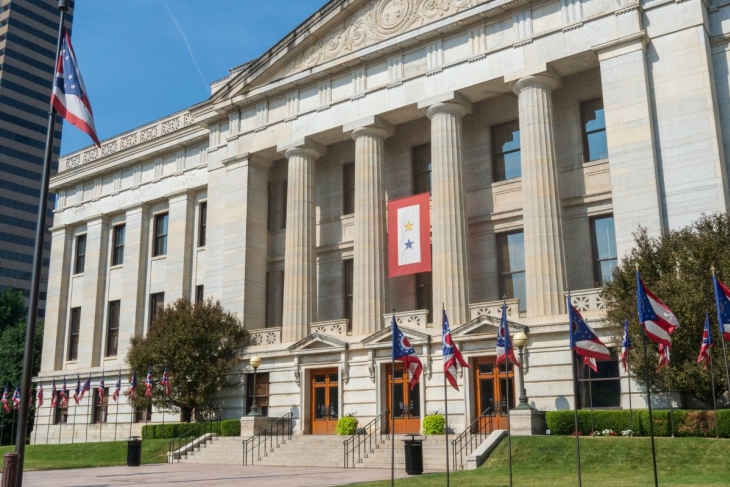
Note: Today, the Ohio Senate Finance Committee heard testimony on its version of House Bill 96, the state’s biennial operating budget. Fordham’s Vice President for Ohio Policy provided interested party testimony on the bill. These are his written remarks.
Let me begin by thanking the Senate for the thoughtful and substantive improvements made to the education portions of the House-passed budget. The Senate’s version reflects a strong commitment to student-centered funding, transparency, and research-driven reform. Among the many positive steps:
- School Funding: Fully phasing in the Cupp-Patterson formula and beginning the shift to direct certification for DPIA is a major step toward a fairer, more accurate funding system.
- Charter Schools: Restoring the governor’s proposals on unused facilities and preserving rigorous eligibility standards for high-quality charter funding are important wins.
- Private School Choice: Removing the proposed Education Savings Account (ESA) for non-chartered, non-tax supported schools reflects prudent fiscal and policy judgment.
- Literacy and Numeracy: Restoring universal reading and math screeners for grades K–3, ensuring transparency around math curriculum materials, and directing DEW to identify high-quality math curricula are smart, research-aligned decisions.
- Educator Data: Enhancing teacher vacancy data collection—including for charter schools—is a key step toward understanding and addressing workforce challenges.
- Career Pathways: Restoring career goal planning, reforming the credential framework, and keeping high graduation standards all underscore your commitment to readiness and rigor.
These provisions demonstrate a serious effort to align Ohio’s education policies with what’s best for students, and we are grateful for your leadership.
As you finalize the omnibus amendment, we urge attention to the following priorities:
- Accelerate the DPIA Transition and Strengthen Support: Accelerate the shift to direct certification by using a 50/50 blend in FY26 and moving to full implementation in FY27. Critically, raise the base amount—currently $422—or risk reducing support to the schools serving Ohio’s most disadvantaged students.
- Phase Out Guarantees: Adopt the governor’s original phase-down of guarantee bases (95 percent in FY26, 90 percent in FY27) to promote both fairness and fiscal responsibility.
- Remove Performance-Based Funding for Districts: We have long advocated for this type of policy, but as written, the provision sets too low a bar and applies retroactively. With more than 400 districts qualifying, it risks becoming a giveaway. We recommend removing or—if time permits—improving this section. We would love to work with you on getting the language right.
- Charter School Equity: Please restore the $1,500 facilities allowance, the $650 equity supplement, and the ability for DEW to go to the Controlling Board if the high-quality charter school fund is oversubscribed.
- Additional Improvements in Math Policy: The budget does not currently include language from Substitute SB 19 to require automatic placement of high-achieving students in Algebra I, establish early pathways for advanced learners, and set math content standards for new elementary teachers. Too many students are falling short of their potential in this essential subject, and we encourage you to add these smart provisions to HB 96.
- Career Pathways Improvements: Include a structured career planning course and give DEW the authority to set minimum standards for graduation plans. Also, restore the governor’s career exploration funding to ensure schools can effectively prepare students for life after graduation.
*****
In closing, the Senate has taken important steps to elevate academic expectations, prioritize resources where they are most needed, and improve transparency and accountability across the system. With a few final improvements, this budget can deliver even more for Ohio’s students.