
In a recent piece, I examined how recommendations from the Let Teachers Teach workgroup in Louisiana could be applied in Ohio to help improve teacher retention. One recommendation stood out as something worthy of a closer look: addressing chronic absenteeism.
Absenteeism has long been a problem in schools. But in Ohio and across the nation, the pandemic turned it into a crisis. Figure 1 below shows Ohio’s statewide chronic absenteeism rate for the five most recent years with available data. In 2018–19, the rate was just under 17 percent, meaning one in six students were missing at least 10 percent of instructional time. By 2021–22, that number had jumped to 30 percent. It ticked down the following year, but 26 percent—more than one fourth of students—is still way too high.
Figure 1. Statewide chronic absenteeism rate, 2018–2023
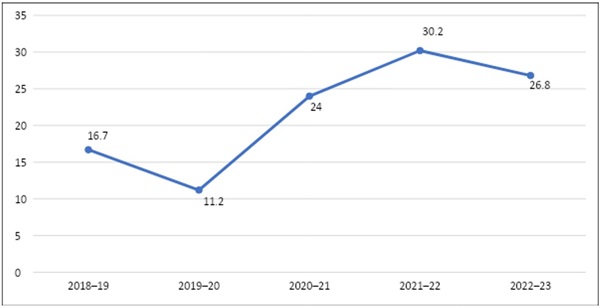
This is bad for kids. Chronic absenteeism negatively impacts both academic and social-emotional development, and it’s made pandemic recovery even more difficult. But as the Louisiana workgroup suggests, sky-high absenteeism rates are bad for teachers, too. Trying to keep chronically absent students on-track can be an exercise in frustration. Planning, overseeing group projects, and grading all become more challenging. Meanwhile, the pressure to catch kids up from learning loss can seem unfair. How can teachers boost learning when students aren’t in class?
In short, chronic absenteeism is a problem that needs to be solved for the sake of both students and teachers. But what can Ohio leaders do?
First, they need to maintain the state’s current system for collecting and reporting attendance data. This might not seem like a teacher-focused solution, but the only way state leaders will know where to direct funding and how to support schools is if they have an accurate picture of the problem. Efforts to water down data accuracy and transparency—like last year’s attempt to prohibit the Department of Education and Workforce (DEW) from including so-called “legitimate” absences in the state’s calculation for the chronic absenteeism indicator—must be avoided. If enacted, such policies will make it appear that chronic absenteeism rates have improved when they actually haven’t. This will compound negative impacts for students and further frustrate teachers.
Second, state leaders need to take advantage of the bully pulpit to address pandemic-caused attitude shifts regarding attendance. According to Brookings, less than half of caretakers with children at risk of being chronically absent report being concerned about it. Students report that remote learning made them comfortable with missing school and that expectations are lower post-pandemic. State leaders have an obligation to address these worrisome attitudes. Mounting an awareness campaign that hammers home the positive impacts of regular attendance, as well as the dangers of chronic absenteeism, would lend schools—and teachers—some much-needed support.
Third, lawmakers should re-examine Ohio’s attendance policies. When they passed House Bill 410 in 2016, they did so to stop schools from “passing on” truancy problems to the courts rather than working with families to address root causes. To be clear, expecting more from districts is important and shouldn’t change. But a report published last fall by the Ohio Attendance Taskforce suggests that House Bill 410 may be going too far by setting “a prescriptive, legalistic, and reactive response to students missing school” and leaving district and school leaders with “no ability to enforce consequences.” If that’s true, chronic absenteeism rates will remain stubbornly high and teachers will remain frustrated. Going forward, lawmakers should seek to thread the needle: Districts should be required to work with families, but they also need to be able to enforce consequences.
Lastly, district administrators must ensure they’re taking ownership of attendance efforts. DEW offers plenty of guidance on effective intervention strategies, but if district officials aren’t implementing them—or if they’re pushing implementation onto the already full plates of teachers—then nothing will change. Many of the recommendations offered by the Ohio Attendance Taskforce are solutions that should be executed by administrators: implementing “robust, authentic, and frequent” engagement experiences; educating families on the impact of missed instruction; improving transportation; and sending nudges via text. Teachers can and should be helping. But it should be up to administrators to initiate and sustain big picture interventions.
Addressing chronic absenteeism requires a collective effort. Teachers play an important role by establishing strong relationships with students, making classrooms engaging and safe, and communicating with parents. But teachers can’t solve this problem on their own. The longer it persists, the more likely it is that teacher retention will suffer alongside student outcomes. For the sake of Ohio’s students and teachers, it’s time for state and local leaders to get serious about absenteeism.