Mobile Navigation

  • National
    • Policy
      • High Expectations
      • Quality Choices
      • Personalized Pathways
    • Research
    • Commentary
      • Gadfly Newsletter
      • Flypaper Blog
    • Events
    • Scholars Program
  • Ohio
    • Policy
      • Priorities
      • Media & Testimony
    • Research
    • Commentary
      • Ohio Education Gadfly Biweekly
      • Ohio Gadfly Daily
  • Charter Authorizing
    • Application
    • Sponsored Schools
    • Resources
  • About
    • Mission
    • Board
    • Staff
    • Career
Home
Home
Advancing Educational Excellence

Main Navigation

  • National
  • Ohio
  • Charter Authorizing
  • About

Ohio Menu

  • Topics
    • Accountability & Testing
    • Advanced Education
    • Career & Technical Education
    • Charter Schools
    • Curriculum & Instruction
    • ESSA
    • Evidence-Based Learning
    • Governance
    • Personalized Learning
    • Private School Choice
    • School Finance
    • Standards
    • Teachers & School Leaders
  • Research
  • Policy
  • Commentary
    • Ohio Gadfly Newsletter
    • Ohio Gadfly Blog
    • Events
School Funding

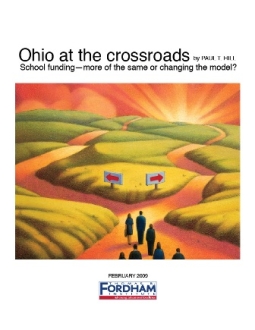
Ohio at the Crossroads: School funding—more of the same or changing the model?

Paul T. Hill
2.17.2009
2.17.2009

Ohio Governor Ted Strickland's education plan calls for modernizing Ohio's K-12 education system, including the state's school-funding system, but the plan's so-called "evidence-based" approach would actually scuttle any modernizing efforts, argues this study issued by the Thomas B. Fordham Institute.

The governor's funding plan "would prop up an outdated system of school finance that establishes funding levels based on convention rather than need, sustains institutions whether they work or not, spends money with little regard for results and holds adults accountable for compliance not results," says author Paul T. Hill, Corbally Professor at the University of Washington, director of that university's Center on Reinventing Public Education, Senior Fellow at Brookings and former senior social scientist at RAND.

In fact, Hill says, "Once one gets past the rhetoric, one finds that the main active ingredients in the governor's plan are spending increases towards helping schools and districts employ more administrators, teachers and support staff."

Hill was lead author on the six-year, $6 million, Gates-funded, nationwide study Facing the Future: Financing Productive Schools. This report, issued in December 2008, is the most comprehensive study of its kind ever conducted, prepared by more than 40 economists, lawyers, financial specialists, and education policy makers. It was comprised of more than 30 separate studies, including in-depth looks at Ohio, North Carolina, Texas and Washington.

Much of Gov. Strickland's evidence-based approach to school funding runs counter to what the Gates report recommended in December. That study shows that "schools and systems that work best, especially for poor and disadvantaged youngsters, are not all alike: they use funds, teachers, students' time, materials, and technology very differently."

Hill provides four recommendations for improving the Governor's school funding plan:

  • Drive funds to schools based on student numbers and needs through a process called weighted student funding.
  • Encourage experimentation with the uses of funds and imaginative new instructional programs.
  • Hold all schools and school districts to account for student performance and continuous improvement.
  • Gather and use data on the uses of funds and the results produced, so that alternative methods of delivering instruction can be compared on cost and effectiveness.
Policy Priority:
School Funding
Topics:
School Finance
Tags: North Carolina Ohio Paul T. Hill Ted Strickland Texas
DOWNLOAD PDF

Paul T. Hill is the founder of the Center on Reinventing Public Education, and Emeritus Professor at the University of Washington Bothell.

Related Resources

view Students sit at laptops in a classroom while social media reaction icons and notification bubbles appear across the foreground.
Standards & Accountability

High Tech, Low Standards: High School in the Age of Distraction

Brian R. Fitzpatrick, Ph.D. 9.9.2026
NationalReport
view Next Chapter SoR report image - Getty Images/ValerioGalli
Standards & Accountability

The Next Chapter: Ohio’s implementation of the science of reading—and where to next

Aaron Churchill 8.18.2026
OhioReport
view Moving Target Featured Image
Quality Choices

Moving Target: The Success and Failure of Missouri’s Charter School Funding Surge

Andrew M. Camp, Ph.D., Collin Hitt, Ph.D., David Griffith, Ph.D. 8.12.2026
NationalReport
Fordham Logo

© 2026 The Thomas B. Fordham Institute
Privacy Policy
Usage Agreement

National

P.O. Box 110
Burke, VA 22009

202.223.5452

[email protected]

Ohio

P.O. Box 82291
Columbus, OH 43202

614.223.1580

[email protected]

Sponsorship

130 West Second Street, Suite 410
Dayton, Ohio 45402

937.227.3368

[email protected]