Over the past decade, Ohio policymakers have made upgrading career-technical education (CTE) a top state priority. Yet the CTE landscape remains complicated and quickly evolving, none more so than in the area of funding.
This paper provides an overview of the various funding mechanisms for CTE, including state and federal programs that aim to provide students with high-quality CTE.
It concludes with policy recommendations that seek to further promote access and rigor in Ohio's CTE initiatives.
Read the report below, or click here to download the full report.
Glossary and acronyms
Career-technical planning districts (CTPDs) are responsible for planning and providing career-technical education (CTE) in elementary and secondary schools. Ohio has ninety CTPDs; forty-nine of them are led by JVSDs (see below), while forty-one are either comprehensive CTPDs (a single school district that provides its own CTE programs) or compacts (groups of districts that share responsibility for providing CTE without creating a JVSD). Every school district and public charter school is a member of a CTPD.[1]
Charter and STEM schools are tuition-free public schools that operate independent of traditional districts. They receive federal and state taxpayer funding, but with few exceptions (in Cleveland) receive no local tax support. In FY24, Ohio had 336 charters—also known as “community schools”—and eight independently run STEM schools.
The fiscal year (FY) of the State of Ohio and local districts runs from July 1 through June 30. FY24, for instance, refers to the period from July 1, 2023, through June 30, 2024 (corresponding to the 2023–24 school year).
Industry-recognized credentials (IRCs) signify one’s acquisition of certain knowledge and skills. In FY25, DEW approved 596 IRCs across fifteen career fields. Each IRC is assigned a point value, from one to twelve, and students can meet certain components of Ohio’s graduation requirements when they earn at least twelve points in a single career field.
Innovative Workforce Incentive Program (IWIP) provides additional state funding to schools when students earn IRCs in specific high-priority career fields (e.g., engineering, health care, IT, and manufacturing). In FY25, 194 IRCs are eligible for IWIP funding.
Joint vocational school districts (JVSDs) provide CTE for students from multiple member school districts in a region. Just like traditional districts, JVSDs are funded through federal, state, and local taxpayer dollars. There are forty-nine JVSDs in Ohio.[2]
Ohio Department of Education and Workforce (DEW) is the state agency that implements most of Ohio’s K–12 education laws. It was formerly known as the Ohio Department of Education (ODE).
The Ohio Eight urban districts are Akron, Canton, Cincinnati, Cleveland, Columbus, Dayton, Toledo, and Youngstown. All eight districts are “comprehensive” CTPDs and provide their own CTE programs.
Work-based learning (WBL) refers to career-development experiences that occur in real workplace settings or simulated environments at an educational institution. Internships and apprenticeships are examples of WBL.
Introduction and summary
Over the past decade, career and technical education (CTE) has garnered renewed attention in Ohio. In his 2014 State of the State address, former Governor John Kasich urged a stronger focus in this area: “How did we ever lose our way on vocational education? Why did we put it down? … I want to see this kind of high-quality experience in both jobs and learning.”[3] Nearly a decade later, his successor, Governor Mike DeWine, pledged to invest more heavily in CTE during his 2023 State of the State address.
“So often, the teachers would tell us that more kids want to take (career-technical) courses, but there are waitlists because there simply aren’t enough open spots. In other cases, they told us they don’t have the most modern, up-to-date equipment needed to teach certain courses. …
To reach more students and to provide better training for twenty-first century jobs, our budget will invest $300 million of one-time funding for capital improvements and equipment for career tech education.”[4]
As promised, Governor DeWine included this hefty investment in his budget proposal, and the General Assembly approved the expenditure via the FYs 2024–25 state budget bill. Yet there’s much more to CTE funding than this initiative. Ohio has multiple programs—some of recent origin—dedicated to CTE and workforce development. This report provides an overview of the various funding streams that support CTE in K–12 schools.[5] It documents how much Ohio public schools spend on CTE overall and describes the various mechanisms that drive these dollars to schools. Though not a comprehensive analysis of Ohio’s CTE policies, we discuss strengths and weaknesses of the funding elements and recommend six policy improvements that would further leverage the system to strengthen CTE.
Beginning with total spending—which includes dollars from state, local, and federal tax revenues—public schools statewide expended $718 million in FY23 to support 75,812 full-time equivalent (FTE) students participating in CTE.[6] As a percentage of total statewide spending on education ($26 billion in FY23), CTE spending represents 3 percent of total statewide K–12 expenditures.
Turning to funding mechanics, we focus on the main state and federal programs dedicated to CTE, which are as follows:
- The largest state initiative is a CTE “categorical add-on” in the funding formula that provided $218 million to schools in FY24. A weighted methodology is used to allocate these dollars, with student participation in CTE programs in higher-priority career fields generating larger amounts than in lower priority fields. Reflecting this funding structure and course-taking patterns (60 percent of CTE students were in category one and category two programs), the figure below shows that CTE in high- and mid-priority career fields did indeed drive the bulk of the categorical aid, with lesser amounts based on course-taking in lower-priority categories.
Figure 1: Breakdown of CTE categorical add-on funding, FY24

- Ohio further incentivizes schools to offer high-quality CTE through the Innovative Workforce Incentive Program (IWIP). Created in 2019, it provides schools with up to $1,250 per industry credential earned in selective high-priority career fields such as health care, information technology, and manufacturing. A disproportionate share of IWIP credentials is earned at JVSDs, with a just small fraction earned at the Ohio Eight urban districts and charter schools that provide their own CTE services. In total, urban schools, which serve more disadvantaged students than the typical district statewide, received less than $1 million out of the total $10.5 million IWIP allotment in FY24.
- Another recently created funding stream provides CTPDs with $10 per pupil to support career awareness and exploration across all grades K–12. Schools can use these funds on a variety of activities, such as career fairs, job shadowing, and career counseling.
- Ohio offers financial incentives that encourage businesses to provide training and workforce experiences. These programs, also relatively new, allow employers to seek reimbursements or tax credits when they provide work-based learning opportunities to high school students. A modest amount, however, supports these initiatives ($5.5 million in FY24).
- As noted above, Ohio allocated $300 million in FYs 2024 and 2025 to expand high-quality CTE. This consists of $100 million to help schools upgrade their equipment and $200 million to support facility expansions or renovations. These funds were awarded via competitive grant, and schools must use them to establish or grow programs that lead to IWIP credentials or support careers on Ohio’s Top Jobs list. While these dollars are critical to expanding high-quality CTE across the state, just a small portion ($3.5 million) of the $300 million allotment went to urban districts or charter schools—those in the Ohio Eight cities—to help grow high-quality CTE programs. It’s not clear whether that reflects urban schools not applying for these grants or less competitive applications. However, the need to grow rigorous CTE programs, including those that lead to IWIP credentials, remains for Ohio’s highest-poverty schools.
- Federal grants further support CTE. The main initiative for secondary-level CTE is known as Perkins V, which delivered $53 million to Ohio in FY24. While mostly targeted to adult workers, the federal Workforce Innovation and Opportunity Act also provides some resources for youth career development. These programs are briefly discussed in this report below.
Whether through the categorical funding system or standalone programs such as IWIP and employer incentives, Ohio is making progress building a CTE system that prepares an increasing number of young people for the jobs of tomorrow. Yet more can be done, and the report offers several policy recommendations for state lawmakers. Briefly, they are as follows (more detail is found at the end of the relevant section of the paper). Note, that as this report goes to press, several of these recommendations are addressed in some form in the state’s operating budget bill (House Bill 96), which will be finalized in July.[7]
- Allow greater flexibility regarding how CTE categorical add-on funds can be used. Current law prohibits schools from using more than 25 percent of these dollars on personnel expenditures; instead, the majority of the funds must be used on items such as equipment, curriculum, or professional development. This restriction could make it harder for schools to attract the skilled teaching corps necessary to offer programs in a wide variety of career pathways.
- Increase the budget allotment for IWIP to ensure that schools receive the maximum per-credential reimbursement. In FY24, the IWIP reimbursements were reduced from a maximum amount of $1,250 per credential to just $550 to avoid exceeding the state’s budget appropriation for the program. This left schools with less funding than anticipated to support attainment of these valuable credentials.
- Create a targeted grant program that helps high-poverty schools launch CTE programs that lead to IWIP credentials. Small numbers of students from high-poverty urban schools are earning these valuable credentials. Lack of access to coursework and equipment that build the skills necessary to attain them is likely one reason. To provide more opportunities for disadvantaged students to participate in high-quality CTE, Ohio should create a capacity-building grant program targeted to high-poverty districts and charter schools.
- Require CTPDs to submit annual reports detailing their use of career awareness and exploration funds. These dollars help ensure that students—as early as elementary and middle school—are introduced to career options and have opportunities to dip their toes into the world of work. However, little is known about how these funds are actually being used. A reporting requirement would add transparency and accountability for these dollars.
- Expand funding for employer-driven, work-based learning. While Ohio has created incentive funding for employers, the amounts represent a small share of the total amount spent on CTE. Additional investments in employer-based programs—particularly in specialized, technical fields—would provide more students with hands-on job experiences and training.
- Scale back funding for CTE programs that aren’t linked to high-demand, high-wage careers. A couple of areas worth further scrutiny include the state’s categorical add-on funding for lower-priority CTE programs (categories four and five), and test-fee reimbursements for credentials that are of minimal value to employers and students.
A rigorous CTE system is a benefit to all Ohio. Employers can hire more highly skilled workers, and students are better positioned to take advantage of rewarding job opportunities. All Ohioans enjoy the fruits of a more prosperous economy. By strengthening its funding policies, more Ohio students will have opportunities to participate in high-quality career technical education.
Total spending on CTE
How much is spent overall on CTE in Ohio? To answer this question, we dig into the state’s expenditure data, which report the amounts spent specifically on CTE.[8] These expenses capture regular day-to-day spending on CTE courses and programs, but exclude spending on core academic instruction, supplemental services such as special education or tutoring, administration, and capital outlay. The amounts spent on CTE reflect dollars generated from state and federal sources, as well as local taxpayer funds, which are raised primarily through property taxes.
As Figure 2 indicates, Ohio public schools spent $718 million on CTE in FY23. The delivery of these programs and services can be done by JVSDs—regional entities that specialize in CTE—as well as traditional school districts and public charter and STEM schools that operate their own career-tech programs. JVSDs spent a majority of these funds: $415 million, or 58 percent of total statewide CTE spending. Traditional school districts spent $290 million, or 40 percent, while public charter and STEM schools spent the remaining 2 percent.
Figure 2: CTE spending by sector, FY23

As might be expected, the spending totals by sector follow enrollment patterns. Table 1 shows that 51 percent of CTE students—counted on a full-time equivalent (FTE) basis (see box below for more)—attended a JVSD, while 35 percent participated in a program at a traditional district. Although charter and STEM schools served 14 percent of CTE students, they spent a relatively small portion of the overall amount (2 percent). This reflects the type of CTE programs that charters provide: As discussed in the categorical funding section below, charters are more likely to provide CTE courses that are funded at lower levels.
Table 1: CTE spending by sector, FY23

State funding mechanisms
Funding K–12 education overall is a joint effort between the state and local districts, with some additional aid from the federal government. This shared funding model applies to CTE as well. The state and local districts provide the majority of funds for CTE programs, while federal programs contribute modest sums to supplement. Even though local taxpayer dollars provide a sizeable portion of CTE funding, they are not allocated through specific formulas or grants. Thus, this section focuses on state funding mechanisms for CTE; a brief overview of federal programs follows.
Table 2 presents an overview of the state’s CTE-specific funding initiatives. The largest funding stream is the CTE categorical add-on, which provides almost a quarter-billion dollars per year to public schools. The state also provides funding—albeit smaller amounts—for several programs that have narrower purposes. These include initiatives that support the attainment of in-demand IRCs (IWIP), promote career awareness and exploration, and offer employers incentives to provide students work-based learning opportunities. Taken together, the state spends approximately $260 million on “regular” CTE-specific funding.[12] Two special programs—which may turn out to be one-time initiatives—are listed at the bottom of the table. They have driven additional resources to schools seeking to expand their capacity to provide high-quality CTE.
Table 2: An overview of dedicated state funding for CTE

The state funding formula provides a “base” per-pupil amount for all students, and it also includes categorical “add-on” elements that drive additional dollars to schools that serve pupils from certain backgrounds or who participate in specific programs such as CTE. These funds—sometimes referred to as “weighted student funding”—help schools cover the extra costs of providing a more specialized education.
The current structure of the CTE add-on was first implemented during the Kasich administration. The model includes weights tied to the base CTE funding amount, and are linked to five categories of CTE programming. This framework was kept intact during Ohio’s recent transition to a new school-funding formula, known as the Cupp-Patterson or Fair School Funding plan, which was first implemented in FY22.
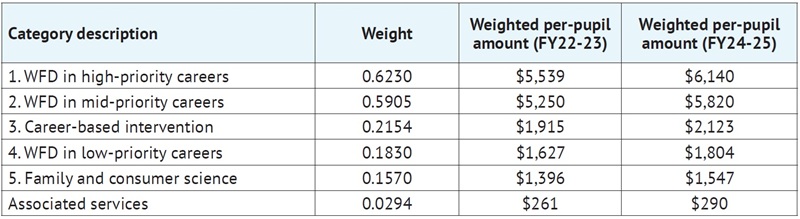
The table below displays the CTE categories and their associated weights (left two columns). The highest-funded category is workforce development in high-priority[13] career fields outlined in statute and listed in the box above. As the far-right column indicates, the additional amount for category one is $6,140 per FTE pupil (0.6230 x $9,856 CTE base per pupil). The next-highest funded category is workforce development in mid-priority careers, followed by career-based intervention programs,[14] workforce development in low-priority careers, and family and consumer science programs.[15] Finally, the state includes an “associated services” element within this system, which provides dollars for CTE administration and oversight. The table also shows that the CTE categorical funding amounts have risen since FY22, driven by the increase in the CTE base per-pupil amount during this period (not due to a change in weights).
Table 3: Categorical add-on funding for CTE
JVSDs, traditional districts, and public charter/STEM schools are all eligible to receive CTE categorical funding. In the case of JVSDs and traditional districts, the “state share percentage” is applied to their weighted funding amounts. This mechanism, which also applies to several other formula components, is used to direct more state aid to districts with less capacity to raise local funds. A low-wealth JVSD or traditional district, for instance, might receive 80 percent of the “full” weighted CTE funding amounts, while a high-wealth district might receive 20 percent. Because charter and STEM schools do not have local taxing authority, and with one small exception (in Cleveland) do not actually receive any local dollars,[16] the state share percentage is not applied to their CTE categorical funding.
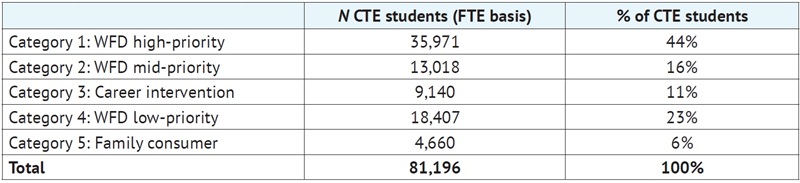
How much actually flows through the categorical add-on? Figure 3 shows that $218.1 million was sent to JVSDs, districts, and charter/STEM schools in FY24. Reflecting the weighted funding system and course-taking patterns, the bulk of these funds were allocated based on student participation in workforce development programs in high-priority careers ($126 million, or 58 percent of the total CTE categorical). The next-largest portion was workforce development in mid-priority career fields ($42 million, or 19 percent), while the remaining dollars were allocated based on participation in the other categories. As Table 4 indicates, three in five CTE students participate in category 1 and 2 programs. That, in conjunction with the weighted funding structure, resulted in 77 percent of the overall CTE add-on being allocated based on participation in category 1 and 2 programs.
Figure 3: Overall CTE categorical add-on funding by category, FY24
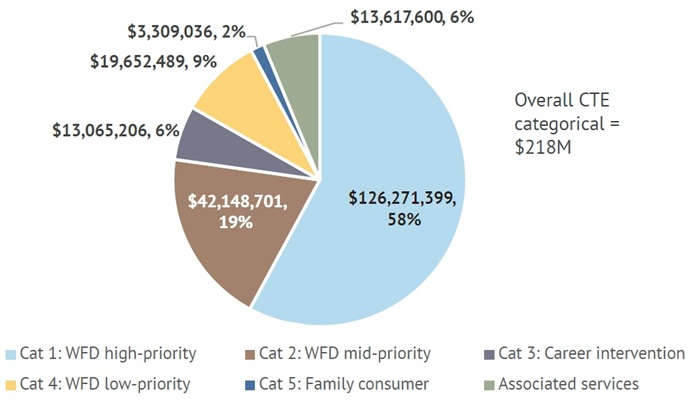
Table 4: Student participation in each CTE category, FY24
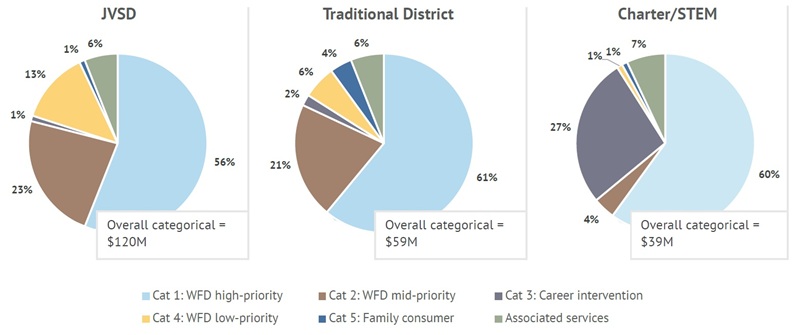
The next figure displays the distribution of categorical funds by category and sector. Given their larger share of CTE enrollment, JVSDs received the largest portion of the categorical dollars ($120 million), while traditional districts and charter/STEM schools received smaller amounts ($59 and $39 million, respectively). Funding by category for JVSDs and traditional districts was generally similar, with the workforce development in high- and mid-priority careers representing about 80 percent of their total categorical. However, the breakdown for charter/STEM schools is different. More than a quarter of their CTE funds were tied to career-intervention programs (category three), while just 1 to 2 percent of JVSD and traditional district categorical funding was based on that category. The higher share of career intervention funding may reflect the fact that dropout-recovery charters—which serve adolescents who are significantly off-track—enroll most CTE charter students.
Figure 4: CTE categorical add-on funding by category and sector, FY24
Ohio puts significant restrictions on how schools may use CTE categorical funds. Under state law, schools cannot spend more than 25 percent of these funds on personnel such as CTE instructor salaries and benefits. Instead, the vast majority of these funds must be used on specific items outlined in statute, such as curriculum, instructional materials, equipment and supplies, professional development, and work-based learning experiences.[17] While it makes sense to limit use of these funds to CTE programs, as the law currently does, the additional restriction related to salaries could make it more difficult for schools to attract and retain the instructional workforce needed to provide high-quality programs across multiple career fields.
Recommendations
The categorical add-on element of the funding formula provides the bulk of state funding for CTE. Importantly, the weighted funding structure encourages schools to provide coursework in high-priority career fields, and the course-taking patterns show that most CTE students are indeed taking courses in those areas. To further improve the categorical funding component, we recommend the following:
- Allow greater flexibility regarding how CTE categorical add-on funds can be used. Under state law, schools may use up to only 25 percent of categorical dollars on personnel expenditures. Instead, the majority of these funds must be used on items such as supplies, curriculum, or professional development. This provision constrains schools’ ability to offer the competitive salaries needed to attract and retain skilled teachers in specialized programs such as welding, computer programing, or physical therapy. Lawmakers should remove the spending restriction to provide schools with more budgetary room for CTE teacher compensation.
- Scale back funding for categories four and five CTE programs. As the state expands CTE funding in areas with the greatest potential, Ohio should also trim funding for courses and credentials that yield less value to students. Lawmakers should consider paring back the additional dollars for categories four and five CTE programs—workforce development in low-priority careers as well as family and consumer science—which together cost the state $23 million per year. Schools could still offer such programs but just not receive additional state aid for them.
Innovative Workforce Incentive Program (IWIP) and IRC test-fee reimbursements
Industry credentials signify the attainment of certain skills and can give young people an edge as they enter the workforce. In recent years, Ohio policymakers have encouraged schools to offer programs that lead to IRCs by making credentials a pathway to high school graduation and including IRC attainment in the state’s accountability system.[18] Another way that Ohio incentivizes IRCs is through the IWIP program and exam fee reimbursements.
IWIP focuses squarely on IRCs in high-demand careers. As such, the state has developed a more select list of IWIP credentials compared to the broader list of IRCs the state approves for graduation purposes. Under this program, schools receive reimbursements of up to $1,250 per credential when students earn selective IRCs in eight designated career fields.[19] JVSDs, traditional districts, and charter/STEM schools are all eligible to receive reimbursements. IWIP is funded via a budgetary earmark, so there is a fixed amount of funding—$10.5 million in FY24—to reimburse schools. If the number of credentials earned times the maximum reimbursement rate exceeds the allocation, the per-credential reimbursement is reduced. This occurred in FY24, when schools received just $550 per credential.
In FY24, students earned 19,175 IRCs in 105 different reimbursable credentials. The ten most frequently earned IRCs are displayed in Table 5 below. At the top are the NCCER Core, a construction credential, which 2,244 students earned, and the STNA certification.
Table 5: IWIP funding by credential, FY24
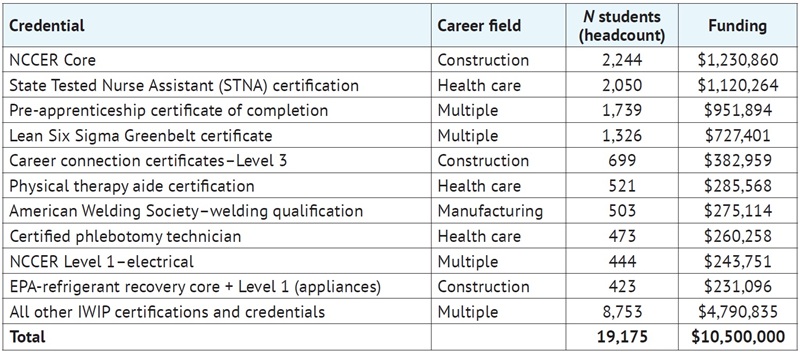
Table 6 shows that about two in three students earned IWIP credentials at a JVSD, a noticeably higher proportion compared to the percentage of CTE students attending JVSDs (51 percent; see Table 1).[20] On the other hand, traditional districts had a lower share of IWIP-attaining students relative to their CTE enrollment statewide (27 percent versus 35 percent of enrollment). Charter and STEM schools represented an even smaller proportion of IWIP earners (5 percent versus 14 percent of CTE enrollment). When looking more closely at traditional district IWIP attainment, we find that the Ohio Eight urban districts—all of which provide their own CTE programs[21]—had just 1,030 students earn IWIP credentials.[22] With a combined high school enrollment of just under 40,000 students (grades 9–12), this means that two in every one hundred Ohio Eight district high-schoolers earned IWIP credentials last year. This suggests significant room to grow high-quality CTE programs that lead to IWIP credentials in Ohio’s urban districts and charter schools. Yet as the discussion below on the state’s capacity-building efforts indicates (see below), Ohio Eight districts and charter schools received very little of those funds.
Table 6: IWIP funding by sector, FY24

In addition to IWIP, the state also encourages IRC attainment by providing reimbursements to schools that subsidize the costs of credentialing exams. In FY24, Ohio allocated $5.5 million for this program, which covered the cost of 114,211 credentials, including both IWIP and non-IWIP credentials.[23] The five most common credentials reimbursed were CPR First Aid (17,691); OHSA 10-Hour Training (15,403); RISE Up Retail Industry Fundamentals (10,981); RISE Up Customer Service and Sales (9,709); and Leadership Excellence (4,228). None of these appear on the more selective IWIP credentials list.
IWIP is an important state initiative, as it incentivizes schools to provide high-quality CTE that leads to credentials in high-demand career fields such as construction, manufacturing, and health care. State lawmakers should continue to support this program by providing adequate reimbursements and supporting its growth particularly in high-poverty urban schools. Policymakers, however, should eliminate test-fee reimbursements to ensure the state is not incentivizing lower-level credentialing programs. Specifically, we recommend the following in the area of IRCs:
- Increase the budget allotment for IWIP to ensure that schools receive the maximum per-credential reimbursement. The maximum IWIP reimbursement of $1,250 per credential had to be scaled back in FY24 to just $550 to avoid exceeding the state’s budget appropriation for the program. State lawmakers should increase funding for IWIP to cover the full reimbursement amount.
- Create a targeted grant program that helps high-poverty schools launch CTE programs that lead to IWIP credentials. Small numbers of students from high-poverty urban schools are earning valuable IWIP credentials. Lack of access to the coursework and training that build the skills necessary to attain them is likely one reason. To create more opportunities for disadvantaged students to participate in high-quality CTE, Ohio should create a capacity-building grant program targeted to urban districts and charter schools.
- Discontinue funding for IRC test fee reimbursements. In FY24, for example, Ohio spent $1.5 million reimbursing schools when students took basic CPR training and OSHA 10-hour job safety tests. These IRCs are worth just one point (out of twelve) in the state’s credentialing system and do not, by themselves, open doors to well-paying jobs. Schools could still support CPR or job safety training but fund them through their general operating budgets, akin to other extracurricular programs.
Career awareness and exploration funds
Beginning in FY22, the state began providing a per-student amount—based on all K–12 students—that supports career awareness and exploration in elementary, middle, and high schools. The initial amount was just $2.50 per pupil and rose to $7.50 and $10 per pupil in FY24 and FY25, respectively. The dollars are paid to the lead district of a CTPD, not directly to a district or charter school, and the CTPD is supposed to provide programs to member districts and schools.[24] Total allocation for the career awareness and exploration program was $12.2 million in FY24 and was funded via an earmark within a larger CTE “enhancements” appropriation in the state budget. The rest of the enhancement dollars ($8 million) are used to support several smaller CTE programs, such as career-based intervention in juvenile correctional facilities, summer agricultural programs, and programs for students interested in the restaurant and computer science industries.[25]
Recommendation
Introducing students to career opportunities can stir interest in acquiring particular skills, motivate them to succeed academically, and help them better plan for their futures. Career exploration comes in many forms, including dedicated coursework, job shadowing, career counseling, and job-related project-based learning. Ohio wisely sets aside funds to support these types of initiatives, and it allows schools to use the dollars in a reasonably flexible way. However, little is known about how CTPDs actually allocate these funds to member schools, nor which specific programs the funds support. To shine light on this initiative, we recommend the following:
- Require CTPDs to submit annual reports detailing their use of career awareness and exploration funds and conduct an evaluation of their effectiveness. A reporting requirement would add transparency and accountability for these dollars, which are crucial to ensuring that all students receive a strong introduction to careers. The state should also conduct—perhaps with the assistance of an independent researcher—an evaluation of the programs being funded through these dollars. It should consider student participation rates and gauge which programs have the greatest impacts on students’ knowledge and awareness of career opportunities.
Work-based learning programs
Valuable technical training and career development can also happen outside of the classroom. To encourage more employer-led training, Ohio has launched work-based learning initiatives for high school students. Total annual investments for these programs are a modest $5.5 million per year.[26]
- High Tech High School Internship: Created in FY21 under the leadership of former Lieutenant Governor Jon Husted, this program provides wage reimbursements—up to $5,000 per student—to employers that host high school interns over the summer. The internships must be in tech-related fields such as IT, software, and cybersecurity. Funding for this program is provided through a larger Ohio Department of Development line item in the state budget, and the expenditure for this program has been approved by the state’s Controlling Board, a legislative committee that periodically approves agency funding requests and makes budgetary adjustments. In August and November 2023, the Controlling Board approved a total of $3 million to fund the program in FY24.[27] Through 2023, the program has supported 510 high school interns.[28]
- Employer Tax Credits: The General Assembly created an employer tax credit in 2021 to incentivize work-based learning for high school CTE students.[29] The program offers a non-refundable tax credit equal to the lesser of $5,000 per student or 15 percent of the wages paid during the calendar year. Only high school students (age 19 and younger) who are enrolled in a CTE program are eligible to generate such a credit for their employer. A student’s wages can be earned via internship, work-based learning, or cooperative education program. Because this is not a cash allocation to employers—and is instead a reduction of an employer’s tax liability—this initiative is not funded via specific budget appropriation. Statute limits the total credits that can be claimed by all employers to $5 million over a biennium,[30] and the tax department reports that businesses received $4.8 million in credits for this program in FYs 2024–25.[31]
Recommendation
Work-based learning can provide the technical training and work experience that cannot be easily gained in a classroom. State policymakers should continue to support valuable workplace experiences for high school students, and we recommend the following:
- Expand funding for employer-driven work-based learning. Out of the millions spent on CTE, just a tiny fraction is dedicated to supporting workplace experiences. Greater investment in work-based learning would provide more students with opportunities to build their skills in real-world work environments. Ohio should build on its two recently launched initiatives, the High Tech High School Internship and the employer tax credit, which combined receive just $5.5 million in annual support. State lawmakers should increase funding for these programs to provide more students with opportunities to gain workplace experience.
CTE capacity-building initiatives
In the state’s FY 2024 and 2025 budget, lawmakers approved $300 million to help schools establish or scale in-demand IRC programs, particularly those that lead to credentials eligible for IWIP funding or support careers on Ohio’s “Top Jobs” list.[32] Of the total allocation, $100 million was set aside to help schools upgrade their CTE equipment (“Equipment Grant”) and $200 million was allotted to help schools expand or renovate the facilities used to provide CTE (“Construction Grant”). While future General Assemblies may choose to continue these initiatives, they were enacted as “one-time funding,”[33] and the construction program was funded with support from temporary federal COVID relief dollars.[34]
- CTE Equipment Grants: Traditional districts, JVSDs, and charter/STEM schools were eligible to apply for the equipment grants, which were awarded via a competitive process. A first round of grants was announced in March 2024, with fifty-six districts and schools receiving a total of $67.7 million.[35] In October 2024, a second round was announced, with an additional thirty-four districts and schools receiving $29.5 million.[36] Across the two rounds, the awards ranged from $30,000 to $2.5 million, with an average grant of just over $1 million. The table below displays the breakdown of grants by sector and funding round.
Table 7: CTE Equipment Grants awarded in 2024

- CTE Construction Grants: Only JVSDs and CTPD lead districts were eligible for these dollars. Grantees were announced in November 2023—the entire $200 million allotment was awarded at that time—and the projects must be completed by September 2026. Thirty-five grants were awarded, with the average grant being worth $5.7 million. The smallest was $1.2 million, while the largest was $14.8 million.[37] These construction grants supplement the ongoing support that the state provides JVSDs and traditional school districts for school construction through the state’s Classroom Facilities grant program.[38]
While no specific recommendation on these initiatives is offered, as discussed earlier, just a small fraction of high school students attending urban district and charter schools attain IWIP credentials. One reason for the low attainment is that their schools may not offer the programming needed to support students seeking to earn them. Yet very little—just $3.5 million—of the $300 million capacity-building investment was allocated to Ohio Eight districts and charter schools. On the district side, only Canton and Columbus received an equipment grant, while just four Ohio Eight charters did so. No Ohio Eight districts or charters were awarded a construction grant. While it’s not clear whether this reflects schools not applying for grants or their applications being less competitive, the need to grow high-quality CTE programs that serve urban students remains (see above for a recommendation on that issue).
Federal initiatives
This section briefly summarizes federal initiatives that support CTE and workforce development programs for Ohio’s secondary students. The main federal law that governs and funds CTE is known as the Carl D. Perkins Career and Technical Education Act, the most recent iteration of which is commonly known as Perkins V. The other relevant federal legislation is the Workforce Investment Opportunity Act (WIOA). While mainly focusing on adult programs, WIOA has elements that support career development for young people, particularly disadvantaged youth.
Perkins V
At a national level, Perkins V provides approximately $1.5 billion per year for CTE programs in secondary schools and institutions of higher education. States distribute the bulk of Perkins funds—at least 85 percent—to schools and institutions that provide CTE programming. The remaining portion is set aside for state-level programs and administration. Under Perkins V, states must develop a statewide CTE plan, establish CTE “programs of study”—i.e., course sequences that lead to credentials—and create an accountability framework to gauge quality.
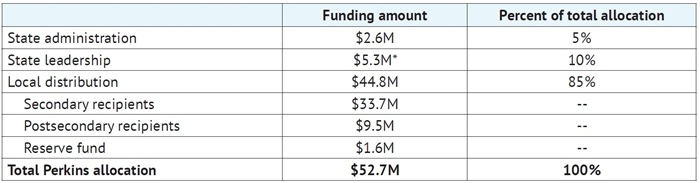
Ohio received $52.7 million though Perkins V in FY24.[39] As the table below indicates, a majority of these funds—about three fifths—is allocated directly to secondary schools that provide CTE, while the rest supports CTE in post-secondary institutions as well as state activities and administration. Federal law establishes the formula used to distribute Perkins dollars to local schools. This formula takes into account Census data on a district’s five-to-seventeen-year-old population, along with the number of children in that age range who are at or below the federal poverty level.[40] Perkins V also allows states to create a small reserve fund that can be used flexibly. Ohio spends these dollars via the Equity for Each grant,[41] a $1.6 million competitive grant aimed at helping special student groups access CTE programs.
Table 8: Breakdown of Ohio’s Perkins V allocations, FY24
Workforce Innovation and Opportunity Act (WIOA)
Most recently amended in 2014, WIOA is the nation’s primary workforce development legislation. While it mostly supports adults, it includes some funding for youth career development. The “youth activities” section of WIOA includes resources for at-risk youth—generally ages 16–24—who have dropped out of school or have another risk factor (e.g., pregnant or homeless). Just over one-third of Ohio’s total WIOA allocation goes toward youth development programs ($37.5 million in FY23).[42] A large majority of these funds is allocated to local workforce development boards, of which Ohio has twenty,[43] and are generally awarded by competitive grants to local youth-service organizations.[44] WIOA also supports the longstanding Job Corps program, which provides employment supports for disadvantaged youth ages 16–24.[45] The program is directly administered by the U.S. Department of Labor, and Ohio is home to Job Corps sites in Cincinnati, Cleveland, and Dayton. Nationally, $1.76 billion was spent in FY23 to operate 121 Job Corps centers across the nation.[46] While no site-based spending data was located, if one assumes each center spends the same amount, the three Ohio-based locations would have spent $44 million on career training for young people.
Conclusion
Creating a system that effectively readies 1.6 million public school students for the jobs of the future is a big lift. One piece in the puzzle is a funding system that incentivizes schools to provide the high-quality CTE and workforce training that put young people on pathways to rewarding careers. Thanks to the work of state leaders, Ohio is moving in this direction. By concentrating dollars to support quality CTE in high-demand career fields—and removing incentives for lower-level CTE—the state will make CTE work better for Ohio businesses, schools, and students.
Acknowledgments
I thank my colleagues at the Thomas B. Fordham Institute—particularly Mike Petrilli, Chester E. Finn, Jr., Chad L. Aldis, and Jessica Poiner—for their insightful feedback during the drafting process. I also wish to thank Cassandra Palsgrove of Ohio Excels, who reviewed an earlier draft of this report. Special thanks to Kathi Kizirnis for copy editing the document, and to Andy Kittles for laying out the report. Thanks also to my Fordham colleague Jeff Murray, who assisted with report distribution.
—Aaron Churchill
Endnotes
[1] For more about CTPDs, see ORC 3317.023 and Ohio Department of Education and Workforce, Ohio Perkins V Plan, 2024, p. 27.
[2] For more about JVSDs, see Ohio School Boards Association, Understanding Joint Vocational School Districts, 2020.
[3] Governor John Kasich, “State of the State Address—2014,” February 14, 2014, Medina Performing Arts Center, Medina, Ohio, 1:16:39.
[4] Governor Mike DeWine, “Governor DeWine’s 2023 State of the State Address,” January 31, 2023, Columbus, Ohio.
[5] CTE and workforce training at post-secondary institutions are not the focus of this report. CTE governance and accountability, as well as student participation and outcomes, are also not covered in this paper. For a primer on governance and delivery models, see Jessica Poiner, Ohio’s Career-Technical Education Landscape: An overview of CTE at the high school level, Columbus, Ohio, Thomas B. Fordham Institute, 2024. Forthcoming Fordham research will delve into participation and outcomes.
[6] The FTE method counts students taking one or two CTE courses during a year as “part-time” students (e.g., 0.25 FTEs). A more detailed discussion is found in the sidebar titled “A note on CTE enrollment” which is located in the “Total spending on CTE” section, navigable on the right side of this page.
[7] As of the writing of this report’s final draft, HB96 (as-introduced) is the most recent version of the budget.
[8] This level of expenditure data was obtained via request to Ohio Department of Education and Workforce. For more about the CTE spending categories, which are officially called “vocational instruction” expenditures, see Ohio Auditor of State, Uniform School Accounting System Manual, Columbus, Ohio, last revised 2023, (pp. 90–96).
[9] This method yields 259,149 students enrolled in CTE in FY23 (this count excludes some forms of CTE, such as students taking a family and consumer science or career intervention course). For more, see Ohio Department of Education and Workforce, Enrollment Technical Documentation, Traditional District and School, Dropout Prevention and Recovery, and CTPD Report Cards, 2023–2024 School Year.
[10] Another way of explaining it is that ten students taking one CTE course equals 1.0 FTE. For more about the methodology, see Ohio Department of Education and Workforce, Level 2 Report Explanation: CTE FTE Reports, last revised January 2024.
[11] A report by the national group Advance CTE examines states’ CTE expenditures on an FTE basis. See Advance CTE, The State of Career Technical Education: An Analysis of State Secondary CTE Funding Models, 2023.
[12] The difference in the total CTE expenditures discussed in the prior section ($718 million) versus the aggregate state-only funding amount reported here ($260 million) is explained by the use of local tax revenues to fund CTE, federal CTE funding, and schools’ use of general “base” state formula aid to support CTE. The $300 million in capacity-building investments would not have shown up in schools’ expenditures during FY23.
[13] Though not an official term, I use the terms “high-, mid-, and low-priority” as shorthand to describe the career fields in each funding category.
[14] More detail about career-based intervention is available at Ohio Department of Education, “Career-Based Intervention,” last accessed January 23, 2025.
[15] More detail about family and consumer science courses is available at Ohio Department of Education and Workforce, “Family and Consumer Sciences,” last accessed January 23, 2025.
[16] Eleven charter schools in Cleveland currently receive a portion of local taxpayer funds; Cleveland Metropolitan School District, “CMSD and Charter School Partnership,” last accessed January 23, 2025.
[18] For more about how IRCs factor into graduation requirements, see Ohio Department of Workforce, “Graduation requirements,” last accessed January 23, 2025. Schools receive state ratings based on graduation rates, and IRC attainment rates are reported on the state’s post-secondary readiness dimension of the report card (currently named “College, Career, Military, and Workforce Readiness”). For more, see Ohio Department of Education and Workforce, “Report Card Resources,” last accessed January 23, 2025.
[19] The career fields represented in the IWIP program are construction, engineering, education, health, law, IT, manufacturing, and transportation. All IWIP credentials have point values of at least six out of twelve possible points in Ohio’s IRC points system. For the current list, see Ohio Department of Education and Workforce, “2024–2025 Innovative Workforce Incentive Program Qualifying Industry-Recognized Credentials.” For the full list of IRCs and information about the IRC points system, see Ohio Department of Education and Workforce, “Industry-Recognized Credentials,” last accessed January 23, 2025.
[20] IWIP reimbursement data are posted on the Ohio Department of Education and Workforce’s school funding websites (Excel files titled “IWIP Payment”). Click here for traditional district information; click here for JVSD information; and click here for charter/STEM school information.
[21] All of the Ohio Eight districts are “comprehensive” CTPDs, which means they provide their own CTE programs for students (they are not members of a JVSD or “compact” CTPD).
[22] A significant portion of this total is represented by 407 Dayton Public Schools students who earned the Lean Six Sigma Greenbelt IWIP credential.
[23] Students must pass the credentialing assessment for their school to receive reimbursement.
[24] Initially, these funds were paid directly to districts and schools. However, legislators revised the statute to require the payment to be made to a CTPD. See Ohio Revised Code 3317.014(E/H).
[25] Ohio Legislative Service Commission, Greenbook: LBO Analysis of Enacted Budget, Department of Education and Workforce, August 2023, p. 35.
[26] Another work-based learning initiative is TechCred, which provides reimbursements to businesses whose employees earn a technology-based credential. While high school students can participate in TechCred, the program likely serves primarily adult workers. The state allocated $25.2 million for TechCred in FY24. For more about the program, see State of Ohio, “TechCred,” last accessed January 23, 2025.
[27] Ohio Controlling Board Requests (August 7, 2023) and ibid. November 13, 2023.
[28] Ohio Governor’s Office of Workforce Transformation, Annual Report, 2023, p. 11.
[29] Ohio Senate Bill 166 of the 134th General Assembly.
[31] Ohio Department of Taxation, Tax Expenditure Report: The State of Ohio Executive Budget for Fiscal Years 2024-2025, January 2023, p. 53.
[32] Ohio Governor’s Office of Workforce Transformation, “Ohio’s Top Jobs List,” last accessed January 23, 2025.
[33] Governor Mike DeWine, “Governor DeWine’s 2023 State of the State Address,” Columbus, Ohio.
[34] Ohio Facilities Construction Commission, “Ohio’s Career Technical Construction Program,” last accessed January 23, 2025. It’s unclear whether the Equipment Grant was funded through Covid-relief.
[35] Ohio Department of Education and Workforce, Career Technical Education Equipment Grant Program, Program Awardees.
[36] Ohio Department of Education and Workforce, Career Technical Education Equipment Grant Program, Round Two Program Awards.
[37] Ohio Facilities Construction Commission and Ohio Governor’s Office of Workforce Transformation, Career Technical Construction Program: Project Summary as of 11/2/2023.
[38] Traditional districts have access to the Classroom Facilities Assistance Program. The state administers a parallel construction grant program specifically for JVSDs.
[39] U.S. Department of Education, “Perkins Collaborative Resource Network,” last accessed January 23, 2025.
[40] Congressional Research Service, Strengthening Career and Technical Education for the 21st Century Act (Perkins V): A Primer, April 2022, pp. 7–8.
[41] Ohio Department of Education and Workforce, “Announcing latest Equity for Each grant awardees,” last accessed January 23, 2025.
[42] Ohio Legislative Service Commission, Greenbook: LBO Analysis of Enacted Budget, Department of Job and Family Services, August 2023, p. 32.
[43] Ohio Department of Job and Family Services, Workforce Innovation and Opportunity Act (WIOA)–Local Workforce System, October 2024.
[44] Congressional Research Service, The Workforce Innovation and Opportunity Act and the One-Stop Delivery System, September 2022, p. 22.
[45] Congressional Research Service, Job Corps: A Primer, August 2022.
[46] U.S. Department of Labor, FY2025 Department of Labor, Budget in Brief, p. 15.