Mobile Navigation

  • National
    • Policy
      • High Expectations
      • Quality Choices
      • Personalized Pathways
    • Research
    • Commentary
      • Gadfly Newsletter
      • Flypaper Blog
    • Events
    • Scholars Program
  • Ohio
    • Policy
      • Priorities
      • Media & Testimony
    • Research
    • Commentary
      • Ohio Education Gadfly Biweekly
      • Ohio Gadfly Daily
  • Charter Authorizing
    • Application
    • Sponsored Schools
    • Resources
  • About
    • Mission
    • Board
    • Staff
    • Career
Home
Home
Advancing Educational Excellence

Main Navigation

  • National
  • Ohio
  • Charter Authorizing
  • About

Ohio Menu

  • Topics
    • Accountability & Testing
    • Advanced Education
    • Career & Technical Education
    • Charter Schools
    • Curriculum & Instruction
    • ESSA
    • Evidence-Based Learning
    • Governance
    • Personalized Learning
    • Private School Choice
    • School Finance
    • Standards
    • Teachers & School Leaders
  • Research
  • Policy
  • Commentary
    • Ohio Gadfly Newsletter
    • Ohio Gadfly Blog
    • Events

The Education Gadfly Weekly

Sign Up to Receive Fordham Updates

We'll send you quality research, commentary, analysis, and news on the education issues you care about.
Thank you for signing up!
Please check your email to confirm the subscription.

Ohio Education Gadfly Biweekly--Volume 12, Number 24

Volume 12, Number 24
12.17.2018
12.17.2018

Ohio Education Gadfly Biweekly--Volume 12, Number 24

Volume 12, Number 24
view
School Funding

Fordham Ohio’s top five blog posts of 2018

We here at Fordham are obsessed with data, in case you didn’t know. Never more so than at the end of the year when we look to see which of our many blog posts were most successful at catching the attention of you, our readers. We have crunched the numbers and consulted the experts, and here are your top five most-read blogs of 2018:

Ohio Education Gadfly 12.17.2018
OhioOhio Gadfly Daily

Fordham Ohio’s top five blog posts of 2018

Ohio Education Gadfly
12.17.2018
Ohio Gadfly Daily

Extending softened graduation requirements is no victory

Chad L. Aldis | Jessica Poiner
12.6.2018
Ohio Gadfly Daily

For Ohio districts with vacant buildings, sharing isn’t caring

Jessica Poiner
12.3.2018
Ohio Gadfly Daily

The State Board’s approach to graduation requirements fails the equity test

Aaron Churchill
11.30.2018
Ohio Gadfly Daily

Social Mobility in Rural America

Jessica Poiner
12.17.2018
Ohio Gadfly Daily

Testimony given before the Joint Legislative Committee on E-School Funding 11/29/18

Chad L. Aldis
11.29.2018
Ohio Gadfly Daily

Chad L. Aldis written testimony on Ohio House Bill 491

Chad L. Aldis
12.5.2018
Ohio Gadfly Daily
view

Extending softened graduation requirements is no victory

Chad L. Aldis, Jessica Poiner 12.6.2018
Ohio Gadfly Daily
view

For Ohio districts with vacant buildings, sharing isn’t caring

Jessica Poiner 12.3.2018
Ohio Gadfly Daily
view

The State Board’s approach to graduation requirements fails the equity test

Aaron Churchill 11.30.2018
Ohio Gadfly Daily
view

Social Mobility in Rural America

Jessica Poiner 12.17.2018
Ohio Gadfly Daily
view

Testimony given before the Joint Legislative Committee on E-School Funding 11/29/18

Chad L. Aldis 11.29.2018
Ohio Gadfly Daily
view

Chad L. Aldis written testimony on Ohio House Bill 491

Chad L. Aldis 12.5.2018
Ohio Gadfly Daily
view

Fordham Ohio’s top five blog posts of 2018

Ohio Education Gadfly
12.17.2018
Ohio Gadfly Daily

We here at Fordham are obsessed with data, in case you didn’t know. Never more so than at the end of the year when we look to see which of our many blog posts were most successful at catching the attention of you, our readers.

We have crunched the numbers and consulted the experts, and here are your top five most-read blogs of 2018:

5. Does Ohio need a revolution in school funding? (Aaron Churchill)

Whether the need for a revolution was there or not, readers were interested in the topic of school finance following the publication of this piece in early February. The basis for the analysis was House Bill 102, introduced in the state legislature in 2017. We have long believed that Ohio’s method of school funding is unnecessarily complicated and unfair, particularly to schools of choice. Aaron examined the proposed system under HB 102 and noted its “simplicity, transparency, and predictability,” as a well its focus on “statewide equity.” While the bill has not been enacted, it’s clear that interest in a funding overhaul has not gone away. We are glad you agree.

4. Ohio’s preliminary test results look pretty good (Jessica Poiner)

Gloom, doom, and disaster permeated many a discussion of the academic readiness of Ohio’s students this year—graduation rates, school report cards, NAEP scores. But before the most apocalyptic of predictions came later in the year, we noted some welcome good news in July. Preliminary test results from the recently-ended 2017–18 school year were promising, showing an increase in the percentage of students performing at or above proficient in most tested areas as compared to the previous year—not just in math and ELA, but in American history and U.S. government, too. As well read as this blog post was, its data were speedily forgotten by most when rhetoric over school report cards and graduation requirements heated up soon after.

3. LeBron’s I Promise School isn’t a charter, but it puts kids first—and that’s all that matters (Jessica Poiner)

As the 2018–19 school year began in late August, Akron City Schools made national headlines thanks to the impending debut of the I Promise School. Designed and supported by NBA superstar (and Akron native) LeBron James and his family foundation, the I Promise School aims to change the game for underserved youth with a fully supportive environment that addresses the needs of its students, both at home and in the classroom. The school’s debut was fodder for practically every writer in the education sphere to impose their own filter on the story, especially regarding whether a traditional public school or a charter school was the right model for such an effort. Fordham’s Jessica Poiner, herself a Northeast Ohio native, expressed her views that the school's goals were more important than its governance.

2. The myth of Ohio's "for profit" charter school system (Aaron Churchill)

Myth busting is a favorite pastime here at Fordham. We pay attention to how education issues are portrayed in the media and always seek to provide our analytical input wherever the rhetoric goes off course. With the missteps of ECOT making headlines across the state, along with a gubernatorial election in full swing, the perennial topic of charter school governance was ripe for some myth busting once again. So repeat after us: All charter schools are public schools. All charter schools are non-profits. Non-profit charter schools may engage for-profit contractors (as may districts), though only a small minority of charters actually does. Here’s hoping that the high readership of this blog means that some of those old myths might be laid to rest at last.

1. Moving Ohio towards a more coherent K–16 governance model (Aaron Churchill)

Our most-read blog of 2018 is perhaps a head-scratcher at first blush. Even if readers were jonesing for a hit of education governance talk, that title is a snore. But our readers are smart cookies who realized quickly that the ideas being discussed could be transformative for Ohio students and families. This post analyzed newly-introduced legislation (House Bill 512) that promised to break down the state’s siloed structures of K–12, higher education, and workforce development with an eye to making sure that children had a smooth path from secondary school to college and career. As with the other legislative analysis blog in this list, the governance bill also went nowhere. Hopefully a new year—and a new governor and General Assembly—will bring another opportunity to make positive changes in the way Ohio goes about the business of education.

***

Honorable mentions

Though all of the above blog posts were published in 2018, we have a trio of classic pieces that continue to rack up substantial page views month after month.

  • We start with a student’s-eye view of AP US History, in which our guest correspondent Alli Aldis extols the virtue of bringing history to life in a rigorous way in the classroom.

  • Then we take a break for lunch. Jessica Poiner’s 2017 review of a study from the National Bureau of Economic Research called “School Lunch Quality and Academic Performance” also continues to be digested in large numbers.

  • And finally, our anointing of the assessment, paean to the pop quiz, and benediction of the blue book—a blog called “Bless the tests”—is a runaway smash, continuing to rack up hundreds of page views per week more than three-and-half years after publication.

Amen!

view

Extending softened graduation requirements is no victory

Chad L. Aldis | Jessica Poiner
12.6.2018
Ohio Gadfly Daily

Ever since the supposed “graduation apocalypse” was first declared two years ago, we at Fordham have been vocal about the dangers of mischaracterizing Ohio’s graduation rates, passing permanent laws without data, and lowering expectations for students.

Of particular concern were the alternatives proffered by the State Board of Education and passed by the legislature for the Class of 2018. These softball alternatives allowed students to graduate based on things like attendance, capstone projects, and volunteer hours. Since the start of the school year, district officials have been calling for these alternatives to be extended to the classes of 2019 and 2020. This week, the Senate Education Committee buckled under pressure: House Bill 491 includes an amendment that, if passed by the full Senate and House (and ratified by Governor Kasich), would extend softened requirements to this year’s juniors and seniors.

As outspoken opponents of the watered-down requirements, we are disappointed that they may once again be used to award Ohio students a diploma. For twenty-five years—since 1994—Ohio students have had to demonstrate some level of objective academic competence to receive a diploma. Not now, nor for the foreseeable future.

Unfortunately, none of this was necessary. The need to extend these alternatives is a direct result of the failure of adults.

Since January, the state board has repeatedly complained about the inaction of the legislature. That’s ironic, perhaps even hypocritical, considering that the board is legally responsible for setting the number of end-of-course (EOC) exam points required to get a diploma. If they believed that students were struggling because the required number of points was too high, they could have easily lowered that number. Instead, the board did nothing. They abdicated their responsibility and wasted the majority of the year—including the entire fall semester of the class of 2019—complaining about a policy they had the power to change. Now they’ve laid it at the feet of the legislature to lower expectations for students.

But that’s not the only issue that’s led us to this point. A lack of clear data has also contributed. It’s been nearly six months since students from the class of 2018 received their diplomas, but the state still isn’t sure—or isn’t saying—how many students used the alternatives to graduate, or how many students met career-technical or IEP requirements instead. Graduation requirements have been the most hotly debated issue over the past two years, yet this debate has proceeded with incomplete data. This has led to wild speculation about whether the state really is withholding diplomas from too many students.

Misinformation being provided to students seems to be another issue. Despite clear language from legislators that the softened requirements were a temporary solution only for the class of 2018, thousands of students and families seemed to have missed the memo. As a result, students like this one in Springfield were “surprised” to learn that the 2018 alternatives wouldn’t be available. Her stepmother told the media: “She had that same pathway that the kids before her had, and then now, they’re going to pull it away with no safety net at the last minute.” That is, quite simply, untrue. The alternatives were never available to the class of 2019, and they certainly weren’t suddenly taken away. It’s almost as if students and parents were misled.

Finally, these requirements were originally passed when the class of 2019 were just completing seventh grade. How much transition time is necessary? Do districts have early-warning systems that flag when students are off track so that schools can provide additional supports and help them catch up? The whole point of higher expectations was to help prepare kids for a more challenging twenty-first-century workplace. There’s little systemic evidence this has occurred. Moreover, the career option for students who wanted to focus on entering the workplace directly doesn’t seem to have been utilized by many, although the data available is insufficient to know for sure. If students are struggling to demonstrate grade-level academic competence, they should have been assisted to both improve their academic skills and earn an industry credential that could lead to workplace success. Yet there is no evidence that suggests this occurred in meaningful numbers.

All in all, adults have created quite a mess for the classes of 2019 and 2020. Legislators have once again declared that this extension is only temporary. Reporters and editorial boards need to be crystal clear about this in their reporting, and district officials, school leaders, and teachers need to communicate to parents and students that these alternatives will not be available for the class of 2021 and beyond. We’re skeptical that will be the case. Next year’s state report card will show a big jump in the graduation rate and many folks will speak of the numbers with pride. But it’ll be at best a pyrrhic victory, with more students receiving a diploma with little evidence that they actually know more.

view

For Ohio districts with vacant buildings, sharing isn’t caring

Jessica Poiner
12.3.2018
Ohio Gadfly Daily

Earlier this month, the Wall Street Journal published an opinion piece that charged school district officials in various cities with attempting to stall the growth of school choice by refusing to sell vacant properties to charter schools, or to private schools that accept vouchers.

The paper didn’t mention any Ohio cities, but the story is regrettably similar here. In a 2016 survey of principals from high-performing Ohio charters, nearly half of respondents noted that local public school districts are generally uncooperative when it comes to making buildings and facilities available. Many leaders speculated that they were denied buildings specifically because they were viewed as competition. About 60 percent of them believed that enforcing the Ohio statute that requires traditional districts to offer unused buildings to charters would be a “very effective” way to improve the charter sector.

The state law they are referring to requires traditional districts to offer unused school facilities[1] for lease or sale to charter schools, college-preparatory boarding schools, and STEM schools—all schools of choice—before they are able to sell to anyone else. The provision is commonly known as “right of first refusal,” and Ohio’s version requires districts to offer the facility for a price that’s no higher than the appraised fair market value. The law also requires that districts give priority to high-performing charters that are located within district boundaries.  

Someone unfamiliar with school choice dynamics in Ohio might read the law and assume it circumvents many of the issues found in the Wall Street Journal analysis. And sometimes, that is indeed the case. Just last spring, the Graham Family of Schools successfully purchased two buildings from the Columbus Board of Education. Such deals are positive for all parties involved: Districts make money from the sale and decrease their annual maintenance costs, while public charter schools are able to teach their students in publicly-funded, purpose-built school buildings.

Unfortunately, things don’t always go this smoothly. Ohio districts don’t usually flout the law outright by selling to entities other than charters, or by engaging in price-gouging. Instead, they’re simply hanging onto all their underutilized buildings, even when it’s financially irresponsible to do so. From the taxpayer’s perspective, this is even worse.

Columbus City Schools (CCS) is a prime example. In recent weeks, the district has been waffling about whether to close or consolidate some school buildings. School closures are always complicated, and it’s understandable that families with students attending the schools slated for closure would protest. But a Facilities Task Force made up community and business leaders was recently told that many of these buildings are “under-enrolled, underutilized, in poor condition, and unpopular among students.” The Columbus Dispatch put it plainly: “The district has too few students in too many buildings. This isn’t a matter only of wasting money; it hurts programs, especially at the high-school level, when there aren’t enough students to justify certain classes or to field strong extracurricular programs.” Closing and consolidating these schools and then selling the vacant buildings would save the district daily operating and long-term maintenance costs—the “sticky,” fixed costs that districts so often worry about in the face of flat or declining enrollments. And it would bring an infusion of cash. Unfortunately, the Columbus Board of Education opted to ignore the task force’s recommendations and kept all the half-empty schools open, with only minor changes to attendance boundaries to alleviate a few of the most egregious inefficiencies.

Similar occurrences have happened in Cleveland. In 2016 the Cleveland school district opted to demolish the “architecturally impressive” Jesse Owens facility that previously housed the district’s Sunbeam School and build a brand new site right next door rather than sell the building to a developer who wanted to preserve the building and renovate the interior into apartments. The district offered a few reasons for why it opted to demolish the building instead of selling it for a profit, including that they would have had to offer it to a charter school before they could sell it to the developer, and that was “a course the district did not want to pursue.” Meanwhile, back in 2011, the district avoided offering thirty closed buildings to charters by tearing some of them down, using others for storage, and classifying the rest with terms like “unusable.”  

The Dispatch editorial board called out the Columbus Board of Education for a lack of leadership in regard to their half-empty buildings. The district’s actions certainly fall into the category of financially unsound decision-making. But just like in Cleveland, they are also the definition of lose-lose: The district continues to bleed money it could be saving, charters continue to lack adequate facilities, and students in both school systems lose out. Students, families, and taxpayers deserve much better.


[1] Unused facilities are defined as those that have been used for school operations but have not been used in that capacity for two years.

view

The State Board’s approach to graduation requirements fails the equity test

Aaron Churchill
11.30.2018
Ohio Gadfly Daily

The ongoing debate on what standards (if any) students in the class of 2019 should have to meet in order to receive a diploma has resulted in very little attention being paid to recent recommendations by the Ohio State Board of Education to change graduation requirements for the classes of 2022 and beyond. In response to clamors for a “long term fix” to graduation standards, the state board has proposed requirements based on criteria such as vaguely defined culminating student experiences (CSEs) that align with concepts of personalized learning—a term used throughout the board’s strategic plan and emphasized in the “each child” part of the plan’s title. The board’s ideas are also reflected in a recent Ohio Department of Education statement supporting the proposal: “Students, with their parents and teachers, will choose how they demonstrate their career, college, or life readiness...with options like an internship, capstone project, or culminating student experience.”

Within limits, it’s perfectly fine to tailor classroom instruction to the needs and interests of individual students. But the application of personalized learning to graduation standards is misguided, especially when viewed through the lens of educational equity—an important concept that the state board affirms as the “greatest imperative and number one principle” in its strategic plan.

Here’s the rub: The concept of equity insists that all students meet a baseline standard. Under equity principles, every young person should graduate possessing the foundational knowledge and skills that are imperative to lifelong success. Yet under state board’s graduation proposal, students would receive diplomas based on standards of widely varying rigor, failing to ensure that everyone who exits high school has demonstrated such competencies. Some would meet the more challenging exam-based and industry-credentialing criteria, while others would receive diplomas under a hodge-podge of subjective criteria, such as CSEs and grade point averages, which are based on different—and likely less stringent—local standards and norms.

The bewildering contradictions of the board’s approach are likely explained by its insufficient definition of equity. Consider how its strategic plan defines equity:

Each child has access to relevant and challenging academic experiences and educational resources necessary for success across race, gender, ethnicity, language, disability, family background, and/or income.

The statement appears non-controversial at face value. Who doesn’t want children to have access to “relevant and challenging academic experiences?” But let’s compare its definition with a couple others. Here’s how the Education Trust—one of the nation’s staunchest advocates for equity and led by President Obama’s second secretary of education John King—describes itself:

Fierce advocates for the high academic achievement of all students—particularly those of color or living in poverty.

The wording is important. Notice how EdTrust views equity as “high academic achievement,” not merely “access” to experiences. EdTrust asserts that its equity goal is for all students to achieve at high levels—a results-oriented approach. This is a more forceful stance than the state board, which believes that results don’t matter, as long as students have had the opportunity to achieve. That’s not the same thing as actually knowing how to read, write, and do math at high levels. Educational opportunities alone won’t get young people good-paying jobs or onto college campuses—achievement does.

Clearly, this isn’t a textbook definition. Let’s see how the Organisation for Economic Co-operation and Development (OECD) defines equity.

Equity in education has two dimensions. The first is fairness, which basically means making sure that personal and social circumstances—for example gender, socio-economic status or ethnic origin—should not be an obstacle to achieving educational potential. The second is inclusion, in other words ensuring a basic minimum standard of education for all—for example that everyone should be able to read, write, and do simple arithmetic.

The state board’s definition of equity, which includes language about “access” to educational opportunities regardless of background, mirrors OECD’s “fairness” dimension. But the board falls short on the “inclusion” part. OECD insists that equity means “ensuring a basic minimum standard of education for all.” Under its conceptualization, there must be a standard and it ought to apply to all. OECD goes further, saying that “everyone”—note again the universal language—"should be able to read, write, and do simple arithmetic.” Like EdTrust, OECD affirms that all students can and should achieve the knowledge and skills needed for adult success.

Fortunately, the State Board of Education does not have final say on graduation requirements. Rather, the Ohio legislature would have to pass statutory revisions to enact its proposal. As lawmakers mull it over, they should be deeply disturbed by the board’s flawed approach to educational equity that, under the banner of “personalization,” writes off some students as incapable of reaching the state’s academic or career-technical standards.

It’s true that each and every one of Ohio’s students is a uniquely talented individual. Respecting and cultivating different talents can be accomplished in many ways in K–12 education, including promoting schools of choice, mastery-based learning, and access to specialized coursework. But we must not allow a misguided zeal for personalization to cloud our thinking about equity. All Ohio students, no matter their background, have the innate ability to reach high academic or career-technical standards. Expecting anything less of some students fails the equity test.

view

Social Mobility in Rural America

Jessica Poiner
12.17.2018
Ohio Gadfly Daily

One of the key tenets of the American Dream is the opportunity for children to grow up to earn more than their parents. Although millions of Americans aspire to get ahead, there are considerable challenges—such as poverty and racial barriers—that can get in the way. For the approximately 60 million people living in rural America, a prevalence of additional obstacles like declining populations, limited job options, and the opioid epidemic make it even harder. 

To identify solutions to these unique challenges, the National 4-H Council and The Bridgespan Group collaborated to release a field report highlighting rural communities that are leading the way in social mobility. The report is based on four main sources of information: 1) interviews with experts from the public, private, and social sectors; 2) site visits to nineteen towns in ten rural counties that included focus groups with over one hundred youth and over 120 nonprofit, business, and civic leaders; 3) county level analysis of demographic, economic, and outcomes data that was used to hypothesize about upward mobility trends; and 4) discussions and focus groups with local leaders in an additional six rural counties in four states to field test initial findings.

Results from the site visits are particularly important because they offer a ground-level view of communities with particularly strong outcomes. To identify site visit locations, the report’s authors worked from data on economic opportunity in rural America gathered by economist Raj Chetty and his colleagues. First, the authors identified 133 counties that rank in the top 10 percent of all rural counties for youth economic advancement. Then, using characteristics that correlate with upward mobility (such as teen birth rates and high school graduation rates) and demographic data (to identify counties with diversity in terms of population size, adjacency to metropolitan areas, racial makeup, and predominant industries), they narrowed it down to ten counties. Specifically, they identified nineteen towns located in four regions—the Texas panhandle, southwest Minnesota, northeastern Nebraska, and western North Dakota—to visit. (Sadly, no rural areas of Ohio were visited.)

The identified towns had populations ranging from 600 to about 20,000 people. Most of the counties in which they were located had economies based on agriculture, energy, and some manufacturing, and seemed to have sidestepped the worst of the opioid epidemic. Although each town was unique, the authors observed six common factors within each that are associated with social capital. The presence and integration of all six seems to create real opportunity for young people to build better economic lives than their parents. The factors are:

  • A high expectation that youth will “opt in” and work hard to acquire the skills to build a better future; a low tolerance for opting out. Within these places, participation in community is the norm. Young people are encouraged to fill their time with a diverse set of activities, including jobs, sports, the arts, and volunteering. In Spearman, Texas, for example, 260 out of 266 students at the high school were involved in at least one afterschool activity.

  • Strong informal support systems, with neighbors helping neighbors. These communities have very few direct service nonprofits. Instead, they offer students informal support systems, such as neighbors who band together to solve challenges or informally “adopt” children facing financial and transportation barriers. Religious institutions play a crucial role in organizing activities and offering services. Communities invest significantly in communal spaces like libraries, parks, schools, and recreation centers. And they routinely celebrate youth achievement through the local paper and radio stations, as well as through events like annual banquets that honor academic achievements.

  • An early focus on career pathways. Parents and teachers expect graduates to pursue some form of post-secondary education, and there is little stigma around community or vocational colleges. In one Minnesota middle school, for example, every sixth and seventh grader has two job shadowing placements a year. Schools offer career-oriented curriculums and classes, and administrators design out-of-school activities toward career development. Students credit summer jobs as having helped them prepare for their careers.

  • A wealth of opportunities for youth to build life skills, regardless of community size. These communities are committed to providing plenty of access points for young people to get involved, and they are small enough that every young person can take on a leadership role, often in multiple activities. Quite a few use technology to offer remote learning opportunities.

  • Many potential challenges to accessing opportunities, but creative solutions for overcoming them. Communities overcome financial barriers by offering most afterschool activities at low or no cost, offering dual-credit classes to lessen the number of college semesters student must pay for, and raising money for local scholarship funds. In Minnesota, the community of Redwood Falls is working to overcome transportation barriers by testing a “Green Route” bus that travels between key community locations, such as the library, the hospital, and the community center. And in multiple locales, school systems are working together to share resources.   

  • A sense of shared fate and deep commitment to sustaining the community. Community members report banding together in the midst of shrinking populations to improve both the supply and demand aspects of economic opportunity. In terms of supply, that means helping young people build critical skills. But on the demand side, communities are working to create career pathways and public amenities that young people will want to return to. For example, Spearman, Texas, residents raised over $1 million to build a community center. A town in Nebraska secured a $5 million loan to extend broadband internet locally. And in Perryton, Texas, the community is supporting two local students while they attend medical school in exchange for their commitment to return to the town after they complete their residencies.

In these communities, individualism and collectivism coexist in a healthy balance. Young people and adults are expected to participate and work through challenges, but they do so in part to improve and sustain their community. There is still plenty of work to be done, particularly in terms of overcoming racial barriers, but by and large the presence of these six factors seems to be leading to positive results.

To close out the report, the authors sought to broaden their perspective on the six factors by interviewing and surveying community leaders in six additional counties that had relatively average levels of economic mobility. Although each county had geographic or cultural areas where all six factors existed to a varying degree, they also had places where the factors were nonexistent. In general, the counties had fewer organized activities, a diminished sense of shared responsibility, limited summer and part-time employment, and a lack of opportunity to build life skills.

This field report studied only a small set of communities. More research is needed to deeply understand not only the unique needs of rural communities, but also potential solutions. Nevertheless, this report and the six factors it identifies are a solid framework for any rural Ohio community interested in creating a brighter future for its youth.

SOURCE: Mark McKeag, Mike Soskis, Luis Ramos & Bill Breen, “Social Mobility in Rural America: Insights from Communities Whose Young People Are Climbing the Income Ladder,” National 4-H Council and The Bridgespan Group (November 2018).

view

Testimony given before the Joint Legislative Committee on E-School Funding 11/29/18

Chad L. Aldis
11.29.2018
Ohio Gadfly Daily

Editor’s Note: Chad Aldis was invited to give testimony before the Ohio General Assembly’s Joint Legislative Committee on E-School Funding. These are his written remarks.

Thank you, Co-Chair Lehner, Co-Chair Cupp, and joint committee members for giving me the opportunity to provide testimony on Ohio’s options for how it funds online charter schools.

My name is Chad Aldis, and I am the Vice President for Ohio Policy and Advocacy at the Thomas B. Fordham Institute. The Fordham Institute is an education-focused nonprofit that conducts research, analysis, and policy advocacy with offices in Columbus, Dayton, and Washington, D.C. Our Dayton office is also an approved Ohio charter school sponsor.

As many of you know, Fordham has been a staunch supporter of school choice for decades. We believe that every family deserves the right to choose their child’s school; however, we also believe that state and local leaders have a duty to ensure that these options are high-quality. Although the Ohio General Assembly has done a considerable amount of work in the last few years to improve charter school laws, the unique nature of online schools has created a specific set of challenges that are yet to be addressed. Most notably, as highlighted by the long-running controversy surrounding The Electronic Classroom of Tomorrow (ECOT), is the best manner to fund online education.

Lessons Learned

ECOT, along with every other online charter school, was historically funded based upon student enrollment. If a student was enrolled in the school during the monthly count date, funding flowed to the school. This changed during the 2015-16 school year after FTE audits examined student engagement in the courses. Calculating the amount of verifiable time spent engaged in learning resulted in ECOT—and a number of other online schools—having to repay a significant amount of state funding. In ECOT’s well-documented and highly-publicized situation, the school was required to repay approximately $60 million of the $108 million received during the 15-16 school year. This situation, the litigation that followed, and the ultimate closure of ECOT has provided some important lessons.

First, funding based upon student enrollment alone is fraught with potential problems. While many people focus on the real risk it poses to taxpayers on the hook for funding an education that may not actually be occurring, the negative impact is even greater for students—many disadvantaged—who enroll in a school that passes them on but requires little effort in return. Funding via enrollment alone can be abused by bad actors more interested in revenue than education and may even play a role in the low academic achievement results posted by some online charter schools.

Second, funding based upon the number of minutes a student is engaged online is at best making the most of a bad situation. It gives weight to the number of minutes a student is logged in and rewards the best record keepers without regard—once again—for student learning. I’ve also heard, even from online schools that are able to successfully navigate this bureaucratic process, that the work it takes to document participation ends up falling on teachers and likely detracts from the education being received. This is a situation where we’ve created a compliance focused environment that may not achieve our long-term goal of boosting student learning.

Both Ohio’s long-time and more recent methods of funding online charter schools are troublesome. They’re, quite frankly, unlikely to deliver the results that students and taxpayers deserve. That’s one of the reasons that I’m encouraged by the work of this joint committee and am looking forward to your recommendations as to whether competency-based funding might be a better option. That being said, I think you have your work cut out for you. From my perspective, there aren’t any ready-made solutions.

The Experience of Other States

I’m not sure that any state has really figured this out. Academic achievement in the online sector has been a challenge everywhere. Some students thrive and others struggle mightily. A number of states have experimented with basing funding on competency and/or course completion. A couple of years ago, two Fordham analysts dug into how competency-based funding works in other states. Here’s an extended excerpt of their findings by state:

Utah

The interesting features of Utah’s approach are its differentiation of course-level funding based on the subject matter, and a payment schedule based on three milestones during a student’s course enrollment. Applying to online courses for students in grades 6–12, Utah allocates funds based on the number and types of courses that students choose. The amount of funding tied to each course depends on its “cost category.” Utah disburses funds in the following manner for a one-credit course: Confirmation of enrollment accounts for 25 percent of the course allocation; continuation or “active participation” as determined by the provider (either the student’s school district or charter school) releases another 25 percent; and 50 percent of the funding is awarded upon course completion, which hinges on students’ passage of the course as determined by their instructor.

New Hampshire

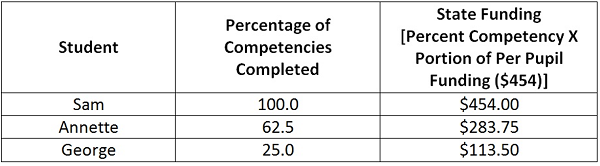
New Hampshire focuses on competency in its funding of online education. Funding is determined by the number of competencies, or discrete topics, that a course’s students master, as verified by an online instructor. Each one-credit high school course students complete through the state’s online school, known as the Virtual Learning Academy Charter School (VLACS), includes various competencies that students must master before they pass the entire course. This benchmarking of progress allows for partial funding at the course level. If students master all the competencies in a course, the school receives the full appropriation. If not, it receives partial payment based on the fraction of competencies the student achieved. Each half-credit, semester-long course was worth a maximum of $454 in 2014–15.

To illustrate this approach, the table below displays a hypothetical example. George reaches the end of the year meeting only 25 percent competency in the course, so VLACS receives just $113.50. Sam, however, met all the required competencies, releasing the entire per-course allotment.

Table 1. Example of VLAC’s Funding Formula for a half-credit (or semester-length) course 
eschool chart

Florida

Unlike Utah and New Hampshire, which allocate partial payments, the Florida Virtual School (FLVS) only receives funds upon course completion, as determined by course grades which includes the results of a statewide end-of-course assessment, if applicable. Course funding for FLVS is determined in the following way: The state’s weighted per-pupil amount is divided by six—the number of credits equal to a full load. If only one credit is completed online, the virtual school receives a one-sixth share of the per-pupil allocation (contingent upon course completion). FLVS submits five enrollment estimates throughout the year and receives regular payments based on these estimates, assuming full course completion. The final enrollment calculation occurs at year’s end, and adjustments are determined based on confirmation of course completion.

Minnesota

Minnesota’s online-learning program also provides funding based on course completion. But unlike Utah, Florida, and New Hampshire—which created single, statewide online education providers—Minnesota certifies multiple, independent entities to serve either as fulltime online schools or as providers of supplemental courses (to students primarily enrolled in a traditional district or charter school). Currently, thirty-three online schools have been approved by the state. Each of them sets its own definitions for course completion, and the Minnesota Department of Education is responsible for verifying the completion of courses. Minnesota’s use of many providers is more akin to Ohio’s online learning environment, with its many e-schools, and could serve as a model.

***

Some thoughts based upon Ohio’s experience and the work in other states:

  1. Generally, competency-based funding is based upon a student passing a course. This creates a rather explicit incentive, and perhaps even pressure, for teachers to pass students. This might be the best policy option, but the unintended consequences should be considered. As a thought experiment, I’d be curious how many ECOT students received passing grades in their courses that didn’t end up generating funding based upon the student participation requirements.

  2. While Florida has experimented with requiring the passage of an objective assessment to generate funding, that’s the exception rather than the rule. Furthermore, this approach would generally be limited to subjects and grades where a relevant test exists to assess how much a student learned. The alternative would be to develop a competency-based assessment for every grade and subject—something that seems rather impractical in today’s antagonistic environment toward testing.

  3. Florida has developed additional guard rails around its online courses that are worth noting. See the link below for the documentation found in the “Course Completion” section of the Florida Virtual School (FLVS) Full Time K-12 Student and Parent Handbook. They’ve broken each class into modules and require: each course to have a semester exam, assignments built-into each course that are completed verbally between the teacher and student, and the completion of all required course elements in order to generate course credit and funding. Worth noting, the FLVS is state-operated which has probably made it easier to create a regimented approach to online courses.

A Critical, Related Idea

Exploring how best to fund online charter schools is the charge of this committee, but a tangentially related idea deserves consideration. We support a proposal mentioned by the auditor and included in House legislation introduced last spring that requires the adoption of rules to determine when an online charter school may dis-enroll a student for not actively participating in learning opportunities. This idea is already being utilized in Indiana.

The proposal is premised on the acknowledgement that in a traditional classroom, teachers are able to directly observe students and select instructional strategies that ensure student engagement. Teachers in online schools, on the other hand, are far more limited in how they can interact with students. Under current law, online schools are only able to monitor and enforce a student’s attendance; they have little power to hold students accountable for active participation. This means that hundreds or even thousands of online students could be cruising through school and not learning anything as long as they log in every day. Even if the school knows there’s a problem and the student isn’t learning much or isn’t engaged, its hands are largely tied because the student is meeting minimum attendance requirements. In such cases, students are being academically harmed and taxpayer dollars are being wasted. By allowing ODE to establish rules that would permit (but not require) online schools to dis-enroll students who are actively refusing to participate, the legislature can greatly reduce the risk of online students falling behind. An additional step that should be included—either in law or rule—would be to require schools to document their attempts to contact families about student engagement issues and to notify the student’s school district of residence when a student is being dis-enrolled.

Without adopting a provision like this, there’s a real possibility that Ohio could devise a competency-based funding system that results in students who aren’t doing school work not being funded and the online school not being able to do anything about it. The result: the state saves a little money and likely a significant number of students escape truancy but receive little or nothing in the way of education. Quite simply, that’s an untenable situation.

Conclusion

Tens of thousands of Ohio families utilize online schooling each year making the stakes high. Yet whatever course this committee recommends is likely going to be the first of its kind in the nation. There’s no one that has really figured it out and no research evaluating whether competency-based funding actually drives better student outcomes. Given the challenge of crafting an online charter school funding system, switching abruptly to a completely new funding system would be needlessly risky and logistically challenging. There’s fairly ample evidence that we’ve gotten funding and incentives wrong in the past, so it’s reasonable for this committee to take the time it needs to get it right moving forward. We’d also recommend the use of a pilot program in one or more schools—if you thought it was necessary—to make sure a new system has the desired impact.

With that, I’m happy to answer any questions that you may have.

view

Chad L. Aldis written testimony on Ohio House Bill 491

Chad L. Aldis
12.5.2018
Ohio Gadfly Daily

Thank you, Chair Lehner, Vice Chair Huffman, Ranking Member Sykes, and Senate Education Committee members for the opportunity to provide written testimony on amendments potentially being offered on House Bill 491 related to softening the graduation requirements for future graduating classes.

In 2014, when the legislature adopted the current graduation requirements and raised the expectations for Ohio students to get a diploma, we applauded your resolve and commitment. It was a powerful acknowledgement that too few Ohio students were graduating high school with the skills necessary to be successful in college or to enter the workforce. Fully one third of Ohio students who did enter an Ohio college required remediation before taking credit-bearing courses. And we routinely heard reports of good paying jobs sitting vacant because young people didn’t have the skills that employers needed.

That’s why this body raised graduation requirements. Last year’s graduating class, the Class of 2018, was supposed to be the first required to earn a diploma by demonstrating readiness in one of three ways: college readiness via the SAT or ACT, successful mastery of high school level academic competencies via objective end-of-course exams, or earning an industry credential and demonstrating work readiness skills.

Hoping to give students another year to adjust to the increased expectations, the legislature extended a set of alternative graduation requirements that were anything but rigorous. It was a huge missed opportunity but understandable if it was temporary. Unfortunately, the same issue is back again this year, and it’s clear that for many it was never meant to be a temporary fix.

Now we’re debating whether to further delay implementation to students who were just completing sixth or seventh grade when the original requirements were passed.

This is a problem. For years, we have been vocal in our criticism of the long-term consequences for lowering expectations for students and giving parents a false sense of security by misrepresenting their children’s readiness for post-high school success. You can pass a law giving students a diploma, but being given a diploma isn’t the same thing as earning it. Without bolstering their academic skills, students are less likely to be ready for college. For those without an interest in going to college, putting in the work to acquire an industry certification could open the door to a job earning a living wage. If they can get a diploma without putting in the effort though, the chances are smaller that they graduate with in-demand skills.

I’m sure that none of this is new so far. Well, here’s something you’re unlikely to have heard before: there is absolutely no need for the legislature to take any action. Why?

  1. There is an incredible lack of data and transparency around this issue. Despite repeatedly asking the legislature to change the law, there’s starting to be some indications that the situation isn’t as dire as some would lead you to believe. At the October state board meeting, the Ohio Department of Education released limited graduation rate data for the Class of 2018. It shows that 68 percent of students from the Class of 2018 graduated because they earned the required scores on state end-of-course (EOC) or ACT/SAT exams. While it’s yet to be released by ODE, if you add in historical data related to the number of students typically earning a diploma via the career-technical graduation pathway and the students who can receive a diploma under Ohio law based upon their Individualized Education Plan, you’re likely going to see somewhere between 77 and 80 percent of Ohio students earning a diploma. This is lower than the 84 percent average graduation rate under the Ohio Graduation Test framework, but it’s a far cry from the disaster that many predicted. Moreover, this was the data for year one of significantly increased expectations. What would have happened in year 2? My money is on students and schools adjusting to the higher expectations and improved performance. That means more students graduating ready for college or prepared to directly enter the workforce.

  2. If you’re still of the mind that this is a problem that needs to be resolved, there’s a better solution than extending the requirements that had been used for the Class of 2018. This body gave the State Board of Education the authority to set the number of end-of-course exam points needed to earn a diploma. Eighteen points isn’t law. It’s a decision of the state board. If they truly believe that Ohio students need more time to adapt to the higher expectations, they could immediately pass a resolution to lower the points required to the number they see fit. This would give relief to students immediately while giving the legislature time to get more data from ODE and determine its long-term approach to the issue. Despite this power, the state board seems intent on abdicating its statutory responsibility and asking the legislature to be the one to lower expectations for Ohio students.  

Don’t do it.

When you raised the bar for graduation in 2014, you put the needs of students above your own comfort. I urge you maintain high expectations for all students. If you don’t, it’ll be the poorest, most disadvantaged students who suffer in the long run. They won’t get the additional supports they need to increase their likelihood of future success. Moreover, when the legislature weakens its expectations for graduation it communicates one of two things to students: either learning doesn’t matter, or we don’t believe you can reach these expectations. We owe it to our students, their families, and every citizen in Ohio to ensure that our graduates don’t earn participation trophies, but meaningful diplomas that indicate basic mastery of reading, writing, and math.

Fordham Logo

© 2026 The Thomas B. Fordham Institute
Privacy Policy
Usage Agreement

National

P.O. Box 110
Burke, VA 22009

202.223.5452

[email protected]

Ohio

P.O. Box 82291
Columbus, OH 43202

614.223.1580

[email protected]

Sponsorship

130 West Second Street, Suite 410
Dayton, Ohio 45402

937.227.3368

[email protected]