Imagine for a moment that William Shakespeare came back to life for one day and promised to devote all of that time to young students—answering their questions about writing and theater and sharing details about the unique aspects of life in England centuries ago. Or that LeBron James and Michael Jordan offered to come to a school to run basketball drills with aspiring hoopsters. Or that Marie Curie showed up ready to discuss her scientific inspirations, methods, and discoveries with physics or chemistry students. Imagine any of these once-in-a-lifetime learning opportunities being made available to students, only to have the adults who run their schools say, “Sounds like a lot of trouble. We’re going to pass.”
Ridiculous, right? Well, the rough equivalent is currently happening right here in Ohio.
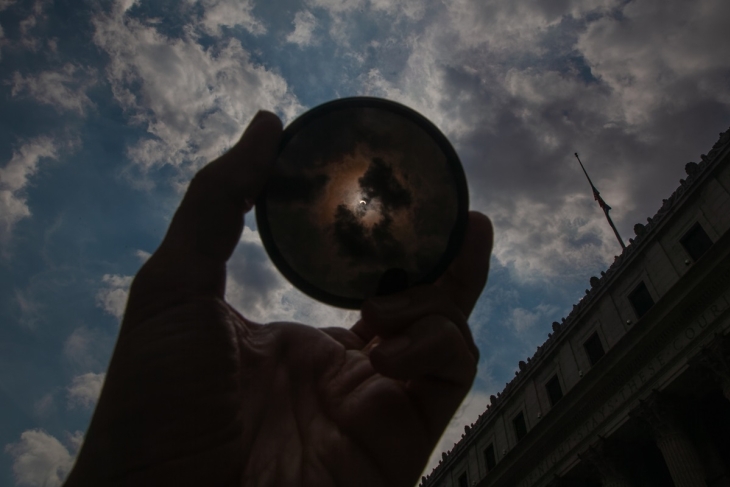
In case you missed it, a total solar eclipse will occur on April 8, 2024. It is a stunning astronomical phenomenon, and the path of totality—the darkest part of the eclipse—will pass through portions of northern Ohio for just over four minutes that afternoon. The event will give observers the chance to examine the solar corona, to view solar winds in action, and to study the Earth’s own ionosphere without the glaring brightness of the sun as an impediment. This is a golden opportunity to expose students to real life science learning. It’s also a once in a lifetime experience: The last total solar eclipse visible in Ohio was in 1806, and the next won’t occur until 2099. In short, the combined knowledge of Galileo, Newton, Einstein, and Hawking will soon come alive for thousands of Ohio students for one day only.
Or at least it would have if their school leaders hadn’t unanimously decided to close their entire districts for the whole day and provide zero educational opportunities whatsoever. Missing out on the rare astrophysical learning opportunity is bad enough, but no English or math or history or art will be taught to students that day either. Many districts are opting to extend their spring breaks by a day, while others jumped through administrative hoops to change their academic calendars and create a three-day weekend. Despite this rare celestial opportunity, nothing of educational value will happen.
Why? Fear, it seems—and of a distinctly Earthly variety.
Large crowds and traffic are expected in prime viewing areas. Spotty Wi-Fi and cell service are deemed to be possible. Police and safety services are expected to be in high demand all day for reasons not fully articulated. It seems local safety officials are driving the concerns, strongly pressuring even those districts that want to hold classes that day to give in and shut down. School leaders are listening, and amplifying the fearful talk.
To be fair, the time of totality is right around 3:00 pm, the traditional time of school dismissal. And, indeed, the idea of school buses and carpools trying to navigate to and from schools at the same time that lots of other folks are stopped in their tracks, staring (through safety glasses, of course) at the sky, is properly concerning. But totality is less than five minutes in duration. And even if police and fire departments are right to expect gridlock for a long time beyond that, that still doesn’t explain why the default response to even that level of concern is to shut down the entire district for the entire day. On the contrary, it’s an overreaction that feels akin to Y2K (remember how that turned out) or to medieval doomsayers prophesying the end of the world because of an approaching comet. Today’s message is the same as in those past examples: Stay home, take shelter, and hope for deliverance from the evils we foresee.
Obviously, student safety is important. But given the extraordinary event in question, is this really the wisest response? Must the educational opportunity of a lifetime be squandered because of overblown worries regarding traffic and dropped phone calls?
There are better responses available. For example, why not have an extended or flexible schedule that day? Perhaps a district-wide science day that starts at noon and ends at 6:00 pm, with livestreams from NASA or in-person demos and explanations guided by local astronomers? With months to plan and local safety services as partners, any of a number of interesting and engaging possibilities could be developed to alleviate safety concerns and maximize the scientific enrichment of students. For the traffic-jam pessimists that refuse to be swayed by the educational potential of an in-person event held safely on school grounds, why not offer some kind of online option led by teachers and supplemented by resources from far and wide?
As we have learned in recent years, fears are easy to stoke, and shutting down is an equally easy response. Finding clever solutions that balance competing priorities—learning and safety simultaneously, new ways of conducting business while still maintaining some traditions—is hard. But taking the easy path in our schools also has consequences—and those consequences are still being felt far and wide. Do we really want to go down this road again?