
The other day I noted that an expert panel had decided, according to Education Week, that “the skills considered necessary for the 21st-century workplace” were “critical thinking and analytic reasoning,” “teamwork and complex communications,” and “resiliency and conscientiousness.” I was skeptical, not because those aren’t important skills, but because they didn’t have much to do with the twenty-first century.
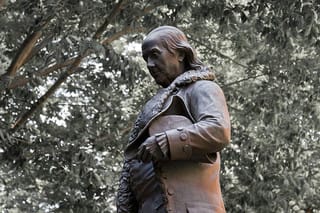 Who better to speak to contemporary American youth than one of the nation's most prolific inventors and entrepreneurs? Photo by Andrew Malone. |
Then along came an email from Dee Selvaggi, a former member of a New Jersey school board and a contributor to The BEV Challenge, recommending “a very interesting book,” Benjamin Franklin on Education (edited by John Hardin Best, Teachers College Press, Columbia University, 1962). Wrote Dee, Franklin’s “concern [was] about the content presented to youth so they could function well in the new contemporary America.”
Who better to speak to contemporary American youth than one of the nation’s most prolific inventors and entrepreneurs? According to Franklin,
The good Education of Youth has been esteemed by wise Men in all Ages, as the surest Foundation of the Happiness both of private Families and of Commonwealths. Almost all Governments have therefore made it a principal Object of their Attention, to establish and endow with proper Revenues, such Seminaries of Learning, as might supply the succeeding Age with Men qualified to serve the Publick with Honour to themselves, and to their Country.
And Franklin proposed a curriculum for the youth of Pennsylvania both “useful” and “ornamental”:
Art is long, and their Time is short. It is therefore propos'd that they learn those Things that are likely to be most useful and most ornamental. Regard being had to the several Professions for which they are intended…. All should be taught to write a fair Hand, and swift, as that is useful to All… Drawing, by Imitation of Prints, and some of the first Principles of Perspective. Arithmetick, Accounts, and some of the first Principles of Geometry and Astronomy. The English Language might be taught by Grammar; in which some of our best Writers, as Tillotson, Addison, Pope, Algernoon Sidney, Cato's Letters, &c. should be Classicks…. Reading should also be taught, and pronouncing, properly, distinctly, emphatically; not with an even Tone, which under-does, nor a theatrical, which over-does Nature.
Such a refreshing approach to education—and to the meaning of “useful.”
Franklin proposed too that,
HISTORY [be] a constant Part of their Reading, such as the Translations of the Greek and Roman Historians, and the modern Histories of antient Greece and Rome [and that] GEOGRAPHY, by reading with Maps, and being required to point out the Places where the greatest Actions were done [be part of it. So to] CHRONOLOGY, by the Help of Helvicus or some other Writer of the Kind, who will enable them to tell when those Events happened [and] ANTIENT CUSTOMS, religious and civil, [as well as] MORALITY, by descanting and making continual Observations on the Causes of the Rise or Fall of any Man's Character, Fortune, Power, &c . mention'd in History; the Advantages of Temperance, Order, Frugality, Industry, Perseverance, &c. &c.”
Indeed, wrote Franklin, “the general natural Tendency of Reading good History, must be, to fix in the Minds of Youth deep Impressions of the Beauty and Usefulness of Virtue of all Kinds, Publick Spirit, Fortitude, &c.”
Have we changed all that much since Franklin? Of course, without the hindsight of history, how would we know? If, as a former state commissioner of education once told my school district’s teachers, “we must look only to the future,” how could we possibly appreciate the fact that “reading good history” could be a useful “virtue of all kinds”? By some twenty-first-century standards, the rollout of Google is ancient history; to others, it’s a data point on the long march toward a “more perfect” union.
In an era saturated with buzzwords and acronyms—STEM, critical thinking, twenty-first-century skills—and our new concerns about meritocracy and social mobility, it is nice to be reminded of the importance of the original great thinkers; we might learn something.
