
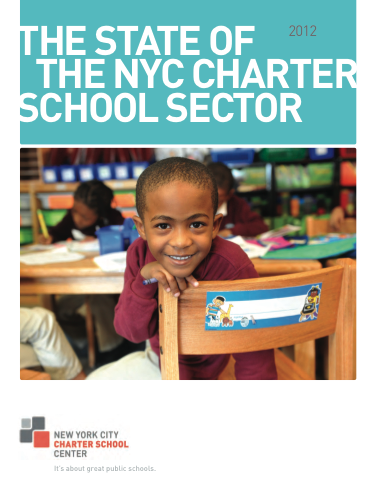
 This pithy report from James Merriman’s New York City Charter School Center offers a look at the state of play among Big Apple charters. It brims with useful statistics framed around four central questions: Who are the students? What choices do charters provide? What are their results? And what is the outlook for their future? To (partially) answer these questions: 136 charters in NYC enroll 47,000 students, representing a 4 percent market share—though these schools are concentrated in Harlem, Central Brooklyn, and South Bronx. For perspective, 25 percent of students in Harlem attend charters. Seventy-five percent of students in charters are low income—comparable to district schools. Sixty percent are black, compared to 30 percent of district students, while 30 percent are Hispanic (versus 40 percent in district schools). Compared to district schools, the charter sector serves smaller percentages of SPED and ELL students and has higher average teacher- and principal-turnover rates. (But—kudos to the charters—they’ve got stronger pupil attendance!) On the achievement front, charters fare better at teaching students math; they’re on par with district schools for ELA and their ELL students appear more likely to pass the English-language-proficiency test and leave the ELL category. What’s more, this sector is slated for growth (assuming the political environment allows it): About half of Gotham’s charters are affiliated with CMO networks and most (60 percent) have been open less than five years. And under the current state cap, existing charters can add 24,000 seats and another 116 schools can open. As Merriman and his crew explain, “this report represents a modest first step toward a more informed and data-driven conversation about charter schools.” As they take the second step, they might consider adding some financial information. How do New York’s charters look on the revenue-and-expenditure side versus district schools, for example?
New York City Charter School Center, The State of the NYC Charter School Sector (New York, NY: New York City Charter School Center, 2012).
