In Ohio, the big news in the career pathways realm is the state’s recent revamp of the industry recognized credentials system. The makeover was sorely needed given evidence that schools had discovered the easiest-to-attain credentials and pushed students to collect them as shortcuts to graduation. Starting with this fall’s freshman, students must earn credentials from a slimmed-down list of 126 credentials to meet alternative graduation requirements (738 were previously approved). The new catalog is built on a data-driven system that incorporates employer demand and wage outcomes to help ensure students earn credentials of value en route to graduation.
Besides diploma requirements, Ohio also encourages credential attainment through the Innovative Workforce Incentive Program (IWIP). First enacted in 2019, it currently provides up to $725 per credential earned. The IWIP list has always been smaller and more selective than the graduation list, with a strong focus on high-priority career fields such as construction, engineering, healthcare, IT, and manufacturing. However, like with graduation, the IWIP credentials list was largely developed based on subjective judgments rather than objective data.
With the graduation list getting a facelift and more data now available on credentials, the IWIP list merits a closer look. As of 2025–26, the state designated 210 credentials as IWIP eligible, more than the number that’s now approved for graduation. This is a reversal of precedent and a potential concern given that IWIP is supposed to incentivize a narrow set of high-priority, high-value credentials.
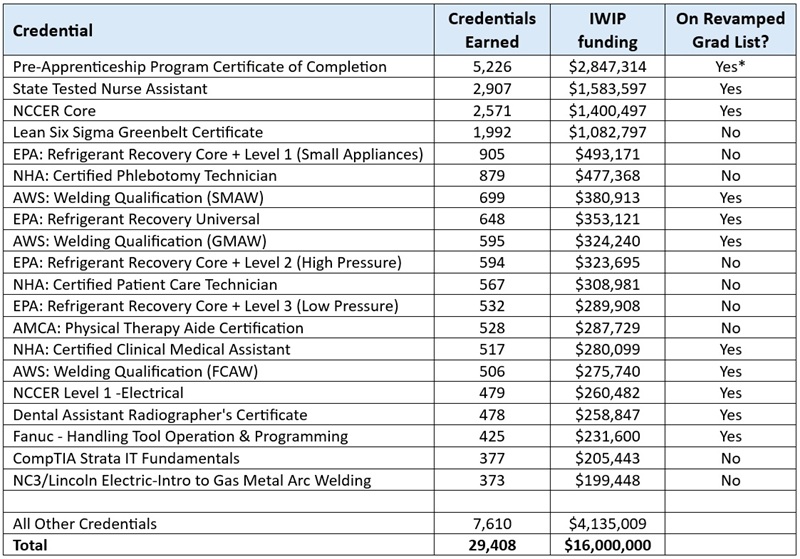
The disconnect is noticeable when looking at the most commonly earned IWIP credentials. As Table 1 indicates, nine of the top twenty IWIP credentials earned in 2024–25[1] do not appear on the revamped graduation list. With wage data available by credential, we learn that several of the non-graduation-approved IWIP credentials lead to low-paying jobs. For Ohio students attaining a six sigma greenbelt, certified phlebotomy technician, certified patient care technician, CompTIA fundamentals, and the physical therapy aide credentials, the median income was just $26,000 to $31,000 shortly after high school. That’s barely above the income for a full-time minimum wage job (about $23,000 per year). Such meager wage outcomes help explain the credentials’ exclusion from the graduation list—and highlight the need to revise IWIP standards.
Table 1: FY2026 IWIP funding—top twenty credentials
Policy options
State officials have some options on how to handle IWIP eligibility in light of recent developments. Let’s explore three possibilities, with the final one (in bold, below) the best approach, in my view.
- Maintain the IWIP list as-is. This has the benefit of consistency and would not withdraw future support for schools that may have developed programs in response to the incentive. The problem is that we now know—as a result of extensive analysis of IRCs—that some IWIP credentials have questionable value for students in the labor market. In addition, maintaining an IWIP list that is larger than the graduation list seems at odds with program intent, which is to provide targeted incentive funds for only the highest-value credentials.
- Align the graduation and IWIP credentials lists. This has the advantage of creating a unified system. When meeting alternative graduation requirements, students would also be attaining an IWIP credential, which the state subsidizes. The rub is that some graduation-eligible credentials are arguably not ones that the state should incentivize monetarily. Most notably, the cosmetology licenses appear on the revamped graduation list but are not currently IWIP-designated. Given the low wages associated with that career field, those credentials should remain off of the IWIP list. Another challenge is that there will likely be significant pressure on state officials to expand the graduation-eligible list in future years. Automatic linkage to IWIP amid a ballooning graduation list would likely tarnish the incentive program. It also risks deeper “prorations” of the IWIP reimbursement rates if the number of credentials-earned rises within the fixed program budget.[2]
- Strategically remove items from the IWIP credentials list or simply start from scratch. This would avoid the problems discussed in the above options, while ensuring that Ohio maintains a more selective IWIP list. One option for accomplishing this is to start from the current IWIP list and remove credentials that have weak employer demand and wage outcomes. Another possibility is to start over: Use the new credentials framework to identify the highest-value credentials and make them IWIP eligible. Safeguarding the selectivity of IWIP will be essential in efforts to build support for increased program funding. Lawmakers are likely more inclined to invest taxpayer funds knowing that the approved credentials lead to strong employment outcomes for students.
State leaders have rightly enacted policies that encourage students to earn credentials. The recent shift towards quality, rigor, and value is critical to ensure that students benefit from attainment. The clean-up of the graduation list was a necessary first step. Now it’s time to do some housekeeping for IWIP as well.
[1] The IWIP program reimburses schools based on prior year credential earning, and is why Table 1 refers to FY2026 funding.
[2] Prorations—i.e., reductions to the maximum reimbursement rates to fit the program appropriation—are already a significant problem with IWIP. In FY26, schools received just $545 per credential (75 percent of the $725 max reimbursement) due to the volume of credentials earned and a limited appropriation of $16 million.