In 2025, the General Assembly created a workgroup tasked with reviewing pupil transportation and developing recommendations aimed at “better meet[ing] the transportation needs of Ohio students.” Consisting of four state lawmakers (two from each party) and 11 school officials (representing all education sectors), the workgroup was formed in response to persistent concerns about students being left without rides, particularly those attending public charter and private schools.
The workgroup’s final report was released earlier this month. It depicts districts’ growing use of an “impracticality” loophole that allows them to deny student transportation. The report offers a series of recommendations—some more realistic than others—that seek to address the problem. Let’s take a look at the findings and key recommendations.
“Impractical to transport”
For more than 50 years, Ohio has required districts to provide transportation to all resident students, whether they choose a district school or an alternative.[1] The law makes perfect sense. It promotes safety and efficiency, as a single entity is responsible for busing rather than hundreds of individual schools attempting the feat. It’s also fair to taxpayers: All parents receive a public service from the district to which they pay taxes. Finally, the law honors parents’ choices. They can rely on their local district for transportation even if they select another option. To support districts in this task, the state provided $830 million for transportation in FY26 (up from $603 million four years ago).
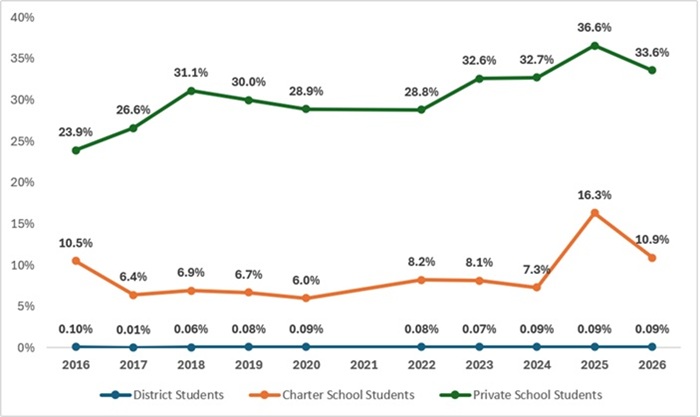
Unfortunately, as the workgroup report discusses, school districts declare tens of thousands of charter and private school students “impractical to transport.” This loophole—or “statutory opportunity,” as the report awkwardly phrases it—permits districts, through school board resolution, to deny tax-paying families the busing service they are otherwise entitled to. The latest numbers per the report: In 2025–26, districts rejected transportation for 19,153 private school and 2,723 charter school students (representing 34 and 11 percent of transported private and charter students, respectively). Instead, districts pay their families a nominal “payment in lieu of transportation” of about $600—half of what districts spend to bus a typical student and the equivalent of a meager three bucks and change per day.
As Figure 1 shows, districts have increasingly used this loophole to avoid busing. Impracticality rates over the past two years are the highest on record (these data have been tracked since 2015–16). And in 119 districts (roughly one in six statewide), the workgroup notes that every single private and charter school student was declared “impractical”—likely reflecting a blanket policy of rejecting parents’ requests rather than making case-by-case determinations. In stark contrast, only 618 district pupils statewide were denied transportation last year, representing less than one in every 1,000 transported district students overall. Likely, these are mainly students attending their home district but could consist of some open enrollees who are entitled to transportation if they make it to a bus stop within their district of attendance.
Figure 1. Percentage of district, charter, and private school students declared “impractical to transport,” 2015–16 to 2025–26
Workgroup recommendations
The workgroup report generally acknowledges that denying transportation en masse is wrong and recommends a policy framework that would “guarantee transportation for all eligible Ohio students to their school of choice.” This goal is spot-on and consistent with Ohio’s longstanding policy (save for districts’ “opportunity” to declare children “impractical”).
Given this, one might have expected a clear and forceful call to simply repeal the impracticality provisions, a move that lawmakers should seriously consider. But, alas, the workgroup—comprised of several district officials—did not go that route. Instead, the report argues for a “phasing out” of impracticality conditioned on a slew of other policies being adopted (e.g., lots more money, regional transportation consortia, increased data collections, statewide student registration systems, and more). Those are fine ideas, but also large and complicated proposals that would be tough to implement in the real world and thus unlikely to be enacted. In the meantime, thousands of Ohio families will continue to be denied transportation because of impracticality.
Fortunately, the workgroup shifts toward more realistic proposals near the end of the report. There, it suggests ways that lawmakers can at least curb districts’ abuse of the impracticality provision. Commendable recommendations include:
- Require the Ohio Department of Education and Workforce (DEW) to audit districts with high rates of impracticality determinations.
- Require DEW to issue rules regarding what standards districts must meet to declare a student impractical—e.g., what precise time or distance allows for impracticality. (Under current law, districts must “consider” six factors—e.g., time/distance and cost—to declare a student impractical to transport, but there are no guidelines about when a factor applies.)
- Add statutory language that requires districts to “provide clear evidence” (not just “consider”) that each of the six factors applies for transportation to be deemed impractical.
Though not formally adopted by the workgroup, a report appendix contains two more critical policy recommendations:
- Increase the payment in lieu of transportation to better support families bearing transportation responsibilities, while also acting as a stronger deterrent to impracticality declarations.
- Codify an attorney general opinion and DEW guidance that ensures equal provision of transportation to private and charter high school students, if offered also to district high schoolers. (State law requires busing for K–8 students but not high school.)
***
School transportation should be a basic public service provided by local governments (districts) to all families in the community. Regrettably, the bus doesn’t come around to serve thousands of Ohio students due to a massive loophole in state law. Though not perfect, the workgroup report contains some recommendations that would help to curtail abuse and better ensure that every student gets a ride to school.
[1] Certain commonsense exceptions do apply: Districts are not required to transport students who live less than two miles from their school or more than 30 minutes away. Providing busing for high school students (grades 9–12) is also optional for districts.