
In Ohio, the summer months are quiet on the legislative front. This fall is shaping up to be quiet, as well, with lawmakers focusing most of their attention on the November election and its potential impacts. But there is some low-hanging, bipartisan fruit that policymakers can and should pluck before the end of the year.
House Bill 644, which was passed out of the House in May, aims to boost postsecondary student outcomes by establishing the Higher Education Evidence-Based Innovation Fund.[1] The fund would be housed in the state treasury and consist of designated dollars from the General Assembly and private contributions. It’s important to note that the bill doesn’t provide state dollars. Its purpose is to create an infrastructure that lawmakers can use to allocate funding in next year’s biennial budget. The chancellor of higher education would then competitively award grants to state institutions to support “the adoption of evidence-based reforms and practices.”
More specifically, grant funds would go toward the “development, piloting, scaling, and assessment” of student success programs. The bill defines these programs as those that are established and operated by a state institution of higher education for the purpose of improving postsecondary retention rates, completion rates, or the time it takes students to earn a degree. Each program must emphasize supporting low-income students. If the bill becomes law, the chancellor would be required to open competitive grant periods at least once every two years beginning in 2027.
There are two reasons why this grant program merits consideration.
First, it emphasizes evidence-based practices. That’s not unique, as most education legislation calls for interventions to be evidence-based. But “evidence” is typically treated as an umbrella term that covers pretty much anything. HB 644, however, explicitly defines an evidence-based practice as an activity, strategy, or intervention that falls into one of two categories.
1. It demonstrates a statistically significant effect on improving student outcomes or other relevant outcomes based on one of the following:
- Strong evidence from at least one well-designed and well-implemented experimental study.
- Moderate evidence from at least one well-designed and well-implemented quasi-experimental study.
- Promising evidence from at least one well-designed and well-implemented correlational study with statistical controls for selection bias.
2. It does both of the following:
- Demonstrates a rationale based on high-quality research findings or positive evaluation that the activity, strategy, or intervention is likely to improve student outcomes or other relevant outcomes.
- Includes ongoing efforts to examine the effects of the intervention.
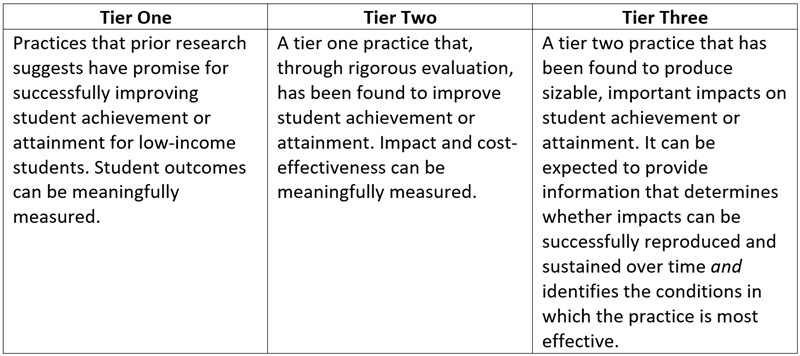
But that’s not all. The bill also separates evidence-based practices into three tiers. Preference must be given to those who plan to use tier three practices.
Table 1. Tiers of evidence-based practices
Second, the bill prioritizes specific and measurable metrics of success. While many grant programs require some type of effectiveness evaluation, HB 644 makes measurement a key feature instead of an afterthought. Grant applications must identify annual benchmarks for student outcomes and outline a plan for evaluating evidence-based practices. This plan must include “experimental designs using random assignment or other research methodologies that allow for the strongest possible causal inferences.” When developing criteria for awarding grants, state agencies[2] must include metrics related to student retention and completion, the economic mobility of students, and student preparation for high-wage or high-need jobs. Collectively, these expectations set a rigorous bar for evaluation that will make it much easier to identify which programs are successfully boosting student outcomes.
It’s easy to pay lip service to evidence-based practices and rigorous evaluation. But HB 644 doesn’t just talk the talk; it walks the walk. It sets a high standard for what actually counts as evidence based. It requires institutions to track specific and measurable metrics. And it pairs these expectations with the possibility of state funding that institutions can use to pilot innovative, promising programs that boost student outcomes. This is a bipartisan, win-win bill. Policymakers should make it law.