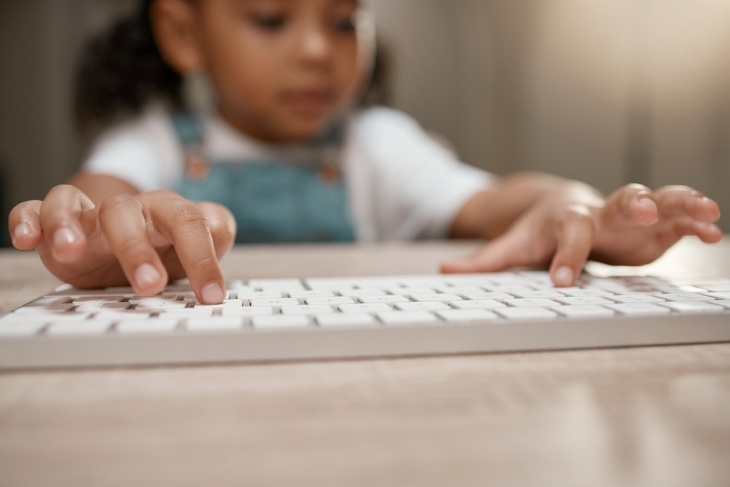
A common concern in evaluating computer-based testing is the perceived differences between students writing by hand and those writing by typing. Historically, typing has been seen as more difficult for students to master—especially younger kids—thus rendering computer-based assessments intrinsically “harder” than pencil-and-paper versions, even when the test material is otherwise identical. But much of the research around the topic is almost a decade old, predating the explosion of online and computer access even our youngest kids (and their teachers) experienced since then, as well as newer research that supports the idea of typing being easier than handwriting. That is, one keystroke—using only one finger most of the time—renders a complete letter rather than a multiple and varied number of pen strokes needed to handwrite any given letter, any one of which can go awry–even for experienced little fingers.
Onto the pile of (almost) up-to-date information we can add brand new findings from Norway. State-run schools in the country were asked to adopt either a handwriting-first or digital-writing-first approach to instruction ahead of the 2018–19 school year. A group of researchers from Volda University College exploited the natural experiment created by comparing the development of writing composition skill among students in five first-grade classes. Half of the children learned to compose text by handwriting on paper and the other half learned by typing on a digital tablet using word-processing software, based on the policies adopted by their schools. All students were evaluated at five separate points during the year by completing the same scheduled narrative writing tasks. All narratives were evaluated in terms of a range of text features capturing both transcription accuracy (spelling, spacing, punctuation) and syntactic and compositional sophistication.
The best news is that all students tended to show strong and similar increases in the accuracy and complexity of their syntax, in the detail and sophistication of their narratives, and in the length of their texts over the school year, with negligible differences based on learning modality. More accurate spelling and word spacing were observed among students in the digital learning group, which the researchers attribute to the software’s inclusion of a text-to-speech function. This allowed students to hear what their typed words sounded like spoken back to them, highlighting misspellings and any words mistakenly strung together or improperly split. Interestingly, students in the digital modality showed lower accuracy with periods, questions marks, and exclamation points than the handwriting group. The researchers surmise that both groups were likely close to the same level of accuracy but that stray marks in the handwriting mode could have been counted as periods by graders, whereas no such moderator existed for kids typing their sentences.
All in all, the researchers suggest that the data represent an even outcome, with both learning modalities proving successful at increasing student growth and achievement in writing. They suggest a number of limitations of both the study design (in 900 hours of instruction over the year, for example, could digital-first teachers have reverted to handwriting for some kids during some lessons?) and the generalizability of their findings (English language instruction with its multiple irregular word structures, they say, would be a very different context to test). They also spend some time discussing the value of the text-to-speech functionality and whether it really represents a positive learning support or a sort of “cheat” for students who use it. On the other hand, might there be some analogous version of that feedback to be incorporated into handwriting-first instruction? Could that then make handwriting superior?
All of this takes on greater significance after years of pandemic-required remote learning and the ongoing utilization of online resources in its wake. At a minimum, it seems, the old mindset that handwriting is an inherently easier learning mode needs to be retired. But beyond that is the future, in which we can merge all the tools and modalities available to provide the very best learning opportunities for students.
SOURCE: Eivor Finset Spilling et al., “Writing by hand or digitally in first grade: Effects on rate of learning to compose text,” Computers and Education (April 2023).