Mobile Navigation

  • National
    • Policy
      • High Expectations
      • Quality Choices
      • Personalized Pathways
    • Research
    • Commentary
      • Gadfly Newsletter
      • Flypaper Blog
    • Events
    • Scholars Program
  • Ohio
    • Policy
      • Priorities
      • Media & Testimony
    • Research
    • Commentary
      • Ohio Education Gadfly Biweekly
      • Ohio Gadfly Daily
  • Charter Authorizing
    • Application
    • Sponsored Schools
    • Resources
  • About
    • Mission
    • Board
    • Staff
    • Career
Home
Home
Advancing Educational Excellence

Main Navigation

  • National
  • Ohio
  • Charter Authorizing
  • About

Ohio Menu

  • Topics
    • Accountability & Testing
    • Advanced Education
    • Career & Technical Education
    • Charter Schools
    • Curriculum & Instruction
    • ESSA
    • Evidence-Based Learning
    • Governance
    • Personalized Learning
    • Private School Choice
    • School Finance
    • Standards
    • Teachers & School Leaders
  • Research
  • Policy
  • Commentary
    • Ohio Gadfly Newsletter
    • Ohio Gadfly Blog
    • Events

The Education Gadfly Weekly

Sign Up to Receive Fordham Updates

We'll send you quality research, commentary, analysis, and news on the education issues you care about.
Thank you for signing up!
Please check your email to confirm the subscription.

Ohio Gadfly—Solid recommendations for combating chronic absenteeism

Volume 17, Number 25
11.8.2023
11.8.2023

Ohio Gadfly—Solid recommendations for combating chronic absenteeism

Volume 17, Number 25
view
Attendance taskforce recs blog image
School Funding

The Ohio Attendance Taskforce offers solid recommendations for combating chronic absenteeism

On October 27, members of the Ohio Attendance Taskforce, which include school and business leaders as well as representatives from the juvenile court system, unveiled a series of recommendations aimed at improving school attendance.

Jessica Poiner 11.8.2023
OhioOhio Gadfly Daily

The Ohio Attendance Taskforce offers solid recommendations for combating chronic absenteeism

Jessica Poiner
11.8.2023
Ohio Gadfly Daily

Three tweaks lawmakers should consider making to their education regulation reform bill

Jessica Poiner
11.14.2023
Ohio Gadfly Daily

More Ohio high school students are earning industry credentials, but are they valuable in the labor market?

Aaron Churchill
11.1.2023
Ohio Gadfly Daily

Looking at a new framework for classroom evaluations

Jeff Murray
11.14.2023
Ohio Gadfly Daily

The effects of a virtual literacy-tutoring program

Jeff Murray
11.2.2023
Flypaper
view
SB 168 analysis blog image

Three tweaks lawmakers should consider making to their education regulation reform bill

Jessica Poiner 11.14.2023
Ohio Gadfly Daily
view
IRCs in Ohio blog image

More Ohio high school students are earning industry credentials, but are they valuable in the labor market?

Aaron Churchill 11.1.2023
Ohio Gadfly Daily
view
New classroom observation and assessment framework SR image

Looking at a new framework for classroom evaluations

Jeff Murray 11.14.2023
Ohio Gadfly Daily
view

The effects of a virtual literacy-tutoring program

Jeff Murray 11.2.2023
Flypaper
view
Attendance taskforce recs blog image

The Ohio Attendance Taskforce offers solid recommendations for combating chronic absenteeism

Jessica Poiner
11.8.2023
Ohio Gadfly Daily

On October 27, members of the Ohio Attendance Taskforce, which include school and business leaders as well as representatives from the juvenile court system, unveiled a series of recommendations aimed at improving school attendance. Their suggestions couldn’t have come at a better time, as districts and schools across the state continue to struggle with high rates of chronic absenteeism. As numerous reports have documented, absenteeism shot up during the pandemic, has yet to come back down to pre-pandemic levels, and is making academic recovery more difficult.

The taskforce’s recommendations are part of a detailed report that’s worth a read, as it includes a look at how some systems and schools—such as the state’s largest district, Columbus City Schools, and the Dayton Early College Academy (DECA), a charter school in Dayton—are seeing promising results from attendance-boosting efforts. The highlight of the report, though, is its five in-depth recommendations. Let's take a look at each.

1. Working together, build awareness and galvanize statewide support for the role attendance plays in student success in academics, careers, and life.

The report emphasizes that a wide variety of stakeholders—districts and schools, students and families, community members, business leaders, faith communities, and state leaders—have an important role to play in supporting student attendance. It’s absolutely crucial for these groups to work together to address absenteeism. One potential way to do this is by expanding the Stay in the Game! Attendance Network into a comprehensive statewide messaging campaign that every district could join (right now, around thirty-five of the state’s 611 districts participate). The campaign could highlight trends and data, identify best practices, and share the stories of schools that are successfully improving student attendance.

Building local partnerships is also crucial, and the report offers several ideas. For example, healthcare professionals like pediatricians and dentists could make sure to offer appointments before and after school hours so that students don't have to miss class. Local businesses could post signage and informational materials that support school attendance efforts. And neighborhood restaurants could recognize local students with high attendance marks.

2. Foster engagement, build trust and belonging, and address local challenges with students, families, and educators.

Implementing “robust, authentic, and frequent” student and family engagement experiences is critical. Parents and families can’t address problems if they’re not aware of them, and students are more likely to attend school if they feel a sense of trust and belonging.

Schools should view families as “respected allies” when it comes to student attendance. Getting off on the right foot is crucial, so the report recommends beginning each school year by sending home positive messages via text, notes, or emails. Throughout the year, schools should make a concerted effort to reach all families and communicate proactively and regularly. Administrators could establish focus groups to gather information and ideas from families or create roles for parents on district and school leadership teams. Offering families the chance to engage with surveys or other feedback-gathering mechanisms at student performances, school exhibits, or sporting events would make engagement a lot more convenient, too.

Students, meanwhile, can be a big help when it comes to crafting innovative solutions that will appeal to their peers. As such, teachers and administrators should offer plenty of opportunities for students to provide feedback. Schools could create student taskforces that allow them to brainstorm ideas and present solutions on various issues—like absenteeism—to building administration. And districts could include a student as an ex-officio member of the school board who can offer an important perspective that might otherwise be absent.

3. Cultivate engaging and relevant learning environments at all Ohio schools so students want to attend.

“Getting teaching and learning right,” the report notes, “is a strong motivator for student engagement and attendance.” In other words, schools need “engaging and relevant” learning environments that make students want to show up. They can do so in a variety of ways: incorporating hands-on activities and interactive technologies into lessons; connecting academic content to real job opportunities and careers, as well as to real world problems; embedding enrichment activities and clubs into the school day; and ensuring that students have the academic supports they need—things like tutoring, counseling, and mentorship programs—to succeed. It’s also important for districts and schools to offer teachers professional development in classroom engagement and management techniques so they have the knowledge and skills they need to enhance classroom climates.

4. Adjust systems and resources to support schools and districts in their attendance work.

When it comes to boosting student attendance, schools can’t do it all on their own. The Department of Education and Workforce can offer support by integrating attendance across multiple state-led areas, including the Positive Behavioral Interventions and Support framework, school improvement efforts, and health and mental health supports. The department should also identify and disseminate best practices. Creating an Attendance Data Guide and enhancing the data and access tools available to districts and schools could help.

District leaders also play a crucial role in supporting schools. One of the best ways to do so is to track and assess the effectiveness of attendance interventions so that schools can focus on what works. District leaders should also prioritize connecting with regional educational service centers and state support teams to offer staff training and support—especially certified Regional Data Leads, who can offer educators support in data analysis and data-driven decision-making. Meanwhile, in the interest of transparency, districts could create a school or district-level data dashboard that provides the public with real time information about student absences and opportunities for early intervention.

5. Work with policymakers to inform comprehensive policy changes that support student attendance.

In 2016, lawmakers overhauled the state’s attendance policies via House Bill 410. With several years of implementation now on the books, the taskforce wisely asked administrators to share what is and isn’t working. They praised the law for requiring schools to examine attendance data and for providing a standardized process and framework to identify the root causes of student absenteeism. But they also critiqued the law’s focus on compliance (rather than prevention and intervention) and noted that, by prescribing how schools must communicate with families, districts have been prevented from using more effective methods—like, for example, text messaging.

In response to this feedback, the report recommends that lawmakers refine Ohio’s attendance-related policies. The taskforce doesn’t call on the state to do away with HB 410 entirely, which means consequence-related provisions like absence intervention teams and filing truancy complaints with juvenile court would remain intact. But it does call on leaders to shift “allocation and action” away from compliance and toward prevention and early intervention. It also recommends adding flexibility regarding how schools can communicate with families. However, it’s important to note that not all adjustments are good adjustments. For example, a recent legislative effort that would have made it easier for students to miss school would move Ohio in the wrong direction. Going forward, lawmakers should be thoughtful as they consider how to adjust state attendance laws.

***

Nationwide, chronic absenteeism has become a crisis. Ohio is no exception, and it’s important for state and local leaders to not only acknowledge the crisis, but to act. The recommendations released by the Ohio Attendance Taskforce provide a great place to start.


view
SB 168 analysis blog image

Three tweaks lawmakers should consider making to their education regulation reform bill

Jessica Poiner
11.14.2023
Ohio Gadfly Daily

Education policy plays a crucial role in determining whether students reach their full academic potential. The funding systems that allocate dollars to schools, data systems that track student outcomes over time, and the policies that hold adults accountable for meeting the needs of students are all incredibly important.

But they’re also incredibly complex. For the most part, this complexity is necessary in working towards systems that are as fair, equitable, and efficient as possible. But sometimes policy can become too complex. Regulations can become burdensome instead of helpful, and changing times call for changing rules. It’s important for policymakers to take a step back every few years and reconsider what’s on the books.

In early October, state lawmakers started that process by introducing Senate Bill 168, legislation aimed at “education regulation reform.” The bill eliminates a handful of “obsolete” provisions from law and adjusts several others. It also has the support of school administrator groups, whose members believe that it would “reduce burdensome and unnecessary regulations, vest more decision-making back into local communities that know their students best, and better equip our school leaders to prepare our students for the future.”

Reducing unnecessary regulations and empowering local leaders are worthy goals. But there are a few provisions in Senate Bill 168 that lawmakers should consider tweaking before they give their final stamp of approval. Here are three areas that deserve a second look.

1. Exempting high-performing districts from certain statutory requirements

In 2016, the legislature passed an initial education deregulation bill that exempted qualifying districts from a variety of statutory requirements for a three-year period. To be eligible, districts had to earn at least 85 percent of the total possible performance index score points on their state report cards, have a four-year graduation rate of at least 93 percent, and a five-year rate of at least 95 percent.[1] The exemptions included requirements related to teacher licensure and qualifications, as well as class size. Senate Bill 168 would permit districts to renew these exemptions every three years, as long as they continue to meet the qualification benchmarks (current law does not address renewal). It would also require the Department of Education and Workforce to annually notify districts of their eligibility, and of the exemptions that exist.

At first glance, these changes seem perfectly reasonable. But a lot has changed since 2016, and it’s important to reevaluate the original policy before expanding it. For example, under the 2016 law, eligible districts have been exempt from the teacher qualification requirements of the third grade reading guarantee. More specifically, they’re exempt from provisions requiring that retained students be assigned to a highly-effective teacher or one with specialized training in teaching reading. Under recent revisions to state law, parents can now request that students be promoted to fourth grade regardless of whether they read at grade level. But even in this case, promoted students are required to receive intensive reading instruction “in the same manner” as retained students. That means they also must be assigned to highly-effective or specially trained teachers. Given the state’s efforts to prioritize early literacy instruction, as well as evidence that many teachers don’t have the training they need to effectively teach reading, it seems unwise to exempt any district, high-performing or otherwise, from this requirement.

2. Reductions in non-teaching staff

Non-teaching employees play a critical role in districts and schools. But under current law, districts making reductions to their non-teaching staff must give preference to employees under continuing contracts—also known as tenure—and then to employees on the basis of seniority. This rule ties the hands of district administrators when they need to reduce staff, as seniority can override their ability to retain high-performers with less seniority. Senate Bill 168 seeks to change this by eliminating the preference for retaining non-teaching staff on the basis of seniority unless the district is deciding between two employees with comparable evaluations.

This is a smart change, as it would give districts more leeway to retain their best non-teaching employees rather than just those who have been around the longest. It also aligns with current law regarding teachers: Districts needing to make reductions in their teaching force are prohibited from giving preference based on seniority unless they’re deciding between teachers with comparable evaluations.

But both current law and SB 168 still require districts to give preference to teaching and non-teaching staff who have tenure. And in Ohio, tenure is more or less determined by how long a staff member has been around (and, in the case of teachers, graduate coursework). It’s not tied to quality or effectiveness, meaning it’s basically another measure of seniority. If lawmakers are truly committed to empowering district leaders with regard to personnel decisions, then they should allow them to retain their most valuable teaching and non-teaching staff, regardless of seniority and tenure, when reductions in force are necessary.

3. Employing unlicensed teachers

Policymakers have recently launched and passed a variety of initiatives and policies aimed at bolstering the teacher pipeline. SB 168 offers another. It would allow public schools to employ individuals as teachers who are not certified or licensed as long as they hold a master’s degree from an accredited institution and have successfully completed an exam in the subject area in which they will teach.

The idea behind this provision is understandable: It could expand the pool of potential teachers, while still ensuring they have some level of content knowledge. But the type of master’s degree someone has should matter, as should the age of potential students. It makes sense to allow someone with a master’s degree in chemistry to teach high school students chemistry. But someone with a master’s degree in communications shouldn’t be teaching sixth grade math, nor should someone with a master’s degree in exercise science teach third grade reading. With this in mind, lawmakers should consider tweaking the bill in two ways. First, unlicensed teachers should have to hold a master’s degree in the subject area in which they will teach in addition to passing a content exam. Second, they should be limited to teaching high school grade levels, where high levels of content expertise are most needed.

***

Lawmakers deserve kudos for tackling education deregulation, especially in areas that have been ripe for reform for nearly a decade. It’s important to ensure that district and school leaders have flexibility, and that they aren’t prevented from doing what’s best for students because of burdensome regulations. With a few key tweaks, SB 168 could be a good first step toward doing just that.


[1] Until the 2021–22 school year, districts also had to earn an A grade for performance indicators met.

view
IRCs in Ohio blog image

More Ohio high school students are earning industry credentials, but are they valuable in the labor market?

Aaron Churchill
11.1.2023
Ohio Gadfly Daily

Industry-recognized credentials (IRCs) can validate attainment of technical skills and signal to employers that a worker is qualified to perform certain tasks. While credentials are particularly useful for adults, they can also benefit high school students by helping to build their skillsets and giving them an edge when it comes time to compete for a job.

But to open doors to great careers, the IRCs that students earn need to be rigorous and signify acquisition of skills prized by employers. This piece takes a closer a look at the credentials that Ohio students earn. Are they earning valuable IRCs that will help them stand out and advance in skilled professions? Or are they accumulating certificates that are easier to complete, and don’t yield the technical knowledge and skills that employers demand?

Before diving into the data, a bit of context is important. Recognizing the potential of IRCs, Ohio has taken steps to incentivize credentialing during high school. In this year’s state budget, for instance, legislators set aside $5.5 million per year to cover testing fees associated with credentialing, along with another $10.5 million to support the Innovative Workforce Incentive Program (IWIP), which provides schools with an additional $1,250 per credential that students earn in high-demand career fields.

The state also encourages credentialing by including it as a graduation pathway and measuring IRC attainment on state report cards. Here, we must understand that Ohio approves hundreds of credentials and certificates,[1] and the state assigns a point value to each—ranging from one to twelve—based on its rigor and perceived value to employers. Students meet certain graduation requirements when they earn at least twelve credential “points” in a single career field. Likewise, districts and schools receive credit on their report cards when students meet this twelve-point mark.[2]

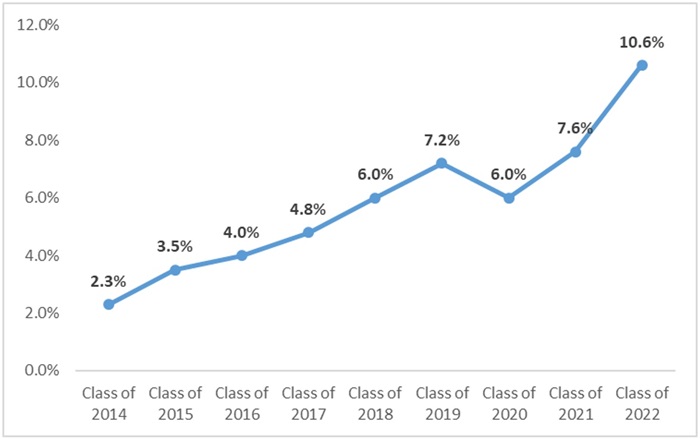
The increased attention on IRCs has pushed Ohio’s credential attainment rates upward in recent years. The figure below displays the percentage of students statewide meeting the twelve-point standard. Just 2.3 percent of the high school graduating class of 2014 met this IRC threshold, but that rate has risen to 10.6 percent for the class of 2022.

Figure 1: Credentialing rates for Ohio’s class of 2014 through 2022

IRCs in Ohio blog figure 1
Source: Ohio Department of Education and Workforce. Note: This chart displays the percentage of students in a high school graduating class (including both graduates and non-graduates) who earned at least twelve points in the state’s IRC system.

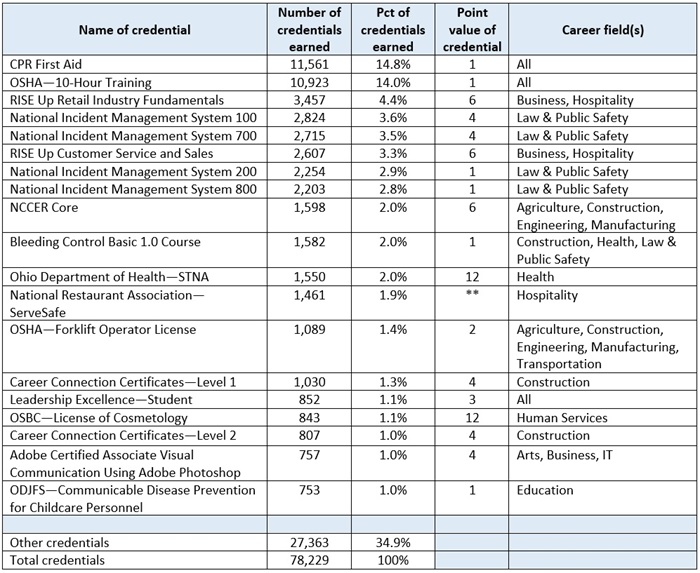
At first glance, this increase in credential attainment seems to be a good thing. But things get more interesting when we look at the specific credentials earned by Ohio students. Table 1 displays the most commonly earned IRCs by Ohio’s class of 2022 (keep in mind that students can earn more than one or none at all).

Table 1: Most commonly earned IRCs in Ohio, class of 2022

IRCs in Ohio blog table 1
Source: Ohio Department of Education and Workforce * Abbreviations: OSHA = Occupational Safety and Health Administration; NCCER = National Center for Construction Education Research; STNA = State Tested Nurse Assistant; OSBC = Ohio State Board of Cosmetology; ODJFS = Ohio Department of Jobs and Family Services. ** It’s unclear which Serve Safe credential (they have different values) is being reported.

In total, students earned more than 78,000 credentials, but nearly 30 percent were CPR and a basic OSHA worker safety course. Both of these credentials can be applied to all thirteen career fields, and neither demands a serious investment of time or effort from students. A CPR course, for instance, can be finished in just two hours, while the ten-hour OSHA course can be completed in as few as two days. Other commonly earned IRCs also appear to be easily attainable. The National Incident Management System 100 and 200 courses, which introduce students to emergency response systems, only takes two and four hours, respectively, and the Bleeding Control training is a mere hour and a half. The two RISE Up retail courses, which together yield twelve IRC points, can be completed in roughly twenty-five to thirty hours. One of them—the Industry Fundamentals course—even allows students to take an untimed, unproctored credentialing exam.

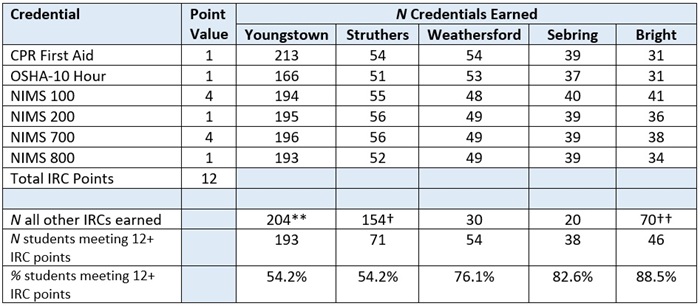
It may not be overly concerning if IRCs of more questionable value were being earned as part of a strong “core” career pathway that leads to more valuable credentials. But district-level data indicate that some students may be “bundling” lower-level IRCs to reach the twelve-point threshold for graduation. Table 2 displays the most-commonly earned IRCs for five of the six districts with the state’s highest IRC rates. In those locales, it seems that a relatively large number of students combined the CPR, OSHA-10 hour, and the various NIMS certificates to yield twelve IRC points in the Law and Public Safety career field.

Consider Youngstown where 193 students—54 percent of its graduating class, or five times the statewide average—met the twelve-point mark. Yet a sizeable proportion of those students likely did so by completing NIMS (totaling ten points), along with the CPR and OSHA certificates. To be clear, without finer-grained data, it’s impossible to know with certainty how many students achieved the twelve-point mark through this combination. But it must be noted that relatively few other credentials were earned in Youngstown—and most of those were of lower point values (only fourteen IRCs earned were worth nine or twelve points). Thus, there is little indication that students were “stacking” CPR or OSHA certificates on top of, say, a full-fledged, twelve-point EMT or firefighter certification. And it’s not just Youngstown, either; the data look similar in the other districts, as well.

Table 2: Most commonly earned IRCs in five districts with high credentialing rates

IRCs in Ohio blog table 2
* NIMS = National Incident Management System ** 101 of the other IRCs in Youngstown were the one-point Bleeding Control certificate, which may have represented the twelfth point for some students who did not earn the OSHA certificate. † 52 of the other IRCs earned in Struthers were the two six-point Rise Up retail certificates, which together would allow students to meet the twelve-point mark. †† 29 of the other IRCs in Bright were the one-point Bleeding Control certificate.

The overall picture of IRCs in Ohio gets murkier when one digs a bit deeper. Yes, credentialing rates are on the upswing. And yes, there are students earning serious credentials: in the class of 2022, for instance, 472 students earned twelve-point certifications in welding and 443 students did so in physical therapy aide. Yet students earning these more rigorous and career-specific credentials isn’t yet the norm.

There’s a lot of good that can come from IRCs. But state policymakers need keep their eye on the ball and ensure that state-approved IRCs promote rigor and mastery of technical skills. Doing so will ensure that Ohio’s IRC policy achieves its intended goal: helping more high school students gain the technical knowledge and abilities needed to pursue careers in skilled professions. 


[1] Completion of certain apprenticeship or state licensing programs also qualify for points. Note also that the list of credentials that apply for graduation and report cards is much larger than the more-selective list of credentials that qualify for IWIP.

[2] Schools could potentially receive credit through IRCs on the report card in two ways: (1) via higher graduation rates if credentials are used to meet graduation requirements and (2) via post-secondary readiness component, which while not currently rated for districts, is a rated element on the CTPD (i.e., career-tech provider) report card.

view
New classroom observation and assessment framework SR image

Looking at a new framework for classroom evaluations

Jeff Murray
11.14.2023
Ohio Gadfly Daily

Real time classroom observations by trained evaluators hold promise to accurately assess the quality of teaching and learning going on inside those four walls; an as-yet-untapped area of “education R&D”. But numerous roadblocks—lack of time and training, disagreement over rubrics, and teacher resistance among them—stand in the way of a systematized and smoothly-functioning assessment system. A group of researchers from Australia has developed a new framework that evaluates teacher and student engagement with course content that can be utilized while observing video-recorded lessons. A recent report explains their methods and describes the findings of its application.

The basis for the new teacher evaluation framework comes from the research of Michelene T. H. Chi, professor at the Mary Lou Fulton Teachers’ College at Arizona State University. Chi was a 2023 Yidan Prize winner for developing the ICAP (Interactive, Constructive, Active and Passive) theory of cognitive engagement to help understand how students learn.

A précis on ICAP’s four modes of engagement: “Passive” cognitive engagement is where learners are being oriented toward and receiving information from instructional materials, such as listening to a lecture or watching a video, without overtly doing anything observable related to more active learning. “Active” engagement requires focused attention while manipulating lesson materials or input—think underlining text or writing a summary of an essay. “Constructive” engagement refers to behavior that produces new ideas that go beyond the information given; students might relate new information to previous knowledge, generate inferences that are not explicitly stated in the text, or provide justifications that make the text or the problem solution more explicit. And “interactive” engagement is a group activity that meets two criteria: (a) the partners’ utterances must be primarily Constructive, and (b) the interaction must extend the generative nature of the prior contributions of the individual partners. In short, it’s a constructive-type engagement with a partner or two rather than the teacher.

Chi’s work argues three that there is a clear hierarchy among these four mode, with passive at the bottom and interactive at the top. Active engagement leads to stronger learning outcomes than passive, she says, because students engage with the material, relate it to prior knowledge, and store it in easily-retrievable ways. Constructive is better than active because students must provide explanations, raise critical questions, or complete other tasks that engage the highest levels of cognitive processing. And the interactive mode of engagement leads to the strongest learning outcomes because dialogue between learners can give rise to knowledge change processes and can create new knowledge that the partners could not have generated alone.

The Australian researchers devised an ICAP-based coding framework that distinguishes the four modes of cognitive engagement, provides reviewers clear operational criteria for defining the different modes when they observe them, and links the different modes to distinct learning outcomes. Best of all, the coding can be done using recorded lessons and transcripts, minimizing classroom disruption that can occur during live observation and maximizing the number observations a single reviewer can complete.

They watched and coded one thirty-minute video recorded lesson from twenty teachers from eight schools in the Greater Adelaide region of South Australia. All but one of the teachers taught in public schools, and all but one at the secondary level; each had more than five years of teaching experience. All had Bachelor degrees, and four also had master’s degrees. All of the teachers taught STEM-related subjects, including math, hard science (physics, biology, etc.), and soft science (psychology, health, etc.). Most schools were rated “less advantaged” via the socio-economic criteria used by the South Australian state government, including several landing at the most disadvantaged level (7 on a 1–7 scale). A few schools were on the “more advantaged” side of the spectrum, but no higher than a 4 on the scale.

The observers coded the lessons and tasks the teachers presented and assigned, as well as the verbal instructions they used in whole class directions, to determine which of the four areas of student cognitive engagement they utilized. Student actions, talk, and outputs were also examined to assess whether the actual mode of engagement that students displayed matched what was described in the teachers’ intentions for each lesson or task. Inter-rater reliability testing showed strong correspondence between different observers’ coding of lessons and tasks.

All together, the observers identified and coded seventy-six lessons and teacher-assigned tasks. Thirty-eight percent of those were active, 35 percent were passive, 13 percent were constructive, and 12 percent were interactive. Observed student engagement with the lessons and tasks—meaning the mode students were in, versus the mode teachers intended—was coded separately. But there was a high degree of correlation—except that students were observed in passive mode more often than any other, especially in the hard-science classes and in the less advantaged schools. In other words, some lessons and tasks designed to be active, constructive, or interactive instead produced passive student engagement.

The researchers deem all of this to be problematic for numerous reasons—including the possibility that it shows teachers who believe that engaging with difficult material is beyond the capabilities of certain students and are choosing to teach “downward” to an entire classroom based on that belief. However, their concerns are predicated on several questionable convictions. Such as that ICAP’s interaction hierarchy is gospel and that students cannot fully and properly understand, say, physics without a specific (and much higher than observed) percentage of constructive and interactive engagement with the material. Their basis for concern is also dependent on the observation of a single lesson, which is not able to account for the flow of a semester- or year-long course, no matter how accurate their coding instrument may be. Many such courses, especially in the hard sciences, typically start with introduction of new and unfamiliar material via lecture and progress to independent and group activities (experiments, reports, and the like) designed to demonstrate and reinforce the new concepts. For all we know, the very next lesson from those teachers, not observed or coded, would have flipped the engagement mode timing entirely around with a whole-class discussion or an entire class period of hands-on lab work.

It’s not a bad idea for teachers to understand how much time they spend in each mode—the observational framework does seem adequate to that purpose—and to provide advice and techniques for them to keep students meaningfully engaged as much as possible. But this research does not yet go far enough to actually prove how much passivity is occurring or whether it’s a problem no matter what that percentage turns out to be. More observation, coding (AI, anyone?), and analysis are minimum requirements.

SOURCE: Stella Vosniadou et al., “Using an extended ICAP-based coding guide as a framework for the analysis of classroom observations,” Teaching and Teacher Education (October 2023).

view

The effects of a virtual literacy-tutoring program

Jeff Murray
11.2.2023
Flypaper

Schools across America continue struggling to help their students catch up following unprecedented learning losses resulting from pandemic school closures beginning in March 2020. It is vital—both to address current needs and to stash away for future use—to determine which methods work to boost student achievement. To that end, a group of researchers, led by Stanford University’s Susanna Loeb, recently examined a high-dosage tutoring effort called OnYourMark, a fully virtual model designed to solidify foundational literacy skills for students in kindergarten through second grade.

The program features a high-quality curriculum informed by the science of reading with a focus on phonics, phonological awareness, and fluency. It includes four twenty-minute sessions per week in either one-on-one or two-on-one formats, regular progress monitoring, and two-week “lesson sprints” that use student data to target specific early literacy skills.

Although OnYourMark currently serves more than 1,400 students across multiple states, the study focuses on how a single charter management organization used the program in twelve Texas schools during the 2022–23 school year. In each school, building-level staff first selected the students who were most in need of academic help (approximately ten per building), and these were given guaranteed access to limited tutoring slots. These 121 students are thus excluded from the study sample, as their enrollment in tutoring was not determined by random assignment. The remaining students in grades K–2 were randomly assigned to available slots in one-on-one tutoring (N=510), two-on-one tutoring (N=570), or a control group (N=1,005) that generally received only regular classroom instruction. Participating students received tutoring in their classrooms from online tutors. A small number of control group students did cycle into tutoring during the year if a slot became available, but they remained in the control group for purposes of the study.

Student performance data come from end-of-year DIBELS testing for basic literacy skills and NWEA MAP testing for reading fluency. Administrative data for comparison include student demographics, school attendance rates, and prior test performance.

At the highest-/simplest-level of analysis, all students assigned to OnYourMark tutoring did better than their control group peers, scoring approximately 0.08 standard deviations (SD) higher on end-of-year early literacy tests. The researchers then break down the overall findings across numerous individual variables. For just two statistically significant examples: Kindergartners benefitted from treatment more than students in other grade levels, and prior low-performers benefitted more than prior high-performers. Additionally, participation in the one-on-one tutoring mode boosted test performance more than did participation in two-on-one mode.

The researchers then combine several variables to find that maximal treatment effects accrued to first graders assigned to one-on-one tutoring (0.19 SD over their control group peers) and to prior low-performers in one-on-one tutoring (0.18 SD).

The research team concludes that the virtual effort appears less effective than in-person tutoring of similar quality and intensity, based on their review of prior research. However, the positive impacts of virtual tutoring compared to no tutoring are also apparent. High-quality and in-person high-dosage tutoring is definitely an effective tool to help students recover from pandemic learning loss. But in locations where in-person options are not available at scale, these positive findings should give school leaders and parents some confidence that a well-designed virtual program can be part of the solution.

SOURCE: Susanna Loeb et al., “The Effects of Virtual Tutoring on Young Readers: Results from a Randomized Controlled Trial,” National Student Support Accelerator (October 2023).

Fordham Logo

© 2026 The Thomas B. Fordham Institute
Privacy Policy
Usage Agreement

National

P.O. Box 110
Burke, VA 22009

202.223.5452

[email protected]

Ohio

P.O. Box 82291
Columbus, OH 43202

614.223.1580

[email protected]

Sponsorship

130 West Second Street, Suite 410
Dayton, Ohio 45402

937.227.3368

[email protected]