Mobile Navigation

  • National
    • Policy
      • High Expectations
      • Quality Choices
      • Personalized Pathways
    • Research
    • Commentary
      • Gadfly Newsletter
      • Flypaper Blog
    • Events
    • Scholars Program
  • Ohio
    • Policy
      • Priorities
      • Media & Testimony
    • Research
    • Commentary
      • Ohio Education Gadfly Biweekly
      • Ohio Gadfly Daily
  • Charter Authorizing
    • Application
    • Sponsored Schools
    • Resources
  • About
    • Mission
    • Board
    • Staff
    • Career
Home
Home
Advancing Educational Excellence

Main Navigation

  • National
  • Ohio
  • Charter Authorizing
  • About

Ohio Menu

  • Topics
    • Accountability & Testing
    • Advanced Education
    • Career & Technical Education
    • Charter Schools
    • Curriculum & Instruction
    • ESSA
    • Evidence-Based Learning
    • Governance
    • Personalized Learning
    • Private School Choice
    • School Finance
    • Standards
    • Teachers & School Leaders
  • Research
  • Policy
  • Commentary
    • Ohio Gadfly Newsletter
    • Ohio Gadfly Blog
    • Events

The Education Gadfly Weekly

Sign Up to Receive Fordham Updates

We'll send you quality research, commentary, analysis, and news on the education issues you care about.
Thank you for signing up!
Please check your email to confirm the subscription.

Ohio Gadfly—Getting career planning right

Volume 18, Number 10
5.7.2024
5.7.2024

Ohio Gadfly—Getting career planning right

Volume 18, Number 10
view
Career plans blog image
School Funding

Getting career planning right

One of the hallmarks of Governor DeWine’s administration has been its emphasis on expanding and improving career pathways for students. Thus, it came as no surprise that the governor focused on this critical issue in his recent state of the state address.

Jessica Poiner 5.7.2024
OhioOhio Gadfly Daily

Getting career planning right

Jessica Poiner
5.7.2024
Ohio Gadfly Daily

Great menus for great meals: Providing vetted curriculum options for every palate

Jocelyn Pickford
4.29.2024
Ohio Gadfly Daily

When public schools keep certain students out—or make them pay to attend

Jude Schwalbach
4.30.2024
Ohio Gadfly Daily

Information sources, data quality, and parental school choice

Jeff Murray
5.7.2024
Ohio Gadfly Daily

How some schools are changing staffing styles due to shortages

Jeff Murray
5.2.2024
Flypaper
view
Pickford blog repost image

Great menus for great meals: Providing vetted curriculum options for every palate

Jocelyn Pickford 4.29.2024
Ohio Gadfly Daily
view
Schwalbach blog repost image

When public schools keep certain students out—or make them pay to attend

Jude Schwalbach 4.30.2024
Ohio Gadfly Daily
view
Campos parent choice SR image

Information sources, data quality, and parental school choice

Jeff Murray 5.7.2024
Ohio Gadfly Daily
view
School administrators and teachers meeting

How some schools are changing staffing styles due to shortages

Jeff Murray 5.2.2024
Flypaper
view
Career plans blog image

Getting career planning right

Jessica Poiner
5.7.2024
Ohio Gadfly Daily

One of the hallmarks of Governor DeWine’s administration has been its emphasis on expanding and improving career pathways for students. Thus, it came as no surprise that the governor focused on this critical issue in his recent state of the state address. After noting that state law currently requires schools to help every student develop a plan for how they will meet graduation requirements, DeWine called on the legislature to “make a very simple fix in statute to insert career planning into existing graduation plan requirements.”

The state law the governor is referring to mandates that every student in grades nine through twelve have a graduation plan that maps their academic pathway to a diploma. Each pathway includes meeting course requirements, specified by both the state and district, and graduation requirements, which are the purview of the state. Plans are developed by the student and a school representative and must be updated each year until the student graduates.

The Department of Education and Workforce (DEW) has created a template for graduation plans. Districts aren’t required to use it, but it does serve as a model for what the state expects plans to contain. It’s worth noting that although the template asks students to identify their career field interests and their post-high school goals, neither section requires much in the way of engagement or in-depth thought from students. Likewise, other than a blank space to fill in “supports needed to achieve this goal,” nothing much is asked of schools, either.

This is likely where the governor sees an opportunity. If graduation plans are going to be truly beneficial for students, then surface-level, fill-in-the-blank career planning needs to be replaced with in-depth and impactful career advising. The solution to this problem seems simple. Just require districts to offer career advising to students. But here’s the twist: Ohio already requires districts to provide students in grades 6–12 with career advising. In fact, the statutory requirements for graduation plans explicitly state that they must “supplement a school district’s policy on career advising.” Even more surprising is the fact that career advising policies have been required under state law since the 2015–16 school year.

So what is the governor asking the legislature to do? It seems that he’s asking them to more clearly align the graduation plan statute with the one governing career advising. Rather than requiring graduation plans to “supplement and enhance the school or district’s policy on career advising,” he seems to be suggesting that state law should mandate that a student’s graduation plan incorporate and include the results of career advising experiences.

That’s a good start. But lawmakers should consider going further and update the career advising law, as well. Nearly a decade after first requiring districts to adopt a career advising policy, there still appears to be far too many students whose experiences are limited to box-checking exercises rather than in-depth exploration and consistent support. Whatever schools are currently doing, it’s not working for too many kids.

Although there are plenty of ways to improve the status quo, lawmakers should consider adding the following requirements to state law.

1. Require students to complete a career exploration course in middle school.

It’s critical that students be given the opportunity to explore each of Ohio’s career fields and the educational pathways that lead into those fields. It’s equally important that they are provided with this opportunity in middle school, so that they have a better idea of which courses—traditional academic, career-technical, or both—they want to take in high school. For example, students who know that they’re interested in cybersecurity or manufacturing prior to their freshman year will have far more time to complete the pathway courses identified by the state, participate in work-based learning, and earn industry-recognized credentials than students who don’t discover their interests until later in high school.

As for the career exploration courses themselves, they should be co-planned by the district and representatives from the district’s CTPD and Business Advisory Council. Course content should cover each of Ohio’s career fields, including available jobs within each field; the training (and training costs) required to obtain those jobs; salary ranges; Ohio regions where each field or job is most in demand; and projected job growth. Students should also be required to complete at least one aptitude or interest survey/assessment during the course. Districts should be free to decide whether to take advantage of state-provided tools to meet this requirement, or choose to utilize other options, like YouScience.

2. Require students to develop a career pathways plan at the conclusion of their career exploration course.

Using what they’ve learned over the duration of the course, students should complete a career pathways plan. As part of this plan, students should select at least one career field they intend to pursue, list specific jobs they’re interested in, and identify the courses or credentials they will need to complete in high school (or beyond) to be prepared for those jobs. Family engagement is crucial, so a parent or guardian should have to sign off on the plan before it can be considered complete. To ensure that students get a robust planning experience, legislators could set aside funds and create an RFP that allows nonprofits and other organizations with expertise and experience in the career planning space to take on the responsibility of helping students craft their plans. This would give students access to professionals with a broad knowledge base and could lighten the load for districts.

3. Require districts to incorporate students’ career pathways plans into their graduation plans.

With the above changes in place, every ninth-grade student would walk into their high school with a career plan. This opens the door for lawmakers to put the governor’s idea into action by mandating that districts use those career plans to help students draft their graduation plan. The most important thing is that students would be able to make informed decisions about which courses and programs to pursue in high school. But this could also lighten the load for school counselors, who would go from working with students who have little to no knowledge of their options and interests, to working with students who already have a solid plan in place.

To ensure that students aren’t stuck following a career plan that no longer matches their interests, districts should be required to assist students with formally updating their career plans twice during high school—once at the conclusion of freshman year, and again at the conclusion of junior year. This update requirement shouldn’t be an additional burden on districts, as they are already required to update graduation plans yearly. Updating career plans could be included in that process. However, districts should also be required to permit students to alter their plans whenever they request to do so.

4. Audit districts’ career planning efforts.

Quality career planning is essential to the success of the state’s career pathways efforts and hugely important for students’ futures. As such, lawmakers should make the creation of robust career plans for middle school students, as well as the biannual updates mentioned above, a condition for districts to receive career-focused funding. Furthermore, either the auditor of state or DEW should be charged with annually reviewing a random sample of career plans from randomly-selected districts. If plans aren’t up to the state’s standards, funding for their career education programs could be reduced or—in extreme cases—taken back entirely. Taken together, these measures should help ensure that districts take their career planning responsibilities seriously.

***

Governor DeWine is right that career planning should be a bigger part of students’ graduation plans. But in order for that planning to be beneficial, students need an opportunity to explore all their options so they can make informed decisions. Districts, meanwhile, need to up their game. Despite the fact that career advising policies have been required for nearly a decade, there are still far too many students who graduate with no clue how to pursue their interests or even what they’re interested in. It’s time for Ohio to boldly rethink career advising and graduation planning. The recommendations outlined above offer a path to do so. 

view
Pickford blog repost image

Great menus for great meals: Providing vetted curriculum options for every palate

Jocelyn Pickford
4.29.2024
Ohio Gadfly Daily

In addition to my passion for all things curriculum policy, I’m also a fervent foodie. When we eat out, I’m reminded of how my husband and I have very different palates. My go-to’s are seafood and pasta while he’s more of a meat and potatoes guy. Ordering off a menu, we’ll choose very different things and have totally different experiences—even though our food is coming from the same source. My best restaurant experiences have come from knowing the menu is thoroughly vetted by the chef and, while I may prefer one item over another, there are no bad options.

In its best-case scenario, curriculum adoption and implementation is like choosing from a well-vetted menu. The definition of quality and capacity depends largely on the consumer, though we can all agree to some universal characteristics. No one wants contaminated ingredients a chef would reject, just like no one should want to use instructional materials that lack an evidence base endorsed by educators. Someone who comes to the table depleted from a 10-mile run will have a much larger appetite than someone who’s been snacking all day, just like districts with outdated materials and professional learning practices will need more support than those looking for supplements to existing strong programs.

We hear a lot of debate about what makes curriculum “high-quality” and who gets to make that determination. Quality is a critical consideration for any program, but we can sometimes get caught up in differences of opinion on which choice is right for which context. Advocating for high-quality materials isn’t about choosing a district’s meal for them; it’s about giving educators access to a menu of vetted options so that they can select what works best for their unique context.

Fortunately, the landscape of curriculum options—and information about their quality—has improved significantly over the past decade-plus. The ingredients have expanded to cover the nuances of instruction in areas like structured literacy and three-dimensional science concepts. Thanks to EdReports, districts and states can come to the table knowing which options appropriately address grade-level standards, include additional dimensions of quality such as supports for multilingual learners, and whether the programs facilitate student learning and enhance a teacher’s ability to differentiate and build knowledge.

The situation unfolding in Ohio offers one look at how the menu matters. Last year, the state passed a sweeping science of reading law, which included a requirement that schools use high-quality instructional materials and allocated $64 million to cover new purchases. In February, Ohio released the results of a survey of the state’s curriculum landscape to better understand the changes needed to comply with the law. The survey shows real challenges Ohio’s districts will have to address. Nearly half will likely need to change their elementary reading program, and it will take much more than adopting a stronger curriculum to realize more effective instruction. These districts will also need to equip teachers with curriculum-aligned training and customize the programs to effectively serve their unique populations.

So far, much of the conversation about this work has focused on the specific offerings included in Ohio’s near-final list of approved curricula that districts will choose from. In my view, the list establishes a new and welcome baseline of quality. All the materials on Ohio’s menu come with strengths and challenges—no program is perfect and each requires human touch—but all are better than using outdated or unreviewed materials. Further, the menu options are just the beginning. From here, the critical work of how districts and teachers implement their choices really begins.

When it comes to efficacy—evidence on how well the curriculum works for students and teachers—knowing what to select from Ohio’s (or any state’s) menu gets murkier. One reason for this is that it’s very hard to find independent studies of any program’s efficacy across multiple contexts. Many studies are sponsored by the publishers themselves, and others look within just one school or district. Independent studies are expensive and can take years to complete—and even when they’re done, can produce inconsistent results. A recent study of more than 10 clearinghouses that evaluate educational program effectiveness finds, “Of all the educational interventions considered here [1,359], only 17 percent were rated by more than one clearinghouse. So, stakeholders interested in learning about the consequences of a specific education program will usually have no choice about which clearinghouses to use or prefer; they must accept whatever is available and the assumptions/standards that go with it.”

While efficacy studies are important to consider for curriculum adoption, depending on the ingredients at hand, design of the kitchen, and skill of the chef, the same recipe can lead to different results. You can serve two people the same dish cooked to perfection and get radically different reactions based on their preferences. The effectiveness of any set of materials depends on whether it was selected for the unique student population in the district and whether teachers are equipped with sustained professional learning and communities of practice.

I applaud Ohio for embracing a state role in offering a vetted menu of curriculum options while trusting teachers to cook up the meals their students need. As other leaders think about tools for assessing curriculum quality and efficacy, they’d be wise to remember the mission: getting better materials into teachers’ hands and equipping them with the ongoing professional learning they need to offer students the education they deserve.

This piece was originally published in CurriculumHQ’s Curriculum A-B-C Blog.

Jocelyn Pickford is an education policy and communications specialist focusing on understanding and promoting practitioner-informed public policy across the private, public, and non-profit sectors as a Senior Affiliate with HCM Strategists.

view
Schwalbach blog repost image

When public schools keep certain students out—or make them pay to attend

Jude Schwalbach
4.30.2024
Ohio Gadfly Daily

This story was produced by The 74, a non-profit, independent news organization focused on education in America. Reposted by permission.

Imagine a situation where it’s easier for families to enroll their children in some private schools than in some public schools. This is true for Ohio students, especially those from low-income families.

As of this school year, most of the state’s families became eligible for EdChoice Scholarships. This means that any Ohio student can access public funds to pay for tuition at one of 462 participating private schools in the state.

However, the scholarship can’t be used at public schools, and because of loopholes in Ohio’s open enrollment laws—which are supposed to allow students to transfer to public schools outside their residential zone—many of the state’s highest-ranked public schools remain out of reach for most children.

For instance, 35 of Ohio’s 97 five-star-rated school districts have chosen not to participate in open enrollment, making them inaccessible to students who don’t live within their boundaries.

Often, the only way for students to access these highly ranked public schools is to move. This is easier said than done, since the cost of public schooling is often hidden in expensive mortgages or rents.

In Ohio, the median home sale price in January 2024 was $215,300, requiring an annual household income of about $64,000 to obtain a typical mortgage. Yet home sale prices in non-participating five-star districts averaged nearly $351,000, according to data collected by Niche, a platform that gathers information on school districts.

For instance, in the five-star Indian Hill Exempted Village School District, the median home sales price is more than $1.1 million. Numbers like these make districts like Indian Hill, and their top-quality schools, effectively off limits to middle- and low-income families.

Currently, 107 of Ohio’s 658 public school districts don’t participate in open enrollment. The Ohio Department of Education & Workforce awarded 52 percent of them four or five stars in student achievement on the state’s Performance Index for the 2022-23 school year, based on statewide exam scores. Notably, these non-participating districts include 22 of the top 50 in the state.

Some of them could likely accommodate transfer students, since K-12 enrollment statewide declined by 5.3 percent—a loss of nearly 81,000 students—between the 2018-19 and 2023-24 school years. For instance, the highly rated and non-participating Beachwood City and Tipp City school districts saw their enrollment decrease by 8 percent and 7 percent, respectively.

Without strong open enrollment laws, these districts can continue to shut out students who could fill those empty seats. However, there is one way for families to get their kids into some of these districts without moving: They can buy their way in.

Under Ohio law, school districts that opt out of the state’s open enrollment program can charge tuition to transfer students at a rate equal to or less than an amount established annually by the state Department of Education. Of the 107 districts, a Reason Foundation investigation found that 22, or 21 percent, charge public school tuition to non-resident students. Another 46 allow district employees who live outside the zone to enroll their kids for a fee.

Ohio Public School Districts’ Annual Tuition Rates Charged to Transfer Students:

In some cases, these districts operate more like private schools than public schools, because admission is often at the superintendent’s discretion. For instance, Northmont requires that applicants have at least a 3.0 grade-point average. Other districts, such as Centerville City, permit tuition-based transfers, but only for children of their teachers.

Of the districts charging tuition, the average fee is about $11,000 per student per school year, the Reason Foundation investigation found. That’s $11,000 annually to attend a supposedly public school. At least 12 districts charge $10,000 per transfer annually, while nine districts charge less.

By contrast, private schools in Ohio charge about $7,900 in tuition, on average. Most families can use EdChoice Scholarships to cover $6,000 at participating private schools, but these scholarships cannot be used to pay tuition at public schools. This means private school tuition can be more affordable than some public schools.

When school districts can sell their seats they lose their democratic qualities and become de facto private schools. Public schools should be free to all students, not just those whose families can afford to live there—or pay.

Jude Schwalbach is an education policy analyst at Reason Foundation and author of the report “Public schools without boundaries,” which analyzes every state’s K-12 open enrollment policies.


view
Campos parent choice SR image

Information sources, data quality, and parental school choice

Jeff Murray
5.7.2024
Ohio Gadfly Daily

Los Angeles Unified School District’s Zones of Choice (ZOC) program began in 2010 as an effort to provide more high school options for a large swath of district eighth graders, combining historical catchment areas in lower-income and lower-performing neighborhoods into larger choice zones and eliminating the default feeder system from middle to high school. ZOC has proven to be an excellent model for researching the positive academic impact of choice. But as a new report published by MIT’s Blueprint Labs shows us, it is also good for examining how parental preferences are shaped.

University of Chicago researcher Christopher Campos conducts a detailed, multi-stage analysis to go beyond the simple “revealed preferences” model typical of school choice research and really tease out what—and who—parents are responding to when they rank their preferred schools. The initial data come from ZOC information and application periods in fall 2019 and fall 2021. (LAUSD spent most of the 2020–21 school year in either full or partial virtual learning; ZOC was functional but highly disrupted.) Approximately 13,000 eighth graders attended a ZOC middle school in each application year under study. Fully 90 percent of ZOC-eligible students were Hispanic (compared to 64 percent in the district as a whole), and 94 percent were classified as low income. The typical ZOC student was entering high school performing roughly 22 percent of a standard deviation behind their typical non-ZOC peer on both math and reading tests. In short, these are exactly the students who stand to benefit most from having access to better options through ZOC.

Campos’s methodology is dense and multi-faceted and defies easy summary. On the school side, he constructs measures of school quality (based on numerous academic factors) and peer quality (that is, the composition of students in receiving high schools according to their individual academic achievement). On the family side, he surveys parents of eighth grade ZOC students prior to them submitting their ranked choice lists for high school in order to determine their beliefs about school and peer quality compared to the actual rankings he devises. On the information side—the real innovation here—Campos constructs a protocol to vary the type and amount of direct information that families receive about school and peer quality for all the schools from which they can choose. This is compared to information received from other families and through other informal sources. Finally, he compares all that pre-choice information to the final options selected, the high schools ultimately attended, and (icing on the cake) the outcomes for ZOC students based on the new understanding of the choices and how they are made.

The results of all these layers of interrelated analyses are also very detailed. Pre-choice survey data show that families tended to underestimate schools’ academic quality, overestimate their peer quality, and that their estimates were least accurate regarding schools they preferred the least. All of these tendencies combined to induce what the report calls “mistakes” on ZOC applications. That is, in a scenario without these biases—pure information about school and peer quality—his models show that parents would rank schools differently. However, families are motivated to choose by the information they receive, right or wrong. Families who received more information, especially those who received it directly from Campos, chose higher-quality schools; those who did not receive direct information but heard about school quality from their Campos-informed neighbors also chose higher-quality schools. It’s not as simple as a quick summary makes it sound, but overall, Campos writes, “the experiment provides robust evidence that when properly informed, families make choices in a way that is consistent with rewarding effective schools and that social interactions are important mediators governing changes in demand.” In previous research, he has noted that ZOC is nearly ideal at offering enough options without overwhelming parents and at providing them with the highest-quality information possible.

While the ultimate aim of this research project is to determine whether ZOC students fare better in their chosen high school, outcome data are limited at this time. Only the 2019 cohort had reached eleventh grade state testing when this analysis was being done, and Campos believes pandemic-mitigation school closures “severely interfered with [their] educational experience.” As a result, no impact of ZOC choices on their test scores was observed. However, survey data showed significant improvements in students’ reported happiness in school, interpersonal skills, school connectedness, and academic effort for the 2019 cohort. Incidents of bullying were also down. These same improvements were reported—at even higher levels—for the 2021 cohort. Campos specifically notes that the academic effort index he constructed from survey responses is more than ten times higher for the 2021 ZOC cohort than the boost reported by the earlier group. He feels it bodes well for an observable test score increase when those students reach eleventh grade, but only time will tell for sure.

Overall, this research—as in-depth and pathbreaking as it is—is not conclusive except to say that parental school preferences are influenced by the information they receive, both from official and unofficial sources. Schools (and indeed policymakers) who are serious about helping families make the best possible educational choices must provide thorough, clear, and digestible information directly to families prior to any application or ranking of schools.

SOURCE: Christopher Campos, “Social Interactions, Information, and Preferences for Schools: Experimental Evidence from Los Angeles,” MIT Blueprint Labs (April 2024).

view
School administrators and teachers meeting

How some schools are changing staffing styles due to shortages

Jeff Murray
5.2.2024
Flypaper

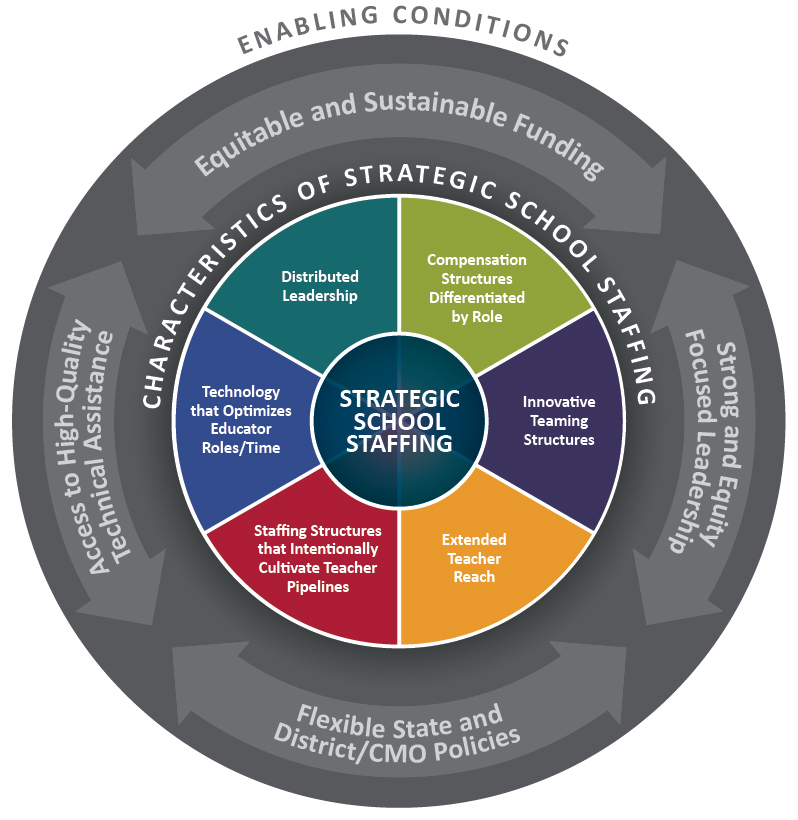
While it seems likely that the end of ESSER funding in September will engender a(nother) seismic shift in the school staffing conversation, education leaders are—for the moment—still talking about teacher shortages, long-term vacancies, hard-to-staff specialties, burnout, dissatisfaction, and attrition. On top of that, they seem interested in talking about how they’ve staffed their schools in light of these realities. A new report from the Center on Reinventing Public Education (CRPE) synthesizes lessons learned from dozens of interviews of school leaders practicing what is termed “strategic staffing.”

At its base, “strategic staffing” is about moving away from the traditional one teacher, one classroom model and implementing strategies like establishing new pathways into the teaching profession, creating new structures for differentiated professional development and pay scales, and rethinking the daily work of teachers and support staff.

CRPE analysts interviewed forty-two leaders (principals, superintendents, etc.) and technical assistance providers working in six different school systems. All the systems are anonymous in this write-up and little description or differentiation is provided, except to say that the list includes both traditional districts and charter management organizations, and that some systems are in right-to-work states, while others are in collective-bargaining states. Interviewees were already well-versed in the tenets of strategic staffing, and were able to answer researchers’ questions regarding the origins and growth of their models, their implementation efforts, stakeholder support and opposition, barriers and enabling factors, and outcomes.

The analysis does not say when the interviews were conducted, though most leaders report that they’d been implementing strategic staffing for “more than three years” at the time of the interview. Several leaders report using federal Covid-relief funds to support their strategic efforts, though that’s not the only funding source noted, and there is no specific discussion of pandemic-era staffing. The overwhelming sense is that these new protocols for recruiting, deploying, supporting, and retaining talent are responses to persistent staffing concerns that predate the pandemic.

The report identifies seven strategies that two or more of the systems have implemented. The most common are creating new teacher leadership roles (which enable teachers to advance in their careers without leaving instruction) and personalized teacher development (defined as providing opportunities that support leadership development as well as teachers’ daily work and personal growth). Other common strategies were redesigned schedules and workloads, broadened recruitment programs, and additional compensation for staffers who take on additional responsibilities or exhibit strong performance. Every system covered in the report was implementing at least three non-traditional staffing strategies, with one system reporting five simultaneous efforts. Leaders explained in their interviews that they believed no one strategy by itself would adequately move the needle on staffing concerns, and that they were working to implement everything they could.

The bulk of the CRPE report discusses challenges, both big and small, that leaders faced in their efforts to make changes. The most frequently-cited—and most difficult to overcome—emerge from the codified aspects of traditional education models. For example, teacher licensure requirements limit who can be recruited to teach and which classes/subjects can be covered by any given teacher; class size requirements complicate team teaching efforts; state-mandated pay scales often forbid bonuses to incentivize teachers to take on new/additional roles; and collective bargaining agreements contain myriad ironclad clauses and requirements based on the oldest of old-school teaching models.

Some leaders, however, offered anecdotes of hope. For example, one system found that union leaders were willing to be more flexible than expected in their interpretation of contract terms, and another discovered that a longstanding district “policy” regularly cited as the reason they couldn’t hire part-time paraprofessionals didn’t even exist! But these fortuitous outcomes weren’t the norm. Policies and prohibitions that looked like roadblocks to change generally were just that.

Leaders also reported another category of potential barriers that were ultimately more permeable. These include inflexible data systems that, in one example, only track student outcome data (attendance, test scores, discipline, etc.) for a single-teacher classroom structure; creating a master schedule for all teachers and support personnel to accommodate new forms of collaboration; HR and other central office staff resistant to changes in recruiting, hiring, and training of teachers; and school-level processes, such as how students are assigned to teachers at the beginning of the grading period, semester, or year. These, leaders say, can be overcome with enough effort and buy-in from staff.

In the end, this report is more about starting points than results. For example, the authors write: “Because of sampling limitations and our reliance on leaders’ recollections and self-reports, the findings do not represent the full breadth of leaders’ experiences, nor the chances that other leaders may encounter similar experiences.” Translation: School systems—while often bound by similar rules, traditions, and norms—are staffed by individuals whose devotion to those strictures can vary widely. “Further,” the authors add, “we do not claim a causal relationship between the strategic school staffing initiatives and the leaders’ reported efficacy.” This is an important caveat because there is really no efficacy information provided at all. Did these six school systems fully solve their staffing issues with what often sound like Herculean (and sometimes Sisyphean) efforts? No idea. And even if they did, how are their students faring in the wake of the changes they were able to make? Again, no clue. It makes sense to think that schools and their students in 2024 might benefit from a refresh of the staffing style of the previous hundred years. But this report is more about compiling a roster of possible ideas than proving their effectiveness.

SOURCE: Lisa Chu, Lydia Rainey, and Steven Weiner, “‘So hard, but so rewarding’: How school system leaders are scaling up strategic school staffing models,” Center on Reinventing Public Education (March 2024).

Fordham Logo

© 2026 The Thomas B. Fordham Institute
Privacy Policy
Usage Agreement

National

P.O. Box 110
Burke, VA 22009

202.223.5452

[email protected]

Ohio

P.O. Box 82291
Columbus, OH 43202

614.223.1580

[email protected]

Sponsorship

130 West Second Street, Suite 410
Dayton, Ohio 45402

937.227.3368

[email protected]