Mobile Navigation

  • National
    • Policy
      • High Expectations
      • Quality Choices
      • Personalized Pathways
    • Research
    • Commentary
      • Gadfly Newsletter
      • Flypaper Blog
    • Events
    • Scholars Program
  • Ohio
    • Policy
      • Priorities
      • Media & Testimony
    • Research
    • Commentary
      • Ohio Education Gadfly Biweekly
      • Ohio Gadfly Daily
  • Charter Authorizing
    • Application
    • Sponsored Schools
    • Resources
  • About
    • Mission
    • Board
    • Staff
    • Career
Home
Home
Advancing Educational Excellence

Main Navigation

  • National
  • Ohio
  • Charter Authorizing
  • About

Ohio Menu

  • Topics
    • Accountability & Testing
    • Advanced Education
    • Career & Technical Education
    • Charter Schools
    • Curriculum & Instruction
    • ESSA
    • Evidence-Based Learning
    • Governance
    • Personalized Learning
    • Private School Choice
    • School Finance
    • Standards
    • Teachers & School Leaders
  • Research
  • Policy
  • Commentary
    • Ohio Gadfly Newsletter
    • Ohio Gadfly Blog
    • Events

The Education Gadfly Weekly

Sign Up to Receive Fordham Updates

We'll send you quality research, commentary, analysis, and news on the education issues you care about.
Thank you for signing up!
Please check your email to confirm the subscription.

Ohio Gadfly Biweekly--Volume 11, Number 18

Volume 11, Number 18
8.7.2017
8.7.2017

Ohio Gadfly Biweekly--Volume 11, Number 18

Volume 11, Number 18
view
Quality Choices

Ohio’s charter sector continues to contract, and here’s why that’s worrisome

The big squeeze continues. Ohio’s charter sector shrinks again as reforms enacted in 2012 and 2015 are fully implemented. The Buckeye State will see a record-low number of new charter schools open this fall, a slow-down that persists for the third year in a row.

Jamie Davies O'Leary 8.7.2017
NationalBlog

Ohio’s charter sector continues to contract, and here’s why that’s worrisome

Jamie Davies O'Leary
8.7.2017
Blog

On poverty: Coming to our senses

Jeff Murray
8.7.2017
Blog

Illiteracy in Ohio: Where does the buck stop?

Madison Yoder
8.7.2017
Blog

Surprise: Some schools are better than others

Jeff Murray
8.2.2017
Flypaper

More than just numbers: Policy implications of the latest CREDO charter study

Jamie Davies O'Leary
7.26.2017
Blog

Kasich keeps Ohio teacher residency program

Jessica Poiner
7.31.2017
Ohio Gadfly Daily
view

On poverty: Coming to our senses

Jeff Murray 8.7.2017
Blog
view

Illiteracy in Ohio: Where does the buck stop?

Madison Yoder 8.7.2017
Blog
view

Surprise: Some schools are better than others

Jeff Murray 8.2.2017
Flypaper

view

More than just numbers: Policy implications of the latest CREDO charter study

Jamie Davies O'Leary 7.26.2017
Blog
view
RESA blog image fix

Kasich keeps Ohio teacher residency program

Jessica Poiner 7.31.2017
Ohio Gadfly Daily
view

Ohio’s charter sector continues to contract, and here’s why that’s worrisome

Jamie Davies O'Leary
8.7.2017
Blog

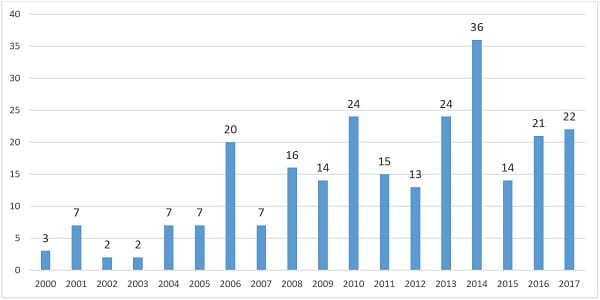
The big squeeze continues. Ohio’s charter sector shrinks again as reforms enacted in 2012 and 2015 are fully implemented. The Buckeye State will see a record-low number of new charter schools open this fall, a slow-down that persists for the third year in a row. Meanwhile, twenty-two schools shut at the end of the 2016-17 school year, the fourth highest number in Ohio’s almost twenty-year charter history. A handful of law changes essentially have accomplished what decades of “self-policing” among authorizers could not: Authorizers have been forced to act more judiciously when determining who should be allowed to start a school and what it takes to keep a school open.

While we are encouraged to see that Ohio’s charter sector has become more quality focused, contraction of the sector alone won’t deliver great options for kids who desperately need them. These numbers point to a worrisome lack of capacity in the state around launching new schools and replicating high-quality models—a situation that warrants attention and action. Let’s take a quick look at the data.

Closures

Twelve of the twenty-two charter schools that closed their doors this June were overseen by traditional public school districts. This provides further evidence that the traditional public school establishment has played its own role in Ohio’s past charter quality issues, despite broad-sweeping anti-charter statements that would prefer to conceal this fact. (For example, an Innovation Ohio analysis of the failures of Ohio’s federal start-up grant winners overlooked the fact that over 40 percent of failed grant recipients were district-run charter schools.) All of the state’s poorly rated sponsors this past year were districts; all of those that have since closed or are going out of business are district authorizers. Maybe someone should tell Randi Weingarten and the NAACP, who have called for all charters to be overseen by districts, that district authorizers have their own quality-control issues.

Graph 1: Ohio charters closed each year

Source: Ohio Department of Education, Closed Community School Directory and updated 2017 closure list from ODE

Here are a few other facts about this year’s closures:

  • One of the closures was a statewide e-school.
  • Two schools were considered closed because of a “merger,” thus not really shuttered so much as absorbed into an existing school.
  • Eight of the closures were dropout recovery schools.
  • Nine were closed at least in part because of sponsor quality issues and/or because their sponsor planned to cease operations
  • Thankfully, none of the closures occurred mid-year.

New school openings

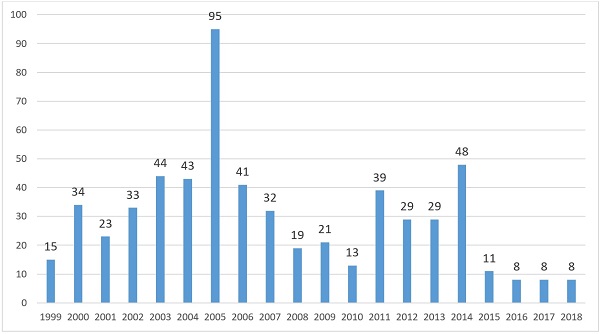
In the aggregate, Ohio authorizers are allowing far fewer schools to open. The state has good company in this respect; fewer charter schools are opening nationwide, apparently because fewer groups are applying for charters. Yet Ohio’s steep decline is surely also attributable to authorizers becoming much choosier. That is by design. Blatant financial incentives to start schools regardless of quality—such as the ability to sell services to said schools—were removed under the recent reforms, and authorizers now face stringent evaluations that weight the academic performance of their schools as a third of their overall rating. Graph 2 shows that for the third year in a row, just eight new charter schools are slated to open this fall. The number for school year 2017-18 come from ODE’s recently released list of possible new schools. If past years are any indication, the actual final total will likely be smaller and represent an all-time low for Ohio. 

Graph 2: Number of new charter schools opening each year (fiscal years)

Sources: Historical data come from ODE’s annual community schools report. The opening number for 2017 (fiscal year) was arrived at by examining ODE’s summer 2016 list of potential new charter schools, then checking Ohio’s community school payment reports to see which schools received funding in the fall of 2016. The number for 2018 comes from ODE’s current list of “possible” new charter schools for the 2017-18 school year.

With an evaluation system encouraging authorizers to act more cautiously, it’s safe to say Ohio has dramatically reduced the likelihood of a year like 2014 when a massive number of newly opened schools closed mid-year, displaced students, and helped crystallize just how bad Ohio’s quality problem had become. In that sense, Ohio’s slow-down could be viewed as a success. However, there are several more questions worth asking and finding answers to:

  • What do we know about the quality of the schools that are opening? For 2017-18, at least two of the eight to open are replications of very high-performing existing networks—but what about the other six, which are being opened by the same authorizer responsible for eight of the high-profile blow-ups of 2013-14?
  • Does the authorizer review system (which currently allows only five Ohio authorizers to approve new schools to open) measure, reward, and sanction what we want it to? Are we okay with the incentives it creates: that it requires a mountain load of compliance paperwork each year, that it weights raw performance so much more heavily than student growth, or that the evaluation as structured makes it easier for authorizers overseeing dropout recovery schools to score well on the academic portion of the evaluation?[1]
  • Are charter schools opening in communities with the highest needs? Of those on the opening list for this year, three are located in Cuyahoga County (Cleveland), two in Franklin County (Columbus), one in Montgomery County (Dayton), and one in Hamilton (Cincinnati). No charters are set to open in Youngstown or Lorain, Ohio districts overseen by academic distress commissions and prioritized through its federal Charter School Program (CSP) Grant.
  • Are we making it feasible for Ohio’s very best networks to replicate? What about high-profile, high-achieving out-of-state networks?

The answer to the last question is almost certainly “no.” Ohio has done a fine job putting pressure on authorizers who historically had few consequences for poor decision-making. But creating a great charter landscape is about much more than how tightly the state can apply a vice grip to charter overseers.

Ohio’s slowed opening rate is useful for a handful of things: showing the feds we’ve gotten serious about the quality of new schools, responding to critics who use five-year-old Wild, Wild West references to demean Ohio’s charter sector, or reminding folks that the strength of a state’s charter law matters. But it’s not going to ensure that more children are given quality educational options that propel them into lives of opportunity. And that’s a serious problem.

*****

The state has worked hard to restrict bad actors and diminish the likelihood of future messes, and lawmakers deserve credit for that. But they haven’t done enough to support the expansion of great charter schools. This year’s admittedly tight state budget did nothing to close the charter funding gap and did not increase their already measly amount for facilities. If Ohio cares about lifting outcomes for its neediest students, it’s going to require intentional investment, not just a giant hammer.


[1] Under the current formula, which is heavily weighted toward variables that correlated with poverty, the academic scores of nearly all charter schools in Ohio are low. (For that matter, overall grades for any urban or poor district will also be low if the state doesn’t change the formula by the time those grades are due out.) Thus, the academic portion those schools contribute to a sponsor’s grades is also poor. For dropout recovery charter schools, the formula is different: One needs to “meet expectations” through modest improvements in order to get a “C” grade.

view

On poverty: Coming to our senses

Jeff Murray
8.7.2017
Blog

Somewhere between the right and the left – between the un-nuanced mantras of personal responsibility and big government – lie most of the problems related to poverty, as well as most of the solutions. So said Hillbilly Elegy author J.D. Vance in his opening remarks at a Columbus Metropolitan Club event in Columbus last week. He framed the discussion titled “On Poverty” by noting that putting both problems and possible solutions at the extreme end of either political ideology ignores reality and stymies understanding and effective action. Any successful effort to address poverty required individuals to leave their extreme positions and to meet somewhere between. Fordham was proud to co-sponsor the event with the hope that Vance’s new and increasingly important take on the topic would find room at the table for education issues as well.

And education quickly became key to the personal stories shared during the panel portion of the event. Vance referenced the now-familiar story of his own difficult upbringing in Middletown, Ohio, as detailed in his New York Times bestselling memoir. Cynthia Dungey, Director of the Ohio Department of Job and Family Services (ODJFS), was co-panelist, and her personal story provided both counterpoint and amplification of Vance’s. As a woman of color who grew up in inner-city Columbus, Director Dungey had two working parents who—while not always secure in employment—were far more stable than Vance’s family. She knew neither the extent of her family’s poverty nor any other alternative beyond the neighborhood in which she grew up. The only pathway she saw was that of the working poor. That all changed when her family took the opportunity to send her to The Wellington School, a non-sectarian private school founded by central Ohio entrepreneurs and located in a wealthy white suburb. “For the first time, I realized I was a minority,” she said. Not only was that revelation not a deterrent, that educational choice also made all the difference in her life. She was a member of the first graduating class of the then-new institution. New pathways were revealed to her, and perhaps most importantly, so were the means to access them.

Knowledge of the pathways out of poverty was a key theme to the panel discussion, moderated by Statehouse News Bureau reporter Andy Chow. Not just the ends of those pathways—family-supporting jobs with benefits—but the beginnings as well. Good schools, supportive families and/or communities (more on this in a minute), elements of the Success Sequence, and common sense government supports that are aligned with on-the-ground realities rather than political expediencies were all touted as key. “It’s terrible to be dealt a crappy hand,” said Vance, bringing both the political rhetoric and the scientific language of poverty into the personal realm, “but if you don’t even try to play it well,” that’s certain to lead to the worst possible outcome. And he knows whereof he speaks in this regard. It was the insistence that even a “crappy hand” doesn’t have to lead to individual, family, or community ruin that united Vance and Director Dungey. Their conviction on this subject – born of different personal struggles against the same enemy – was evident in their words.

“Social capital” encompasses a wide variety of resources, many of them intangible. J.D. Vance often tells the story of attending a networking event for Yale Law students and being confused by many aspects of a formal dinner, from fork usage to wine choices and everything in between. Cynthia Dungey characterized it in terms of access—to needed services, to role models, to a ride to work, etc.—and described the work of ODJFS as focused on improving the social capital of the citizens she serves across the state. The specific needs of poor citizens in rural Ohio are often different than those of inner-city residents, but the desired outcome is the same: stability, support, opportunity, and direction. Something as simple as an acknowledgement that “it’s okay to be smart; it’s okay to be successful” could go a long way in changing mindsets and disrupting generational dynamics. It is here where Vance and Dungey drew upon their disparate-yet-linked upbringings, noting that churches and other faith-based organizations were bedrock in their respective communities. Both expressed interest in re-engaging such organizations with the specific intent to go beyond provision of basic needs—like food and clothing —and to provide much-needed mentorship and pathway guidance as would a family. In the absence of stable families and positive role models and ladders of support, the mantras of the right and the left—let alone political point-scoring that seems to occupy those on both sides—mean nothing and solve nothing.

While specifics of education policy were not topics of discussion at the event, the individual journeys of the panelists are heavily defined by education: Vance from a small town public school to The Ohio State University to the hallowed but bewildering halls of Yale; Dungey from a small non-sectarian private school that opened up eyes and minds to DePauw University to Ohio Northern. And perhaps it is here where the true “somewhere between” lies. Between the compelling government interest in educating its citizenry to the highest level possible and the personal responsibility of citizens to take best advantage of the educational opportunities afforded them lies education’s contribution to solving poverty. J.D. Vance says we must end the political blame game and stop the polarizing rhetoric that unnecessarily divides us. Cynthia Dungey says we must remove obstacles and support citizens toward their pathway to success. We must see what success for poor children and families looks like—exemplified by Vance and Dungey—and do whatever is necessary to replicate all contributing factors for everyone.

To do that we must, as J.D. Vance tells us, “come to our senses.”

Full video for the sold-out Columbus Metropolitan Club event can be found here. With grateful appreciation to the CMC.

view

Illiteracy in Ohio: Where does the buck stop?

Madison Yoder
8.7.2017
Blog

Last month, several urban Ohio school districts began sounding alarms over Ohio’s third-grade reading guarantee—a policy put in place several years ago that requires students who don’t reach reading proficiency by the end of grade three to be held back—fearful that a much larger number of their third graders won’t meet the requirements for promotion. The policy was put in place for good reasons; research shows that students who can’t read by third grade often fall behind in other skills, like writing, and are at a high risk of failure for the rest of their schooling careers. In addition, another brand-new research study found that retaining students can boost their high school readiness years later.

Here’s what’s happening: Students who fall short on Ohio’s state reading test can take and pass “alternative” assessments from national test vendors (e.g., NWEA MAP and Terra Nova) that in the past have been arguably easier than state tests (judging by the large number of students being promoted based upon passage of alternative tests). However, those test vendors recently set higher targets—and now an increasing number of students are missing the alternate bar. Yet rather than taking responsibility for Ohio’s youngest students’ dismal test scores, some school officials are crying “error” and “glitches,” declaring the alternate assessments to be unfair and misaligned.

Nonsense. The real issue is deciding where the buck stops when it comes to ensuring that children can read—and understanding the consequences of promoting students when they can’t.

Consider the following example. When I was in college five years ago, I was a writing tutor for undergraduate and graduate students. At the beginning of a typical session, I’d ask my students to read their assignments aloud because it broke the ice and usually made them more comfortable with their essays. In addition, it encouraged them to make suggestions along the way. Occasionally, I found myself in a position where students would refuse to read aloud, due to bashfulness. A few times, though, it was for a more unsettling reason: They were nearly illiterate.

I remember one student in particular. She was in her late twenties and had a thick Appalachian accent that quivered when she read her piece to me. The stress she felt was almost palpable. She knew her essay wasn’t at the level it needed to be. But she also knew she needed to get a good enough grade on this paper or she would fail. Unfortunately, she could barely write a coherent paragraph.

She’s not alone. Somehow she and thousands of young people just like her receive high school diplomas while barely being able to read. According to Seeds of literacy—a Cleveland organization devoted to providing personalized education that empowers adults to succeed—a staggering 66 percent of Cleveland residents are functionally illiterate. And a 2014 study by the United States Department of Education and the National Institute of Literacy found that 32 million adults in the U.S. cannot read; more troubling is that 19 percent of those adults graduated from high school, likely products of social promotion. Some of these young women and men who struggle to read are admitted to college.

Today’s students deserve better than the practices of the past. They should be equipped with the knowledge and tools they need to thrive after they receive their diplomas. And while many leaders in the education space may have good intentions, some solutions are deeply misguided. Most notable are “fixes” that provide students “outs” when they fall short of educational requirements. Are we helping struggling readers when we allow schools to promote them, despite failing to reach proficiency on the state reading exams or the alternate assessments? And are we doing right by our older students by creating a graduation alternative that gives high school seniors credit toward their diplomas just for showing up to class? Is this how we encourage grit and persistence, behaviors that are essential to success as an adult?

As my colleague Jamie Davies O’Leary put it, “there’s nothing compassionate about diminished expectations” for students. When we have college students showing up for tutoring while reading at a fifth grade level, it’s beyond time to admit there’s a problem, that we need to do more, that we need to hold our feet to the fire and follow through on policies meant to hold schools accountable (which Ohio hasn’t done well of in the past).

I never learned what grade my student received on her assignment, as we only had one session. I’m hopeful that she left that day and went on to receive the supports she needed to help her finish college and enter the workforce. I wonder if her teachers had hoped for the same: that someone else along her path would prepare her with the skills she needed that are so fundamental to adult success, things like basic literacy. But hope isn’t enough—and policies like the third-grade reading guarantee and meaningful graduation requirements should be guarantees that students are prepared. I understand that no one wants to see their student fail. But we need to ask ourselves which is crueler: holding a student back because they’re not ready yet, or promising them they’re prepared when they’re not.

view

Surprise: Some schools are better than others

Jeff Murray
8.2.2017
Flypaper

A new analysis from David Figlio and Krzysztof Karbownik, part of the “Evidence Speaks” series from Brookings, indicates that variation in educational practices between individual schools explains a large amount of the socioeconomic achievement gap. In short, school quality varies, and it matters for every student.

Using a specially created data set from the Florida Departments of Education and Health, Figlio and Karbownik were able to match each child’s school record with his or her birth certificate data, which includes parental education, family structure, and poverty status. Based on a child’s socioeconomic status (SES) at birth, they grouped children into SES quartiles. Then, they examined academic gaps between low- and high-SES students at three points in time: kindergarten entry (using existing readiness data), the end of third grade (the point at which most students in Florida are first formally assessed), and the end of fifth grade. The study included 568 elementary schools across the state with a substantive distribution of students in all four socioeconomic quartiles, excluding schools that were practically all low- or high-SES (about one quarter of the elementary schools in the state).

In line with prior research, achievement gaps were observed between high- and low-SES pupils. Yet wide variations in the size of these gaps were observed from school to school. There were schools where the gaps were small and both groups enjoyed strong academic growth relative to state averages. There were schools where the gaps were small but growth was poor compared to the state average. Then, there were schools where high-SES students far outpaced their low-SES peers.

The general trend was that low-SES students appeared to perform somewhat better when in schools where their high-SES peers also do well. A rising tide lifts all boats.

The researchers dug deeper into the data to test variables that might explain their findings.

As befits the current vogue for preschool as a solution to poverty-related achievement gaps, the first variable examined was preschool preparation, measured by students’ kindergarten readiness scores. While the vast majority of students at all socioeconomic levels tested “ready,” it was not surprising to observe that high-SES students generally had higher kindergarten-readiness rates than their low-SES peers. But data from specific schools again varied widely, including eighteen schools whose low-SES kindergartners had slightly higher readiness rates than their high-SES peers. Additionally, while students with higher kindergarten readiness tended to perform better on the Florida Comprehensive Assessment Test (FCAT) in both third and fifth grades, wide variations in FCAT achievement between individual schools were observed which could not be explained by either individual socioeconomic status, a school’s overall SES level, or students’ kindergarten readiness.

Further digging into these and other variables led Figlio and Karbownik to conclude that while socioeconomic status plays a large role in achievement and test scores for students throughout elementary school, some individual schools were clearly making real and ongoing contributions to mitigating the influence of low SES on academic outcomes. The best schools helped both high and low-SES students to achieve.

However, identifying the “special sauce” that created these pockets of excellence for poor students is beyond the scope of this report and the authors surmise that a variety of efforts are at play. They recommend policymakers take a close look at practices and instructional policies at the school level, tracking the achievement and growth by subgroup to figure out which schools have greater success with low- and high-SES students. They also recommend that accountability systems focus at the school rather than district level, which can obscure variation in performance by school.

While only correlational rather than causal, the patterns documented here seem an important evidentiary underpinning to a fundamental truth: Some schools are better than others. While this tenet has always been a guide star for folks able to buy a house in a “good” school district, it has often been bound up with non-academic considerations, which can distort the definition of “good.” The same is true of the school choice movement, where mere access to choice has sometimes taken precedence over the quality of those choices. But we have turned that corner and research that points with specificity to schools and settings that are making a difference for low-SES kids is a timely reminder: Advocates of interdistrict open enrollment, private school vouchers, and charter schools must put academic quality—especially for the neediest students—at the forefront of our definition of a “good school”.

SOURCE: David Figlio and Krzysztof Karbownik, “Some schools much better than others at closing achievement gaps between their advantaged and disadvantaged students,” Economic Studies at Brookings (July 2017). 

view

More than just numbers: Policy implications of the latest CREDO charter study

Jamie Davies O'Leary
7.26.2017
Blog

Last month, the Center for Research on Educational Options (CREDO) at Stanford University released a new analysis of the performance of charter management networks, entities that may be engaged to oversee the day-to-day operations of a charter school. (See here for a short review of the report.) As in past CREDO studies, the results showed wide variations in performance depending on several indicators: network type, state, demographics, years spent in charters by pupils, etc.

Despite dozens of analyses and myriad ways to parse the CREDO data, most of the buzz around this study has focused on the analysis of network type, by profit status. Here are four takeaways that venture beyond the flashy headlines.

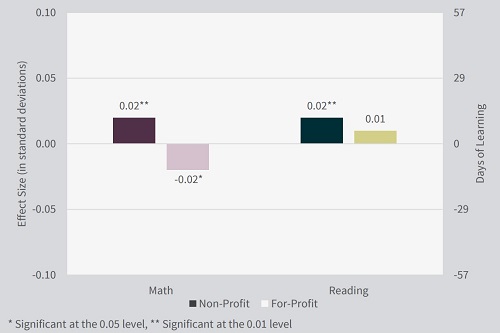
1) The for-profit versus non-profit discussion needs lots of nuance. CREDO’s comparison of charters based on the profit status of their operators snatched many of the headlines. This was unsurprising, given the current political milieu and much larger rifts within the charter coalition, where “profit” seems to be playing proxy for other issues. Still, it’s simplistic at best and misleading at worst to say—as EdWeek did—“for-profit charter schools show poor academic growth.” In comparison to their nonprofit counterparts, schools overseen by for-profit firms did underperform slightly in both subjects.

Figure 1: Impact of Attending a Nonprofit or For-Profit Charter School, Math and Reading
JO figure

Figure 22 in the report

But CREDO’s analysis included large virtual schools—nearly all of which are managed by for-profit companies. Given the well-documented weakness of virtual charters, this finding is no shocker.[1] A more useful comparison would have removed the virtual schools and asked how brick-and-mortar schools managed by for-profit entities compared to those operated by nonprofits.

Note, too, that pupil performance among for-profit-managed charter schools was no different than traditional public school performance in reading, and six days per annum less in math—not exactly earth-shattering given the inclusion of large virtual charters. The report’s breakout of charter operators at the end also illustrates that some for-profit networks had positive gains—including one of Ohio’s highest performers (National Heritage Academies). As Andy Rotherham elucidated in a recent US News column, “any outright ban on for-profits would not only clean up bad actors; it would also take away an option that is working for some families. And that’s why this debate is not as simple or straightforward as many advocates make it out to be.”

2) Consistent enrollment matters. CREDO found, unsurprisingly, that the longer a child was enrolled in a charter school, the stronger gains she realized relative to peers in traditional public schools. This was true for all types of charters studied. CREDO researchers categorized charters into four groups: independent (standalone) charters; those overseen by a charter management organization (CMO)—for purposes of this study, this could be for-profit or non-profit[2]; vender-operated schools (VOSs)—those that provide services under contract to at least three charters but do not “hold the charter;” and hybrids, which for purposes of this report was a small grouping of companies that had aspects of both a CMO and a VOS.

For students attending CMO-run charters, results actually flipped from negative during the first year of enrollment to positive the second and third years. By year 3, those kids attained an extra 40 days of learning in reading and 46 days in math. Figures 1 and 2 show steady, upward gains the longer students are enrolled in nearly any type of charter.  

Figure 2: Annual Growth Rates Based on Years in Charter by Charter Sector, Reading

Figure 15 in the report

Figure 3: Annual Growth Rates Based on Years in Charter by Charter Sector, Math

Figure 14 in report

This study affirms that kids benefit more when they utilize choice and then enroll consistently. This is true not just for charter students: A recent Fordham study on interdistrict open enrollment found small but positive gains for students who open enrolled for multiple years. Recent analyses of voucher programs also show that kids who consistently attend private schools make up ground after an initial dip in achievement.

While the reasons for student mobility are complex and often outside the school’s capacity to affect, education policy can make a difference. Charter schools in some communities have the benefit of allowing students to enroll from anywhere. More traditional public schools should consider the same; if nothing else, they could allow limited open enrollment for students who move outside district bounds and want to remain in their former school. There’s also room to start or strengthen grassroots advocacy groups that help counsel families in school decision-making and improve the odds of a good school fit.

3) Charters work especially well for historically underserved students. Like past studies, this analysis finds that students in poverty as well as black and non-ELL Hispanic students fare especially well in charter schools. Readers should understand CREDO’s methodology, which “matches” charter students to traditional public school (TPS) students who are like them in observable ways: (e.g. a low-income, African-American fourth-grader in a charter school without a disability who scored in the 30th percentile is matched to a “virtual twin” in a TPS). By controlling for these variables, CREDO makes an impressively close apples-to-apples comparison, given the data at hand. These findings are more robust statistically than a simple comparison of charter schools to their nearest traditional neighborhood schools, which may have fundamentally different student populations.

Any school or strategy that enables our poorest children to achieve at high levels deserves our fullest support. There is nothing more deserving of bi-partisan support than high-quality educational options that successfully propel our most underserved kids into lives of greater opportunity. This isn’t theoretical; good charter networks are producing outstanding gains for poor kids. Sometimes, these very same networks are facing political opposition to their expansion—a discouraging but necessary reminder that even when the data are clear cut, political power brokering and posturing can stand in the way.

4) Tightening charter oversight and reining in bad actors can only get us so far. CREDO breaks out results by charter operator, and finds that the less effective ones “often serve as many or more students than the high-achieving networks.” CREDO rightly asks, “Why are charter schools with weak academic track records allowed to replicate? Why are some networks with terrible average growth allowed to continue to operate multiple schools?” The authors go on to identify the importance of quality authorizing and the impact of state policies on charter practices and oversight.

As Ohio has learned the hard way, sound charter oversight matters greatly. It is much harder to tighten up or fix later than it is to get it right at the outset. Strengthening charter oversight policies and ensuring that vetting of new schools is rigorous can prevent some of the damage done by large, ineffective networks. It can curb the replication of schools that aren’t helping students toward proficiency and graduation, and it can mitigate the reputational damage done to the charter movement.

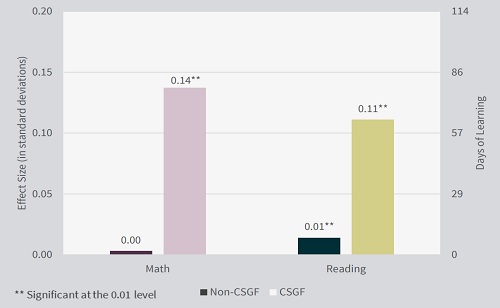
Still, strong oversight is not enough to create a vibrant charter movement. These schools also need sufficient resources—funding, facilities, top-notch human capital—in order to truly thrive. Mindful that such investments matter, CREDO analyzed results for schools funded by the Charter School Growth Fund, a national nonprofit that invests in charter networks that are already excelling, helping them to reach greater scale. Non-CSGF schools are represented by the black bars in Figure 4; CSGF schools are the pink and yellow bars.

Figure 4: Charter School Effect Sizes by Charter School Growth Fund Participation, Math & Reading
JO figure 61

Figure 61 in report

The differences are staggering: the equivalent of 80 days of learning in math and 57 days in reading. To be fair, CSGF has a rigorous vetting process, which itself likely predicts these networks’ success. But the important finding here is that CSGF enables already excelling networks to expand further. Such investments are essential to growth, be it from CSGF, federal Charter School Program grants, or generous state (or local) funds that bring charter funding closer to parity with their traditional counterparts.

*****

On balance, the latest CREDO analysis reminds us that discussions about charter school performance are far more nuanced than the average headlines would have us believe. This study makes clear that just like schools, not all management companies are created equally, but having a great one can have a real impact on student outcomes. Of course, folks bent on opposing charters aren’t going to be easily persuaded by CREDO’s findings (nor by powerful personal stories from students and families), and opposition in the form of sweeping anti-charter policy positions from powerful groups like the NAACP and the National Education Association reminds us how much work lies ahead. CREDO’s research provides a useful window into what’s working in the charter space—where, how, and for which students in particular. As such, it’s worth our careful evaluation and reflection.


[1] This piece isn’t about virtual charters. That their test results have trailed those in most other charters is noted here simply because it impacts the conclusions that can be drawn from the CREDO study.

[2] In common charter parlance, CMOs are non-profit and EMOs (educational management organizations) are for-profit. CREDO categorizes any management company that “holds the charter” (in other words, that manages nearly all aspects of the school, as opposed to contracting for particular services like a vendor-operated school) as a CMO, regardless of whether it is for-profit or nonprofit.

view
RESA blog image fix

Kasich keeps Ohio teacher residency program

Jessica Poiner
7.31.2017
Ohio Gadfly Daily

Nestled within the General Assembly’s final budget plan as sent to Governor Kasich on June 28 was an under-the-radar provision that would have eliminated Ohio’s teacher residency program. This didn’t get a lot of coverage. Neither did Governor Kasich’s veto, which saved the program.

The limited coverage was likely a symptom of unfamiliarity: Unless you have direct contact with this program, you probably don’t know much about it. Yet the legislative change would have had a significant impact on the experiences of new Ohio teachers. Let’s examine what the residency program is and why the General Assembly should look to fix it rather than continue to seek its elimination.

Background

Back in 2009, Governor Ted Strickland’s education reform and funding plan proposed both a teacher residency program and a licensure ladder to ensure that only “top-quality” teachers would stand in front of Ohio pupils. In response, lawmakers created a residency program based on the idea that new teachers need robust support and training and that far too many schools were leaving their newbies to sink or swim.

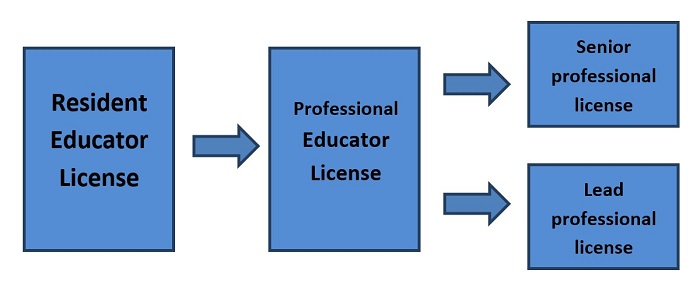
Ohio now implements a ladder licensure system with an embedded residency program. In general, the licensure system looks like this:[1]

RESA chart​

As the diagram indicates, all new teachers begin with the Resident Educator License. To receive one of these, a would-be teacher must meet a variety of requirements, including earning a bachelor’s degree and passing various licensure tests. Once issued, the license covers a four-year period and serves as the stepping stone to the advanced licenses.

During that four-year period, teachers are required to take part in the Resident Educator Program (REP), which was designed to provide support through mentorship, collaboration with veteran educators, professional development, and formative assessment feedback. Program completion requires successfully passing the Resident Educator Summative Assessment (RESA), a performance-based assessment that requires teachers to electronically submit a portfolio of completed tasks that demonstrates their teaching abilities. RESA submissions are graded based on a rubric that is aligned to the state’s Standards for the Teaching Profession.

Although the resident license is technically renewable, it is not intended to be permanent. Teachers are only able to renew or extend it if they need more time to complete the REP or RESA. In other words, in order to progress to a professional license—and continue teaching in Ohio—educators must complete the residency program and pass the assessment.

Program pushback

Despite the good intentions of policymakers, on-the-ground feedback has been mixed. On the one hand, some educators have expressed concern about needless paperwork and the program’s rehashing of material that’s already been covered in teacher education programs. On the other hand, there are quite a few Ohio teacher education programs that aren't doing a good enough job—and some Ohio educators have said that the program helps to inculcate and reinforce effective teaching habits. 

The greatest pushback has been against RESA assessment. It’s been accused of failing to provide immediate, direct, and specific feedback on practices and being too cumbersome when piled on top of a teacher’s typical workload. One Ohio educator called RESA “the worst experience I’ve had since becoming a teacher.” There’s even a Change.org petition to end it. According to news reports, complaints like these are exactly why the House proposed eliminating the program all together.

But when the REP was put on the chopping block, quite a few influential folks stood up to defend it. A REP coordinator from Solon City Schools—one of the highest performing districts in the state—told lawmakers that the mentoring aspect of the program, combined with the accountability of RESA, ensures that “all students will have a competent teacher.” Both state teachers unions voiced their views on the importance of maintaining support networks for new teachers. And State Superintendent Paolo DeMaria shared that he was worried about the “gaping void” that removing the program would create—without it, any Ohio teacher who teaches for four years under a resident license or alternative resident license is automatically qualified to apply for a permanent professional license.

Moving forward

Kasich’s veto allowed the residency program and its assessment to live another day, and that’s a good thing. As the Governor notes in his veto message, the rationale for the program still stands: New teachers do need extra help, and providing them with it is “critical for student success and for retaining teachers.” Furthermore, without a policy in place, there’s no guarantee that districts will give them the requisite support. Other states with high-performing education sectors (like Massachusetts) have effectively leveraged rigorous licensure systems (and other critical reforms) to increase student performance. A recent study demonstrated that high-quality mentoring and induction programs can also raise student achievement. While Ohio’s program hasn’t been put through a similarly rigorous review (one would certainly be welcome, though), its structure and requirements match the framework of other programs and systems that have had positive impacts.

But REP and RESA critics also have legitimate concerns. DeMaria acknowledged as much when he said that the Ohio Department of Education (ODE) “would like to have the opportunity to address issues within the system, rather than see it eliminated.” There are already some changes in the works, including allowing newly licensed teachers to “test out” of the program. That’s a good start. Two additional revisions should be considered:

Align the RESA and Ohio Teacher Evaluation System (OTES) rubrics. It’s no secret that Ohio’s teacher evaluation system needs work. The state’s Educator Standards Board released some solid recommendations for an overhaul in March. One of these suggestions is to revise the rubric that evaluators use during classroom observations. RESA submissions—which include videos of educators teaching lessons—are also evaluated on a rubric. This gives the General Assembly an opportunity to declare that the same rubric should be used for both the evaluation system and the licensure system.

From a practical standpoint, it would be easier for new teachers to have one observational rubric to model their practice on instead of two. But such a move toward alignment (and common training for both OTES and RESA evaluators) would also address another common criticism, which is that teachers who score well on one rubric sometimes fail to do so on the other. If Ohio is serious about having rigorous evaluation and licensure systems, policymakers should consider aligning the two so that teachers are held to the same standards throughout their careers. 

Improve the feedback loop. A common criticism of RESA is that it doesn’t offer teachers actionable insight into why they pass or fail certain portions of the assessment or how to improve their practice moving forward. To be clear, RESA was only intended to be a summative assessment that determined teacher ability prior to permitting them to move on to a more advanced license. But considering how much time teachers put into their online portfolios—and the dearth of quality professional development experiences that many subsequently experience—it’s reasonable for them to request some final constructive criticism. ODE could consider asking Educopia—the organization responsible for RESA’s creation and implementation—to improve the nature of their feedback by giving participants clear examples of what they do well and what they need to improve on. 

In the end, this is yet another policy that policymakers would be wise to mend rather than end. After all, we went down this road for a reason—too few beginning teachers were ready for the rigors of teaching, and the sink or swim mentality only compounded the issue. The Resident Educator Program is a framework with promise, and it can be tweaked to live up to its potential.


[1] For more information about the requirements needed to obtain specific Ohio teaching licenses as well as information about alternative pathways, see here. 

Fordham Logo

© 2026 The Thomas B. Fordham Institute
Privacy Policy
Usage Agreement

National

P.O. Box 110
Burke, VA 22009

202.223.5452

[email protected]

Ohio

P.O. Box 82291
Columbus, OH 43202

614.223.1580

[email protected]

Sponsorship

130 West Second Street, Suite 410
Dayton, Ohio 45402

937.227.3368

[email protected]