Mobile Navigation

  • National
    • Policy
      • High Expectations
      • Quality Choices
      • Personalized Pathways
    • Research
    • Commentary
      • Gadfly Newsletter
      • Flypaper Blog
    • Events
    • Scholars Program
  • Ohio
    • Policy
      • Priorities
      • Media & Testimony
    • Research
    • Commentary
      • Ohio Education Gadfly Biweekly
      • Ohio Gadfly Daily
  • Charter Authorizing
    • Application
    • Sponsored Schools
    • Resources
  • About
    • Mission
    • Board
    • Staff
    • Career
Home
Home
Advancing Educational Excellence

Main Navigation

  • National
  • Ohio
  • Charter Authorizing
  • About

Ohio Menu

  • Topics
    • Accountability & Testing
    • Advanced Education
    • Career & Technical Education
    • Charter Schools
    • Curriculum & Instruction
    • ESSA
    • Evidence-Based Learning
    • Governance
    • Personalized Learning
    • Private School Choice
    • School Finance
    • Standards
    • Teachers & School Leaders
  • Research
  • Policy
  • Commentary
    • Ohio Gadfly Newsletter
    • Ohio Gadfly Blog
    • Events

The Education Gadfly Weekly

Sign Up to Receive Fordham Updates

We'll send you quality research, commentary, analysis, and news on the education issues you care about.
Thank you for signing up!
Please check your email to confirm the subscription.

Ohio Education Gadfly Biweekly--Volume 12, Number 9

Volume 12, Number 9
4.17.2018
4.17.2018

Ohio Education Gadfly Biweekly--Volume 12, Number 9

Volume 12, Number 9
view

John Kasich’s education legacy

John Kasich is wrapping up his second term as Governor of Ohio and likely his career in public service. In a moment of reflection, he recently quipped, “I've tried to change two institutions during my career. One is the Pentagon and the other is the education system.

Chad L. Aldis 4.17.2018
OhioBlog

John Kasich’s education legacy

Chad L. Aldis
4.17.2018
Blog

The tragic lack of progress for Ohio’s low-income and black students

Aaron Churchill
4.23.2018
Blog

Ohio’s Democrat candidates for governor weigh in on education

Ohio Education Gadfly
4.13.2018
Blog

Ohio’s Republican candidates for governor weigh in on education

Ohio Education Gadfly
4.13.2018
Blog

Five takeaways from Ohio’s 2017 NAEP results

Aaron Churchill
4.11.2018
Blog

When it comes to graduation requirements, mastery matters

Jessica Poiner
4.16.2018
Blog
view

The tragic lack of progress for Ohio’s low-income and black students

Aaron Churchill 4.23.2018
Blog
view

Ohio’s Democrat candidates for governor weigh in on education

Ohio Education Gadfly 4.13.2018
Blog
view

Ohio’s Republican candidates for governor weigh in on education

Ohio Education Gadfly 4.13.2018
Blog
view

Five takeaways from Ohio’s 2017 NAEP results

Aaron Churchill 4.11.2018
Blog
view

When it comes to graduation requirements, mastery matters

Jessica Poiner 4.16.2018
Blog
view

John Kasich’s education legacy

Chad L. Aldis
4.17.2018
Blog

John Kasich is wrapping up his second term as Governor of Ohio and likely his career in public service. In a moment of reflection, he recently quipped, “I've tried to change two institutions during my career. One is the Pentagon and the other is the education system. And I've largely failed on both.”

His influence on military reform is best left to someone else to analyze, but let’s dig into his education record. What follows are a few of the most noteworthy K–12 reform efforts—in no particular order—occurring under his watch and a brief assessment of their likely long-term impact.

Instituting A-to-F school grades

Governor Kasich’s first term included establishing a few significant academic accountability measures, most notably A-to-F school grades intended to make school quality data clearer and more useful for parents and the general public.

Implemented in phases over several years, A-to-F school grades have ruffled more than a few feathers. The pushback has been strongest in suburban areas where schools sometimes receive lower grades than popular perception would suggest they deserve. The complexity of some of the graded measures combined with the sheer volume of grades received by each school cuts against the purpose of clarity and has taken some of the shine off this reform. Recently introduced legislation by Republican Representative Mike Duffey suggests that there is an appetite to eliminate school ratings or rankings altogether, going far beyond just undoing A-to-F school grades. If enacted, accountability in Ohio for student achievement would be virtually nonexistent.

Verdict: This is probably the boldest education reform undertaken by Governor Kasich and could, if adhered to, be a useful tool for driving long-term increases in student achievement. However, the lack of legislative champions in the face of serious challenges puts its future in jeopardy.

Adoption of a Third Grade Reading Guarantee

Less controversial but no less ambitious, this is probably the reform Governor Kasich has talked about most passionately. Ohio’s Third Grade Reading Guarantee was enacted with the hope of ending social promotion by requiring students to demonstrate reading proficiency before promotion to fourth grade. Districts, especially those with large numbers of high poverty schools, have implemented a variety of local efforts to help students attain the vital skills. Bold on its face, this reform hasn’t been as disruptive as anticipated, with almost 94 percent of third graders being promoted in 2016–17. The promotion rate is at odds with state assessment results showing that only 64 percent of third grade students achieved proficiency—a worrying discrepancy.[1]

Verdict: The jury is still out on this reform’s effects. Its focus—helping young students to read—is undeniably good, but the gap between proficiency and promotion rates will need to be closed if kids are going to reap the benefits of heading into fourth grade reading on grade level.

Implementing charter school accountability

Supportive of charter schools broadly, Governor Kasich’s early efforts focused on lifting limitations surrounding the creation of new online and brick-and-mortar charter schools and providing some facility assistance.

Rather quickly, Kasich seems to have surmised that all wasn’t well in Ohio’s charter sector. House Bill 555 (HB 555) in 2012 saw the establishment of a charter sponsor evaluation system; however, it was given a couple of years before it would be fully operational. The interim period saw a rash of charter school closings and a report showing that Ohio’s charters were underperforming academically.

By late 2014, Governor Kasich publicly committed himself to pursuing a more comprehensive charter school reform package and was very engaged in efforts surrounding the passage of House Bill 2 (HB 2) in 2015. HB 2 is significantly reshaping Ohio’s charter sector, but its effect on student achievement is still unclear.

Verdict: Kasich’s decision to emphasize quality over quantity in Ohio’s often politically charged charter school environment was likely something that only a Republican could accomplish. If Ohio’s charter sector has truly turned the corner, this could very well be one of Governor Kasich’s lasting legacies.

Revamping educator policies

As Kasich took office in 2011, efforts to revise teacher policies were sweeping the nation. Ideas like merit pay, basing retention on performance rather than seniority, and making it easier to remove low-performing educators from the classroom featured prominently in Governor Kasich’s first budget proposal. These policies and a host of others also found their way into Senate Bill 5 (SB 5), which took a much harder line toward public employee collective bargaining writ large. Although Kasich signed SB 5 into law, voters overwhelmingly repealed it in a statewide referendum in November 2011, delivering a “sharp rebuke” to the governor.

This setback led Kasich to leave teacher reform issues largely untouched during his tenure, with a couple notable exceptions. First, Kasich championed the introduction of Teach For America (TFA) into Ohio and provided some budgetary support to the nonprofit. As his term winds down, state support for TFA has already started to decrease, leaving the organization to depend more heavily on philanthropy for its long-term future.

Second, Kasich continued down the data-driven statewide teacher evaluation path initiated during the Strickland administration. Unfortunately, its effect on teacher quality is unclear. Thus far an overwhelming percentage of teachers have received a favorable evaluation, and even those who receive low ratings are unlikely to lose their positions as a result.

Verdict: Although Governor Kasich challenged the status quo, it’s difficult to see much lasting change in educator policies.

Expanding private school choice

Another early area of focus for Governor Kasich was expanding private school choice. His first year in office saw passage of the Jon Peterson Special Needs Scholarship and an increase in the cap of Ohio’s flagship voucher program, the EdChoice Scholarship, from 14,000 to 60,000 over two years. The Peterson scholarship, designed for students with disabilities, has grown steadily and serves nearly 5,000 students.

On the other hand, the EdChoice Scholarship—intended to give students in consistently low performing public schools a private school option—has grown more slowly. Because of safe harbor provisions in state law, the list of affected public schools has remained frozen over the last few years and likely contributed to slower growth. In 2013, Kasich agreed to expand EdChoice eligibility to low-income students based upon a specific line-item appropriation each year. The program started with kindergarten students and added a new grade level of eligibility each year. Limited to approximately 2,000 scholarships per year, the program now serves students in grades K–4, and demand has outpaced available funding each of the last two years.

Verdict: Governor Kasich greatly expanded private school educational options for many Ohio families, especially parents of students with disabilities. But safe harbor has limited the effect of increasing the EdChoice Scholarship cap, and many of Ohio’s lowest income students—despite clear indications of demand—have little opportunity to access private school choice.

Reworking school funding

It’s hard to improve education without venturing into the treacherous waters of school funding. Even knowing its perils, Governor Kasich endeavored to remake Ohio’s system. He started with repealing Governor Strickland’s “evidence-based” funding model. Using a placeholder formula for a couple of years, Kasich labored to move Ohio toward a weighted-student-funding system, including advocating for eliminating caps and guarantees for districts. The current formula is a vast improvement over the inputs-driven evidence-based model. But his efforts to fully move Ohio to a student-centered formula have fallen short in large part because significant structural funding reform is almost impossible unless it’s a year when the state revenue coffers are overflowing and the state can ensure that everyone gets more dollars as the funding mechanism is modified.  

Verdict: Despite dedicating significant time to the issue, it’s not clear how much long-term change will result from Kasich’s education budgets. It seems likely that, at the very least, serious conversations about caps, guarantees, and how and when money should follow the child are now an integral part of budget discussions.

*****

Governor Kasich dreamed big on education reform, which is likely why he feels that he’s fallen short. His tenure saw some significant changes to Ohio schools, but he’s right in thinking that there are areas where change has struggled to take hold.

At the end of the day, his education legacy is likely to rest on two important questions. First and foremost, has student achievement improved? Second, were the changes he championed long lasting or were they poorly implemented and weakened or repealed as soon as he left office? The achievement question, as it always does, will take time to reveal itself. Even if student achievement ends up improving, early signs suggest that implementation challenges could result in those changes being short lived.


[1] State law allows for the administration of alternative assessments, a limited number of exemptions, and a transition period allowing students with a score lower than proficient to be promoted for a period of time.

view

The tragic lack of progress for Ohio’s low-income and black students

Aaron Churchill
4.23.2018
Blog

Achievement gaps between poor and minority students and their peers are well documented and persistent. For years, data indicate that these students have generally been making slow but steady progress. But now results from the 2017 National Assessment of Educational Progress (NAEP) cast doubt on whether they remain on an upward trajectory. Nationally, the most recent trends have been flat to downwards for both black and Hispanic students, as well as for those in the bottom 10 percent in achievement.

Does Ohio follow the national trends? In this post, we’ll take a look at the NAEP data for Ohio’s low-income pupils and black students. Though not discussed here, average achievement among Hispanic students also lags behind their peers (their NAEP performance can be seen here). In contrast to Ohio’s state tests, which have changed in recent years, NAEP’s math and reading exams have remained largely consistent and provide a big-picture sense of the direction achievement is moving in Ohio. Keep in mind that NAEP takes “snapshots” of different students every two years; hence, it’s difficult to draw conclusions about what’s causing changes seen in the data. The shift to tablet assessments in 2017 may (or may not) have influenced results in states still using paper-and-pencil tests, but it’s unlikely to have affected Ohio, as more than 90 percent of students now take state exams online.

Low-income students

NAEP reports data by students’ eligibility for free or reduced price lunch (FRPL). Since eligibility is generally based on family income, this is a commonly used proxy for identifying low-income students. In Ohio and nationally, the average FRPL-eligible (or “low-income”) student performs below their peers. For instance, in 2017, just 24 percent of Ohio’s low-income students reached proficiency on NAEP’s fourth-grade reading exam, while 55 percent of higher-income students cleared this bar. When it comes to trends over time, figure 1 indicates that average scores for Ohio’s low-income students have slid in three of the four NAEP subject/grade combinations, starting in 2009 (for eighth grade reading) or 2011 (for fourth and eighth grade math). This is a reversal of the gains seen across these tests during the early 2000s. In only fourth grade reading is there a relatively consistent—but very modest—move upwards for low-income students from 2003–17.

Figure 1: Average NAEP scores of low-income students, Ohio and national, 2003–17.

NAEP subgroups chart 1 low income 4th reading

NAEP subgroups chart 2 low income 4th math

NAEP subgroups chart 3 low income 8th reading 0

NAEP subgroups chart 4 low income 8th math 0

The source for figures 1 and 2 is the NAEP Data Explorer.

Black students

Among the major racial/ethnic groups, black students have struggled the most on achievement measures. That pattern continued in 2017. For example, on NAEP’s fourth grade reading exam, 15 percent of Ohio’s black pupils reached proficient or above, while 44 percent of white students met that standard. Understanding why this happens is a complicated area of research, but the data continue to reveal the need to significantly improve black students’ outcomes. NAEP trends, however, indicate that Ohio’s black students have made little progress over the past decade and a half. The results are somewhat uneven from year to year, but the general trend from 2003–17 is quite flat—a pattern also evident in Ohio’s ACT data. Also worrisome is that black students’ math performance has fallen in the most recent iterations of NAEP across both grades, wiping out the gains made in the early 2000s, while scores in reading have been more or less flat in both grades. Perhaps most alarming is that achievement among Ohio’s black students has drifted somewhat below the national average in all four assessment areas.

Figure 2: Average NAEP scores of black students, Ohio and national, 2003–17

NAEP subgroups chart 5 black 4th reading

NAEP subgroups chart 6 black 4th math

NAEP subgroups chart 7 black 8th reading

NAEP subgroups chart 8 black 8th math

* * *

Given the dramatic progress needed to catch up to their peers, the NAEP trends for Ohio’s low-income and black students are disheartening. Even more troubling is that, according to a recent Brookings Institution analysis, Ohio is one of just a few states where achievement gaps are increasing, not narrowing. Although it’s possible that the recent slippage is due to the recession, that doesn’t change the basic story that “the racial achievement gap is a persistent fact of life,” as Roland Fryer and others put it a few years ago.

No one should be content with this status quo. Though not novel ideas, we should recommit to a couple basic tenets in the continuing quest to boost achievement for Ohio’s low-income and minority students.

  1. Hold students of all backgrounds to high academic standards. In recent months, we’ve seen Ohio policymakers waver on high standards for all, including a softening of graduation requirements and proposing ways to weaken accountability. But lowering the bar isn’t the right answer. Instead, these approaches adhere more to the “soft bigotry of low expectations” that likely plays some role in the troubling results displayed above. Instead, what disadvantaged students need are adults—from policymaker to local educator—willing to maintain high expectations for all.
  2. Concentrate on creating excellent high-poverty schools. Rigorous studies from Boston, Chicago, and New York City show that high-performing charter schools close achievement gaps and open opportunities to higher education. Ohio also has some terrific homegrown charter networks working hard to close gaps, but it still desperately needs more extraordinary schools—charter, district, STEM, or private—in our least advantaged communities. To this end, state and local leaders need to invest additional resources that help expand the reach of great schools, launch brand-new schools, and attract talented educational organizations to Ohio.

Ever since the Coleman Report was released in the mid-1960s, data have revealed patterns of underachievement among less advantaged students. Tragically, the 2017 NAEP results continue to show massive gaps, with indications that progress among low-income and minority students has slowed, or even reversed, after years of progress. Fluency in math and reading remains key to advancement later in life, and Ohio must stay resolute its efforts to assure that all young people exit high school with a solid academic foundation.

view

Ohio’s Democrat candidates for governor weigh in on education

Ohio Education Gadfly
4.13.2018
Blog

In case you missed the memo, early voting for the May 8 Ohio gubernatorial primary started this week. Building off our national Eduwatch coverage of the 2016 presidential election, Fordham Ohio presents a look at the primary candidates for governor.

Below you will find—in their own words as much as possible—the positions of candidates in the Democratic primary on various education issues in the Buckeye State. (We list them in alphabetical order.) It is worth noting that two of the candidates’ running mates currently hold positions relating to K–12 education.

The corresponding collection of quotes from the Republican primary candidates can be found here.

***

Richard Cordray (former Director of the U.S. Consumer Financial Protection Bureau and former Ohio Attorney General). Running mate: Betty Sutton (former U.S. Representative)

1. ECOT: ECOT will be a key issue this year because it “represents the culture of corruption” under Republican rule. February 2018.

2. Charter schools: “The for-profit charter schools have been a scandal… We've got $70 million missing in Columbus that we're never going to see again. And $1 billion poured into charter schools that have been so scandal plagued.” March 2018.

3. Education governance: “It would be a good thing for the governor of the state of Ohio to have more direct control over education policy in this state. It has been badly fragmented for years.” February 2018.

4. Career and Technical Education (at the community college level): “There is a lot of very sophisticated job training that we are doing around Ohio. Some of these jobs are more complicated today than they have ever been before. Generally computers are part of just about every job.” February 2018.

5. Pre-K: “This is exactly the problem in the state of Ohio…You have a state legislature that has this mania for giving more tax cuts to the rich. And all of that money comes out of local services and programs. First responders, in this case [pre]schools—the local communities are being hurt to fund an ideological agenda in Columbus and it’s not good for the state of Ohio.” February 2018.

6. School funding: The state needs to examine school funding… The primary property tax model still produces inequality among communities. February 2018.

7. College affordability: Free community college for all Ohioans is “a win-win for Ohio businesses and workers… It is affordable. The cost is modest.” April 2018.

***

Dennis Kucinich (former U.S. Representative, former Mayor of Cleveland). Running mate: Tara Samples (Akron City Councilwoman)

1. School funding: “Ohio public educational funding has been subverted by special interest groups and for-profit charter school management companies, who through campaign contributions have, in the past decade, normalized the privatization of public education funding, creating an often substandard, for-profit system ‘education’ system, using and misusing billions of dollars in public funds.” February 2018.

2. Charter schools: “The normalization of what is essentially a wholly corrupt system constitutes one of the greatest scandals in the history of the state of Ohio because billions of public funds have been diverted away from public education and have enriched private, for-profit enterprises.” February 2018.

“I’m not saying shut [charter schools] down…I’m saying local control. Give people a voice... This then becomes a public discussion instead of a situation where acts of the legislature are rigging a system in favor of for-profit management companies whose principals then turn around and give money to legislators and other state officials...to continue the process.” February 2018.

3. HB 70/Youngstown Academic Distress Commission: “There are people inside the process not happy about recent turn of events where the privatization of the Youngstown City School District is being seriously considered…I was contacted by someone inside [with this information] and I am quite satisfied the information I have is accurate and needs to be made public. We are talking about lives of thousands of Youngstown city schoolchildren being set at odds to profit motives.” February 2018.

4. HB 70/Lorain ADC: “I recommend two things. One, you can proceed with court action challenging the provisions of HB 70 that effectively removes power of the board. Two, this board and people in Lorain have the ability and the right to file charges against the CEO, put them in the form of a petition, get the requisite amount of signatures, and then submit to the Common Pleas Court of Lorain County for a decision.” March 2018.

“House Bill 70 was an anti-democratic bill.” March 2018.

5. College affordability: “The idea [of free tuition for the first two years of education at public universities or colleges] is that no one should be denied an opportunity to start or continue going to college.” March 2018.

***

Bill O'Neill (former justice of the Ohio Supreme Court, former nurse, Vietnam War veteran). Running mate: Chantelle Lewis (Lorain City Schools elementary principal and former East Cleveland City Councilwoman).

1. School funding: Ohio’s education funding process is “a tragedy of epic proportions.” January 2018.

O’Neill blasted Ohio’s “illegal funding system” for producing a “failing education system.” January 2018.

2. Education governance: “When elected, there will be a seat created in my cabinet for the czar of education with the full authority of the governor's office to fix this problem once and for all.” He said that his running mate, Chantelle Lewis, would be that czar. January 2018.

***

Joe Schiavoni (state senator and former Minority Leader of the Ohio Senate). Running mate: Stephanie Dodd (elected member, State Board of Education).

1. Accountability: “I think we need to have accountability and transparency for all schools. We are making progress with that in the Senate. I do believe we need accountability and transparency for charter schools too.” May 2017.

2. College affordability: If Ohioans purchase a home within five years after graduating from college in Ohio, the state may help forgive part of their student loan debt. January 2018.

3. ECOT: “ECOT failed many, including the state’s tax-paying public…Those millions of dollars of unearned revenue could have gone to much more effective use had they been channeled toward the state’s financially struggling but much more closely monitored public school districts.” January 2018.

4. HB 70/Academic Distress Commissions: “I believe a state ‘takeover’ is a lazy solution to Ohio’s longstanding and worsening problem of poverty and its effect on student success.” January 2018.

5. Wraparound services: “Every legislator and candidate for governor should take a trip to Cincinnati to see how that city is addressing poverty. They use a wraparound service model, which includes teachers, city officials, nonprofits, business owners and the community in education.” January 2018.

6. Education governance: “There is no honorable excuse for removing the elected voice of parents and students from education. On top of that, combining agencies doesn't remove inefficiencies. It creates them. We need collaboration between real leaders to improve Ohio's education system…The GOP could easily work to address these issues without a government restructure that will have lasting consequences for future generations of Ohioans.” February 2018.

view

Ohio’s Republican candidates for governor weigh in on education

Ohio Education Gadfly
4.13.2018
Blog

In case you missed the memo, early voting for the May 8 Ohio gubernatorial primary started last week. Building off our national Eduwatch coverage of the 2016 presidential election, Fordham Ohio presents a look at the primary candidates for governor.

Below you will find—in their own words and via direct quotes as much as possible—the positions of candidates in the Republican primary on various education issues in the Buckeye State. (We list them in alphabetical order.)

The corresponding collection of quotes from the Democratic primary candidates can be found here.

***

Mike DeWine (Ohio Attorney General and former U.S. Senator). Running mate: Jon A. Husted (Ohio Secretary of State)

1. School quality: Wants to place “a real emphasis on education”…encouraging and replicating schools that are propelling underprivileged children toward “their version of the American dream.” If they’re not serving that goal…they should be closed down. October 2017.

2. Schools serving at-risk youth: The good news is that today there are models for what yields good schools—models of schools that can make a difference in children’s lives. November 2017.

3. Career and Technical Education: Ohio should encourage some students to pursue vocational education as an alternative to college to help boost the state's workforce. March 2018.

4. Statewide education governance: “If you look at any kind of education reform, it needs to focus on kids and how we do a better job for kids…I don’t see that this proposal [HB 512] really does that or accomplishes very much at all.” April 2018.

5. School funding: “We should do everything we can to bring about equity in school funding, but that’s not the only thing. For example, Cleveland has very high performing charter schools that are reaching kids who are at risk, and their costs are about $13,000 a head. For city schools, it’s about double that. It’s not all about the money.” January 2018.

***

Mary Taylor (Lieutenant Governor of Ohio). Running mate: Nathan Estruth (businessman).

1. Education and jobs: Creating and continuing jobs in the state requires a fix to the education system. That could include giving high school students the necessary tools for after they graduate and either go to college or immediately enter the workforce. If students decide they want to start a career right after high school, schools need to offer their students during their four-year tenures skills and training for jobs. “I don't think we should wait until these kids get out of high school.” July 2017.

2. Statewide education governance: “This proposal is exactly the opposite of what my approach is, and I’m absolutely opposed to House Bill 512.” April 2018.

3. Education funding: “We will roll out an education proposal that will really focus on what matters in education, not a discussion on money but rather how to improve schools for kids, a solid proposal that looks at where the dollars are spent.” January 2018.

4. Standards and testing: “We would eliminate Common Core standards and return control to local districts, revamp graduation standards that focus on the results we need. We have lost our minds on testing, doing way too many. Parents need to know how their kids are performing, and the testing system doesn’t do that.” January 2018.

5. Relevant high school coursework: “Our kids aren’t learning the stuff in high school the way that they should.” Students should get more immediately into their coursework and have access to more internships. January 2018.

view

Five takeaways from Ohio’s 2017 NAEP results

Aaron Churchill
4.11.2018
Blog

Yesterday, the U.S. Department of Education released data from the 2017 National Assessment of Educational Progress (NAEP). Given every two years to fourth and eighth graders in math and reading (and other grades and subjects though sometimes on a less frequent basis), NAEP is an important check on how Ohio students achieve against rigorous national standards and compare to their peers in other states. The big takeaway is that student achievement is stuck in neutral across much of the nation. But there’s more to unpack, especially here in Ohio.

Note that the NAEP data are simply descriptive—they give us information about achievement at face value. They can’t tell us with any certainty what’s causing these patterns and trends, including how the shift to tablet-based assessments, economic or demographic trends, and other dynamics that may influence achievement are affecting results. Moreover, other excellent analyses of NAEP data are already out, including a demographically adjusted look at the 2017 results by state. In the days ahead, we’ll take closer looks at  “cohort gains” in Ohio compared to other states—i.e., examining fourth graders results in 2013 and comparing them to 2017 eighth grade results—as well as dig into performance by subgroup.

With all this in mind, let’s dive into a first look at the Ohio data.

1. Ohio outperforms the national average … but not by much

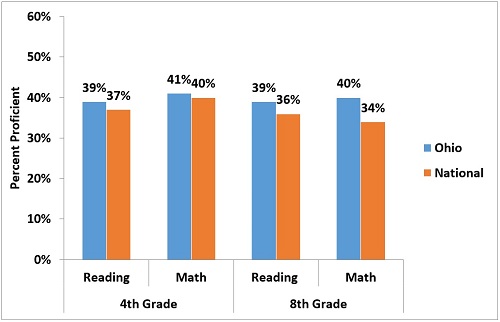
For years, roughly two in five Ohio students have reached NAEP’s proficiency standard. That story remains unchanged in 2017, as 39 to 41 percent of Ohio students reached proficiency, depending on the grade and subject. (Note: NAEP’s standard is considerably higher than Ohio’s proficiency bar on state exams.) When compared to the national averages, Ohio performs higher in all four subjects, though just two are statistically significant—fourth grade reading and eighth grade math. Ohio should continue to be proud of its national standing; we’re better than most. But given that the state is now outperforming the national averages by rather slim margins, we can’t afford to stand still lest the rest of the nation pass us by.

Figure 1: Proficiency rates on NAEP, Ohio versus national, 2017

Figure 1

2. Reading achievement has been stagnant for a decade

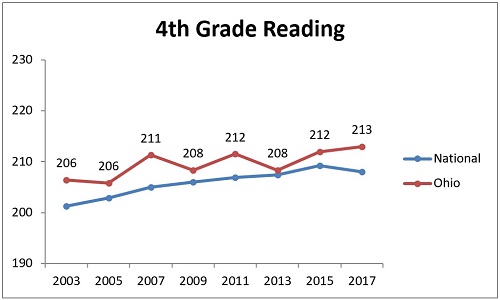
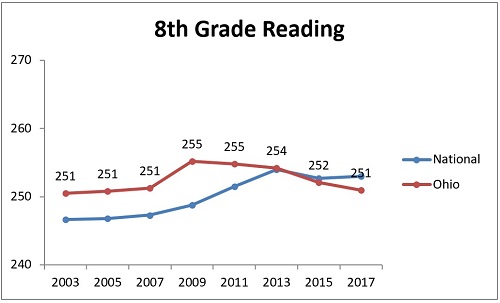
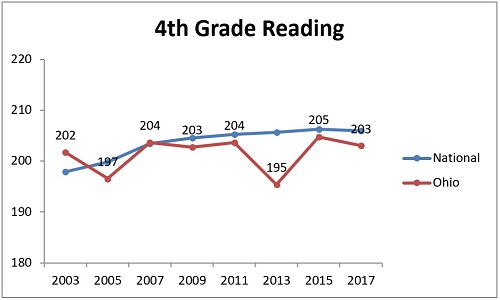
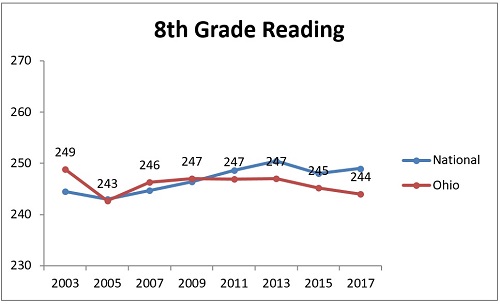
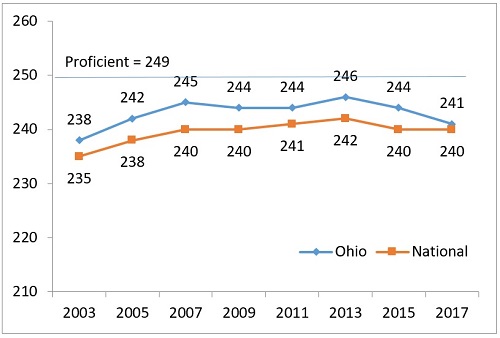
Ohio’s reading performance on NAEP has been flat for almost a decade and a half in both fourth and eighth grade. Consider Figures 2 and 3, which show the average reading scores in Ohio. Compared to 2003, the results today show little progress: In fourth grade, Ohio has improved by three points, and in eighth grade, just a single point—a touch slower than the national rate in both grade levels. Although the national average has not risen dramatically in reading either, Ohio’s lack of improvement should concern policymakers and educators. Appreciably moving the achievement needle may require a major break in the way schools approach literacy, shifting to a more content-rich and knowledge-based curriculum that starts in elementary school, as E.D. Hirsch and others have suggested. But first we need to acknowledge something is amiss in reading instruction.

Figure 2: Average scale scores in fourth grade reading, Ohio versus national, 2003–17

Figure 2

Figure 3: Average scale score in eighth grade reading, Ohio versus national, 2003–17

Figure 3

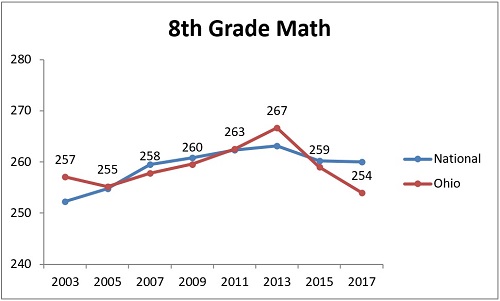
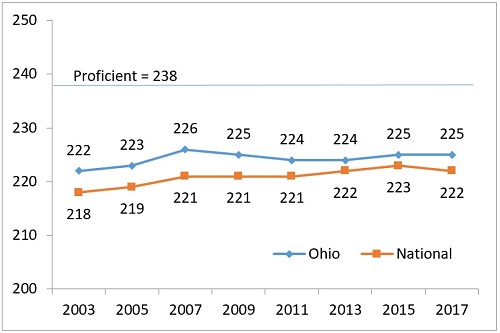
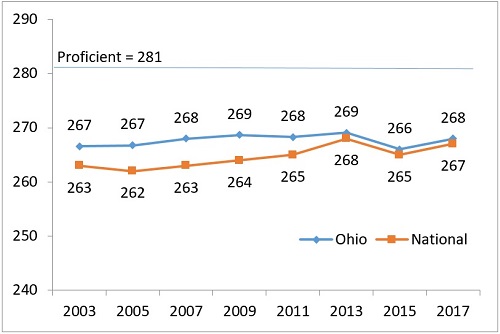
3. Math achievement has been a mixed bag in more recent years

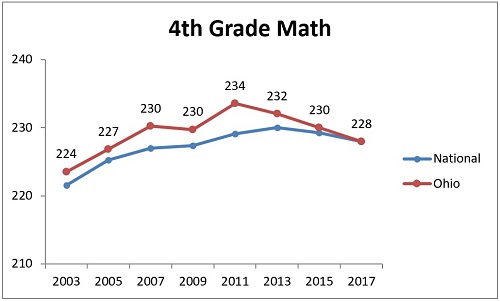
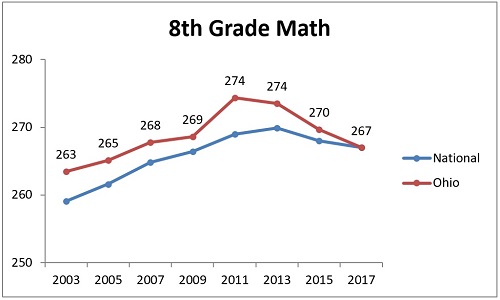
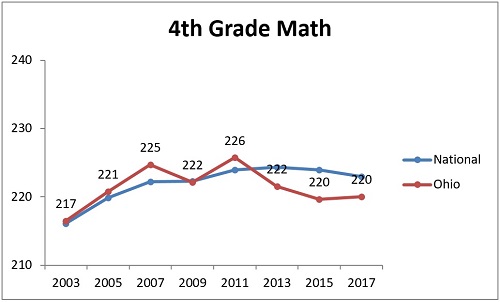
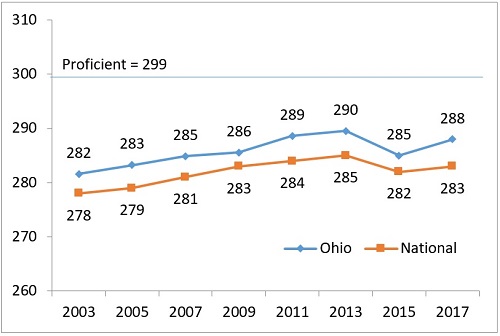
Unlike reading, math performance has trended more consistently upwards over the past decade. That is, until 2015 when math scores dipped noticeably in Ohio and nationally. The 2017 results in Ohio went in different directions. In fourth grade math, NAEP scores continued to slide—mainly the result of declines among white students, as my colleague Mike Petrilli found. That’s worrisome and puzzling. Might the laser focus on early literacy be crowding out math instruction? Did the Great Recession depress achievement? It’s impossible to know, but policymakers should monitor whether this trend persists. On the other hand, in eighth grade math, Ohio’s average score rebounded. That’s good news, perhaps indicating that the 2015 decline was a one-year bump in the road. 

Figure 4: Average scale score in fourth grade math, Ohio versus national, 2003–17

Figure 4

Figure 5: Average scale score in eighth grade math, Ohio versus national, 2003–17

Figure 5

4. Ohio is competitive, but not at the top, in comparison to nearby states

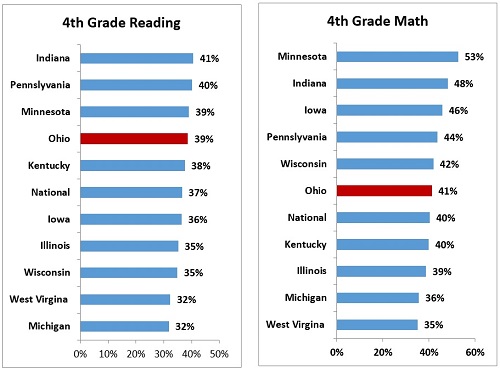
Just as The Ohio State University aspires to win the Big Ten conference championship every year in athletics, the Buckeye State should aspire to be the cream-of-the-crop when it comes to student achievement among other Upper Midwest states. How does Ohio fare among its nearest neighbors? Figure 6 shows comparisons in fourth grade that indicate Ohio stacks up pretty well among its nearby states, but also has room to grow. Figure 7 repeats the results for eighth grade; it shows Ohio toward the middle in reading, but higher in math. Note, of course, that minor differences between states’ proficiency rates are likely to be statistically insignificant. The results from 2017 generally track those from the 2015 NAEP iteration.

Figure 6: Fourth grade proficiency in reading and math, Ohio versus nearby states, 2017

Figure 6    

Figure 7: Eighth grade proficiency in reading and math, Ohio versus nearby states, 2017

Figure 7

5. Getting to the top spot in the nation will be a long road

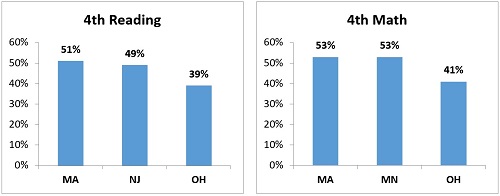
The best careers of the future will likely fall to states and cities with the strongest knowledge and skills base. Hence, our future prosperity hinges in no small part on how well Ohio schools educate today’s students. Although Ohio has performed modestly well against national averages and in relation to nearby states, the Buckeye State should aim for the top of the mountain so that it can continue to compete economically on a national—and global—stage. Figures 8 and 9 indicate that Ohio has its work cut out to make it to the top. In both fourth and eighth grade, the state trails national leaders—Massachusetts, Minnesota, and New Jersey—by about 10 percentage points. These are, of course, “raw” achievement data, but demographically adjusted NAEP data also indicate that Ohio’s in the top half of states but doesn’t quite crack the highest echelons.

Figure 8: Fourth grade proficiency rates of top two states versus Ohio, 2017

Figure 8   

Figure 9: Eighth grade proficiency rates of top two states versus Ohio, 2017

Figure 9​

* * *

NAEP regularly forces us to pause and reflect on Ohio’s academic progress over time and how it fares in comparison to other jurisdictions. Sometimes the news is worth celebrating; other times it exposes troubling patterns. So is Ohio a state “at risk”? The answer depends, I suppose, on where you sit. If you’re mostly satisfied with above average rankings, then the answer might be no. But if you—like me—want Ohio to lead the nation in academic achievement because we believe that Buckeye students absolutely can be the best, then today’s results should stir us to pursue something better. Ohio has a proud history of committing to education, and it has many of the ingredients for a top-of-the-class school system. Excellence is within reach, but we’ll need to continue taking the long, challenging journey towards reaching our state’s fullest potential in education. 

view

When it comes to graduation requirements, mastery matters

Jessica Poiner
4.16.2018
Blog

A recent paper from the left-leaning Center for American Progress (CAP) examined high school graduation requirements across the nation to determine whether they were aligned with requirements for each state’s public university system. By and large, the authors found a “significant misalignment” between states’ high school and college systems. This “preparation gap,” as the authors call it, forces students seeking admission to their states’ university systems to take additional coursework that isn’t required to earn a high school diploma.

To remedy this issue, the authors recommend that states require students to complete as part of their diploma requirements the fifteen-credit college-ready coursework that’s required by most public university systems. This includes four years of English; three years of math up through algebra II; three years of laboratory science, including biology and either chemistry or physics; three years of social studies, including U.S. or world history; and two years of courses in the same foreign language.

If there’s one big takeaway from the CAP paper, it’s that rigorous coursework requirements matter—not just for the students who are bound for college, but for everyone. Research shows that the fifteen-credit college-ready curriculum leads to beneficial outcomes for students regardless of whether they choose to go to college. Ohio’s coursework requirements for graduation are already pretty close to fulfilling this recommendation; all the state would need to do to be in alignment is change its laws to require graduates to complete two years of study in the same foreign language.

The fact that not all students want to go to college shouldn’t excuse schools from their responsibility to ensure that every student could go to college if they chose to. If John decides that he wants to obtain his paramedic certification rather than go to Ohio State, he has every right to do that. But John shouldn’t be forced to choose one option over the other just because he didn’t take the right high school classes. In short, CAP is absolutely right: Coursework matters immensely. But course requirements are also only half of the meaningful diploma equation. The other half is measuring how well students have actually mastered content.

To understand why, consider the process of obtaining a driver’s license. In Ohio, new drivers are required to obtain a learner’s permit and complete driver's education, which includes twenty-four hours of classroom instruction and eight hours of behind-the-wheel training. These requirements are in place to ensure that drivers know the rules of the road and can operate their vehicles safely. But the state doesn’t just hand out licenses to all the folks who have fulfilled these prerequisites. Instead, state law mandates that drivers also pass both a written and on-the-road skills exam. These assessments are in place to verify that drivers have actually learned the content knowledge and physical skills needed to operate a car. There are thousands of people each year who are disappointed to find that they need more training and practice before they can get behind the wheel unsupervised. The state rightly recognizes that it is in applicants’ best interest—and necessary for protecting other drivers—not to grant licenses to individuals who haven’t proved they can drive safely.

High school diplomas should be viewed the same way. Rigorous coursework requirements matter, but so does making sure that students have actually mastered the content of their courses. If the state fails to hold the line at academic competency, we risk sending students out into the world severely unprepared. Some of these students will struggle to obtain or keep jobs in companies that are looking for employees with solid reading, writing, and math skills. Others will end up in remedial college courses that are a waste of time, money, and effort.

Moreover, just as licensing reckless drivers can harm others, giving diplomas to young people who haven’t demonstrated mastery can also cost employers and colleges. For instance, an employer might hire a recent high-school graduate, only to find out that he or she doesn’t have the skills and abilities needed to truly excel in the position. As a result, the employer might need to let that person go, thus wasting time and resources devoted to that short-term employee. The same might be said of post-secondary institutions that spend resources (some public) to educate students, only to see them drop out when they’re unable to manage the rigors of college coursework.  

Back in January, the Ohio State Board of Education recommended that lawmakers extend softened graduation requirements to the classes of 2019 and 2020.These include the idea of allowing students to graduate without demonstrating competency on Ohio’s end-of-course exams—the state’s way of verifying that students have a basic foundation in the core academic areas before they receive a diploma. Such a move would be akin to granting a driver’s license to every person who could show that they had completed driver’s education, even if they hadn’t demonstrated their ability to actually maneuver a vehicle. Sure, the high school graduation rate will be high if the board’s proposals are adopted. Nobody will be disappointed, and adults won’t have to answer hard questions about why so many kids are struggling. But Ohio will also be choosing to hand out participation certificates instead of meaningful diplomas. And in an increasingly competitive global society, meaningless diplomas aren’t in the best interest of anyone.

Fordham Logo

© 2026 The Thomas B. Fordham Institute
Privacy Policy
Usage Agreement

National

P.O. Box 110
Burke, VA 22009

202.223.5452

[email protected]

Ohio

P.O. Box 82291
Columbus, OH 43202

614.223.1580

[email protected]

Sponsorship

130 West Second Street, Suite 410
Dayton, Ohio 45402

937.227.3368

[email protected]