Mobile Navigation

  • National
    • Policy
      • High Expectations
      • Quality Choices
      • Personalized Pathways
    • Research
    • Commentary
      • Gadfly Newsletter
      • Flypaper Blog
    • Events
    • Scholars Program
  • Ohio
    • Policy
      • Priorities
      • Media & Testimony
    • Research
    • Commentary
      • Ohio Education Gadfly Biweekly
      • Ohio Gadfly Daily
  • Charter Authorizing
    • Application
    • Sponsored Schools
    • Resources
  • About
    • Mission
    • Board
    • Staff
    • Career
Home
Home
Advancing Educational Excellence

Main Navigation

  • National
  • Ohio
  • Charter Authorizing
  • About

Ohio Menu

  • Topics
    • Accountability & Testing
    • Advanced Education
    • Career & Technical Education
    • Charter Schools
    • Curriculum & Instruction
    • ESSA
    • Evidence-Based Learning
    • Governance
    • Personalized Learning
    • Private School Choice
    • School Finance
    • Standards
    • Teachers & School Leaders
  • Research
  • Policy
  • Commentary
    • Ohio Gadfly Newsletter
    • Ohio Gadfly Blog
    • Events

The Education Gadfly Weekly

Sign Up to Receive Fordham Updates

We'll send you quality research, commentary, analysis, and news on the education issues you care about.
Thank you for signing up!
Please check your email to confirm the subscription.

Ohio Education Gadfly Biweekly -- Volume 11, Number 14

Volume 11, Number 14
6.19.2017
6.19.2017

Ohio Education Gadfly Biweekly -- Volume 11, Number 14

Volume 11, Number 14
view
Sidestepping Accountability 1
High Expectations

Ohio’s history of sidestepping accountability

When it comes to high standards and accountability, Ohio talks a pretty good talk. Many of the most popular education reforms of the day have already been proposed or passed in the Buckeye State, and a few have even been hailed as best in the country.

Jessica Poiner 6.19.2017
OhioOhio Gadfly Daily

Ohio’s history of sidestepping accountability

Jessica Poiner
6.19.2017
Ohio Gadfly Daily

Beware of fake policy solutions

Jamie Davies O'Leary
6.13.2017
Blog

Interdistrict Open Enrollment in Ohio: A recap of Fordham’s latest event

Ohio Education Gadfly
6.19.2017
Blog

Suburbanites want isolated public school districts, but broad choice can tear down those walls

6.14.2017
Flypaper

Social studies exams shouldn’t be first on the chopping block

Aaron Churchill
6.19.2017
Blog

Education savings accounts: The future of school choice in Ohio

6.13.2017
Blog
view

Beware of fake policy solutions

Jamie Davies O'Leary 6.13.2017
Blog
view

Interdistrict Open Enrollment in Ohio: A recap of Fordham’s latest event

Ohio Education Gadfly 6.19.2017
Blog
view

Suburbanites want isolated public school districts, but broad choice can tear down those walls

6.14.2017
Flypaper
view

Social studies exams shouldn’t be first on the chopping block

Aaron Churchill 6.19.2017
Blog
view

Education savings accounts: The future of school choice in Ohio

6.13.2017
Blog
view
Sidestepping Accountability 1

Ohio’s history of sidestepping accountability

Jessica Poiner
6.19.2017
Ohio Gadfly Daily

When it comes to high standards and accountability, Ohio talks a pretty good talk. Many of the most popular education reforms of the day have already been proposed or passed in the Buckeye State, and a few have even been hailed as best in the country. As these policies have been implemented, however, and as sometimes unwelcome consequences begin to kick in, Buckeye policymakers have had a difficult time walking the walk. In fact, they’ve shown a lamentable habit of backing down in the face of pressure to weaken accountability.

Take the ongoing uproar over graduation requirements. Back in November, district superintendents started to warn of a graduation “apocalypse” in which a third of the class of 2018 might fall short of the state’s new and more rigorous graduation requirements. Despite many unanswered questions, the State Board has recommended that students be permitted to graduate regardless of whether they pass end-of-course exams or meet career and technical requirements. Instead, they’ll only need to two of eight conditions, a list that includes such rudimentary achievements as 93 percent attendance or 120 hours of work/community service during their senior year. As my colleagues have pointed out, the board’s proposal is “awash in questionable options that are open to gaming and don’t assure that young people are ready for success in college or career.” 

Even more than that, it’s the perfect example of failing to walk the walk. Graduation requirements were raised because too few products of Ohio high schools were prepared for success despite having a diploma in hand. The Ohio Graduation Tests were replaced because they tested middle school knowledge levels and were a breeze to pass. Policymakers made changes because they recognized that a low bar creates a false impression of success—and many young people are then destined to stumble as soon as they encounter the higher bars of college and the real world. But now, in the wake of political pressure and the reality of what it means not just to favor accountability but to implement it, lawmakers are being asked to walk back their expectations. None of our reasons for raising the bar has changed. All that’s changed is the reality that implementation will have unwelcome near-term consequences as we pursue necessary long-term gains.

Unfortunately, this isn’t the first time the Buckeye State has backed off accountability. Back in 2012, the General Assembly adopted the third-grade reading guarantee. The underlying concept is straightforward and laudable: kids (with some exceptions) may not enter fourth grade until they demonstrate minimum competency in reading. Ample data show that reading proficiently by the end of third grade is a “make-or-break benchmark in a child’s educational development.” But as the first year of Ohio’s new guarantee got under way, many folks started to worry that significant percentages of kids would be held back. What to do? State policymakers opted to let students be promoted to fourth grade based on alternative tests approved by the Ohio Department of Education (ODE). In some places during the first year of implementation, the number of students who failed the state test but passed an alternative were staggering: Cincinnati Public Schools reduced the number of possible retentions from nearly 900 to 100 just by offering alternative assessments. If significant percentages of Ohio third graders pass the guarantee only because of these alternative tests, one must ask why it’s so much easier to pass them than to earn a proficient score on the state exam. Is the policy now a “reading guarantee” riddled with holes?

In 2014, lawmakers created a “safe harbor” policy to shield students, schools, and teachers from accountability as Ohio transitioned to new standards and assessments. That protection period was extended two more years via the 2015 budget, and bills currently in the House would extend it farther. Though it’s understandable that teachers and students need time to adjust to higher standards and new assessments, what’s a reasonable grace period? Ohio’s safe harbor has turned into the pretense of holding schools accountable for results without actually doing so.

Up in northeast Ohio, the much acclaimed Cleveland Plan was created to substantially improve academic performance in the Cleveland Metropolitan School District (CMSD) through a variety of aggressive reforms—including a teacher merit pay system that would reward the district’s strongest instructors. The plan garnered the support from a wide spectrum of hopeful fans, including the city’s mayor, school district officials, the teachers union, the General Assembly, and Governor Kasich. Fast forward approximately four years, however, and reform advocates have abandoned merit pay in the face of fierce opposition from a teachers union that reversed its position.

While other states have modeled how to set high expectations and stick with them even when the going gets tough, Ohio continues to soften accountability lest it make people unhappy. What the General Assembly is being asked to do on graduation standards isn’t likely to be a temporary fix—given recent history, it is more likely to become enduring policy. Ohio doesn’t need lawmakers who are spooked by hard choices; it needs leaders who stand up with courage and focus on the state’s long-term well-being. 

Here’s hoping that the Governor and legislative leaders recognize the opportunity that’s before them. Choosing to do hard, sometimes painful work now instead of kicking the accountability can down the road for others to try to take care of at some indeterminate future point is plenty hard. But it’s also the right thing to do. 

view

Beware of fake policy solutions

Jamie Davies O'Leary
6.13.2017
Blog

When I was growing up, “fake news” was the black-and-white photograph of the infamous bat child. Staring back at me in the supermarket check-out line, it was easy to spot—the line demarcating fiction from reality was as recognizable as the red and yellow tabloid headlines. Nowadays, fake news, defined by Wikipedia as “written and published with the intent to mislead in order to gain financially or politically, often with sensationalist, exaggerated, or patently false headlines that grab attention,” is rampant, flourishing in social media like algae in warm lake water. It’s also harder to pinpoint, having taken on so many esoteric forms beyond the blatantly untrue or “good-old fashioned viral emails” of years past. (You know it’s bad when the ignorance of yesteryear brings on nostalgia.)[[{"fid":"118770","view_mode":"default","fields":{"format":"default","external_url":""},"type":"media","field_deltas":{"1":{"format":"default","external_url":""}},"link_text":null,"attributes":{"style":"height: 259px; width: 225px; float: left;","class":"media-element file-default","data-delta":"1"}}]]

Today’s fake news is insidious and creeping—like an invasive weed posing as a hearty, colorful garden plant before wilting and seeding itself in the wind to multiply its damage. The most dangerous form isn’t the outright lie. It’s the distortion of fact, the misrepresentation, the half-truth. News isn’t all that’s “fake” nowadays. Too many public policy proposals also deserve this moniker—solutions that purport to solve a problem that doesn’t really exist, or that mislead as to what the problem actually is; ideas that score easy political points regardless of real-life impact or that offer unworkable solutions to genuine problems.

One such fake policy proposal now floating around Columbus, Ohio is House Bill 181, also known as the “Student and Teacher Liberty Act.” A press release issued by one of its sponsors promises that the measure will “liberate teachers and students from an unproven and excessively scripted system of testing and evaluations,” and will retrieve the “creativity and learning” that were allegedly decimated by the Common Core and its “affiliated tests.”

If you’re thinking that such language reads like a foreign policy scheme to restore peace after [[{"fid":"118771","view_mode":"default","fields":{"format":"default","external_url":""},"type":"media","field_deltas":{"2":{"format":"default","external_url":""}},"link_text":null,"attributes":{"style":"height: 278px; width: 225px; float: right;","class":"media-element file-default","data-delta":"2"}}]]the toppling of an oppressive dictator, indeed more like that than a plan to improve the state’s testing and teacher evaluation systems, you’re not alone.

HB 181 is chockablock with troublesome provisions (as is another Common Core repeal bill, HB 176). Here are a few standouts:

  • Bans Common Core or any academic content standards developed nationally or by a multistate consortium. Ohio evidently must become a remote education island unto itself.
  • Eliminates the state’s current standards review committees for each subject, though by all accounts these seem to be thorough, teacher-inclusive, and working well.
  • Prohibits the State Board of Education from adopting model curricula.
  • Requires that the state use new tests starting in 2018-19. This gives Ohio a single year to develop yet another set of new exams—the fourth in six years—which are to be aligned to a yet-to-be-created set of standards.
  • Defangs the state’s third-grade reading guarantee by lowering the passing score needed as well as the bar for retention, and removes the autumn diagnostic test used to identify and provide interventions to struggling readers.
  • Removes a current incentive in law for districts to encourage all students to take exams—which could lead to increased opting out. This could jeopardize Ohio’s 95 percent participation rate requirement and place the state afoul of federal law.
  • Extends “safe harbor” for districts until 2020, furthering delaying meaningful accountability. (Safe harbor protects districts and charters from a variety of consequences, including closure, restructuring, designation on the scholarship eligibility list, and more.)
  • Voids the academic ratings of charter sponsors until 2019 and delays until 2020 the consequences faced by sponsors rated ineffective or poor. Rigorous new evaluations for sponsors were a critical part of Ohio’s landmark charter reforms passed in 2015.
  • Eliminates statewide frameworks for teacher and principal evaluation systems and allows each district or school to go it alone (in coordination with their teachers’ union)—overlooking the solid recommendations recently offered by Ohio teachers and the state’s educator standards board.

It’s unclear how a further delay in the state’s accountability system for traditional public schools as well as charter schools and their overseers will liberate students, especially those whose schools aren’t delivering an acceptable education. Nor is it obvious how yet another round of standards and exams will bring liberty to teachers, who have overwhelmingly expressed fatigue and frustration at the myriad changes Ohio has undergone in the last several years. Also hard to parse is the notion that a ban on model curricula would be empowering, when many teachers welcome curricular resources at their fingertips that spare them from having to rely on Google or Pinterest.

Walking back a decade and a half of accountability measures, thrusting Ohio back to the drawing board on standards and tests (again!), dumping the third-grade reading guarantee, and letting schools and districts off the hook for several more years is nothing more than throwing in the towel on nearly all of Ohio’s modern-day education reforms. Indeed, the bill sponsors admit as much when they declare that “Ohio needs to go “back to what we know works”—a sentiment that seems based more on cranky nostalgia and a desire to be left alone than on actual evidence regarding how best to lift achievement for all students.

Poorly thought out policy ideas aimed at blowing up the system (like 181 and its cousin, 176) are easier to sell when cloaked in compelling language—even when the guise is thin. This bill does nothing to liberate teachers or students. Some may genuinely believe Ohio would be better off rewinding the clock on education, but the bill’s provisions are “fake” inasmuch as they set out to solve problems that don’t truly exist. Ohioans have already rejected the much maligned PARCC exams; the state has developed its own set of standards; Ohio’s charter reforms were long overdue, bipartisan, and much lauded; and no one—at least as far I can tell—is clamoring to do away with model curricula or teacher evaluations entirely. But try telling that to people who’ve reserved lifetime echo chamber seats, fueled by confirmation bias, whose virulent opposition to standards and accountability-based reforms would have them believe just about anything. 

view

Interdistrict Open Enrollment in Ohio: A recap of Fordham’s latest event

Ohio Education Gadfly
6.19.2017
Blog

In the wake of Donald Trump’s election and his selection of Betsy DeVos as Education Secretary, a lot of attention has been focused on school choice. Though charters and vouchers have received the lion’s share of attention, there’s another under-the-radar school choice program that impacts thousands of students: interdistrict open enrollment, a policy that permits students to attend school in a district other than the one in which they live.

Though Ohio’s program was one of the nation’s earliest, limited information has been available about who participates and how they perform academically. To shed some light on this important program, we commissioned a report: Interdistrict Open Enrollment in Ohio: Participation and Student Outcomes. On June 6, we hosted an event to present the findings and to learn more about how the policy works in practice.

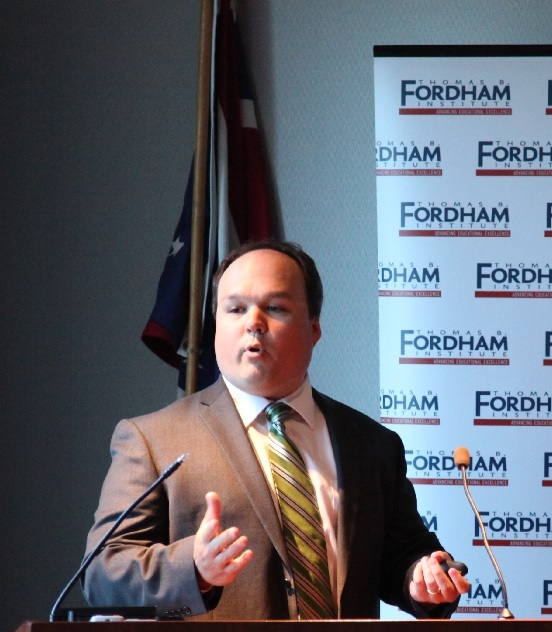
Opening the event was Dr. Deven Carlson, a professor from the University of Oklahoma and one of the report’s co-authors. Carlson began by overviewing Ohio’s open enrollment program. (His slide deck is available here.)  
Deven presenting

Report co-author Deven Carlson presents findings

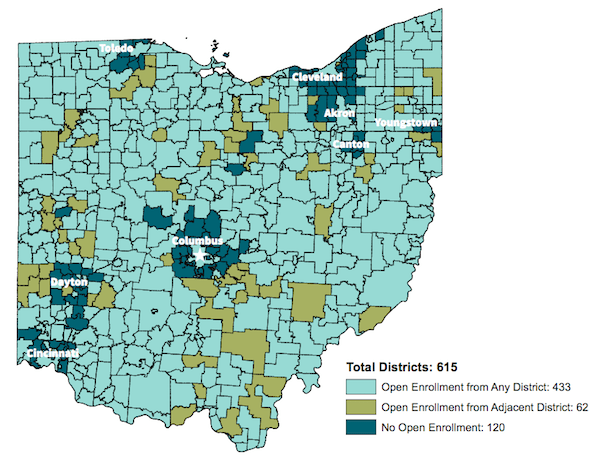
In regards to district participation, Carlson noted that a large and growing majority of Ohio districts are choosing to take part—statewide, 73 percent of districts accept students from any district and 8 percent from adjacent ones. The districts that choose not to participate are largely clustered in the suburbs around Ohio’s Big Eight school districts.
OE event image 1

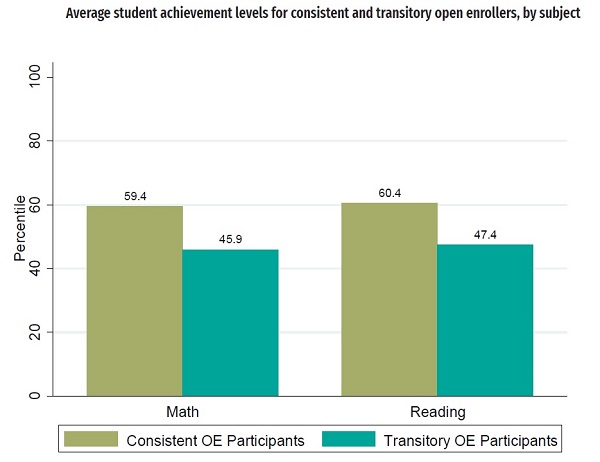
Student participation, meanwhile, has grown from about 50,000 students during the 2008-09 school year to nearly 72,000 in 2013-14. Compared to students who attend their resident districts, students who open enroll are less likely to be economically disadvantaged and somewhat higher achieving. As for participation by race, black students tend to participate at lower rates, though they also have less of an opportunity to open enroll than their white peers due to district participation decisions.
OE event image 2

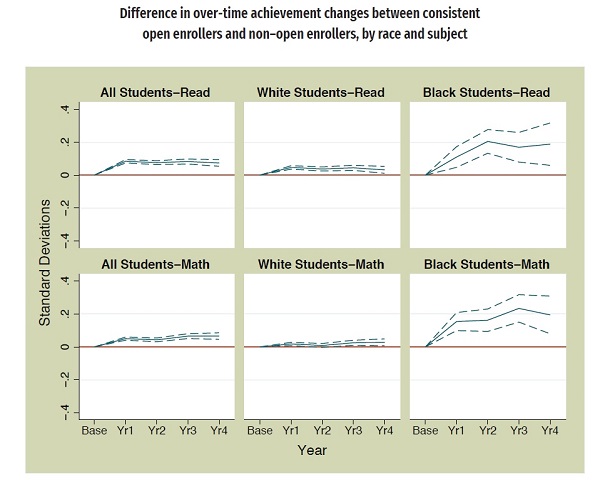
When considering the achievement growth of consistent open enrollers, Carlson reported that they perform about as well as they did prior to transferring. Yet when consistent open enrollers are compared to those who never open enroll, academic gains emerge. Carlson noted that this suggests that while open enrollers don’t exhibit substantial gains relative to their own baseline test scores, they don’t face the declines that non-open enrollers appear to experience. These gains are largest for black students and students in high-poverty urban and rural areas.
OE event image 3

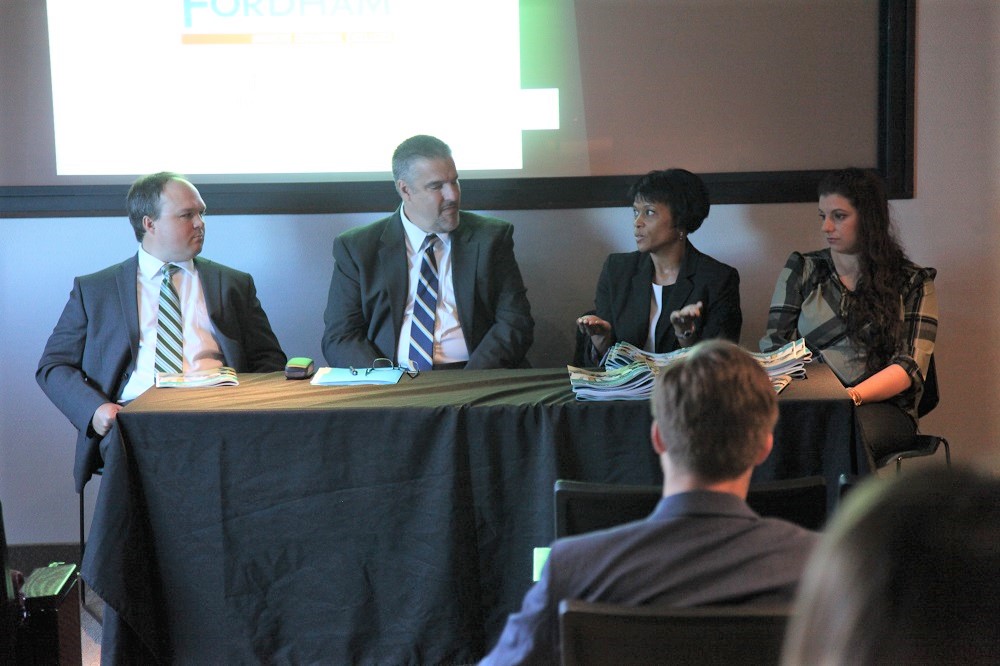
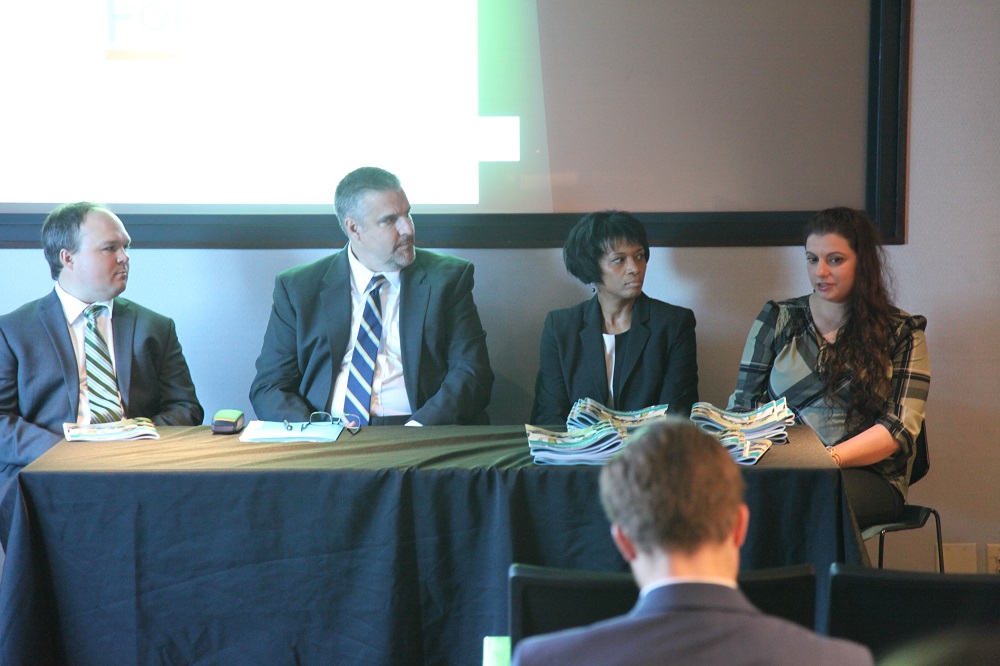
To complement the research presentation, three on-the-ground panelists shared their experiences and thoughts on Ohio’s open enrollment program. They included Tina Thomas-Manning, Superintendent of Reynoldsburg City Schools (adjacent to Columbus); Geno Thomas, Superintendent of Lowellville Local Schools (near Youngstown); and Gadah Hamad, a Central Ohio parent whose daughter has benefited immensely from the program.

When asked why their districts chose to participate in open enrollment, Thomas-Manning explained that Reynoldsburg initially did so based on “selfish” reasons. “We found ourselves in a pretty weak situation where we had a lot of space in some of our school buildings, and our enrollment appeared to be declining,” she said. “We had a lot of space and we wanted to utilize that space and we thought this policy would be a very creative way to provide access to students outside our district and fill classrooms.” She emphasized that overall, the policy has been “very good for kids and has been good for our school district.”
Panel 2

Panelists Deven Carlson, Geno Thomas, Tina Thomas-Manning, and Gadah Hamad

Thomas, meanwhile, pointed out that Lowellville is a small district—it currently enrolls around 600 students in grades K-12. Open enrollment has increased the population of the district and thus the type of opportunities they can offer to students, but it’s also improved the district in other ways—namely by expanding its diversity. “We’re very happy with open enrollment,” Thomas said. “It’s not a funding issue. It does help our schools, but it’s much deeper than just the funds.”

Thomas also referenced research done a few years ago in Mahoning County, where his district is located. “Part of the study was spurred because Youngstown was put into academic distress,” he explained. People “wanted to see if open enrollment truly did make on impact on students that traveled from one district to another.” Open enrollment turned out to matter immensely for the Mahoning County students who chose to take advantage of it. “We have about 135 to 140 students from Youngstown City Schools that come to Lowellville,” Thomas explained. “Those students are performing if not equal to then better than our resident students and the overall population of all students, and significantly outperforming other students in the Youngstown City Schools.” Thomas also addressed an argument made by choice opponents, which accuses choice-related programs of “creaming” students. “People might say well, you got the good kids from Youngstown,” he said. “That’s an insult. These kids are academically or economically disadvantaged, multicultural, from broken homes and single-family homes, and there are transient and transportation issues that we face daily.”

Thomas-Manning echoed the sentiment that open enrollment had proved beneficial for students within and outside her district. “We find each year, and have for the past seven years, that our open enrollees are students who are keeping pace, or in some instances […] outperforming our resident students.” She emphasized that to date, Reynoldsburg has found no evidence that opening their district borders has had a negative impact on its performance. “We truly embrace the idea that these are our kids,” she said.

For Hamad, Reynoldsburg’s accepting attitude was a big part of the reason she open enrolled her daughter there. “It was something that was very beneficial for my family,” she explained. “It was a location where I could get the best of both words.” When asked about the challenges of open enrollment, Hamad had some key insights. “I don’t work. So for me, I dedicated my whole day and my life to my kids. Anything they wanted to do education wise, I supported them,” she said. “But I think for other parents, that’s a big problem. Because if it’s going to be between a mom getting to her job or sending her kid to the local school because the bus stop is across the street, then I see where she’s going to go. She’s not going to be able to send her kid across town, especially in rush hour.”

Both superintendents agreed that transportation is a significant challenge for interested families. “We have found, by and large, that transportation is a huge barrier,” Thomas-Manning shared. “Particularly for our younger students who are not in charge of driving themselves to school.” Thomas pointed out that although resident districts must provide transportation or transportation vouchers for students who choose to attend charter or parochial schools, there is no such benefit for families who decide to transfer from one public district to another.

The panelists’ final statements revolved around opportunity and access. “Everyone wants to have a voice,” Hamad shared. “Everyone wants freedom. Freedom of speech, freedom to choose, freedom of everything. But I think that the freedom to pick your education is one of the most important. This is what shapes the children.” She nodded in the direction of her daughter, who was sitting in the audience. “She found herself. And every child should have the right. I don’t think that should be taken away.”
Panel 1

Thomas-Manning agreed that it’s important for families to have the right to choose. When families “choose us, that’s wonderful,” she said. “There’s no greater vote of confidence.” 

view

Suburbanites want isolated public school districts, but broad choice can tear down those walls

6.14.2017
Flypaper

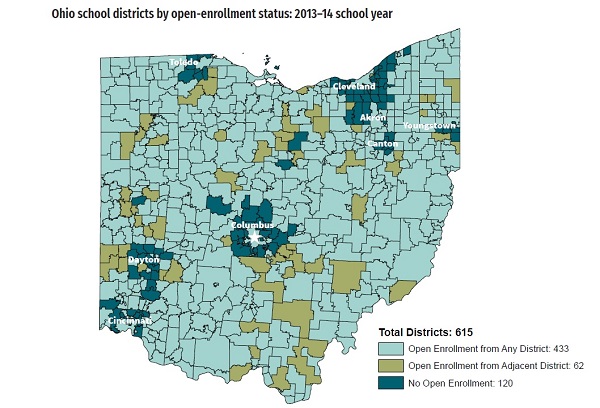
The Fordham Institute has released an important new study on open enrollment in Ohio. Figure 1’s dark blue areas show districts not participating in open enrollment, and they just happen to be leafy suburban districts that are both higher income with predominantly white student bodies and near large urban districts with many students, who are neither of these things. Feel free to reference this the next time someone claims that public schools “take everyone.”

Figure 1. Ohio school districts by open-enrollment status: 2013–14 school year

Many moons ago, I wrote a study for the Mackinac Center for Public Policy about the interaction between charter schools and open enrollment in Michigan. I found a very clear pattern among some of the suburban districts whereby charter schools provided the incentive for early open enrollment participants to opt-in. After one district began taking open enrollment transfers and some additional charters opened, it created an incentive for additional nearby districts to opt in—they were now losing students to both charters and the opted-in district. Through this mechanism, the highly economically and racially segregated walled-off district system began to collapse.

Not every domino fell, however. I interviewed a superintendent of a fancy inner-ring suburb who related that his district saw their competitors as elite private schools, not charter schools. When I asked him why his district chose not to participate in open enrollment, he told me something very close to: “I think historically the feeling around here is that we have a good thing going, so they want to keep the unwashed masses out.”

Contrast this as well with Scottsdale Unified in Arizona, which is built for 38,000 students and educates 25,000 students, 4,000 of whom transferred into a Scottsdale Unified school through open enrollment. Four thousand transfer students would rank Scottsdale Unified as the ninth largest CMO in Arizona, and they are far from the only district participating in open enrollment in a big way. Why is Scottsdale willing to participate unlike those fancy Ohio districts? They have 9,000 kids living within their boundaries attending charter and private schools with the assistance of private choice programs.

Why haven’t choice programs torn down the Berlin Walls around suburban Ohio districts? Sadly, it’s because they have been overly focused on urban areas. The National Alliance for Public Charter Schools’ Data Dashboard shows that 72.6 percent of Ohio charter schools operated in urban areas. The voucher programs likewise started in Cleveland and then expanded out to include failing schools (and children with disabilities statewide). More recently, a broader voucher program has begun the process of phasing in slowly on a means-tested basis, but the combination of adding a single grade per year and means testing promises to unlock a very modest number of walled-off suburban seats.

These programs have benefits, but they will not provide an incentive for fancy suburban districts to participate in open enrollment any time soon. Informal conversations I have had with Ohio folks related to me that Ohio suburban and rural dwellers—a.k.a. the people who elect the legislative majorities—tend to look at charter schools as a bit of a “Brand Ech” thing for inner-city kids. Rest assured that the thousands of Scottsdale moms sitting on BASIS and Great Hearts charter school waitlists do not view charters as “Brand Ech.” Likewise these folks probably see themselves as paying most of the state of Ohio’s bills through their taxes and just might come to wonder why the state’s voucher programs seem so determined to do so little for their kids and communities.

A serious strategic error of the opening act of the parental choice movement was to look out to places like Lakewood, Ohio, or Scottsdale, Arizona, and say “those people already have choice.” This point of view is both seriously self-defeating in terms of developing sustaining coalitions, and it also fails to appreciate the dynamic interactions between choice programs. Arizona’s choice policies include everyone and have created a virtuous cycle whereby fancy districts compete with charter and private school options for enrollment. This leads to a brutal crucible for new charter schools in Arizona in which parents quickly shut many down because they have plenty of other options. Educators open lots of schools and parents close lots—leading to Arizona’s world-class charter NAEP scores. Indeed, Arizona leads the nation in statewide cohort NAEP gains since 2009, which was more or less mathematically inevitable once this process got rolling. Ohio not so much.

I’m open to challenge from any of my Ohio friends and anyone else. But Ohio’s choice programs sure look to be mired in an urban quagmire, and they need the leafy suburbs to play in order to win. The state’s current policies haven’t unlocked Ohio’s Scottsdale Unified equivalents, and they likely never will. The National Association of Charter School Authorizer put Ohio’s revised charter school law in its top ten, but allow me to pull up a couch and heat up some popcorn for the next few years as charters lawyer up, parents resist arbitrary bureaucratic closures, and the rate of new schools opening goes glacial.

Competition is by far the best method of quality control, and bringing the leafy suburban districts into the melee is crucial if you are in the urban fight to win. The districts that are currently largely untouched by charter-and-private-choice overlap are those not participating in open enrollment. Regulating urban charters is not going to make your suburban districts into de facto charter management organizations. This isn’t hard to figure out. Although it’s counterintuitive to many folks, if states and districts want to secure improved education options for the poor, they need to include everyone.

Matthew Ladner is a Senior Research Fellow at the Charles Koch Institute

The views expressed herein represent the opinions of the author and not necessarily the Thomas B. Fordham Institute.

view

Social studies exams shouldn’t be first on the chopping block

Aaron Churchill
6.19.2017
Blog

Some Ohio lawmakers and educators recently proposed to roll back the state’s social studies exams, which presently include tests in fourth and sixth grade and end-of-course assessments (EOCs) for high-school students in both U.S. history and government. The proposals come from two avenues. As part of its version of the budget bill, the Senate Finance Committee would scrap fourth- and sixth-grade social studies testing. Meanwhile, an assessment review committee convened by state superintendent Paolo DeMaria goes further and jettisons all four social studies exams. (Superintendent DeMaria’s opinion differed from the committee, as he suggested that Ohio drop its fourth grade test and U.S. government EOC while leaving the other two in place.)

In today’s anti-testing climate, it’s not hard to see why policymakers are willing to abandon these exams. Unlike math, reading, and science, testing in social studies is not required under federal law and dropping it would marginally reduce total test burden while also satisfying political demands. Yet before policymakers sacrifice social studies on the anti-testing altar, they should consider the important reasons not to.

Social studies is an essential content area

One of the central missions of education is to prepare citizens and a key part of that is the duty to impart to every young person a sufficient knowledge of economics, geography, government, and history (world, national, and state). As former Justice Sandra Day O’Connor and Congressman Lee Hamilton write, “Knowledge of our system of governance and our rights and responsibilities as citizens is not passed along through the gene pool. Each generation of Americans must be taught these basics.” As my colleagues Robert Pondiscio and Kate Stringer discovered, many (though not nearly enough) districts include citizenship in their mission or vision statements. While testing per se can’t guarantee that schools are effectively educating pupils in these key subjects, it signals that they are essential elements of every child’s education and it assures the public that schools deliver at least a minimum amount of social studies instruction. Without assessment data, it’s difficult to gauge in any objective or systematic way whether students are attaining the knowledge necessary for informed citizenship.

Cutting these assessments would demote social studies to second-class status, which will deprive many young Ohioans of any understanding of, e.g., what the Bill of Rights and Declaration of Independence say or how the Northwest Ordinance paved the way for Ohio’s statehood. It will fail to ensure that all Ohio pupils are able to distinguish Cincinnati from Columbus on a map (much less identify which one is the state capital). Neglecting social studies will do little to help students leave high school with a firm grasp of how elections work, how public policy is made, and how markets function. Alongside the “three Rs” and science, social studies should be seen by all as a key ingredient in every child’s education, as knowledge in this content area remains essential to a flourishing democracy and thriving economy.

The issue of testing time is not solved by dropping social studies exams.

If reducing testing time is the aim, policymakers would better focus their efforts on eliminating the tests used in connection with Ohio’s broken teacher evaluation system. Consider the chart below, which displays typical pupil time on tests of all sorts. As you can see from the two purple slices, most testing is local assessment used to satisfy state policy requirements or student learning objectives (SLOs). Used to evaluate certain teachers (e.g., gym or art), SLOs are a very time-intensive form of assessment. Although it’s not clear what is included in the darker purple segment, vendor assessments (also used in teacher evaluations) are likely part of that slice. Requiring schools to spend many hours testing kids so as to generate teacher ratings doesn’t make sense, especially when those evaluations fail to differentiate performance and are rarely used in HR decision making. Policymakers should toss SLOs—a course of action recommended by Superintendent DeMaria—along with evaluations based on vendor assessments. Dropping these unnecessary tests would significantly ease the testing burden and yield more instructional time.

Chart: Average time on testing over Ohio students’ K-12 education

[[{"fid":"118817","view_mode":"default","fields":{"format":"default","external_url":""},"type":"media","field_deltas":{"2":{"format":"default","external_url":""}},"link_text":null,"attributes":{"style":"height: 381px; width: 500px;","class":"media-element file-default","data-delta":"2"}}]]

Source: Ohio Department of Education, Slide 11 from “Superintendent’s Advisory Committee on Assessments: Update to SBOE” (June 12, 2017)

***

State leaders are right to recognize that schools have limited time and that testing can grow to consume too much of it. In this instance, however, they have misjudged the deeper root of the problem. Unproductive yet burdensome testing associated with SLOs and vendor assessments could usefully vanish. Instead, sadly—and dangerously for the state’s future—social studies exams are on the chopping block, despite the fact that they gauge pupil achievement in essential subjects and have relatively light testing burdens. The future of the Buckeye State—and of the nation—hinges in no small part on young people who have a firm grasp of our history, government, and the economy. Ohio policymakers should know that better than anyone.

view

Education savings accounts: The future of school choice in Ohio

6.13.2017
Blog

NOTE: The Thomas B. Fordham Institute occasionally publishes guest commentaries on its blogs. The views expressed by guest authors do not necessarily reflect those of Fordham.

The Buckeye Institute in Ohio recently released Education Savings Accounts: Expanding Education Options for Ohio, a report co-authored with the Heritage Foundation’s school choice expert Lindsey Burke, which explains how Education Savings Accounts (ESA) will build upon Ohio’s already successful voucher and scholarship programs. Adopting a robust ESA program would propel Ohio’s outdated public education system into the 21st century, and make it nimble enough to navigate the needs of today’s students.

ESAs take the next step toward putting parents in charge of their child’s education. In envisioning education in the 21st century, parents—not bureaucrats—are primarily responsible for meeting the educational needs of students. And ESAs will help Ohio realize that vision.

For more than a century, an “Industrial Age” model of mass learning and limited flexibility has dominated the public education paradigm. This model too often ignores the individual needs, differences, skills, and interests of the children it purports to instruct. By embracing a more flexible and personalized approach to learning, ESAs will help Ohio transition into the new “Information Age”—empowering consumers, parents, children, and taxpayers to customize education to better meet student and community needs.

Ohio has helped lead the nation’s school choice movement, and already boasts strong charter schools and five different voucher programs that allow parents to seek education options to best meet their students’ individual needs. Adding a healthy ESA program simply builds on this success by giving families more purchasing power to customize their child’s education. Even beyond the flexibility of Ohio’s voucher programs, ESAs would present parents with an à la carte menu of education products and services, including textbooks, tutors, online classes, private school tuition, and saving for college. 

An Ohio ESA program could function in a variety of ways, but the keys to its success will always be flexibility for students and families, and minimizing bureaucratic intervention.

In broad strokes, an ESA program deposits an established base dollar amount into a participating family’s account, and would allow for more funds to be added according to a formula that factors relevant demographic criteria and other student needs. Like Ohio’s vouchers, the base amount should hew closely to the state’s guaranteed per-student funding. ESA funds would be dispersed on a periodic basis after parents submit receipts for eligible education expenses. ESA funds from the state would not be taxable income, and parents should be permitted to supplement their ESA funds with personal revenue and to rollover ESA funds from year-to-year in order to enhance market power and increase the supply and demand for new educational products.

Ohio, of course, uses a complex school funding formula and an elaborate mechanism of local and state taxes that would make Rube Goldberg proud. Thus, any ESA funding formula will need to account for those complexities to ensure that the state allocates adequate resources.

Like any state considering ESAs, Ohio should also look to the five successful ESA programs already up and running in Arizona, Florida, Mississippi, Nevada, and Tennessee. The programs in Florida, Mississippi, and Tennessee are currently only available to certain special needs students, but Arizona and Nevada have created effectively universal ESAs for their students.

In 2011, Arizona created the first ESA program with its Empowerment Scholarship Accounts for children with special needs. The program has been a resounding success, with 70 percent of survey respondents indicating that they were very satisfied with their child’s educational experience and Arizona Governor Doug Ducey signing legislation this year to expand the ESAs into a near universal program.

Nevada was first to adopt universal ESAs in 2015, but litigation over the state’s chosen funding stream has delayed its implementation.

Already, Ohio policymakers appear keen to join this revolutionary school choice trend. Two companion bills, Senate Bill 85 (sponsored by Senator Matt Huffman) and House Bill 200 (sponsored by Representative Kyle Koehler), would modify Ohio’s existing non-special needs vouchers by creating a single Opportunity Scholarship. These would closely mirror ESAs and would be available to eligible students based upon a sliding income scale, and they offer Ohio a good place to start.

Nothing succeeds like success. As policymakers and the public learn of ESA successes around the country, demand will continue to grow for more school choice, more parent empowerment, and more innovative and effective ways to educate our students. School choice has always recognized that a traditional one-size-fits-all public education does not meet the individualized and nuanced needs of students and their families. ESAs take the next logical step away from a bureaucratic education system that proves increasingly outmoded and unable to satisfy the demands of the new century.

Greg R. Lawson is a research fellow at The Buckeye Institute in Ohio and an expert in school choice.

Fordham Logo

© 2026 The Thomas B. Fordham Institute
Privacy Policy
Usage Agreement

National

P.O. Box 110
Burke, VA 22009

202.223.5452

[email protected]

Ohio

P.O. Box 82291
Columbus, OH 43202

614.223.1580

[email protected]

Sponsorship

130 West Second Street, Suite 410
Dayton, Ohio 45402

937.227.3368

[email protected]