

A newly released report, Is There a Gifted Gap?, by the Thomas B. Fordham Institute sheds further light on the many challenges gifted students from underserved populations face in being identified and served.
The report confirms our knowledge that students living in poverty, from racial and ethnic minorities, and who are English learners, are often overlooked for gifted programs.
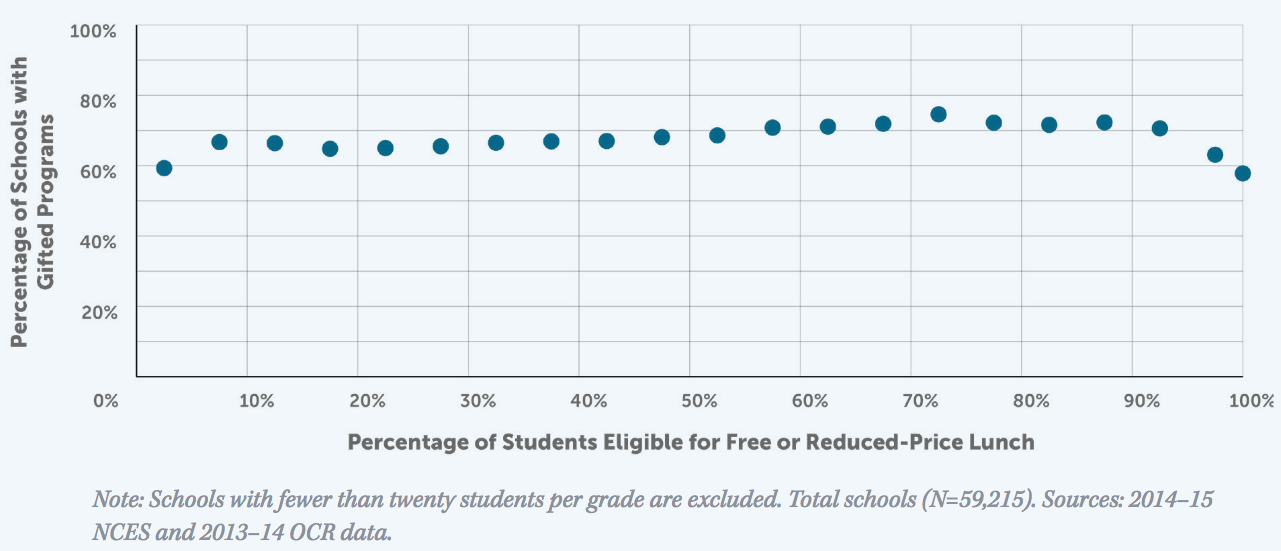
Data taken from the U.S. Department of Education’s National Center for Education Statistics and the Office of Civil Rights shows that high-poverty schools are just as likely as low poverty schools to have gifted programs available. (See figure 1 from the report.) This key point highlights that the underrepresentation of gifted students from poverty backgrounds is not for lack of programs in high-poverty schools.
Figure 1. High-poverty schools are generally just as likely to have a gifted program as low-poverty schools.
The report should sound an alarm for all advocates for social justice and incite action for changes in policy that create supportive learning environments for all learners, especially for well qualified children from poverty and minority backgrounds who are repeatedly overlooked for gifted programming.
NAGC supports recommendations put forward in Is There a Gifted Gap? and provides model legislation and advocacy resources to advance policies on equitable identification, professional development, acceleration, and monitoring progress through the Giftedness Knows No Boundaries (GKNB) initiative. The GKNB advocacy tools are being used across the nation to improve policies at the state and local levels with leaders in Connecticut, Washington, and Illinois successfully securing changes to monitoring, acceleration, and funding policies.
Is There a Gifted Gap? is another important call to action to create change in policies and practice to ensure that children from all backgrounds can reach for their personal best and contribute to their communities. We know that with increased understanding about their nature and unique needs, we will be able to develop supportive environments for learning and implement research-based practices that help all gifted children flourish.
The implementation of identification policies that support all students, strong professional development, acceleration, and the inclusion of gifted and talented students in state accountability systems will answer the call for greater attention to the excellence gap by shining a light on these children.
M. René Islas is the executive director of the National Association for Gifted Children (NAGC).
The views expressed herein represent the opinions of the author and not necessarily the Thomas B. Fordham Institute.