
With Ohioans facing sticker shock from tax bills tied to real estate inflation, property tax reform is top of the mind for state lawmakers. Last year, a joint committee held extensive hearings on property taxes and produced a report with findings and recommendations. Legislators have put forward various proposals that would shield homeowners from tax hikes, while also attempting to make Ohio’s byzantine local tax system more intelligible to the average citizen. Frustration with the system has led to a grassroots push to repeal property taxes altogether via a statewide ballot initiative.
It’s clear that something needs to change. The Senate version of the budget bill proposes important steps forward on property taxes. If enacted, these provisions would reduce some of the unnecessary complexity of the system and better equip voters to make informed decisions about education funding. Greater simplicity and transparency could also ameliorate voter irritation (and nip the urge to simply dump the system) and should help foster more productive dialogue between district leaders and citizens about the resourcing needs of local schools and students.
Specifically, the Senate addresses four structural problems by:
- Eliminating the emergency levy moving forward. State law permits school districts to raise property tax revenues through special “emergency” levies. At face value, it might seem okay to allow a cash-strapped district to put out an urgent call to citizens for financial help through an emergency measure. However, as discussed previously on this blog, a district does not have to be in any stage of state-defined fiscal distress to put this type of levy on the ballot—all it has to do is claim the levy is needed to “avoid an operating deficit.” Today, 207 districts (about one in three) impose an emergency levy,[1] despite school funding being at record levels and districts sitting on billions in cash. This suggests that districts have exploited the policy, likely to use charged language to gain an edge at the ballot box, and as discussed next, to stay at the millage floor. The Senate plan encourages more “truth in advertising” by prohibiting districts from seeking emergency levies moving forward.
- Requiring existing emergency levies to count toward the 20 mill tax floor. A well-known feature of Ohio property tax law is the “HB920 tax reduction factors.” Enacted in the 1970s, this policy shields homeowners from most of the tax increase associated with rising property values. Yet under a lesser-known policy, districts whose effective tax rates are at the 20 mill (or 2 percent) floor capture inflation-driven tax increases. As of 2023, more than 400 school districts are at this floor in at least one class of property (residential or commercial), meaning that taxpayers feel the pinch as their property values rise. One peculiarity, however, is that emergency levies do not count towards the 20 mill calculation. This exemption allows districts to pass emergencies levies, while also maintaining a tax rate that allows them to reap inflationary revenue gains. By incorporating provisions from a standalone bill (SB66), the Senate budget would close this loophole.
- Repealing the replacement levy, moving forward. Following a House-passed standalone bill (HB28), the Senate eliminates the “replacement” levy. This special type of levy allows school districts to extend an existing levy, but at the tax rate voters originally approved sometime in the past. The issue here is that voted property tax rates—due to HB920 reduction factors—decline over time, such that the effective rate property owners actually pay is lower than the voted rate. The upshot: When districts pass replacement levies, they gain a windfall—and conversely, homeowners face a tax hike. The table below illustrates how this happens. When replacement levies pass, the tax rate resets, with districts generating additional revenue due to inflationary increases in property values.
Table 1: Simplified illustration of how replacement levies generate additional tax revenue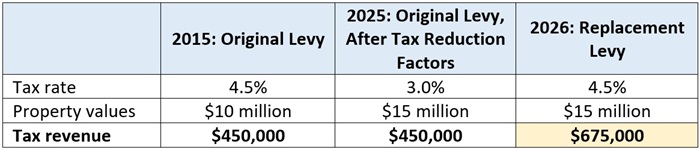 Voters may not be aware that the innocuous-sounding “replacement” levy actually constitutes a tax hike. In bill sponsor testimony, Representatives Adam Mathews and Thomas Hall drove home that point: “This incongruity can lead to surprises [higher tax bills] by voters when they think they had just voted to keep things as they were.” The Cleveland Plain Dealer editorial board has called for discontinuing the replacement levy on grounds of voter confusion, as have groups such as the Buckeye Institute and Ohio Chamber of Commerce. In sum, replacement levies are on the chopping block, and rightly so. Their elimination would add clarity at the ballot box, as districts would need to seek more transparent “additional” levies when they ask voters for a property tax increase.
- Adding transparency and guardrails about district cash reserves when citizens are asked to vote on tax measures. One of the most-discussed issues this budget cycle has been school districts’ massive cash reserves. At the end of FY2024, districts sat on nearly $11 billion—the highest amount on record—with some districts having six months to more than a year’s worth of cash on hand. Lawmakers have voiced serious concerns about the size of these reserves at a time when Ohioans are feeling the pain of higher school taxes. In their budget proposals, both the House and Senate included a controversial idea to return some of those dollars to taxpayers when reserves exceed a certain level.[2] The concept is understandable, but has downsides, including the likelihood that districts would blow through their reserves just to get underneath the threshold.
A couple Senate provisions would take a more tactful approach to addressing “excess” reserves, but through the ballot box rather than a hammer-like cap/refund policy. First, the Senate would prohibit districts from ballot measures when their reserves are above a year’s worth of spending. That’s sensible: Such districts are sitting on a lot of cash, and shouldn’t be going to voters asking for more money. Second, it would require disclosure of districts’ cash reserves on the actual ballot (assuming they’re under the reserve threshold). If—based on this information—voters believe their district is inappropriately asking citizens to pay higher taxes, they can vote “no” right then and there.
Ohio’s property tax system is complicated. That complexity makes it all the harder for citizens to understand their tax liabilities, what they are being asked to vote on at the ballot box, and how to hold local schools accountable for wisely stewarding their hard-earned money. Reforming the local tax system in ways that ensure fairness to schools and taxpayers will be heavy lift. But passing these commonsense provisions in this year’s budget will make that load just a touch lighter.
[1] Sixty-nine districts impose a “substitute” levy, which continues an expiring emergency levy. Substitute levies would also be repealed under the Senate budget, and existing ones would count toward the 20 mill tax floor.
[2] The proposed cash reserve thresholds are 30 and 50 percent of a district’s annual budget in the House and Senate plans, respectively.