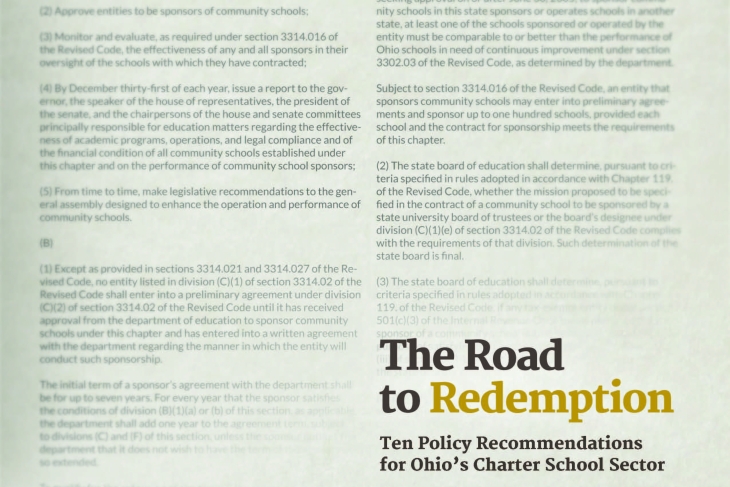
NOTE: On December 16, 2014, the Thomas B. Fordham Institute published a report researched and written by Bellwether Education Partners with the aim of providing a strong roadmap to guide charter school advocates and policymakers in Ohio when moving forward with a broad rewrite of the state's charter school law. This is the Foreword to that report. The full report can be found here.
[[{"fid":"113906","view_mode":"default","fields":{"format":"default"},"type":"media","attributes":{"height":"3300","width":"2550","style":"height: 129px; width: 100px;","class":"media-element file-default"},"link_text":null}]]
This fall, the editorial boards of two Ohio newspapers issued stinging missives urging legislators to make sweeping changes to the state’s charter-school law. In September, the Cleveland Plain-Dealer opined that lawmakers should “work together on a bill to improve charter schools.” One month later, in light of revelations about a questionable charter-facilities deal, the Columbus Dispatch argued that charter reform “should address lease deals along with other loopholes, conflicts and oversights in Ohio’s charter-school system.”
They’re absolutely right: 120,000 Buckeye charter students deserve to attend a school governed by a great charter law—a law that puts the interests of children first. But at the present time, Ohio’s charter law too often fails to protect these students’ best interests; instead, in too many ways, it protects powerful vested interests, smothers schools with red tape, starves even the best schools, and tolerates academic mediocrity.
Predictably, overall charter-school performance in Ohio has been lackluster. In the two most extensive evaluations of Ohio charter performance in 2009 and 2014, Stanford University’s Center for Research on Education Outcomes (CREDO) found that Ohio charter-school students, on average, make less academic progress than their district counterparts. The 2014 results estimated that charter students received an equivalent of fourteen fewer days of learning in reading and forty-three fewer days of learning in math.
But fixing Ohio’s charter law is no easy task. The law itself is roughly 40,000 words and has been amended nineteen times since its enactment in 1997. It contains many peculiar exceptions, loopholes, and restrictions. Few would argue that the current law clearly expresses how the charter-school system ought to function.
Policymakers must know exactly what needs to be repaired and how best to make the fix. To assist in this task, we enlisted Bellwether Education Partners, one of the smartest education-consulting firms in the land. We were excited that Andy Smarick, who has worked on charter-policy issues with the New Jersey Department of Education and the United States Department of Education, agreed to conduct a thorough review and analysis of Ohio charter law (along with two Bellwether colleagues).
The report offers ten policy recommendations that, if implemented, will lead to stronger charter policy in Ohio. In our view, these recommendations pivot around three central objectives that policymakers must focus on in a charter-reform bill:
- Define governing relationships: Currently, Ohio charter law too vaguely defines the powers and responsibilities of each actor in the charter-governing system. State policymakers need to remedy this by more clearly and explicitly establishing the governing relationships, starting with the powers and duties of the State Board and the Ohio Department of Education. From there, policymakers must make clear the responsibilities of charter-school authorizers, governing boards, and management companies—and to whom (and how) each entity is held accountable.
- Purge conflicts of interest: State policymakers should not tolerate permissive laws that allow adults to make dishonest gain at the expense of students’ best interest. For example, a charter authorizer—the entity that regulates a charter school—is allowed to sell services to that school. This bizarre arrangement creates an obvious disincentive for an authorizer to hold its school accountable, especially if closure is called for. Ohio charter-school law also strongly protects management companies, even if they fail to deliver a quality education. Because of a loophole in law, charter-school boards have little leverage to terminate a management contract. One national policy analyst gave this particular provision “the award for the most breathtaking abuse in the nation.”
- Help charters compete: At present, state policy treats Ohio charters as second-class public schools. They receive less overall taxpayer funding, garner scant facilities support, and are often at the mercy of traditional districts when it comes to student transportation. Taken together, state policy places charters on an uneven playing field with their district counterparts. While a few Ohio charters are producing exemplary results through smarts and raw determination, their results are the exception, not the rule. For too long, policymakers have unfairly asked charters to make educational bricks without straw, and now is the time to remedy charter-funding inequities.
In 2006, Fordham, along with two national charter organizations, published seventeen recommendations for Ohio charter-policy reform in a report titled Turning the Corner to Quality: Policy Guidelines for Strengthening Ohio’s Charter Schools. Some of its suggestions have been adopted, including fairer school accountability that includes student-growth measures and a rigorous evaluation system for charter school authorizers. Yet other recommendations have fallen on deaf ears.
Eight years later, the Ohio policymaking community is poised yet again to tackle charter-school reform. This report, The Road to Redemption: Ten Policy Recommendations to Improve Ohio’s Charter Sector, builds on the policy foundations laid in our 2006 report, considers the latest developments in Ohio charter policy, and reflects some of the very best thinking nationally concerning charter-school policy.
Wise policymakers—those who care deeply about the twin principles of good governance and robust competition in our public institutions—will keep this report at their side in the coming days.