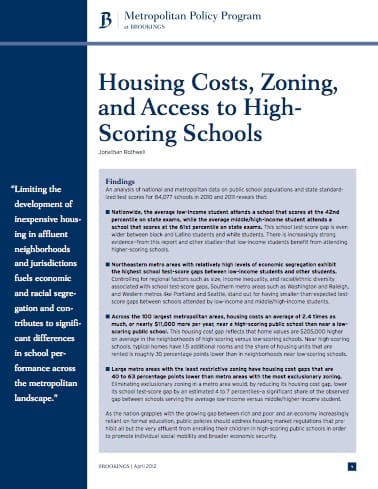
 Before the real-estate bubble burst, there was a growing literature on the link between government regulation of housing and home prices. Tougher zoning restrictions, it seemed, drove up the cost of housing. This Brookings Institution report builds off this notion: Restrictive zoning regulations—such as those that limit the construction of high-rise apartments or other multi-family units in certain neighborhoods—not surprisingly create cities that are segregated by income and race. And that, in turn, produces unequal access to quality schools. By loosening or even eliminating restrictive zoning, cities may see housing-cost gaps narrow by as much as 63 percentage points and see school-achievement gaps narrow as a result, Rothwell writes. (In other words, less zoning results in less segregated neighborhoods, and less segregated schools.) In the meantime, district-choice plans, charter schools, and school vouchers can help offset the effects of zoning, the author argues. Unfortunately, in these tough economic times, districts are too often restricting school choice—by drawing tighter attendance zones around specialty schools or by denying bus service to them. That’s a poor way to save money. And if Rothwell teaches us anything, it’s that quality choices are still largely available only to those who can afford them—especially in cities with restrictive zoning.
Jonathan Rothwell, Housing Costs, Zoning, and Access to High-Scoring Schools (Washington, D.C.: Brookings Metropolitan Policy Program, April 2012).