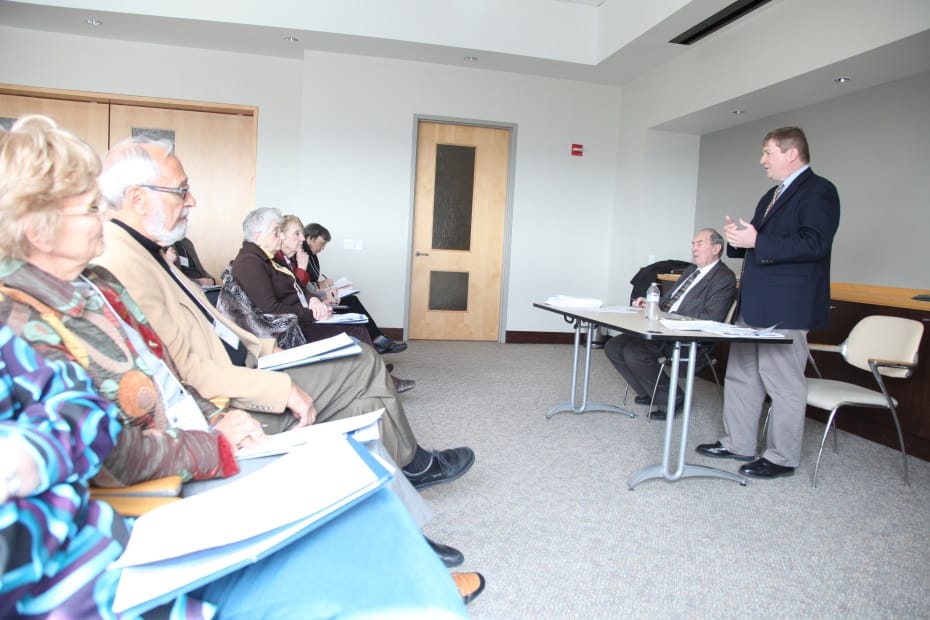
Terry Ryan addresses a gathering of the Ohio League of Women Voters at the Riffe Center on Tuesday, March 19, 2013.
Terry Ryan was a guest of the Ohio League of Women Voters today during their annual Statehouse Day, participating in a panel session on education funding in Ohio with Dr. William Phillis, Executive Director of The Ohio Coalition for Equity & Adequacy of School Funding.
A standing room only crowd of highly-engaged individuals from across Ohio listened to opening statements that looked back at least as much at the history of education funding in Ohio as they looked to the future of that funding, as proposed in the current state budget, HB 59. Dr. Phillis presented the history of changes in the organization and administration and funding of “the public common school” since 1821, raising alarms over loss of money from existing districts via charter schools and vouchers as well as alarms over the loss of local control of education and the loss of community when schooling is not held in common in a given area of the state. He previewed his public testimony for Wednesday by arguing forcefully for a legislative education commission – of the kind that existed in Ohio off and on from 1913 to the 1980s – to research and inform the General Assembly on matters of public education.
Terry took a similar historical view, but noting how very many things have changed from the early 20th century to today – technology, demands on parents, requirements on schools and teachers, transportation, and global competition among them. His message was simple: now is not the time to go backward. The ways of the past do not hold up to the requirements of the future. The shape of education funding in the future is a generational issue, he argued, noting that by 2015 Medicaid expenditures are projected to take up to 50% of Ohio GRF dollars while education expenditures will take up 27%.
Terry also sketched in the history of educational choice in Ohio, which he reported from his experience was driven largely from the bottom up: parents not satisfied with the educational outcomes of their children and who wanted a better option. That choice landscape today includes open enrollment, charter schools, vouchers, e-schools, and hybrid learning that takes place both in traditional classrooms and on computer screens in people’s homes.
Questions from the audience were detailed, specific and pointed. They covered the advantages that charter schools may have over traditionally-run district schools, the disappointing lack of data on the performance of students receiving private school vouchers in Ohio, expenses incurred by schools in regard to testing and accountability, and even the definition of school “district”. Terry’s recent editorial in the Columbus Dispatch was dissected by guests, looking for more detail and information from the 750-word review of Governor Kasich’s education budget. Terry drew on his experiences as a teacher, a father, an ed reformer, a school district volunteer, and yes, an amateur historian, to speak to the points raised.
The future is the issue – there is no “magic number” for funding student success; there are too many bad schools in cities and towns across Ohio; more data is needed to find and fund what works; what has been done in the past is less and less relevant. Those who care about the future of education in Ohio – quality education for all children – need to start here.