
The day after Superintendent Gene Harris announced her 2013 retirement from the Columbus City Schools (CCS) last month, Mayor Michael Coleman declared he’d play a greater role in improving the city’s schools. The district has been plagued in recent months by a data-tampering scandal and its unrelenting news coverage, and academic achievement has been stagnant for several years now. Coleman and City Council President Andrew Ginther have launched what is effectively the start of the post-Gene Harris era with a briefing about the district from Eric Fingerhut, corporate Vice President of Battelle's Education and STEM Learning business and the Mayor’s newly appointed education advisor; Mark Real, founder of KidsOhio.org; and John Stanford, deputy superintendent of CCS. The briefing is one of four intended to bring city leaders up to speed on the state of the city’s schools and related issues.
So what did they learn? There were at least three major takeaways.
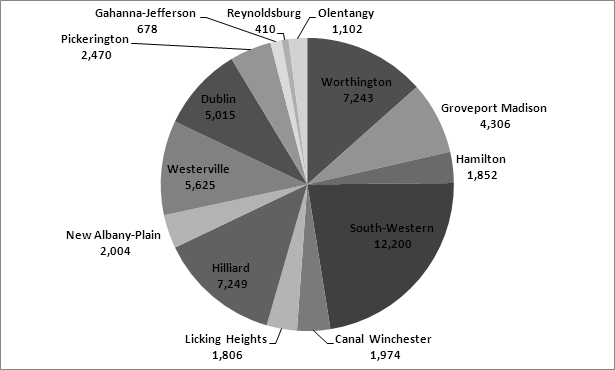
The city’s footprint is significantly larger than the district’s. The distinction between kids who live in the City of Columbus and those who live within the boundaries of Columbus City Schools (CCS) is important – and something most residents and observers would find surprising. Columbus’s population has doubled since 1950 and the region continues to grow. But much of the growth has happened in parts of the city not served by CCS. Real reported that 131,000 K-12 students live in the city; however, just 49,000 attend CCS. About 13,000 attend a charter school and roughly the same number attends a private school (another 2,400 use a voucher to attend a private school). But the biggest chunk of students attends one of 14 suburban school districts. Fully 49,600 city students go to school in the suburbs. Chart 1 shows the distribution of these students among those 14 districts.
Chart 1. Enrollment of City of Columbus resident students by suburban district, 2010-11
Source: KidsOhio.org
More striking than these numbers are the percentages of students in suburban districts who live in the City of Columbus. Following are the percent of each district’s student body that live in the City of Columbus (from highest to lowest): Worthington: 80 percent, Groveport Madison: 75 percent, South-Western: 63 percent, Hamilton: 62 percent, Canal Winchester: 57 percent, Licking Heights: 53 percent, Hilliard: 49 percent, New Albany-Plain: 48 percent, Westerville: 40 percent, Dublin: 37 percent, Pickerington: 24 percent, Gahanna-Jefferson: 10 percent, Reynoldsburg: 7 percent, and Olentangy: 7 percent.
When Mayor Coleman announced his new focus on education, he was quick to say he wouldn’t seek mayoral control of the schools. These data show, in part, why: Nearly 40 percent of his city’s K-12 students – and their families – aren’t served by Columbus City Schools.
Student achievement is lagging, though the district is fighting an uphill battle. With the state’s third-grade reading guarantee looming next school year, Real shared that 39 percent of the district’s third graders didn’t pass the state reading test in 2011 (recently released data show that 43 percent failed the exam in 2012). If the guarantee were in place, those students (with some exceptions) would not have been promoted to fourth grade. The district is working to improve early reading intervention so that pass rates improve, but teachers are fighting an uphill battle.
Thirty-four percent of kindergartners entering CCS in the 2010-11 school year were not kindergarten-ready, according to the state’s required literacy assessment. This rate is on par with Ohio’s other major urban districts; however, it is several times the rate in most of the county’s districts – with notable exceptions: South-Western City Schools, Groveport Madison Schools, and Whitehall City Schools all had higher percentages than Columbus of kindergartners who weren’t ready for school.
This news isn’t all bad. Stanford shared that of kindergartners who participated in the district’s preschool program, 89 percent are “kindergarten ready.” The school board is currently debating expanding the program to serve 1,500 more students.
Too many students aren’t graduating, and post-secondary supports are needed for those who do. The district’s five-year graduation rate is 78 percent, ten points lower than any other district in the county and fifth among the Big Eight districts. Likewise, CCS’s college-going rate is low: For the class of 2009 (the most recent year for which data are available), just 51 percent of graduates enrolled in a post-secondary program that fall, and 66 percent enrolled within two years of graduating.
On the upside, Stanford reported that among those CCS graduates who complete their freshman year of college, about 75 percent matriculate to sophomore year. Real and Stanford agreed that district, higher education, and community efforts to get students into college – and support them once there – are vital to increasing the number of college-educated adults in the area. The Central Ohio Compact, a coalition of education and community leaders, has set the goal of increasing the percent of Franklin County adults who have earned a post-secondary credential from 44 percent to 60 percent by 2025.
The next briefing will be held tomorrow at 6 p.m. at Columbus Downtown High School and focus on central Ohio workforce trends and how well the district is preparing students for jobs.
You may access the full briefing materials at mayor.columbus.gov/education.
